The European Organisation for the Exploitation of Meteorological Satellites (EUMETSAT) launched its latest polar orbiting satellite yesterday from the Baikonur Cosmodrome in Kazakhstan. The Metop-B spacecraft carries with it a host of instruments that will help feed models that forecast the weather and climate. Read the rest of this story on Examiner.com and find out what it means for you.
MetOp-B launch from the Baikonur Cosmodrome in Kazakhstan. (YouTube / ESA) Click the image to watch video of the launch.
On the surface of the Earth hurricanes bring destruction and oftentimes death with a ferocity unlike any other type of weather. Viewed from above however hurricanes seem almost tranquil and in some ways beautiful as is seen in new video of Hurricane Isaac from the International Space Station. Check out the stunning video as well as amazing photos of previous hurricanes as seen from space.
Hurricane Isaac is seen moving inland from the GOES East satellite early Wednesday morning. Click to read more and view video from the ISS. (NOAA / NASA)
A solicitation on a United States government website seeking hollow point bullets and targets for the National Weather Service caused an online stir today. NOAA was forced to quickly deal with the controversy saying it was a ‘clerical error.’ Read the rest of this story on Examiner.com
To listen to the United States’ primary agency responsible for monitoring the climate, one would think the end is near as global temperatures continue to rise at an alarming rate. However, the National Oceanic and Atmospheric Administration’s (NOAA) own monitoring network specifically designed to monitor global warming contradicts these claims. Read the rest of this story on Examiner.com to find out why we should be skeptical when we hear claims of record-setting heat.
NOAA created the US Climate Reference Network (USCRN) to ensure the integrity of climate data yet it disregards results from the system. (NOAA)
Sweltering, unseasonably warm temperatures gripped much of the contiguous United States last month breaking many records. In the final analysis of the month, NOAA announced that July was the hottest month ever recorded in the U.S. How hot was it? Read the rest of this story on Examiner.com
Much of the Lower 48 states saw above average temperatures during July 2012. Click the image to view the story and slideshow. (NOAA)
The Wireless Emergency Alerts (WEA) system takes the system into the 21st century giving targeted alerts for weather, natural disasters, AMBER alerts and even alerts from the President of the United States.
The National Oceanic and Atmospheric Administration (NOAA) released its climate summary for June 2012 showing the United States experienced an unusually warm month. Most notably the U.S. has recorded its warmest first half of the year on record and the warmest 12 month period on record. Climate change? Learn more about the warm weather across the nation on Examiner.com.
Colorado’s deadly and destructive wildfire season continues with as many as a dozen blazes burning in recent days. Smoke from the fires has blanketed parts of the state in recent weeks and new NASA satellite imagery shows the smoke plumes from some of the blazes. Read the rest of this story and view the images on Examiner.com.
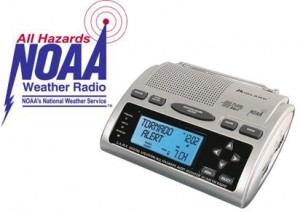
Weather radios provide life saving information when severe weather strikes. 'The voice of the National Weather Service' can even sing Christmas carols.
NOAA Weather Radio (NWR) is called ‘the voice of the National Weather Service’ and provides critical and life saving information when severe weather strikes. ‘Tom’ is one of the latest voices that you hear when listening to it and in the holiday spirit, NOAA had ‘Tom’ sing a classic Christmas carol.
Listen to ‘Tom’ sing Deck the Halls below
NWR began in the late 1990s and now transmitters for the service allow coverage across most of the nation. When the weather is calm, listeners hear current conditions, forecasts and other weather related news. It is however when severe weather strikes that NWR reaches its real potential.
Many of today’s radios can be programmed to turn on automatically and sound an alert when severe weather or another national emergency occurs. These alerts can make the difference between life and death, particularly when a fast developing situation like tornadoes occur.
We have long extolled the virtues of the system and recommended that all homes should have them, particularly in places like Colorado that are prone to tornadoes. It can also provide critical information during other types of disasters like earthquakes, chemical spills, and AMBER alerts.
‘Tom’ is one of the current text to speech voices of NOAA Weather Radio. He, along with ‘Donna’ and ‘Javier’ are the voices you hear when listening to the system.
The National Oceanic and Atmospheric Administration’s Climate Prediction Center (CPC) released updated outlooks for winter 2011 – 2012 indicating it could be a snowy one for the northern half of Colorado.
The original outlooks from the agency released previously offered a drier picture, primarily based on the influences of La Niña in the Pacific. Given however that the current event is relatively mild, its effects are limited, particularly this far inland.
For the meteorological winter from December 2011 to February 2012, NOAA places virtually all of Colorado in an area that has equal chance of well above, well below, or near-normal temperatures. However, the northern half of the state, including Denver, is given a 33% chance of experiencing above normal precipitation.
NOAA said:
The winter outlook for this winter favors above average temperatures across much of the South, from New Mexico across the Southeast to the Atlantic coast… and also favors below average temperatures across much of the Northern plain, the Northern Rockies, the Pacific Northwest, and a good part of the West as well as the southern half of Alaska.
With regards to precipitation, we see those areas most likely to experience below-average precipitation across the South– in particular Florida and Texas– with a better than even chance of being wetter than average across much of the North– particularly from the Ohio valley and the Northern Rockies and the Pacific Northwest.
Last year, Denver experienced second least snowiest snow season on record as the city only recorded 22.8 inches (21.2 inches in Thornton). This season the picture is much improved with 22.2 inches having been recorded so far – nearly as much as all of last season.
NOAA's updated Winter 2011 - 2012 outlook. Click the image for a larger view. (NOAA)