Please view the Winter Weather Preparedness series to ensure you are ready for the winter!
We recently published a series of articles from the National Weather Service as part of Colorado’s Winter Weather Preparedness Week. We have now made those stories easier to find by adding them to the Weather Education menu on the left of every page.
This series of articles is a ‘must read’ for anyone living or traveling in Colorado or any place else that receives severe winter weather. Covering a wide range of related topics, these articles help ensure you are ready for the coming winter. The articles cover the following topics:
Wild Western Weather 2008 will be held on November 18th.
The channel 7 24 / 7 Weather Center has accounced an exciting event – Wild Western Weather 2008. The event will be held at the Wild Life Experience in Parker on Tuesday, November 18th from 6:00pm to 10:00pm. This looks to be a great event with a number of notable speakers.
Some of the highlights include:
Tim Samaras – Tornado Expert – featured in National Geographic Magazine, “Inside Tornadoes – The Latest Research: Twistex 2008”
Tony Laubach – Storm Chaser – “The Windsor Tornado vs Douglas County Landspouts”
Dr. Walt Lyons – Lightning Researcher – “Flash Facts – Red Sprites, Blue Jets and Other Rare Airities”
Ethan Green – Director, Colorado Avalanche Information Center – “Avalanches and the Big Snow Winter of 2007-08”
Dr. Thomas Schlatter – NOAA’s Earth System Research Lab and the University of Colorado – “The Pine Bark Beetle – A Canary for Climate Change?”
I do wish they had chosen a more central location for it or at least held the event on the weekend. It is pretty tough for anyone who works and lives north to try to make it down there.
A Preview of Denver's November Weather - Will it be a Fall Month or a Winter Month?
A preview of Denver’s November weather – Will it be a fall month or a winter month? Typically November is a quiet weather month with plenty of nice, fall days but it can also turn wet with plenty of snow and moisture. Just like Forest Gump’s proverbial box of chocolates, you never quite know what you are going to get.
Looking into the weather history books, we see that November is actually Denver’s second snowiest month, second only to March (April is third). Historically we average 10.7 inches of snow during the month.
ThorntonWeather.com junior stormchaser Bobby pursued a tornado in Weld County yesterday and provided live reports for 7News. Watch the video below (you may need to turn up the sound due to a lot of background noise).
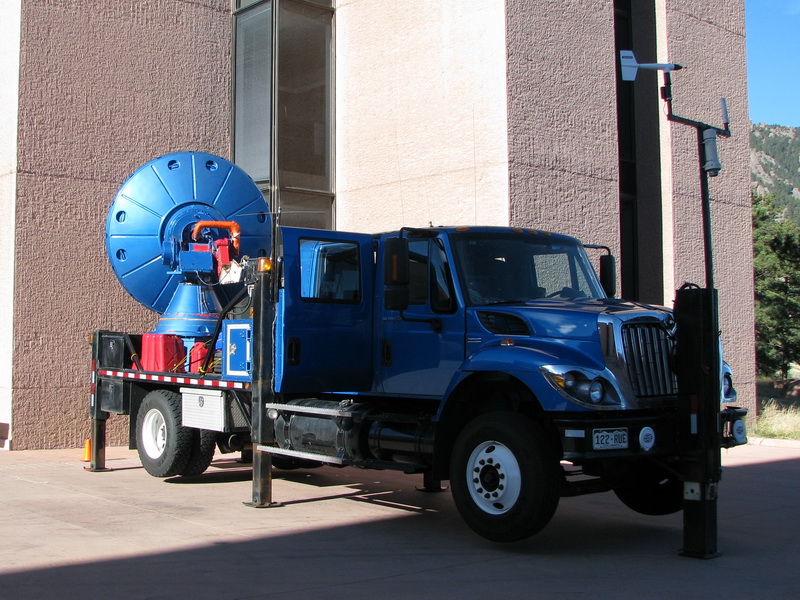
The DOW - Doppler On Wheels - as seen on Storm Chasers.
🙂 Okay, so maybe not but it still is kind of fun. This was taken yesterday at NCAR’s Super Science Saturday in Boulder. Channel 7 was there with their “24 / 7 Weather Experience” which was a lot of fun as it gives folks a small taste of what goes into a weather broadcast. Unfortunately Mike Nelson, author of our favorite weather book, wasn’t there when we were but this was probably the highlight of the day up at NCAR for the kids.
There was also a bit of a celebrity there too as Justin Walker from Discovery Channel’s Storm Chasers TV show was there with their Doppler On Wheels (DOW) truck – a mobile radar vehicle. Justin serves as one of the team members from the Center for Severe Weather Research that chases the storms. He in particular is tasked with placing scientific probes in the path of the tornadoes. We got to spend a good bit of time chatting with Justin about their chases this past tornado season and in particular the ones in the north central Kansas area where a good bit of my family lives. He had some fascinating anecdotes to share about the storms, in particular the one that struck near Glen Elder, KS.
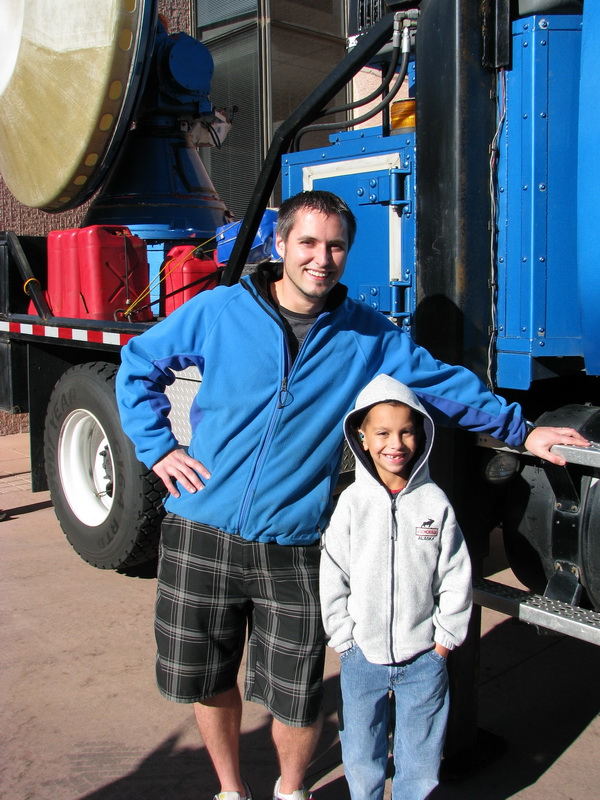
Bobby with Justin Walker of Storm Chasers.
For those that didn’t make it up there, you really missed a great opportunity for kids to learn more about not only the weather but also things like energy, the environment and more.
This week in Denver weather history - October 26 to November 1.
Lots of interesting stuff in this look back at Denver weather history for the week of October 26th to November 1st. Lots of snow including some major storms and the seemingly ever present wind are on this look into history.
PUBLIC INFORMATION STATEMENT
NATIONAL WEATHER SERVICE DENVER CO
645 PM MDT SAT OCT 25 2008
…THIS WEEK IN METRO DENVER WEATHER HISTORY…
25-26 IN 1996…4 TO 6 INCHES OF SNOW FELL IN THE FOOTHILLS WEST OF
DENVER. ONLY 1.5 INCHES OF SNOWFALL WERE MEASURED AT THE
SITE OF THE FORMER STAPLETON INTERNATIONAL AIRPORT ON THE
26TH. THIS WAS THE ONLY MEASURABLE SNOW OF THE MONTH AT
THE SITE. THE SNOWFALL PRODUCED ICY AND SNOWPACKED
HIGHWAYS…WHICH RESULTED IN A 50-TO 60-CAR PILEUP ON I-25
SOUTH OF METRO DENVER. WEST WINDS GUSTED TO 33 MPH AT
DENVER INTERNATIONAL AIRPORT.
IN 2006…A WINTER STORM BROUGHT HEAVY SNOWFALL TO METRO
DENVER AND THE EASTERN FOOTHILLS. TOTAL SNOWFALL RANGED
FROM 12 TO 22 INCHES OVER THE HIGHER TERRAIN AND 6 TO 12
INCHES ACROSS METRO DENVER. NORTHERLY WINDS AT SUSTAINED
SPEEDS OF 20 TO 30 MPH WITH GUSTS AS HIGH AS 47 MPH AT
DENVER INTERNATIONAL AIRPORT WHIPPED THE SNOW INTO DRIFTS
3 TO 4 FEET DEEP. MANY TREE LIMBS SNAPPED UNDER THE WEIGHT
OF THE HEAVY…WET SNOW WHICH ALSO DOWNED POWER LINES…
LEAVING THOUSANDS OF RESIDENTS WITHOUT POWER. STORM TOTAL
SNOWFALL INCLUDED: 25 INCHES NEAR ASPEN SPRINGS…CONIFER…
AND EVERGREEN; 23.5 INCHES NEAR ROLLINSVILLE; 23 INCHES IN
IDAHO SPRINGS; 22.5 INCHES NEAR BLACKHAWK; 21.5 INCHES NEAR
BAILEY; 19 INCHES NEAR BERGEN PARK; 18 INCHES NEAR ASPEN
SPRINGS…GENESEE…AND JAMESTOWN; 17 INCHES SOUTHWEST OF
BOULDER; 16 INCHES IN EVERGREEN; AND 15 INCHES NEAR
GEORGETOWN AND PERRY PARK. SNOWFALL TOTALED 5.3 INCHES
IN THE DENVER STAPLETON AREA. AT DENVER INTERNATIONAL
AIPORT…RAIN…INCLUDING A THUNDERSTORM…CHANGED TO SNOW
ON THE EVENING OF THE 25TH AFTER A HIGH TEMPERATURE OF
70 DEGREES. Continue reading This week in Denver weather history – October 26 to November 1→
As we have talked about this week, winter weather can be dangerous and downright deadly. However, being prepared helps to ensure that you and your family remain safe when the snow starts to fly or other winter weather conditions occur. It is very easy to ignore the dangers of weather – no matter the season – and find yourself saying, “I wish I would have….” Now is the time to think about how you can prepare for these conditions, before it is too late and you find yourself wishing you had.
In this sixth and final message in a series on Winter Weather Preparedness from the National Weather Service, ThorntonWeather.com reviews the topics we covered this week and directs you to the previous articles and other resources to help you get ready.
An example of severe winter weather occurred in March 2003 across the eastern foothills, adjacent plains, and mountains. Snowfall amounts ranged from 80 to 110 inches, along with strong winds in some areas. The Denver metro area averaged nearly three feet of snow. The storm was well forecast, and people, for the most part, heeded the warnings, so casualties and impacts were mitigated.
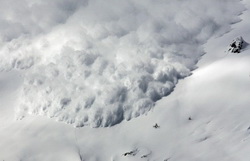
Avalanches in Colorado claim an average of six lives per year. Be prepared!
As snow starts to fall, many Coloradoans and out of state visitors will take advantage of it and head to the mountains for a variety of outdoor activities. Whether skiing, snowshoeing, or hiking, anyone who spends time outdoors in the high country needs to be aware of the danger avalanches present. On average six people die in Colorado every year from avalanches and being prepared is an essential survival skill.
In this fifth in a series on Winter Weather Preparedness from the National Weather Service, ThorntonWeather.com helps you understand avalanches, where they occur, how to protect yourself and where to go for more information.
PUBLIC INFORMATION STATEMENT
NATIONAL WEATHER SERVICE DENVER CO
600 AM MDT FRI OCT 24 2008
Avalanches – Are you prepared?
Thousands of avalanches occur each winter in the mountains of Colorado. With the enormous popularity of winter sports in Colorado, this poses a risk to skiers, snowboarders, hikers and snowmobilers. On average 6 people die in avalanches in the state of Colorado every year. Anyone who travels into the high country in the winter should be prepared for avalanches and know how to avoid them.
The first thing to know is most avalanches occur during or just after snowstorms and most occur on a slope of 30 to 45 degrees. A significant snowfall may result in an unstable snowpack. By waiting 36 hours after a big snowstorm you may allow the snow to become more stable. If you stay in valleys away from avalanche chutes, in stands of dense trees, or on gentle slopes you can minimize your avalanche risk.
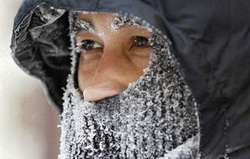
Wind chill, frostbite and hypothermia are very real dangers in the winter.
Winter weather can not only be trying on the mind and soul, it also presents very real dangers to the human body. Extreme wind chills can be deadly and bring on the outset of frostbite and hypothermia. Here in Colorado, all residents should be aware of these hazards and be prepared to deal with them.
In this fourth in a series on Winter Weather Preparedness from the National Weather Service, ThorntonWeather.com helps you understand wind chill and how to protect yourself from frostbite and hypothermia.
PUBLIC INFORMATION STATEMENT
NATIONAL WEATHER SERVICE DENVER CO
ISSUED BY NATIONAL WEATHER SERVICE GOODLAND KS 600 AM MDT THU OCT 23 2008
Extreme wind chill – Potentially life-threatening and often overlooked
The combination of wind and cold temperatures in winter can be deadly. Winter storms often bring heavy snow to Colorado which results in slick roadways, traffic accidents and stranded travelers. While the attention of most people is focused on expected snow accumulation before a storm arrives, many ignore the life threatening combination of extreme cold and strong wind which often develops after the storm passes. Wind chill is a measure of heat loss from the body due to wind and cold air. Frostbite and hypothermia are two consequences of wind chill. All three will be discussed today as part of Colorado Winter Weather Preparedness Week.
Winds in the winter can be one of the most frustrating and dangerous weather conditions. What causes them and how can you protect yourself?
As we have experienced in the last 24 hours or so, high winds in Colorado can cause conditions to deteriorate rapidly. They present a very real danger to life and property, especially when coupled with other winter conditions like snow. Why does it seem like we get so much wind in the winter? What causes this? How can you prepare and protect yourself and your property?
PUBLIC INFORMATION STATEMENT
NATIONAL WEATHER SERVICE DENVER CO
ISSUED BY NWS PUEBLO CO
600 AM MDT WED OCT 22 2008
HIGH WINDS ARE A MAJOR THREAT IN COLORADO DURING THE WINTER
Governor Bill Ritter has proclaimed this week through October 25th as winter weather preparedness week in Colorado. This is an excellent time for all individuals, families, businesses, schools, and radio and television stations to review their winter weather preparedness plans.
Two main causes of high winds in Colorado during the cold season are the air pressure difference between strong low pressure and cold high pressure systems, and Chinook winds developing along the front range and mountains in the eastern half of the state.
What does that warning mean? Knowing what the various advisories mean is important part of winter weather preparedness.
We all are familiar with the crawls on the TV screen or the announcements on the radio for winter weather advisories such as Winter Storm Watch, Blizzard Warning, Freeze Warning and more. But, how many of us really know what those mean? There is very specific criteria the National Weather Service follows in issuing these watches and warnings and there are important differences between all of them.
The National Weather Service will inform you about critical weather with outlooks, watches, warnings and advisories. Do you know what they mean? Now is the time to find out during this Colorado winter preparedness week.
This list has the watch, warning and advisory criteria for Colorado east of the continental divide. Save this list throughout the winter.