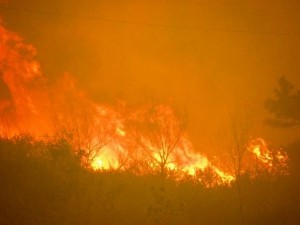
As firefighters continue to battle a large wildfire near Colorado Springs, the extent of destruction caused by the fire is now being realized. While assessments will continue in the coming days, it is now known that at least one person has been killed and nearly 350 homes destroyed. Get the latest on the fire and view new pictures of the blaze on Examiner.com
A rapidly spreading smoke cloud surrounds the U.S. Air Force Academy's T-38 in Colorado Springs, Colo., June 26, 2012. Click the image to view a slideshow of the fire near the academy. (U.S. Air Force Photo/ Mike Kaplan)
The only Department of Defense wildfire fighting team is being deployed to aid in the battle against wildfires ravaging Colorado. The hot shot crew from Vandenberg Air Force Base is expected to be on the lines of the Waldo Canyon Fire near the Air Force Academy. Read the rest of this story on Examiner.com and check out the amazing slideshow of the fire approaching the academy.
The High Park Fire rages in the mountains west of Fort Collins, Colorado. The dry conditions have prompted the state to ban all open burning and personal use of fireworks. Click the image for a slideshow of the blaze. (US Forest Service)
Colorado Gov. John Hickenlooper today issued an executive order banning all open burning and the use of personal fireworks across the state. As the High Park Fire shows, conditions are tinder dry and while lightning was the cause of that blaze, man is often to blame for wildfires as well.
“We can’t completely eliminate the threat of wildfire because there’s no way to control Mother Nature,” Hickenlooper said in a statement. “But we can take steps to reduce the risks of more wildfires starting. This ban is a necessary step to help protect people, property and the beautiful state we live in.”
The ban will put a damper on 4th of July fireworks festivities but is a necessary step to protect life and property. For campers, there will be limitations in unimproved locations but fires in permanent pits within developed campgrounds will still be allowed as long as the local authority allows it.
The High Park Fire now ranks as the third largest blaze in Colorado history. In 96 short hours the blaze grew to encompass an area more than 72 square miles and is now only 10% contained and still growing.
Now at 14,000 acres, the High Park Fire continues to grow unabated. Winds had shifted overnight sending the smoke over the metro area and Thornton but this afternoon they moved to the east. Satellite imagery, shown in the video below, clearly shows the smoke plume stretching through Colorado into Wyoming and Nebraska and starting to impact South Dakota.
A windstorm pummeled northeastern Colorado on New Year's Eve 2011.
Northeastern Colorado closed out 2011 with pummeling high winds on New Year’s Eve. Wind gusts of tropical and hurricane storm strength slammed into the region causing damage and claiming one life.
In the Denver metro area gusts approaching 50mph were common while areas in the foothills and mountains to the west and on the plains to the northeast saw much higher speeds. Here in Thornton we recorded a maximum gust of 44.9mph in the predawn hours.
Post-Storm Summary of the New Year’s Eve Windstorm
A fast moving upper level storm system, along with a deep low pressure system over Nebraska and high pressure building over Utah, combined to create a powerful windstorm across Northeast and North Central Colorado on December 31st. The high wind event began in the mountains after midnight Friday night, and then spread across the plains early Saturday morning. The height of the windstorm on the plains occurred around mid day when numerous gusts between 60 and 80 mph were reported.
The strong winds produced damage to fences and some roofs, and also knocked down trees resulting in power outages to approximately 19,000 residents. Some trucks were also blown off the road, and 1 fatality occurred due to a flying tree limb on U.S. Highway 36 north of Boulder.
Visibilities over the northeast corner of the state were also reduced significantly by a combination of blowing dust and blowing snow.
The following is a list by county of maximum wind gusts associated with this powerful windstorm…
Grand…
Berthoud Pass 94 MPH
11 N Kremmling 80 MPH
9 S Fraser 80 MPH
Jefferson…
3 SSE Pinecliffe 111 MPH
3 S Golden 86 MPH
Highway 72 and 93 Junction 79 MPH
National Wind Technology Center 77 MPH
3 NNW Morrison 76 MPH
4 S Rocky Flats 73 MPH
2 E Golden 67 MPH
2 E Northeast Lakewood 64 MPH
2 ENE Lakewood 64 MPH
3 W Conifer 62 MPH
Wheat Ridge 55 MPH
Larimer…
4 E Loveland 73 MPH
Natural Fort Rest Area 71 MPH
5 NW Fort Collins 67 MPH
3 NE Loveland 67 MPH
Wellington 63 MPH
4 E Fort Collins 63 MPH
Virginia Dale 62 MPH
Fort Collins 57 MPH
Lincoln…
3 W Cedar Point 80 MPH
Limon Airport 74 MPH
Weld…
4 ENE Eaton 80 MPH
3 NNW Cornish 79 MPH
2 NNW New Raymer 77 MPH
10 NE Pawnee Buttes 74 MPH
Briggsdale 72 MPH
9 NNE Briggsdale 72 MPH
7 N Rockport 70 MPH
Greeley Airport 67 MPH
4 ENE Severance 63 MPH
Eaton 63 MPH
1 N Greeley 62 MPH
6 E Berthoud 62 MPH
2 W Keenesburg 58 MPH
Milliken 56 MPH
12/31/11 - Here is surface pressure analysis (light blue lines) and infrared satellite image at 12 PM MST near the height of the windstorm. Note the large difference in pressure between the surface low pressure over southeast Nebraska and high pressure centered over southern Idaho, and the resulting tight gradient across Colorado. This is a key feature in windstorms across the Front Range and High Plains. (NWS)12/31/11 - A 6 hour model forecast of 700 mb winds (approximately 10,000 ft MSL) and surface pressure. 700 mb wind strength is noted by flags (50kts) plus barbs (10kts for full & 5kts for half). Stronger downslope flow and large scale subsidence which occurred in this storm can bring these stronger winds aloft down to the surface. (NWS)12/31/11 - A surface plot of weather stations across the region during the windstorm. This image was taken at 1 PM MST, when the maximum winds were spreading across the northeast plains of Colorado. At this time, the strongest corridor of winds stretched from Sterling (gusting to 59 kts or 68 mph), to Akron (gusting to 63 kts or 72 mph) to Burlington (gusting to 66 kts or 76 mph). (NWS)
The National Oceanic and Atmospheric Administration’s Climate Prediction Center (CPC) released updated outlooks for winter 2011 – 2012 indicating it could be a snowy one for the northern half of Colorado.
The original outlooks from the agency released previously offered a drier picture, primarily based on the influences of La Niña in the Pacific. Given however that the current event is relatively mild, its effects are limited, particularly this far inland.
For the meteorological winter from December 2011 to February 2012, NOAA places virtually all of Colorado in an area that has equal chance of well above, well below, or near-normal temperatures. However, the northern half of the state, including Denver, is given a 33% chance of experiencing above normal precipitation.
NOAA said:
The winter outlook for this winter favors above average temperatures across much of the South, from New Mexico across the Southeast to the Atlantic coast… and also favors below average temperatures across much of the Northern plain, the Northern Rockies, the Pacific Northwest, and a good part of the West as well as the southern half of Alaska.
With regards to precipitation, we see those areas most likely to experience below-average precipitation across the South– in particular Florida and Texas– with a better than even chance of being wetter than average across much of the North– particularly from the Ohio valley and the Northern Rockies and the Pacific Northwest.
Last year, Denver experienced second least snowiest snow season on record as the city only recorded 22.8 inches (21.2 inches in Thornton). This season the picture is much improved with 22.2 inches having been recorded so far – nearly as much as all of last season.
NOAA's updated Winter 2011 - 2012 outlook. Click the image for a larger view. (NOAA)
Hurricane-force winds pounded the Colorado high country on Saturday, November 12, 2011. Click the image for a larger view.
Fed by a strong jet streak roaring above the Colorado Rocky Mountains, a mountain wave setup over the western half of the state yesterday. Strong winds were the result and were combined with heavy snow in the central and northern mountains.
The incredibly strong winds that would be the equivalent of a Category 3 hurricane ripped through Colorado’s high country in the past 24 hours. Many locations reported gusts in excess of 100mph downing power lines and trees and creating hazardous driving conditions.
The top wind gust reported by the National Weather Service was 115mph south of Frisco in Summit County.
Berthoud Pass saw a 113mph gust at the Mines Peak Summit (12,500 feet) with sustained winds to 86mph. After sending that reading, the station’s anemometer (wind sensor) broke.
Other locations recording gusts near 100mph included Loveland Pass at 100mph and Kenosha Pass recorded 101mph. Berthoud in Larimer County saw 99mph and the National Center for Atmospheric Research Mesa lab in Boulder recorded 90mph.
Here in Thornton we thankfully didn’t see winds nearly that fast however ours were notable. We recorded a 38mph gust Saturday afternoon and a 47mph gust shortly after midnight Sunday morning.
High winds like these, while quite strong, are not entirely unusual. Dangers from these powerful winds include power outages, flying debris, collapsed structures and the potential to overturn vehicles. Learn more in our story, Winter weather preparedness: The threat of high winds in Colorado.
Below is a water vapor satellite showing the mountain waves as the moved across the southern part of Colorado.
Stay up to date with all the latest Colorado weather:
Water vapor satellite imagery shows the mountain waves that existed across much of southeastern Colorado and northeastern New Mexico around 19:45 UTC on 12 November 2011. (CIMSS)
Weather, natural disasters & climate news and information.