Category Archives: Thornton Weather

September 2012 Thornton weather recap: Warmer and wetter than normal

Thornton saw yet another month with above normal temperatures during the month of September 2012.  The one saving grace was that it was also a wet one with above normal precipitation.

The month started out with three out of the first six days of the month recording temperatures above 90 degrees and the other three warming to above 85 degrees.

Cooler weather arrived on the 12th and Thornton saw a high of only 59.6 degrees.  Rain began late on the 11th and continued into the 12th as we recorded 1.32 inches of precipitation in our bucket during the period.  Denver officially recorded 0.95 inch on the 12th which was a record for the date.

Above normal temperatures soon returned however and overall we recorded 15 days of high temperatures of at least 80 degrees during the month.

Another storm system moved in on the 25th and 26th and brought more precipitation.  Thornton recorded 0.81 inch during the period.  At Denver International Airport 1.95 inch was recorded over the two day period.  On the 26th alone the airport recorded 1.41 inches, a record for the date.

The average temperature for the month was 64.0 degrees in Thornton.  DIA averaged 66.3 degrees which was 2.9 degrees above normal.

Temperatures in Thornton ranged from a high of 94.6 degrees on the first down to a low of 41.6 degrees on the 18th.  Denver saw its warmest temperature of 95 degrees on the 1st as well and its lowest of 45 degrees on the 22nd and 28th.

Thornton ended the month with a welcome 2.17 inches of precipitation.  Denver fared better with 2.95 inches, well above the September normal of 0.96 inch.  Officially the month went into the books as the 5th wettest October on record in Denver.

For the 12th consecutive September no snow was recorded in Denver.  The last time we went such a long period without September snow was from 1914 to 1926.

Click here to view the ThorntonWeather.com climatology report for September 2012.

ThorntonWeather.com September 2012 Temperatures

ThorntonWeather.com September 2012 Precipitation

Denver’s Official September 2012 Climate Summary

...THE DENVER CO CLIMATE SUMMARY FOR THE MONTH OF SEPTEMBER 2012... 

CLIMATE NORMAL PERIOD 1981 TO 2010
CLIMATE RECORD PERIOD 1872 TO 2012

WEATHER         OBSERVED          NORMAL  DEPART  LAST YEAR`S
                 VALUE   DATE(S)  VALUE   FROM    VALUE  DATE(S)
                                          NORMAL
................................................................ 
TEMPERATURE (F)
RECORD
HIGH               97   09/01 1995
                        09/04/1995
                        09/05/1899
 LOW               17   09/29/1985
HIGHEST            95   09/01        97      -2       96  09/01
LOWEST             45   09/28        17      28       38  09/21
                        09/22
AVG. MAXIMUM     80.3              78.5     1.8     78.6
AVG. MINIMUM     52.3              48.3     4.0     49.9
MEAN             66.3              63.4     2.9     64.2
DAYS MAX >= 90      7               3.4     3.6        1
DAYS MAX = .01         5               6.5    -1.5        6
DAYS >= .10         3               3.3    -0.3        2
DAYS >= .50         3               0.6     2.4        1
DAYS >= 1.00        1               0.1     0.9        0

GREATEST
 24 HR. TOTAL    1.63   09/25 TO 09/26

SNOWFALL (INCHES)
RECORDS
TOTAL             0.0
TOTALS            0.0               1.3

DEGREE_DAYS
HEATING TOTAL      69               125     -56       95
 SINCE 7/1         69               141     -72       95
COOLING TOTAL     113                76      37       78
 SINCE 1/1       1235               764     471      941

FREEZE DATES
RECORD
 EARLIEST     09/08/1962
 LATEST       06/08/2007
EARLIEST                        10/07
LATEST                          05/05
...................................................... 

WIND (MPH)
AVERAGE WIND SPEED              8.8
RESULTANT WIND SPEED/DIRECTION   3/197
HIGHEST WIND SPEED/DIRECTION    30/300    DATE  09/01
HIGHEST GUST SPEED/DIRECTION    37/290    DATE  09/01

SKY COVER
POSSIBLE SUNSHINE (PERCENT)   MM
AVERAGE SKY COVER           0.50
NUMBER OF DAYS FAIR           10
NUMBER OF DAYS PC             16
NUMBER OF DAYS CLOUDY          4

AVERAGE RH (PERCENT)     40

WEATHER CONDITIONS. NUMBER OF DAYS WITH
THUNDERSTORM              5    MIXED PRECIP                0
HEAVY RAIN                2     RAIN                       2
LIGHT RAIN                7     FREEZING RAIN              0
LT FREEZING RAIN          0     HAIL                       1
HEAVY SNOW                0     SNOW                       0
LIGHT SNOW                0     SLEET                      0
FOG                       6     FOG W/VIS

Long range forecasts portend an extended period of cooler weather for Denver

With the start of the month of October upon us it appears Mother Nature is set to deliver a healthy dose of fall weather conditions. Not only do short term forecasts indicate cooler temperatures and even a chance for snow, long range forecasts indicate the potential for an extended period of cooler weather.  Read the rest of this story on Examiner.com.  

The temperature outlook for the period from October 5 to October 9 indicates cooler than average temperatures for much of the nation. (CPC)
The temperature outlook for the period from October 5 to October 9 indicates cooler than average temperatures for much of the nation. (CPC) Click the image to read more about what long range forecasts predict for our coming weather.

Denver receives much needed rain, snow falls in the Colorado Rocky Mountains

A record number of 90 degree days and a distinct lack of precipitation marked Denver’s summer months but Mother Nature finally delivered some relief. The recent storm system brought much-needed precipitation and cooler temperatures to northeastern Colorado. Read the rest of this story on Examiner.com and check out the amazing pictures of snow on Pikes Peak.

Snow covers Colorado's Pikes Peak on the morning of Thursday, September 13, 2012 following a storm system. (City of Colorado Springs)
Snow covers Colorado's Pikes Peak on the morning of Thursday, September 13, 2012 following a storm system. (City of Colorado Springs) Click the image to view a slideshow of the recent snow.

Storm brings much needed precipitation to Colorado Front Range

Following months of scorching heat and below normal precipitation, northeastern Colorado desperately needed precipitation.  Mother Nature finally provided relief as many locations recorded more than 1″ of rain over the past 24 hours.

Here in Thornton we recorded a welcome 1.32″ since yesterday.  Of that, 1.26″ was recorded since midnight today, the biggest single day precipitation event we have had since July 12, 2011.

Some other rainfall totals:

  • Denver International Airport: 0.97″
  • Denver City Park: 1.62″
  • Buckley Air Force Base: 0.38″
  • Rocky Mountain Metropolitan Airport (Broomfield): 0.61″
  • NCAR Table Mesa Boulder: 1.29″
  • Longmont Vance Brand Airport: 0.56″

View more totals for the metro area on the map below.

Snow was also recorded at higher elevations above 11,000 feet in the mountains southwest of Denver.  Pikes Peak was blanketed in white and received at least a few inches.

While the recent rain will provide some temporary relief, precipitation totals for the calendar year remain well behind normal.  For Denver an average year brings 14.92″ of liquid precipitation.  To date 2012 has only recorded 6.46″in the rain bucket.

24 hour rainfall totals for the Denver metro area from 5:30pm on Tuesday, September 11, 2012 to 5:30pm on Wednesday, September 12, 2012.

Thornton’s September preview: Is there an end to the heat in sight?

SeptemberDenver has seen a record-setting summer with extraordinarily warm temperatures and dry conditions.  The question on everyone’s mind now is whether or not September will bring some relief.
Current indications are that overall the month will remain unseasonably warm and dry.  However, temperatures will cool as is normal for September.

As temperatures start to drop, September usually reminds us that summer is at an end and fall is now here. Sunshine is predominant though as the month actually has the highest percentage of sun out of any month. Sunny days and clear, cool nights are the standard weather pattern for the month.

Get a complete look at September’s weather and more details as to what we can expect this year here.

August 2012 Thornton weather recap: The hot and dry summer continues

Denver's August 2012 will go into the books as the 5th hottest and 4th driest August since 1872.

There would be no break from the hot and dry summer of 2012 in August as records continued to tumble and the ground remained parched.  While a few cold fronts provided some relief, they were short-lived and high pressure dominated during the month.

Denver recorded an average temperature of 75.0 degrees which was 2.5 degrees above normal.  This ties August 1994 as the 5th warmest August since record keeping began in 1872.

In all, 20 days recorded high temperatures at or above 90 degrees at Denver International Airport.  By the end of the month 2012 moved into the record books as having the most seasonal 90 degree days of any year (66 as of 8/31).  Highs ranged from 98 degrees on the 3rd, 6th, 9th, and 27th to a low of 47 degrees on the 17th.

Here in Thornton our average temperature was quite a bit cooler, although still above average in comparison to recent years.  Thornton’s average for the month came in at 72.7 degrees.

Thornton recorded 17 days of 90 degree or hotter high temperatures.  Our hottest temperature was 96 degrees which occurred on the 27th and 29th.  The coldest temperature recorded was 48 degrees on the 17th and 19th.

Precipitation continued to elude the Mile High City as a mere 0.11 inch fell into the rain bucket during the month, and that all came in a single day.  This was far below the normal of 1.68 inches for August and put 2012 into the books as the 4th driest August on record.

Thornton fared only slightly better on the precipitation front as we recorded 0.31 inch of rain.  As with Denver, that total came all in a single day, the 1st of the month.

More on ThorntonWeather.com:

August 2012 Graphs

Thornton's August 2012 Temperatures.

Thornton's August 2012 precipitation.

Denver’s Official August 2012 Climate Summary

...THE DENVER CO CLIMATE SUMMARY FOR THE MONTH OF AUGUST 2012...

CLIMATE NORMAL PERIOD 1981 TO 2010
CLIMATE RECORD PERIOD 1872 TO 2012

WEATHER         OBSERVED          NORMAL  DEPART  LAST YEAR`S
                 VALUE   DATE(S)  VALUE   FROM    VALUE  DATE(S)
                                          NORMAL
................................................................
TEMPERATURE (F)
RECORD
 HIGH             105   08/08/1878
 LOW               40   08/26/1910
                        08/25/1910
                        08/24/1910
HIGHEST            98   08/27        87      11       99  08/25
                        08/03
                        08/06
                        08/09
LOWEST             47   08/17        40       7       55  08/20
AVG. MAXIMUM     91.0              87.2     3.8     92.7
AVG. MINIMUM     58.9              57.9     1.0     61.3
MEAN             75.0              72.5     2.5     77.0
DAYS MAX >= 90     20              11.5     8.5       22
DAYS MAX = .01         1               8.6    -7.6        3
DAYS >= .10         1               4.3    -3.3        1
DAYS >= .50         0               1.2    -1.2        0
DAYS >= 1.00        0               0.3    -0.3        0
GREATEST
 24 HR. TOTAL    0.11   08/11 TO 08/11           08/03 TO 08/03

SNOWFALL (INCHES)
RECORDS
 TOTAL            0.0  NO SNOW EVER RECORDED IN AUGUST
TOTALS            0.0  NO SNOW EVER RECORDED IN AUGUST

DEGREE_DAYS
HEATING TOTAL       0                10     -10        0
 SINCE 7/1          0                16     -16        0
COOLING TOTAL     319               244      75      382
 SINCE 1/1       1122               688     434      863

FREEZE DATES
RECORD
 EARLIEST     09/08/1962
 LATEST       06/08/2007
EARLIEST                        10/07
LATEST                          05/05
..................................................

WIND (MPH)
AVERAGE WIND SPEED              9.9
RESULTANT WIND SPEED/DIRECTION   3/217
HIGHEST WIND SPEED/DIRECTION    38/330    DATE  08/30
HIGHEST GUST SPEED/DIRECTION    45/330    DATE  08/30

SKY COVER
POSSIBLE SUNSHINE (PERCENT)   MM
AVERAGE SKY COVER           0.50
NUMBER OF DAYS FAIR            8
NUMBER OF DAYS PC             22
NUMBER OF DAYS CLOUDY          1

AVERAGE RH (PERCENT)     34

WEATHER CONDITIONS. NUMBER OF DAYS WITH
THUNDERSTORM              4     MIXED PRECIP               0
HEAVY RAIN                0     RAIN                       0
LIGHT RAIN                9     FREEZING RAIN              0
LT FREEZING RAIN          0     HAIL                       0
HEAVY SNOW                0     SNOW                       0
LIGHT SNOW                0     SLEET                      0
FOG                       0     FOG W/VIS

Denver weather radar to receive upgrade to latest technology

Denver's radar at Front Range Airport is receiving a major upgrade that will greatly enhance weather monitoring capability. (ThorntonWeather.com)

The National Weather Service has begun a significant upgrade to Denver’s weather radar.  The new dual-polarization (dual-pol) radar brings 14 new data types and will greatly enhance the ability of forecasters to monitor and analyze storms.

During the upgrade while Denver’s radar is inoperative, ThorntonWeather.com’s radar page will be using the adjacent radar in Cheyenne.  This will somewhat limit the ability to monitor storms during the two week period while the work is taking place.

The information below is from the National Weather Service and describes the dual-pol upgrade and what it brings to the table in terms of enhancements with monitoring severe weather.

From the National Weather Service:

During a two-week period, beginning August 30, 2012, the Doppler radar at your National Weather Service Forecast Office will undergo an upgrade to incorporate new technology. For these two weeks, radar data will be unavailable from NWS Denver/Boulder! 


This much anticipated upgrade is part of the NWS vision to build a Weather-Ready Nation to better protect lives and livelihoods. This exciting upgrade will incorporate a new technology called dual-polarization, or dual-pol. This new technology will result in 14 new radar products that will enable us to continue providing our suite of high quality products and services to the public. This new technology and data will primarily help forecasters identify the type of precipitation that is falling as well as improve rainfall estimates

Why Upgrade to Dual-Pol?
Current NWS Doppler radars transmit and receive pulses of radio waves in a horizontal orientation. As a result, the radar only measures the horizontal dimensions of targets (e.g. cloud and precipitation droplets). Dual-polarimetric radar transmits and receives pulses in both a horizontal and vertical orientation. Therefore, the radar measures both the horizontal and vertical dimensions of targets. Since the radar receives energy from horizontal and vertical pulses, we can obtain better estimates of the size, shape, and variety of targets. It is expected that this will result in significant improvements in the estimation of precipitation rates, the ability to discriminate between precipitation types (e.g. hail vs. rain), and the identification of non-meteorological returns, such as chaff, ground clutter, and smoke plumes from wildfires that are not uncommonly detected by weather radar systems such as WSR-88D.
Current NWS Doppler Radar
Dual-Pol Radar
The Benefits of Dual-Pol
  • Better estimation of total precipitation amounts
  • Better estimation of the size distribution of hydrometeors (raindrops, snowflakes, hailstones, drizzle)
  • Much improved ability to identify areas of extremely heavy rainfall that are closely linked with flash floods
  • Improved detection and mitigation of non-weather related radar echoes (chaff, smoke plumes, ground clutter)
  • Easier identification of the melting layer (helpful for identifying snow levels in higher terrain)
  • Improved ability to classify precipitation type

The full benefit of dual-pol radar, however, will not be fully realized until NWS forecasters and research meteorologists develop real-time expertise.

What is Polarization?
A radio wave is a set of oscillating electric and magnetic fields, oriented 90 degrees to each other. Polarization of the wave is the direction, or orientation, of the electric field.

Horizontal Polarization

Horizontal Polarization Graph The electric field is oriented horizontally, along the x-axis (blue). The magnetic field is oriented vertically along the y-axis (white).
Vertical Polarization
Vertical Polarization Graph The electric field is oriented vertically, along the y-axis (orange). The magnetic field is oriented horizontally along the x-axis (white).
Want to Learn More?

ThorntonWeather.com gets a credit on CBS4 for grasshopper swarm story

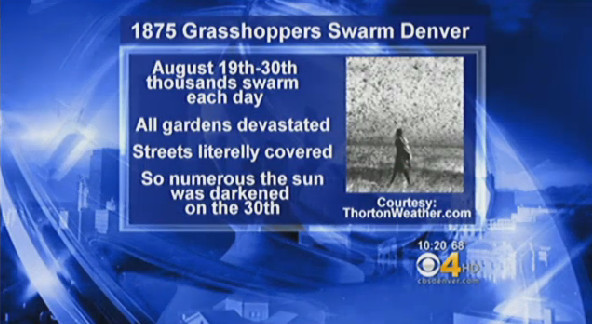
CBS4 meteorologist Dave Aguilera credited ThorntonWeather.com for information on a particularly noteworthy Denver weather event in our history.

During Sunday night’s 10:00pm newscast CBS4 meteorologist Dave Aguilera talked about one particularly notable historical weather-related event: massive swarms of grasshoppers over the Mile High City this week in Denver weather history.  The graphic Aguilera displayed during the broadcast had details on the event with a credit to ThorntonWeather.com as the event was one of many in the This Week in Denver Weather History series that we post every week.

This isn’t the first time ThorntonWeather.com has been in the news.  As the most popular local personal weather station website in the Denver metro area, we have also been featured in the Denver Post’s YourHub, the Northglenn-Thornton Sentinel and Thornton’s community access station.

It was pretty neat to see us get credit and we thank Dave for the credit – it is much appreciated.  Dave, if you ever want to do a story on personal weather station websites and owners, let us know!  😉

Smoke from northwestern United States wildfires blankets neighboring Colorado

The Mile High City found itself in a bit of a haze yesterday that continues into today as smoke from wildfires to Colorado’s northwest moves into the state. Dozens of fires are burning across the region and while none have been as devastating as those seen in recent months, their effects are being felt far and wide. Read the rest of this story and view satellite imagery of the smoke plume on Examiner.com.