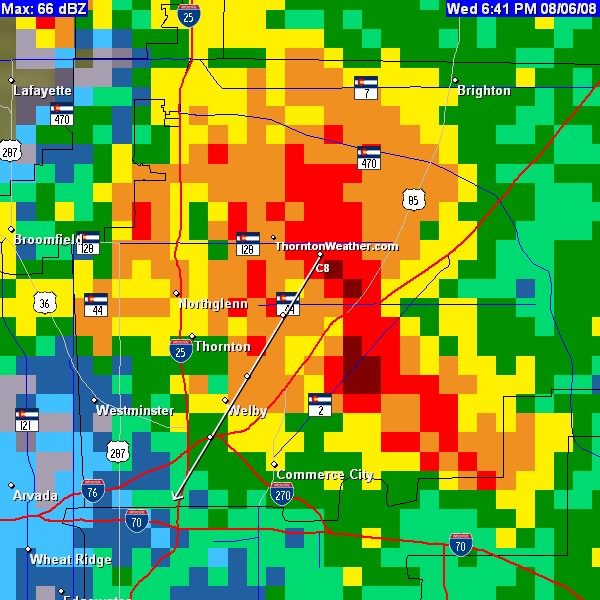
An exciting evening in Thornton as far as the weather goes. Just before 6:00pm Wednesday a slow-moving severe thunderstorm over north Thornton brought everything from funnel clouds to lightning to torrential rain.
The Thornton radar image when the storm was at its height. The storm dumped over 2" of rain in 1 hour.
Rain began falling in the area of 120th and Colorado Blvd at 6:00pm and over the next 70 minutes dumped 2.36″ of precipitation. Lightning and thunder were predominant for the entire time as well. At 6:40 the National Weather Service issued a Tornado Warning when several funnel clouds were spotted between south Thornton and Dacono. These slow moving storms presented a clear and present danger but appear to have passed relatively uneventful. Minor street flooding has been reported in some parts of Thornton but otherwise little damage.
As of this writing, a Flood Advsiory and Flash Flood Watch remains in effect for much of the Denver metro area. Radar does indicate the storm is deteriorating and things should beging to settle down now.
As always, please stay tuned to ThorntonWeather.com for the latest. Be sure to monitor our Warnings and Advsiories page for realtime updates on current watches and warnings.
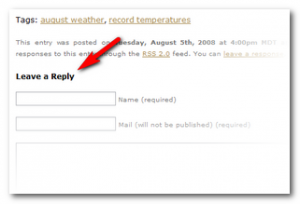
We have turned on the capability for visitors to leave comments to postings in your news / blog section. This is a great way for you to share your thoughts on the weather, comments on a topic, suggestions for us, or if you have a question about a topic, you can ask it here and we will respond.
Leaving a comment / question is very simple. If you are viewing a page that lists multiple stories (like the main index), at the bottom of each story you will see a link that says “X Comments” – clicking on that will take you to that individual posting where you can leave your comment. If you are viewing an individual posting already, at the bottom of that posting is a section that says “Leave a reply” – simply fill out the form and your comment will be sent.
Oftentimes these comment sections turn into nothing more than a repository for “comment spam” but we have implemented measures to help control this. In addition to some behind the scenes software that will control this, we also will have the system set so that we must manually approve a comment before it appears. Don’t worry – there won’t be any censoring of comments – we are going to do this temporarily until we are sure we aren’t going to get spammed with comments.
Now you can leave comments & questions to us!
We are excited to be able to implement this new feature to help us share our passion for everything weather! So, do you have anything to say? Let us know!
Here in Thornton our high thus far today has reached 88.3. However, out at DIA where the official Denver measurements are taken, the temperature reached 91 degrees. This of course extends the streak to 41 days. From the National Weather Service:
The Denver heat wave continues. At 243 pm the temperature at Denver International Airport reached 91 degrees. This temperature extends our current streak of consecutive 90 degree days to 24 days in a row. It is amazing that 24 consecutive 90 or above high temperatures were recorded breaking the 18 day streak last set 107 years ago in 1901.
So far in 2008 41 ninety degree days have been tallied. 2008 remains 9 days away from the 10th top seasonal total of 50 set in both 1960 and 1964.
Denver’s record of consecutive days with 90+ degrees continues as Saturday reached 103 degrees officially at DIA. Here in Thornton we topped out at 98.6. The temperature was quickly climbing and we were sure we were going to break 100 but early afternoon brought cloud cover to the Thronton area thus keeping us from reaching triple digits.
From the National Weather Service, four records were broken in the first two days of the month:
August 1st: New record high: 104 degrees Old record: 100 degrees last set in 1938
August 2nd: New record high: 103 degrees Old record: 100 degrees last set 130 years ago in 1878
August 2nd: New record high minimum: 70 degrees Old record 68 degrees last set in 1938
August 2nd: the consecutive 90 streak record continues with 21 consecutive days tallied.
Quite the start to the month!
New website feature added today!You can now view official National Weather Service “Local Storm Reports” directly on our website. These reports are submitted by NWS personnel, trained spotters, law enforcement as well as other emergency responders. They are a great way to see what is happening. This new feature not only displays these reports for the metro area but also for all NWS offices across the country! Special thanks to Curly at Michiana Weather for sharing the code that allows this to happen.
You can view the storm reports at any time by a new menu item added under the “Live Condtions” menu and the “Forecast” menu on the left.
It is official – we have broken Denver’s 107 year old record of consecutive days with over 90 degree temperatures. Thursday marked day 19 in the streak, moving past the old record of 18 days set way back in 1901 and 1874.
At the current time, it looks like the 90+ degree heat will continue until Wednesday at the earliestso the streak could number around 24 days or so by the time it is done. Thornton’s forecast calls for 101 degrees Friday, 100 Saturday and 98 on Sunday so the weekend will be a hot one for sure. This gives us the potential to break Denver’s all-time record for August 1st and 2nd of 100 degrees (set in 1938 and 1878 respectively). Thankfully it doesn’t look like we will break the overall all-time Denver temperature record of 105 so you can consider that a bit of a silver lining. 🙂 Continue reading Record streak official. Heat Advisory and possible record temps to come.→
This is beginning to sound like a broken record – pun intended. 🙂 As for Tuesday our streak of consecutive 90 degree days hit 17, moving us into a tie for second place. Assuming today reaches 90 degrees or more – and it almost certainly will – we will then tie the record that has been set twice previously (in 1901 and 1874).
An end in sight? Not yet. High pressure continues to hold over the area and temperatures are most likely going to actually climb to near 100 on Friday and through the weekend. Beyond that it is hard to say but things aren’t looking good to cool down anytime soon.
Certainly this streak is significant but we haven’t reached records for “hottest summer” just yet. Thus far we have had 34 days this year of 90+ degree temperatures. The number 10 slot for most 90+ degree days in a summer is held by 1960 when there were 50 days. The most? 2000 when there were 61.
As on Monday, Denver has seen 16 consecutive days with 90 degrees or higher temperatures. There was some hope the streak might be broken today but that quickly vaporized as we reached 95 degrees.
The current streak moves into a tie for fourth (with 2000). The record of 18 days consecutive set in 1901 and 1874 is looking to be sure to be broken before the heat eases. The next couple of days will see us remain in the mid 90’s and by Thursday and Friday we will be in the upper 90’s (possibly 100). The weekend shows no relief with temps well into the 90’s as well. At the current time it looks like we will thouroughly eclipse the 18 day record and there is no end in sight at this time.
As summer vacations wind down and families prepare to send kids back to school in August, Colorado weather also starts to settle down. The chances for severe weather decrease markedly during August and by the end of the month daytime temperatures are dropping quite a bit as well. For more information on what to expect in August, click here to view our August 2008 Preview.
As of today, Thursday, we are at 12 consecutive days with 90 plus degrees. Unfortunately there doesn’t appear to be an end in sight although some coming days may drop just below the 90 degree mark.
Recently we were asked what are the “zones” that the National Weather Service uses and what is their purpose. This is a very good question.
The National Weather Service in Boulder breaks down Colorado (and other states) into various zones for use when issuing forecasts, watches, warnings, etc. If you look at the text of these, you will see something like this:
SHORT TERM FORECAST
NATIONAL WEATHER SERVICE DENVER CO
1125 AM MDT MON JUL 07 2008
COZ040-041-043-045-071930-
Notice the part in bold. That tells you which zones are affected by the warning – in this case, the CO of course means Colorado. The “Z” part tells you zones 40, 41, 43 and 45 are affected. So what zone do you live in? In general, if you are in the Denver metro area, you are in either zone 39 or zone 40. You can click here for a PDF map of all Colorado zones.
Weather, natural disasters & climate news and information.


 It is official – we have broken Denver’s 107 year old record of consecutive days with over 90 degree temperatures. Thursday marked day 19 in the streak, moving past the old record of 18 days set way back in 1901 and 1874.
  This is beginning to sound like a broken record – pun intended. 🙂 As for Tuesday our streak of consecutive 90 degree days hit 17, moving us into a tie for second place. Assuming today reaches 90 degrees or more – and it almost certainly will – we will then tie the record that has been set twice previously (in 1901 and 1874).
 As summer vacations wind down and families prepare to send kids back to school in August, Colorado weather also starts to settle down. The chances for severe weather decrease markedly during August and by the end of the month daytime temperatures are dropping quite a bit as well. For more information on what to expect in August,
 Recently we were asked what are the “zones” that the National Weather Service uses and what is their purpose. This is a very good question.