Fire tornadoes, sometimes called fire whirls or fire devils, are formed when heated air from a fire rises and rotates. This vertical column of air can pull fire into it turning it into an amazing display of nature’s fury. Watch video of one in Brazil below.
Dry conditions, abundant fuel and strong winds create dangerous wildfire conditions. When in the right combination, a rare event – a fire tornado – can occur and one was captured on video in Brazil yesterday.
Coloradoans are not strangers to the dangers of wildfires. A relatively wet winter and summer has allowed us to escape relatively unscathed so far this year. Other parts of the globe however have not been so lucky.
Brazil as well has seen extensive wildfire activity in the last few weeks due to a drought. The brush fires have been fueled by the dry brush and they have devastated open land and destroyed homes.
Videographers filming near the city of Aracatuba in the Brazilian state of Sao Paolo captured a fire tornado yesterday as it tore through a Brazilian field. The rare event results when hot air on the surface rises and is twisted by winds thus pulling the fire vertically.
August 22 to August 28 - This week in Denver weather history
Lightning is a very real danger here in Colorado. The outdoor-centric lifestyle we lead oftentimes puts us in situations when we are better off heading for cover. The dangers of not properly taking shelter when lightning is in the area are highlighted by a number of events in our look back at this week in Denver weather history.
In 1875…grasshoppers appeared in great numbers at 10:00 am on the 19th. Thousands landed on the ground. The streets were literally covered with them. Swarms of grasshoppers were seen on each day. All gardens in the city were devastated…and in the countryside the grasshoppers were very destructive to ripened grain. On the 30th the grasshoppers were so numerous as to almost darken the sun.
22
In 1898…an apparent thunderstorm produced southwest sustained winds to 40 mph with gusts to 43 mph.
In 1903…a late afternoon thunderstorm produced rain…hail… And east winds sustained to 40 mph with gusts to 44 mph.
In 1904…the lowest recorded temperature in August…40 degrees…occurred. The same temperature also occurred on three consecutive days…August 24…25…and 26 in 1910.
In 1965…heavy rain and hail caused some damage from flooding over northern Douglas County from Castle Rock to Franktown.
In 1981…thunderstorms moved across metro Denver. At least 5 funnel cloud sightings were reported. Funnel clouds were seen at 96th Ave. And Sheridan Blvd. and at 92nd Ave. and Federal Blvd. In Westminster and 7 miles north of Stapleton International Airport. Lightning injured two people in Boulder. A quarter inch of rain fell in just 5 minutes in Brighton. Up to 3/4 inch of rain doused Parker in 30 minutes.
In 1983…3/4 inch diameter hail was reported at Kittredge… Along with 0.60 inch of rain in 25 minutes.
In 1984…a thunderstorm dumped 4 inches of rain on Brighton in 90 minutes…causing extensive street flooding in the downtown area.
In 1987…over an inch of rain fell in 24 hours throughout most of metro Denver. A public library suffered water damage to the ceiling…carpet…and a few books. Rainfall was 0.76 inch at Stapleton International Airport.
In 1990…lightning knocked out power to about 2500 homes in Lakewood for about an hour.
In 1991…National Weather Service personnel at Stapleton International Airport sighted an apparent tornado briefly on the ground 3 miles west-northwest of the airport. No damage was reported.
In 1995…lightning struck 3 electrical power substations in Louisville. Residences of more than 4500 people were without power from 30 minutes to more than an hour.
In 1996…between 1 and 3 inches of rain fell across metro Denver. As a result…several low lying areas were flooded. A bicyclist was swept into a fast moving creek when he tried to cross a flooded bike path. The man was washed downstream about 15 feet before getting snagged by a tree stump. He and a man who tried to rescue him received minor injuries. The heavy rain caused numerous power outages…false fire alarms…and traffic accidents. In Lakewood…telephone service to around 60 thousand residents was knocked out when a switching center was flooded. Funnel clouds were sighted near Chatfield Reservoir and Highlands Ranch.
In 2000…lightning sparked a blaze which gutted a 10-unit apartment building in Highlands Ranch. Twenty-eight people were left homeless. Damage was estimated at 2 million dollars.
In 2007…severe thunderstorms produced large hail…up to 1 1/4 inches in diameter…in the vicinities of Castle Rock… Elizabeth and Franktown.
From the National Oceanic & Atmospheric Administration: The combined global land and ocean surface temperature made this July the second warmest on record, behind 1998, and the warmest averaged January-July on record. The global average land surface temperature for July and January–July was warmest on record. The global ocean surface temperature for July was the fifth warmest, and for January–July 2010 was the second warmest on record, behind 1998.
The monthly analysis from NOAA’s National Climatic Data Center, which is based on records going back to 1880, is part of the suite of climate services NOAA provides government, business and community leaders so they can make informed decisions.
Global temperature anomolies, July 2010. (NOAA)
Global Temperature Highlights
The combined global land and ocean average surface temperature for July 2010 was the second warmest on record at 61.6°F (16.5°C), which is 1.19°F (0.66°C) above the 20th century average of 60.4°F (15.8°C). The averaged temperature for July 1998 was 61.7°F (16.5°C).
The July worldwide land surface temperature was 1.85°F (1.03°C) above the 20th century average of 57.8°F (14.3°C) — the warmest July on record. Warmer-than-average conditions dominated land areas of the globe. The most prominent warmth was in Europe, western Russia and eastern Asia. Cooler-than-average regions included central Russia, Alaska and southern South America.
According to the Finnish Meteorological Institute, Finland set a new all-time maximum temperature on July 29 when temperatures soared to 99.0°F (37.2°C), surpassing the previous record set in July 1914 by 2.3°F (1.3°C).
Western Russia was engulfed by a severe heat wave during much of July. On July 30, Moscow set a new all-time temperature record when temperatures reached 102°F (39°C), exceeding the previous record of 99.0°F (37.2°C) set four days earlier. Before 2010, the highest maximum temperature recorded in Moscow was 98.2°F (36.8°C), set nine decades ago.
According to the Beijing Climate Center, the July 2010 average temperature across China was 73.0°F (22.8°C), which is 2.5°F (1.4°C) above the 1971-2000 average and the warmest July since 1961.
The worldwide ocean surface temperature was 0.97°F (0.54°C) above the 20th century average of 61.5°F (16.4°C) and the fifth warmest July on record. The warmth was most pronounced in the Atlantic Ocean.
La Niña conditions developed during July 2010, as sea surface temperatures (SST) continued to drop across the central and eastern equatorial Pacific Ocean. According to NOAA’s Climate Prediction Center, La Niña is expected to strengthen and last through the Northern Hemisphere winter 2010-2011.
For the year-to-date, the global combined land and ocean surface temperature of 58.1°F (14.5°C) was the warmest January-July period on record. This value is 1.22°F (0.68°C) above the 20th century average.
Global temperature anomolies, January through July, 2010. (NOAA)
Polar Sea Ice and Precipitation Highlights
Arctic sea ice covered an average of 3.2 million square miles (8.4 million square kilometers) during July. This is 16.9 percent below the 1979-2000 average extent and the second lowest July extent since records began in 1979. The record low July was set in 2007. This was the 14th consecutive July with below-average Arctic sea ice extent. July 1996 was the last year that had above-average sea ice extent.
Antarctic sea ice extent in July was above average, 4.8 percent above the 1979-2000 average—resulting in the largest July sea ice extent on record.
According to Australia’s Bureau of Meteorology, the continent received an average of 34.4 mm (1.35 inches) of precipitation during July 2010—this is 55 percent above the 1961-1990 average and the highest value since 1998.
Scientists, researchers and leaders in government and industry use NOAA’s monthly reports to help track trends and other changes in the world’s climate. This climate service has a wide range of practical uses, from helping farmers know what and when to plant, to guiding resource managers with critical decisions about water, energy and other vital assets.
Colorado storm chaser Roger Hill was shown on the Drudge report and that led to appearances on most major TV networks.
Roger Hill is considered quite famous among storm chasers as he has a proven, uncanny ability to place himself right where severe weather will strike. A recent headline on the Drudge Report featuring Hill has now shined the national media spotlight on him and his profession as co-owner of a storm chasing tour company.
Hill is no stranger to the media as his amazing videos and photos have been featured on the Weather Channel, Discovery Channel, National Geographic and all major news networks. For nearly a decade Hill and his company Silver Lining Tours have been showing thrill seekers what it is like to experience severe weather at closer range than what may be possible otherwise. Interest in “storm chasing tours” however has hit a fevered pitch in recent weeks.
Crews from Inside Edition and Nightline then followed by riding along with Hill and Silver Lining Tours as they crisscrossed the Great Plains on the hunt for tornadoes.
The Nightline piece aired this past Friday and gave a good idea of what it is like to be on tour with Hill (watch the video below). From the frenzied pace to the seemingly endless ingestion of fast food and of course the thrill of the tornado chase, reporter Eric Hong experienced it all.
This storm cell over north Thornton on Sunday, August 15, 2010 was beautiful as it was lit by the setting sun. See more images in the slideshow below.
Over the last two days, Thornton has seen its share of severe weather. Thunderstorms on Sunday and Monday afternoons provided excitement but calmer weather is forecasted.
On Sunday, thunderstorms boomed over the northern part of town just as the sun was setting. They provided a fantastic light show as the setting sun illuminated the thunder clouds in orange and lightning provided the flash. These storms didn’t produce much within Thornton but further east they produced two tornadoes.
Monday the main event struck the northern half of the city. Around 5:00pm dark, ominous clouds arrived with a green cast that warned severe weather was coming. An astounding 0.53 inch of rain was recorded at ThorntonWeather.com in a mere 25 minutes as it dumped on the area. Some minor street flooding was reported.
August 15 to August 21 - This week in Denver weather history
While not as common this time of year, severe weather can still strike as we close out summer. Most notable are the heavy rain events that can come along as a result of the monsoon season. The dangers of these are oftentimes ignored and as we see can oftentimes turn deadly.
15
In 1899…a thunderstorm produced southwest sustained winds to 43 mph with gusts to 46 mph.
In 1972…a pilot reported a funnel cloud briefly touching the ground in open fields…17 miles east-northeast of Stapleton International Airport.
In 1980…thunderstorm winds gusted to 55 mph in Boulder.
In 1982…brief heavy rain and winds estimated as high as 70 mph occurred in the conifer-Evergreen area. No damage was reported.
In 1990…lightning triggered a small attic fire in a house near Sedalia…20 miles south of Denver. A furious lightning storm caused widespread power outages across southern sections of metro Denver. One lightning bolt knocked out an electrical substation…causing a 90-minute blackout in southeast Denver affecting nearly 10 thousand homes and businesses.
In 2007…severe thunderstorms produced large hail…up to 2 inches in diameter…near Larkspur. Extensive damage to vehicles in the area was reported. In Parker…lightning struck a residence. The ensuing fire damaged the attic and top floor; causing $100000 in property damage.
In 2008…at least three homes were hit by lightning during the early morning hours in Arapahoe County. Lightning also struck two homes in Castle Rock…damaging the roofs.
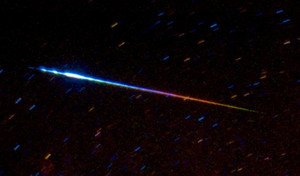
Stargazers have an extraordinary opportunity to see the Perseid meteor shower Wednesday and Thursday nights.
An extraordinary opportunity to view the annual Perseid meteor shower awaits those who stay up late or get up very early the next two days. The night sky tonight and tomorrow will be lit up with the fiery fragments of Comet Swift-Tuttle thanks in part to moonless nights.
For the 2010 show, the moon will not be up during the pre-dawn hours allowing a very dark sky to show off the meteors as they enter the Earth’s atmosphere. At its peak, observers this year may see as many as 100 Perseids per hour.
This is a great opportunity to see an extraordinary light show in the heavens.
Comparison of updated 2010 Atlantic hurricane season forecasts.
Despite what seems like a slow start to the Atlantic hurricane season, forecasters are warning that the worst is yet to come. In updates to their annual predictions released last week, Colorado State University (CSU) forecasters and the National Oceanic and Atmospheric Administration (NOAA) are sticking to their earlier forecasts of an above normal level of activity for 2010.
On Wednesday the professional team of Dr. Philip J. Klotzbach and Dr. William M. Gray at CSU said they were sticking with their original prediction of 18 named storms, 10 hurricanes and 5 major hurricanes (Category 3 or higher). The pair warns, “We anticipate a well above-average probability of United States and Caribbean major hurricane landfall.”
NOAA updated their annual forecast Thursday saying, “The Atlantic Basin remains on track for an active hurricane season” and that there was a “90% chance of an above normal season.” Warmer than average water temperatures in the Atlantic and Caribbean and low wind shear are expected to help storm generation. The agency did slightly lower its forecast to 14 – 20 named storms, 8 – 12 hurricanes and 4 – 6 major hurricanes.
Hurricane Alex became a tropical storm on June 26th and a hurricane on the 29th. The storm became a Category 2 hurricane before making landfall in northeastern Mexico.
Tropical Storm Bonnie formed on July 22nd followed by Tropical Storm Colin on July 30th. Colin only survived for 12 hours initially then reconstituted itself late last week only to fall apart as it passed over Bermuda.
The worst is yet to come
Hurricanes can occur at any time of year but the peak period is from August to October. (NOAA)
Experts reminded the public that August and September are historically the most active months with the peak occurring during the second week of September. Dr. Gerry Bell of NOAA’s Climate Prediction Center said, “All indications are for considerable activity during the next several months.”
Keeping the public safe and aware is one of the primary purposes of the forecasts and despite the slow start to the season, they warn coastal residents not to be complacent. NOAA Administrator Jane Lubchenco said, “August heralds the start of the most active phase of the Atlantic hurricane season and with the meteorological factors in place, now is the time for everyone living in hurricane prone areas to be prepared.”
Satellite imagery released by NASA clearly shows the extent of the smoke plume from wildfires burning in western Russia. (NASA) Click the image to view a slideshow of the wildfires as seen from space.
More than 600 wildfires burning across Russia have clouded the skies and claimed the lives of at least 50 people. NASA has trained its satellites on the nation capturing imagery of the blazes as they continue to burn.
Seven regions of Russia are under state of emergency as officials struggle to gain an upper hand against the fires. All told, estimates are that more than 484,000 acres (196,000 hectares) have been scorched with no end in sight.
President Dmitry Medvedev fired several military officials today for their inability to slow the fires. Thousands of people have lost their homes as the flames continue unabated. A naval base in Kolomna was destroyed last week and a nuclear research facility in Sarov is now threatened.
The choking smoke over places like Moscow has added to the misery of what has been an unusually hot summer. The plumes of smoke are so extensive they can easily be captured by NASA satellites orbiting 22,300 miles above the surface of the Earth.
The imagery below was captured by NASA’s Terra satellite yesterday. In the top image, the plumes of smoke from the fires in western Russia stretch more than 1,800 miles (3,000 km). The lower image shows a closer view of the fires burning southeast of Moscow.
Satellite image showing the extent of the smoke plume from fires burning in Russia (NASA)
Satellite image of smoke from wildfires burning southeast of Moscow (NASA)
Intense fires continued to rage in western Russia on August 4, 2010. Burning in dry peat bogs and forests, the fires produced a dense plume of smoke that reached across hundreds of kilometers. The Moderate Resolution Imaging Spectroradiometer (MODIS) captured this view of the fires and smoke in three consecutive overpasses on NASA’s Terra satellite. The smooth gray-brown smoke hangs over the Russian landscape, completely obscuring the ground in places. The top image provides a close view of the fires immediately southeast of Moscow, while the lower image shows the full extent of the smoke plume.
The fires along the southern edge of the smoke plume near the city of Razan, top image, are among the most intense. Outlined in red, a line of intense fires is generating a wall of smoke. The easternmost fire in the image is extreme enough that it produced a pyrocumulus cloud, a dense towering cloud formed when intense heat from a fire pushes air high into the atmosphere.
The lower image shows the full extent of the smoke plume, spanning about 3,000 kilometers (1,860 miles) from east to west. If the smoke were in the United States, it would extend approximately from San Francisco to Chicago. The MODIS sensor acquired the right section of the image starting at 5:55 UTC (10:55 a.m. local time, 8:55 a.m. in Moscow). The center section is from the overpass starting at 7:35 UTC (11:35 local time, 10:35 in Moscow), and the westernmost section was taken at 9:10 UTC (12:10 p.m. local time in Moscow).
Early analyses of data from the Multi-angle Imaging Spectroradiometer (MISR), another instrument on the Terra satellite, indicates that smoke from previous days has at times reached 12 kilometers (six miles) above Earth’s surface into the stratosphere. At such heights, smoke is able to travel long distances to affect air quality far away. This may be one reason that the smoke covers such a large area. The pyrocumulus cloud and the detection of smoke in the stratosphere are good indicators that the fires are large and extremely intense.
According to news reports, 520 fires were burning in western Russia on August 4. MODIS detected far fewer. It is likely that the remaining fires were hidden from the satellite’s view by the thick smoke and scattered clouds. High temperatures and severe drought dried vegetation throughout central Russia, creating hazardous fire conditions in July.
As of August 4, 48 people had died in the fires and more than 2,000 had lost their homes throughout central Russia, said news reports. The dense smoke also created hazardous air quality over a broad region. Visibility in Moscow dropped to 20 meters (0.01 miles) on August 4, and health officials warned that everyone, including healthy people, needed to take preventative measures such as staying indoors or wearing a mask outdoors, reported the Wall Street Journal. In the image, Moscow is hidden under a pall of smoke. Close to the fires, smoke poses a health risk because it contains small particles (soot) and hazardous gases that can irritate the eyes and respiratory system. Smoke also contains chemicals that lead to ozone production farther away from the fires.
The large image provides the full scene shown in the lower image at the sensor’s highest resolution (as shown in the top image). The MODIS Rapid Response Team provides the scene in additional resolutions.
NASA image courtesy Jeff Schmaltz, MODIS Rapid Response Team at NASA GSFC. Caption by Holli Riebeek with information courtesy Mike Fromm, Naval Research Laboratory.
August 8 to August 14 - This week in Denver weather history
Monsoon season in Colorado typically brings short-lived but heavy rains. These can result in flash flooding and we see that in our look back at this week in Denver weather history. Also notable are the number of lightning deaths and injuries as well as hail events and even a swarm of grasshoppers!
8
In 1874…swarms of grasshoppers invaded the city. Millions of them were seen cruising through the air. The insects were apparently picked up by a thunderstorm gust front and carried into the city. The grasshoppers had ravaged crops in surrounding counties for the last month.
In 1878…the highest temperature ever recorded in Denver…105 degrees…occurred at 3:20 pm. This temperature was equaled on July 20th in 2005.
In 1969…the temperature reached 100 degrees at Stapleton International Airport.
In 1976…in Thornton…a 13 year old boy riding a bicycle was struck and killed by lightning.
In 2000…lightning struck three homes in central Arapahoe County east of Denver. Damage was estimated at 47 thousand dollars.
In 2003…hail to 1 inch in diameter pelted Denver. Hail to 7/8 inch was measured in Boulder.
In 2008…heavy rain also caused flash flooding over south Denver and its nearby suburbs. Heavy rain…from 2.5 to 4 inches…fell in less than 90 minutes. Firefighters rescued 20 people as the water quickly rose along creeks…flooded roadways…and stranded motorists. Three people had to be rescued along Cherry Creek when the bike path flooded. In Evergreen…a man suffered minor injuries when he was struck by lightning. It entered his finger…traveled down his body… And exited his foot.