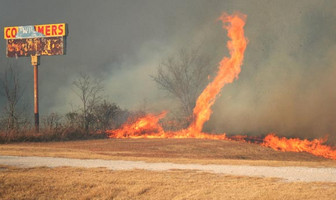
The Fourmile Canyon Fire sent smoke over Thornton on Monday. (ThorntonWeather.com)
A fast moving wildfire burning northwest of Boulder sent smoke over Thornton on monday and more is expected today. The Fourmile Canyon Fire started late Monday morning and has burned 3,500 acres thus far.
Tinder dry fuels, low humidity, warm temperatures and gusty winds fueled the Fourmile Canyon Fire yesterday as it grew quickly. Firefighters took up defensive positions trying to save what homes they could but many were reduced to cinder.
More than 100 firefighters are on scene with 35 engines from 30 local agencies. Boulder County Fire is acting as the primary agency for the fire.
High winds prevented air tankers with retardant from operating for most of the day but the wind eased in the late afternoon and evening allowing some operations. 18 flights by three tankers were carried out before the sun set and they were able to drop 40,000 gallons of retardant on the fast moving fire.
Four additional tankers arrived Monday and will begin operations today, weather permitting.
With plenty of heat and a lack of moisture the fire danger is high along the Front Range on Sunday. (National Weather Service)
September is starting off as a hot one along the Front Range and indeed across the state of Colorado. With temperatures set to approach record highs, low humidity and windy conditions the fire danger has prompted a Red Flag Warning for Sunday.
The record high temperature for September 5th is 97 degrees and that is what Denver’s thermometer is expected to rise to today. Humidity during the heat of the day is forecast to drop below 15% and the afternoon will bring breezy conditions with winds gusting over 30 mph.
All of those factors will serve to dry out the Colorado Front Range and bring what the National Weather Service calls “extreme fire danger” to the area.
The service has issued a Red Flag Warning that will be in effect from 10:00am to 9:00pm today covering the Front Range foothills and adjacent areas including Denver and Thornton. Conditions are expected to be at their peak from 11:00am to 6:00pm.
Similarly, the Western Slope from the Continental Divide west to the Utah border is under a Red Flag warning from noon until 9:00pm.
Colorado has made it through what has been a relatively hot summer without any major wildfires. However conditions today are ripe and should a fire get started, it could spread rapidly and with devastating effects. With the Labor Day holiday weekend many people will be spending time outdoors and extreme caution should be exercised.
Is it global warming at work? Probably not but the Mile High City experienced a very warm month of August that nearly ended up in the “top 10” statistical column. Were it not for things cooling down in the last week that almost certainly would have happened.
Denver’s average temperature for the month was 73.8 degrees – 2.1 degrees above normal. That put it 0.3 degrees shy of the number ten spot for warmest August on record which was in 1947 with an average temperature of 74.1. We should be thankful we didn’t reach near the top spot. The hottest August on record was in 1937 when we hit an average of 76.8 degrees.
In terms of extremes, the hottest day of the month occurred on the 22nd when the mercury climbed to 97 degrees. The coldest temperature recorded was on the 17th when we dropped to 47 degrees. Neither of those were records.
Overall we recorded 12 days with 90 degree or higher temperatures – three above normal. Similarly we have seen 41 ninety degree plus days this year which is 10 more than normal.
Only one temperature record was set for the month. That occurred on the 18th when a record high minimum of 67 degrees was recorded. This tied the previous record for the date set in 1986.
Here in Thornton we were a bit cooler than the Denver measurements. We saw an average temperature of 72.3 degrees with a high of 93.9 on the 18th and a low of 51.1 degrees on the 17th.
It may not have seemed like it as we did have quite a few days with thunderstorms but we in fact finished August with below normal precipitation. Denver recorded 1.05 inch but that was 0.77 inch below normal.
Most of that precipitation however fell within the first seven days of the month when 1.03 of the total was recorded. Of that, 0.68 inch was recorded on the first of the month. However, a mere 0.02 inch was recorded for the final three weeks of the month.
Thornton fared better than the official measurements in terms of precipitation. We recorded 1.41 inches for the month and the moisture we received was spread out across the month much better.
At the official Denver monitoring station at Denver International Airport they recorded 10 days with thunderstorms. The max wind gust was 45 mph recorded on the 12th and again on the 16th.
September 5 to September 11 - This week in Denver weather history
September is typically one of our quietest weather months and in fact it is our sunniest. That doesn’t however mean we can’t experience weather extremes. This week in Denver weather history we see everything from scorching heat and severe thunderstorms to snow and damaging wind. For more about September’s weather, check out our September weather preview.
1-5
In 1995…record breaking heat occurred on the first 5 days of the month when the temperature climbed into the 90’s on each day. Record high temperatures of 97 degrees on both the 1st and 4th equaled the all-time record maximum for the month. High temperature of 95 degrees on the 3rd was a record for the date. High temperatures of 94 degrees on both the 2nd and the 5th were not records. The low temperature of 64 degrees on the 4th equaled the record high minimum for the date.
1-7
In 1978…the temperature reached 90 degrees or more on seven consecutive days with the highest temperature…94 degrees… Recorded on both the 4th and 6th.
3-6
In 1909…rainfall for the 4 days accumulated to 3.97 inches in Boulder…while in Denver rainfall totaled 2.45 inches on the 4th…5th…and 6th.
5
In 1899…the highest recorded temperature in September…97 degrees…occurred. The same temperature was also reached on September 4…1960…and September 1 and 4…1995.
In 1940…a severe wind and hail storm confined mostly to the west and north parts of the city occurred shortly after 4:30 pm. Hail stones ranged in size from 1/4 to 1/2 inch in diameter. In north Denver…hail piled to a depth of 4 inches. Flooding occurred in one underpass…which stalled 2 cars. One girl was injured when the weight of the hail flattened a porch on which she stood. Northeast winds were sustained to 29 mph with gusts to 32 mph in downtown Denver.
In 1987…a thunderstorm complex produced hail as large as 1 3/8 inches in diameter…2 miles east of Buckley Field in Aurora. No damage was reported.
NASA Astronaut Douglas Wheelcock captured this image of Hurricane Earl on Monday. Click the image for a slideshow of hurricanes as seen from space. (NASA)
A slightly weakened but still powerful Hurricane Earl continues on its path drawing nearer to the United States East Coast. In recent days, astronauts aboard the International Space Station have been afforded stunning views of the storm from their 220 mile high perch.
According to the National Hurricane Center (NHC), Hurricane Earl’s forecast path will bring it dangerous close to the East Coast from South Carolina through Maine. The center of the storm is expected to remain at sea however the centers “cone of uncertainty” includes much of the coast.
Astronaut Douglas Wheelcock is the commander of the Expedition 24 crew now on board the space station. The West Point graduate and Army colonel previously logged hundreds of hours aboard the Space Shuttle and is in the third month of a six-month stay commanding the ISS.
Like other recent visitors to the space station, Wheelcock is keeping the public up to date with the crew’s activities via Twitter. As the user ‘Astro_Wheels’, Wheelcock has used the messaging service to report on repairs to the station and ongoing experiments and now has posted extraordinary photos of Hurricane Earl.
The two images of the powerful hurricane span roughly 17 hours. The first, taken over the central Atlantic on Monday shows Earl when it was a Category 2 storm with loose, rotating bands. The second, taken this morning, shows how much more organized – and powerful – the storm has become.
The slideshow below contains the images taken by Colonel Wheelcock as well as images of previous hurricanes taken by International Space Station and Space Shuttle crews and NASA satellites.
As temperatures start to drop, September reminds us that summer is at an end and fall is now here. Sunshine is predominant though as the month actually has the highest percentage of sun out of any month. Sunny days and clear, cool nights are the standard weather pattern for the month.
However that isn’t to say the weather can’t be a lot more “interesting.” Extremes can occur during September ranging from heat to cold to yes, even snow.
August 31, 2010 - Hurricane Earl passes to the north of Puerto Rico. The major hurricane is a threat to the United States from the mid-Atlantic to New England.
Hurricane Earl continues its slow trek toward the west-northwest after pummeling parts of the Caribbean yesterday. Today it looks like most areas will be spared the worst of the storm but a forecasted turn to the north may put parts of the East Coast at risk.
The eye of Earl is currently 146 miles north of San Juan, Puerto Rico and the storm is packing 135 mph winds making it a Category 4 hurricane. A bit more strengthening is expected over the next 24 hours as the storm continues to encounter warm waters and favorable conditions.
Of particular concern is the path that Earl may take. It is expected to gradually turn north and eventually to the northeast. Within its forecast cone is a vast area stretching from South Carolina to Maine. With many large population centers within the possibility for landfall, the potential for a major disaster are great.
August 22 to September 4 – This week in Denver weather history
Certainly this time of year we start to see temperatures drop and the conditions moderate. This is usually one of Denver’s most pleasant times of years when the heat of summer fades and the snow and cold of winter is still far away. That however wasn’t the case when the most notable event in Denver weather history this week occurred. It was in 1961 on the 3rd of September that Denver received its earliest measurable snowfall – 4.2 inches!
19-30
In 1875…grasshoppers appeared in great numbers at 10:00 am on the 19th. Thousands landed on the ground. The streets were literally covered with them. Swarms of grasshoppers were seen on each day. All gardens in the city were devastated…and in the countryside the grasshoppers were very destructive to ripened grain. On the 30th the grasshoppers were so numerous as to almost darken the sun.
29
In 1876…after the passage of a gentle rain shower to the east during the late evening hours…the moon shone brightly and a remarkably bright lunar rainbow appeared.
In 1910…an apparent cold front produced sustained northeast winds to 40 mph.
In 1946…the high temperature warmed to only 55 degrees…the record low maximum for the month.
In 1989…a spectacular lightning display knocked out power to 300 blocks in southeast Denver. One bolt started a fire in a lumber yard in the northeast part of the city…and the attic of a home in the same area was set ablaze by a lightning bolt.
In 1996…3/4 inch diameter hail was measured in Parker.
In 2000…lightning struck two homes in Thornton. The extent of damage was unknown.
In 2002…two small tornadoes caused damage in southeast metro Denver. The first tornado…associated with a multi-vortex storm…touched down briefly near E-470 and South Jordan Road. Some fences were damaged…and a few trees were blown down. A few of the homes also sustained minor roof damage. Damage from this storm totaled 100 thousand dollars. The second tornado associated with the storm touched down in a subdivision that was under construction at Gartrell and Arapahoe roads. Four large condominiums under construction were destroyed. The most heavily damaged portions of the structures were still in the framing stages. Adjacent sections where enclosed walls were in place were not destroyed. A man suffered 4 broken ribs and several cuts and bruises when the trailer he sought shelter in was flipped three times and torn apart by the twister. Damage from this storm totaled 6 million dollars. A severe thunderstorm produced 1 inch diameter hail near Evergreen.
In 2006…severe thunderstorms produced large hail in the foothills west of Denver. Hail to 1 inch in diameter fell near Blackhawk. Hail as large as 7/8 inch was measured near Idaho Springs…along with 3/4 inch hail near Nederland and Conifer.
Fire tornadoes, sometimes called fire whirls or fire devils, are formed when heated air from a fire rises and rotates. This vertical column of air can pull fire into it turning it into an amazing display of nature’s fury. Watch video of one in Brazil below.
Dry conditions, abundant fuel and strong winds create dangerous wildfire conditions. When in the right combination, a rare event – a fire tornado – can occur and one was captured on video in Brazil yesterday.
Coloradoans are not strangers to the dangers of wildfires. A relatively wet winter and summer has allowed us to escape relatively unscathed so far this year. Other parts of the globe however have not been so lucky.
Brazil as well has seen extensive wildfire activity in the last few weeks due to a drought. The brush fires have been fueled by the dry brush and they have devastated open land and destroyed homes.
Videographers filming near the city of Aracatuba in the Brazilian state of Sao Paolo captured a fire tornado yesterday as it tore through a Brazilian field. The rare event results when hot air on the surface rises and is twisted by winds thus pulling the fire vertically.
August 22 to August 28 - This week in Denver weather history
Lightning is a very real danger here in Colorado. The outdoor-centric lifestyle we lead oftentimes puts us in situations when we are better off heading for cover. The dangers of not properly taking shelter when lightning is in the area are highlighted by a number of events in our look back at this week in Denver weather history.
In 1875…grasshoppers appeared in great numbers at 10:00 am on the 19th. Thousands landed on the ground. The streets were literally covered with them. Swarms of grasshoppers were seen on each day. All gardens in the city were devastated…and in the countryside the grasshoppers were very destructive to ripened grain. On the 30th the grasshoppers were so numerous as to almost darken the sun.
22
In 1898…an apparent thunderstorm produced southwest sustained winds to 40 mph with gusts to 43 mph.
In 1903…a late afternoon thunderstorm produced rain…hail… And east winds sustained to 40 mph with gusts to 44 mph.
In 1904…the lowest recorded temperature in August…40 degrees…occurred. The same temperature also occurred on three consecutive days…August 24…25…and 26 in 1910.
In 1965…heavy rain and hail caused some damage from flooding over northern Douglas County from Castle Rock to Franktown.
In 1981…thunderstorms moved across metro Denver. At least 5 funnel cloud sightings were reported. Funnel clouds were seen at 96th Ave. And Sheridan Blvd. and at 92nd Ave. and Federal Blvd. In Westminster and 7 miles north of Stapleton International Airport. Lightning injured two people in Boulder. A quarter inch of rain fell in just 5 minutes in Brighton. Up to 3/4 inch of rain doused Parker in 30 minutes.
In 1983…3/4 inch diameter hail was reported at Kittredge… Along with 0.60 inch of rain in 25 minutes.
In 1984…a thunderstorm dumped 4 inches of rain on Brighton in 90 minutes…causing extensive street flooding in the downtown area.
In 1987…over an inch of rain fell in 24 hours throughout most of metro Denver. A public library suffered water damage to the ceiling…carpet…and a few books. Rainfall was 0.76 inch at Stapleton International Airport.
In 1990…lightning knocked out power to about 2500 homes in Lakewood for about an hour.
In 1991…National Weather Service personnel at Stapleton International Airport sighted an apparent tornado briefly on the ground 3 miles west-northwest of the airport. No damage was reported.
In 1995…lightning struck 3 electrical power substations in Louisville. Residences of more than 4500 people were without power from 30 minutes to more than an hour.
In 1996…between 1 and 3 inches of rain fell across metro Denver. As a result…several low lying areas were flooded. A bicyclist was swept into a fast moving creek when he tried to cross a flooded bike path. The man was washed downstream about 15 feet before getting snagged by a tree stump. He and a man who tried to rescue him received minor injuries. The heavy rain caused numerous power outages…false fire alarms…and traffic accidents. In Lakewood…telephone service to around 60 thousand residents was knocked out when a switching center was flooded. Funnel clouds were sighted near Chatfield Reservoir and Highlands Ranch.
In 2000…lightning sparked a blaze which gutted a 10-unit apartment building in Highlands Ranch. Twenty-eight people were left homeless. Damage was estimated at 2 million dollars.
In 2007…severe thunderstorms produced large hail…up to 1 1/4 inches in diameter…in the vicinities of Castle Rock… Elizabeth and Franktown.





 As temperatures start to drop, September reminds us that summer is at an end and fall is now here. Sunshine is predominant though as the month actually has the highest percentage of sun out of any month. Sunny days and clear, cool nights are the standard weather pattern for the month.