NASA satellites capture images of deadly flooding in Pakistan

Flooding in Pakistan is easily seen in this satellite image released by NASA.  See larger images below and click here to view images from on the ground in Pakistan. (NASA)
Flooding in Pakistan is easily seen in this satellite image released by NASA. See larger images below. (NASA)

While Colorado has witnessed some pretty good rain showers in recent days due to the monsoon season, it is nothing compared to what Pakistan is experiencing.  Seemingly endless monsoonal rains have flooded hundreds of thousands of acres in Pakistan that were easily spotted by NASA satellites.

The floods, said to be the worst in the nation since 1929, have claimed more than 1,500 lives and affected 3.2 million people. Entire villages have been submerged by the water that continues to rise across large swaths of the nation.

By comparison, Colorado’s worst natural disaster was the Big Thompson Flood which killed 143 people in 1976.  This occurred during our own monsoon season but pales in comparison to what is happening in Pakistan. 

The images taken by NASA on July 31st show the Indus River in northwestern Pakistan clearly overflowing. The difference between the image taken this year versus one taken on August 1, 2009 provide a stark contrast that demonstrates how much worse this season is.

Flooding in Pakistan – Image captured July 31, 2010 (NASA)
Satellite image of flooding in Pakistan along the Indus River. (NASA)

Pakistan – Image captured August 1, 2009 (NASA)
Satellite image of flooding in Pakistan along the Indus River. (NASA)

More on the Pakistan flooding: Floods ravage Pakistan killing 1,500 and affecting millions

Slideshow: Death and devastation as monsoon rains flood Pakistan

Russians caught in raging wildfire – Amazing video

This screenshot from a YouTube video shows flames coming dangerously close to volunteers that went to help those in need as wildfires burn across western Russian. (YouTube)  Watch the video below.
This screenshot from a YouTube video shows flames coming dangerously close to volunteers that went to help those in need as wildfires burn across western Russian. (YouTube) Watch the video below.

Wildfires have been sweeping across European Russia in recent days prompting the government to declare a state of emergency. A recently released video shows how the fast moving blazes can turn a relatively calm situation into a desperate flight – and flight – for life in the face of advancing flames.

The video, released on YouTube, shows volunteers that went to the village of Tamboles to assist residents finding themselves instead in need of help.

The translated caption for the video explains that the vehicle’s occupants passed along the same road a half hour before and there was no hint of the fire. When they went to return, they were surrounded by flames as trees and brush burned around them and they were confronted with walls of flame.

Listening to the audio in the video one does not have to speak Russian to understand the desperateness of the situation they are in. Amazingly enough, the vehicle and its occupants survived their fiery journey.

Solar flare headed to Earth; Expected to light up the sky in some parts of the nation

This X-ray photo of the Sun was taken by NASA's Solar Dynamics Observatory (SDO) on Sunday morning, August 1st.  The dark area near the top right edge is a filament of plasma being ejected, part of the coronal mass ejection (CME).  The bright region on the left half is an unrelated flare. (NASA)  Watch video of the ejection at the link below.
This X-ray photo of the Sun was taken by NASA's Solar Dynamics Observatory (SDO) on Sunday morning, August 1st. The dark area near the top right edge is a filament of plasma being ejected, part of the coronal mass ejection (CME). The bright region on the left half is an unrelated flare. (NASA) Watch video of the ejection at the link below.

A large solar flare on Sunday is expected to strike the Earth tonight treating sky watchers in the northern United States to a display of aurorae. The increased activity is being monitored by NOAA’s Space Weather Prediction Center (SWPC) in Boulder.

The ejection of charged particles from the sun follows a period of relative calm in terms of solar activity. What is being termed a “solar tsunami” – a wall of charged ion particles – is expected to trigger a geomagnetic storm visible in the northern latitudes.

The aurorae, normally only visible at extreme northern latitudes, are expected to put on a show for areas as far south as the northern contiguous United States the nights of August 3rd and 4th. 

Unfortunately for those in Colorado, the phenomena won’t be strong enough to reach the state. But, those in Oregon, Montana, North Dakota and other states further north should be able to witness the event.

You can get the rest of this story including seeing some amazing video of the eruption on the Denver Weather Examiner.

There's more to this story on Examiner.com!

August 1 to August 7 – This week in Denver weather history

August 1 to August 7 - This week in Denver weather history

August isn’t normally associated with severe weather but our look back at the history books show it certainly can and does happen.  We see many occurrences of dangerous lightning and of particular note is the flood events – a byproduct of the monsoon season the first of August brings.

18-2 

In 1987…a streak of 16 consecutive days of 90 degrees ranked 4th on the list of hot streaks.  The record of 24 consecutive days was established in the summer of 2008.

1

In 1888…heavy rain in the mountains and foothills caused flooding on clear creek in Golden.  The high waters also washed away portions of the railroad tracks in the canyon between Idaho Springs and Golden.
 
In 1901…the temperature reached a high of 100 degrees in the city.
 
In 1902…the high temperature climbed to 100 degrees in downtown Denver.
 
In 1914…a thunderstorm produced 1.00 inch of rainfall in just 21 minutes and north winds sustained at 43 mph with gusts to 50 mph.  Rainfall totaled 1.17 inches.
 
In 1938…the temperature climbed to a high of 100 degrees in downtown Denver…which is the record maximum for the date.  The temperature was also recorded on this date in previous years.
 
In 1976…flight operations at Stapleton International Airport were suspended for 90 minutes when the airport tower radar was knocked out and water reached a foot deep on some taxi ramps after 1.50 inches of rain fell in one hour.  Heavy rain also caused minor flooding in east Denver and Aurora where lightning damaged the roof of a home and injured the owner.  One young man was swept down a flooded ditch…but was rescued by firemen.  A number of rafts were floated in flooded streets.  Thunderstorm rainfall totaled 1.71 inches at Stapleton International Airport.
 
In 1978…a tornado damaged a house and broke a power pole 5 miles northwest of Parker.  A microburst wind gust to 52 mph briefly reduced visibility to 1 mile in blowing dust at Stapleton International Airport.
 
In 1985…heavy thunderstorms roared through the southern and western sections of metro Denver…producing large hail and heavy rain.  Lightning hit a recreational vehicle trailer causing it to burn.  There was a lot of street flooding over western suburbs where rainfall totaled over 2 inches in some areas.  One inch diameter hail was reported in Littleton and near Evergreen.  Hail piled 4 to 6 inches deep at Tinytown in the foothills southwest of Denver.
 
In 1990…a small rope-like tornado was spotted in open country 15 miles southeast of centennial airport. No damage was reported from the twister.
 
In 1992…pilots reported a funnel cloud near the construction site of the new Denver International Airport.  A few minutes later…a tornado was reported near Bennett.  The tornado remained on the ground for about 18 minutes and was visible from the national weather service office at Stapleton International Airport.  Thunderstorm wind gusts to 70 mph were reported near Bennett and Watkins with a wind gust to 60 mph at Brighton.  Two men were injured when struck by lightning.  A young man sustained serious injuries when struck by lightning while jet skiing on Cheery Creek Reservoir.  A man received only minor injuries when struck by lightning while golfing in Westminster.
 
In 1994…heavy thunderstorm rains in the foothills west of Denver caused the closure of the Virginia Canyon Road north of Idaho Springs by rocks and debris.
 
In 2001…a 34 year old man on the South Platte River bike path in Denver received minor injuries when lightning struck a nearby tree.  Lightning…coupled with strong thunderstorm winds…knocked out electrical power to about 10 thousand homes and businesses in Golden.
 
In 2006…strong thunderstorms hit southern metro Denver. A severe thunderstorm wind gust estimated to 71 mph knocked down a tree in Aurora near Cherry Creek. Lightning sparked a fire in a home near Lone Tree and struck a transformer at an RTD light rail station at Interstate 25 and Yosemite street.  Heavy thunderstorm rainfall forced the closure of Arapahoe road between Holly and Quebec streets due to high water.  Flooding was also reported near park meadows mall and greenwood village.  Heavy rainfall also caused flooding in Highlands Ranch…Lone Tree…and Parker.  Water up to 6 inches deep was reportedly running over the roads.

Continue reading August 1 to August 7 – This week in Denver weather history

34 years ago today – the Big Thompson Flood remembered

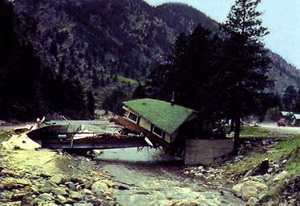
The Big Thompson Flood in 1976 claimed the lives of 143 Coloradoans in what is Colorado's deadliest natural disaster.

July 31, 1976 started like most other summer days in Colorado. It was 1976 and the nation was celebrating its bicentennial and Colorado was celebrating its centennial. What should have been a quiet summer day quickly turned disastrous as the Big Thompson Flood killed more than 100 people in Colorado’s deadliest natural disaster.

In terms of weather, the day started out much like one would expect but by late afternoon storm clouds loomed over the mountains. Mountain thunderstorms are an almost daily occurrence in Colorado but the storm that struck in the early evening that day was unlike any other.

With light winds aloft, the storm stalled over the upper portion of the Big Thompson basin where it sat dumping tremendous amounts of rain – nearly 8 inches in one hour and 12 inches over four hours. The rain came so fast that the water didn’t have time to be absorbed into the ground.

I’m stuck, I’m right in the middle of it, I can’t get out…about a half mile east of Drake on the highway. Get the cars out of the low area down below…
~ Radio transmission by Sergeant Willis Hugh Purdy, Colorado State Patrol. Purdy was never heard from again.

In the mid-sections of the canyon and lower, there was little indication of what was to come. The flash flood that resulted from the rain further up rushed down the canyon creating a wall of water that was 20 feet high in places. The flood scoured the canyon of everything – cars, homes, buildings and people.

The following day the Rocky Mountain News ran with the headline “Scores dead, hundreds hurt in Big Thompson flash flood.” A subheading said, “U.S. 34 west of Loveland is no more.”

When the flood was over, 143 people had lost their lives, more than in any other natural disaster in state history. 418 homes, 52 businesses and 400 cars were destroyed at a cost of over $40 million.

More coverage:

This story was originally published on the Denver Weather Examiner.  Be sure to visit Examiner.com for all the latest Denver and Colorado weather news and information.

A look at Denver and Thornton’s August weather

Denver and Thornton's August weather preview and history.

As summer vacations wind down and families prepare to send their kids back to school in August, Colorado weather also starts to settle down. The chances for severe weather decrease markedly during August and by the end of the month daytime temperatures are dropping quite a bit as well.

At the start of the month Denver usually averages around 88 degrees for a high temperature. By the end of August that drops to 82 degrees. Similarly, nighttime lows drop from 60 to 53 from the start to the end of the month.

Generally clear skies can be expected between midnight and noon but the afternoon often brings showers and thunderstorms. These storms typically develop over the foothills then bring precipitation to the Denver metro area.

Get all the details including complete statistics and a look back at August 2009 in our August weather preview here.

That’s a big chunk of ice! South Dakota hailstone sets world records

A massive hailstone with a diameter of 8 inches will likely set the record as the largest hailstone in terms of diameter and weight. (NWS)
A massive hailstone that fell in South Dakota on July 23rd set world records for diameter and weight. (NWS)

The massive hailstone that fell over rural South Dakota last week has officially set world records for its weight and diameter. According to the National Oceanic and Atmospheric Administration (NOAA) the chunk of ice easily eclipsed the previous record setter.

On Friday, July 23rd, severe weather rolled through northeastern South Dakota and Stanley, Jones, and Lyman counties. With it was massive hail so big it left holes in the ground the size of coffee cans. Les Scott, a ranch hand, recovered the now record setting stone afterwards.

NOAA’s National Climate Extremes Committee determined that the huge chunk of ice from the sky officially measured 8.0 inches in diameter and weighed 1.9375 pounds (1 pound, 15 ounces) setting records for both. It also measured 18.62 inches in circumference falling just short of breaking the record for that measurement.

The previous record holding hailstone in terms of weight fell on September 3, 1970 in Coffeyville, Kansas and weighed 1.67 pounds.

The stone that previously held the record for diameter measured 7 inches and fell in Aurora, Nebraska on June 22, 2003. That stone still holds the record for circumference having measured 18.75 inches.

While Scott froze it immediately, David Hintz, a meteorologist at NOAA’s Aberdeen weather forecast office, said in a statement some melting had probably occurred resulting in the official measurements being smaller than what the stone was when it first fell.

“Mr. Scott told me the area was littered with large hailstones and the largest had a greater diameter when he first found it. He immediately stored it and several others in his freezer, but a power outage caused some melting,” Hintz said.

South Dakota hail stone measures 8 inches in diameter – likely world record

A massive hailstone with a diameter of 8 inches will likely set the record as the largest hailstone in terms of diameter and weight. (NWS)

Hail is one of the most damaging weather events capable of doing thousands of dollars worth of damage to homes and vehicles and utterly shredding crops. Last week in South Dakota the mother of all hail stones appears to have fallen – a beast weighing nearly two pounds and measuring 8 inches in diameter.

On the evening of July 23rd severe weather rolled through the northeastern corner of South Dakota bringing with it a great deal of hail and some tornadoes. Near Vivian in Faulk County, the hail grew to proportions likely not seen anywhere else.

Ranch hand Les Scott watched the drama unfold as the hail pummeled the surrounding land. The stones were large enough that holes the size of coffee cans were left in the ground.

One particular hailstone caught Scott’s eye due to its sheer size. After retrieving it, he stuck it in his freezer. Word soon traveled about the massive chunk of ice and National Weather Service personnel made preliminary measurements placing the diameter at 8 inches with a circumference over 18 ½ inches.

Yesterday, the service returned to Vivian to transport the stone to the closest certified scale at the local post office to have it weighed. The scale tipped at an amazing 1.9375 pounds. It also had lost a bit in size dropping to 17 inches around.

Scott said the hailstone was quite a bit larger when he first found it, possibly as large as 11 inches in diameter. However, power was out in the area for six hours Friday and after he pulled it out to show various people, it lost some of its mass.

Continue reading South Dakota hail stone measures 8 inches in diameter – likely world record

Eastlake grain elevator added to the National Register of Historic Places

The Eastlake grain elevator, built not long after the turn of the last century, has been added to the National Register of Historic Places and the Colorado State Register of Historic Properties.  (ThorntonWeather.com)
The Eastlake grain elevator, built not long after the turn of the last century, has been added to the National Register of Historic Places and the Colorado State Register of Historic Properties. (ThorntonWeather.com)

The city of Thornton was founded in the 1950’s but it traces its roots much farther back than that.  In fact, one could go back to the late 1800’s / early 1900’s and the Eastlake area to find some of the first ‘settlers’ of where modern day Thornton sits.  Now, one of the original buildings from those early days has been named to a very auspicious list.

The old Eastlake grain elevator at 126th Ave and Claude Court was built around 1914 not long after the Post Office and was followed by schools, churches and other buildings that were part of a growing town. 

The grain elevator is one of the few remaining buildings from those early days and it has recently been named to the National Register of Historic Places and the Colorado State Register of Historic Properties.  

This is a great step in helping to preserve our quickly fading past and ThorntonWeather.com is excited the city is working to ensure the elevator remains as a visible reminder of our history. 

This past winter, we took some photos in the Eastlake area just after a fresh snowfall, some of which included the Eastlake grain elevator.  You can view them in the slideshow below.

Tornado that struck the Bronx rated an EF-1 with 100mph winds

A tornado that struck the Bronx in New York was rated an EF-1 on the Enhanced Fujita Scale. (ThorntonWeather.com)

A common myth is that tornadoes don’t strike cities. That myth was dispelled again this past Sunday when a twister packing 100 mph struck the Bronx in New York.

The tornado, rated an EF-1 by the National Weather Service (NWS), struck at 2:55pm. The service said that at its biggest the twister was 100 yards wide.

Initially touching down on the grounds of the Hebrew Home for the Aged on the east bank of the Hudson River, the tornado tore a path one half mile long. Seven people were injured by the storm and a variety of damage was documented by survey teams.

A flagpole was toppled as were numerous trees. Some large trees were stripped of their leaves.On West 254th Street across Netherlands and Arlington Streets “significant damage occurred.” One residential home sustained roof damage.

The National Weather Service this was only the second tornado to strike the Bronx since 1950. The first occurred on September 2, 1974.

From the National Weather Service:

PUBLIC INFORMATION STATEMENT
NATIONAL WEATHER SERVICE NEW YORK NY
216 PM EDT TUE JUL 27 2010

…TORNADO CONFIRMED NEAR NORTH RIVERDALE IN BRONX COUNTY NY…

LOCATION…NORTH RIVERDALE IN BRONX COUNTY NY
DATE…JULY 25 2010
ESTIMATED TIME…255 PM TO 300 PM EDT
MAXIMUM EF- SCALE RATING…EF1
ESTIMATED MAXIMUM WIND SPEED…100 MPH
MAXIMUM PATH WIDTH…100 YARDS
PATH LENGTH…0.6 MILES
BEGINNING LAT/LON…40.91N / 73.91W
ENDING LAT/LON…40.90N / 73.90W
* FATALITIES…0
* INJURIES…7

Weather, natural disasters & climate news and information.