July 25 to July 31 – This week in Denver weather history

July 25 to July 31 - This week in Denver weather history

Colorado’s unofficial severe weather season is during the months of May and June.  However, as we look back in Denver weather history, we see that July can oftentimes hold its own.  Many occurrences of flooding, scorching heat, and even tornadoes have been recorded.  Most notably, this week marks the 24th anniversary of the Big Thompson Flood – Colorado’s deadliest weather disaster ever.

7-25 

In 1934…a streak of 15 consecutive days of 90 degrees ranked 5th on the list of hot streaks.  The record of 24 consecutive days was established in the summer of 2008.

13-5 

In 2008…a streak of 24 consecutive days of 90 degrees shattered the previous record of 18 consecutive days established in 1901 and 1874.   Ironically…no new single day record high temperatures were set in the month of July. In August however…a record of 104 degrees was set on the 1st…and another record of 103 degrees was set on the 2nd. In addition…a record low min of 70 degrees was set on August 2nd.

18-2 

In 1987…a streak of 16 consecutive days of 90 degrees ranked 4th on the list of hot streaks.  The record of 24 consecutive days was established in the summer of 2008.

20-25

In 1965…heavy showers and thunderstorms doused metro Denver with significant rain each day.  Rainfall for the six days totaled 5.16 inches at Stapleton International Airport. Massive rainfall occurred on the 20th…21st…and 25th… Flooding streets and basements and causing streams to overflow.  The heaviest rainfall…2.05 inches…at Stapleton International Airport occurred on the 25th.

24-25

In 2003…maximum temperature of 100 degrees on the 24th was a record high for the date.  Low temperature of 73 degrees on the 25th was a record high minimum for the date.

25   

In 1875…brief heavy rain and hail lasted only 5 minutes… But the 1/4 inch diameter hail covered the ground to a depth of 1/2 inch and made the streets look like there had been snowfall.  There was much crop damage…especially to corn…and some sheep were killed.  Precipitation totaled 0.51 inch in the city.
 
Continue reading July 25 to July 31 – This week in Denver weather history

July 11 to July 17 – This week in Denver weather history

July 11 to July 17 - This week in Denver weather history

As we move further into summer, we see a decrease in traditional things associated with severe weather like tornadoes.  However, there is a corresponding increase in heavy rain as Colorado gets closer to its monsoon season.  We see many occurences of dangerous flooding as well as damaging hail, deadly lightning and more as we look back at this week in Denver weather history.

1-18 

In 1874…a streak of 18 consecutive days of 90 degrees tied for second with another streak that was later set in the summer of 1901. The record of 24 consecutive days was established in the summer of 2008.

6-23 

In 1901…a streak of 18 consecutive days of 90 degrees tied for second with another streak set in the summer of 1874. The record of 24 consecutive days was established in the summer of 2008.

7-25 

In 1934…a streak of 15 consecutive days of 90 degrees ranked 5th on the list of hot streaks.  The record of 24 consecutive days was established in the summer of 2008.

11

In 1872…heavy rainfall started at 4:00 pm and continued into the night.  The heavy rainfall damaged homes and buildings in all parts of the city.  Rainfall totaled 1.64 inches.
 
In 1888…the temperature reached 100 degrees in downtown Denver.
 
In 1954…the high temperature climbed to 102 degrees at Stapleton Airport.
 
In 1970…a girl walking in a park in southeast Denver received eye and facial injuries when lightning struck nearby.  Lightning also caused numerous power outages and heavy rainfall produced local flooding at several locations across metro Denver.
 
In 1974…large hail up to 1 1/2 inches in diameter fell in Thornton.
 
In 1990…the worst hailstorm in American history in terms of dollar damage at the time battered metro Denver.  Storm damage totaled 605 million dollars…as it cut a 5-to 10-mile wide swath from just southeast of Estes Park to northeast of Colorado springs.  Hail as large as baseballs (2.75 inches) pounded metro Denver.  Hardest hit areas were southeast Boulder County…the Jefferson County Airport in Broomfield… Arvada…east Wheat Ridge…southwest and south-central Westminster…west Thornton…northwest…west-central and downtown Denver…northeast and east-central Lakewood…just east of Littleton…portions of Arapahoe County west of I-25… And northern and central Douglas County near Castle Rock and franktown.  Golf ball to baseball size hail severely damaged roofs on thousands of homes and buildings…battered tens of thousands of automobiles…windows…signs…street lights…and traffic signals…stripped paint…awnings…and trim from buildings…punched holes in the roofs of two homes in Arvada…knocked out power and telephone service to thousands of homes and businesses…defoliated thousands of trees…ripped up greens and fairways on a number of golf courses…and severely damaged several aircraft tied down at Jefferson County Airport.  Hail the size of baseballs fell for several minutes in old town Arvada.  Later…golf ball size hail and heavy rain pummeled two northwest Denver amusement parks.  Hardest hit was Elitch Gardens amusement park where 47 people were injured and received treatment for bumps…cuts…and bruises at local hospitals.  Many of the injured were stranded on rides during the storm when power failed.  Hail clogged storm sewers…causing rain water to back up 3 to 6 feet deep on some roads and intersections in Arvada.  Several basements were flooded.  In some places hail was washed into drifts several feet deep.  In addition… The storm spawned 2 small tornadoes.  One touched down briefly in Lakewood near 6th avenue and Kipling Blvd….but did no damage.  In Castle Rock…a tornado (f1) did heavy damage to some homes and vehicles in the Founders Village development near Ridge Road.
 
In 2001…lightning struck two homes in Thornton.  Most of the damage was confined to the attics of both homes.  Hail as large as 3/4 inch in diameter fell in Keenesburg…Longmont… And near Boulder.

Continue reading July 11 to July 17 – This week in Denver weather history

South-central Alaska struck with magnitude 5.0 earthquake

A magnitude 5.0 earthquake struck north of Anchorage, Alaska on Wednesday evening. (USGS)

Alaska is one of the most seismically active parts of the United States and early Thursday morning residents near Anchorage received a reminder of that fact. A magnitude 5.0 temblor stuck in the evening hours on Wednesday and was felt across the south-central area of the state.

Centered 50 miles north-northwest of Anchorage, the quake struck at 07:15pm and according to the U.S. Geological Survey (USGS) was at a depth of 12.9 miles below the surface.

The service said it had received reports of the temblor being felt as far away as Palmer and Valdez to the east and Skwentna to the west. Residents of Anchorage and Seward to the south also felt the shaking.

Being along the Pacific Ring of Fire, Alaska regularly experiences earthquakes although most are small and not felt. The boundary of the North American and Pacific tectonic plates that runs through south-central Alaska and the Aleutian Islands is where most of the activity occurs.

The Alaska Earthquake Information Center (AEIC) says that the state receives from 50 to 100 earthquakes a day. Three of the 10 largest earthquakes recorded in the world, all larger than magnitude 7.9, have been recorded in Alaska.


For all the latest on earthquakes as well as other natural disasters including hurricanes, tornadoes, floods and more, please visit the Natural Disasters Examiner.

While the east roasts, the west chills – Record temperatures of both extremes in the U.S.

Record heat strikes the northeastern U.S. while southern California sees record low maximums.  Denver may see its own temperature record today. (Examiner.com)
Record heat strikes the northeastern U.S. while southern California sees record low maximums. Denver may see its own temperature record today. (Examiner.com)

Triple digit heat broiled the northeastern United States on Tuesday while record setting cool weather struck southern California. Denver may be next to see cool temperatures for the record books as the United States experiencing a wide variety of temperatures.

On the East Coast, temperatures exceeding 100 degrees struck from Virginia north to Massachusetts. Many of the temperatures recorded set new high temperature records for the date including:

  • Allentown, PA – 101 degrees (old record 100 degrees set in 1999)
  • Atlantic City, NJ – 102 degrees (old record 99 degrees set in 1999)
  • Baltimore, MD – 105 degrees (old record 101 degrees set in 1999)
  • Newark, NJ – 103 degrees (old record 102 degrees set in 1999)
  • New York City, NY (Central Park) – 103 degrees (old record 101 degrees set in 1999)
  • Philadelphia, PA – 102 degrees (old record 98 degrees set in 1999)
  • Warwick, RI – 102 degrees (old record 97 degrees set in 1999)
  • Wilmington, DE – 103 degrees (old record 98 degrees set in 1999)
  • Windsor Locks, CT – 102 degrees (old record 99 degrees set in 1999)

On the opposite coast of the nation, record low maximum temperatures were recorded from San Diego up to Riverside. Low pressure and a thick marine layer of clouds held temperatures down and residents that would normally be wearing shorts and tank tops traded that clothing for jeans and sweatshirts.

Among the tied or broken record low maximums recorded in southern California on Tuesday were:

  • Escondido – 69 degrees (old record 78 set in 1987)
  • Laguna Beach – 62 degrees (old record 68 set in 1968)
  • Newport Beach – 66 degrees (tied record of 66 last set in 1995)
  • Oceanside Harbor – 62 degrees (old record 65 set in 2002)
  • Riverside – 79 degrees (old record 80 set in 1969)
  • San Diego – 65 degrees (tied record of 65 last set in 1912)

On Wednesday, both the northeastern United States and southern California may see those record-setting temperature trends continue.

Denver also stands a chance to see a record setting low maximum today. The forecast for Denver International Airport where Denver’s official temperature measurements are now taken is for a high of 63 degrees today. The current record low maximum is 65 degrees last set in 1952.  Here in Thornton we will see similar temperatures.

Denver records its wettest 4th of July ever; Record draws attention to climate data problems

According to the National Weather Service, record-setting rain fell in Denver on the 4th of July.  But is it accurate to say that? (ThorntonWeather.com)
According to the National Weather Service, record-setting rain fell in Denver on the 4th of July. But is it accurate to say that? (ThorntonWeather.com)

Heavy rain showers put a damper on a lot of Independence Day celebrations yesterday.  Thunderstorms moved across the Front Range dumping rain and hail across northeastern Colorado with enough rain falling to set a record for the 4th of July.

At Denver International Airport (DIA), 1.84 inches of rain was recorded.  This easily eclipses the old 4th of July record dating back to 1909 when 1.44 inches fell. 

Here in Thornton we weren’t nearly as wet having recorded 0.81 inches for the storms that moved through.  Some of the other rainfall totals from across the metro area:

  • Arvada: 0.89 inch
  • Aurora: 0.86 inch
  • Broomfield: 0.57 inch
  • Castle Rock: 0.71 inch
  • Conifer: 0.31 inch
  • Centennial:  1.01 inches
  • Denver (north): 0.51 inch
  • Littleton: 0.26 inch
  • Longmont: 0.43 inch

Denver, we have a problem

The rain totals at DIA were impressive however comparing them to the other amounts recorded at stations across the metro area once again highlights problems with Denver’s climate records.  As we have discussed before on Examiner.com, moving Denver’s official monitoring station to DIA is forever altering climate records

The rain yesterday was heavy in places but nowhere in the central Denver area measured anywhere near the amount DIA recorded (see map below).   When the National Weather Service (NWS) announces a “record” like the rain yesterday, it is comparing the measurements at DIA to historical records taken at the old Stapleton International Airport from 1950 to 1995 and downtown from 1871 to 1949. 

Is it accurate to claim a weather record when the station doing the recording is 12 miles away from where historical records were made?  Of course not and this is a problem.   

Last year the NWS partially conceded to the problem and installed an official monitoring station in Denver City Park.  Denver’s official records however still come from the station at DIA. 

The National Weather Service either needs to start recording Denver’s official statistics from the new station or it needs to quit comparing data from DIA to that recorded before the move in 1995. 

Denver’s climate records are forever being altered and the public is being misled. 

The National Weather Service recorded 1.84 inches of rain at the official monitoring station at DIA on Sunday, July 4, 2010.  No other station in the area recorded near this amount though. (MesoWest / ThorntonWeather.com)

July 4 to July 10 – This week in Denver weather history

July 4 to July 10 – This week in Denver weather history

As we pointed out in our July weather preview, the month is not only our hottest but it is also the stormiest.  Scorching summer heat is certainly evident when we look back at this week in Denver weather history.  Perhaps more notable is the severe weather we have seen with everything from hail, damaging wind, dangerous lightning and deadly flooding having occurred.

29-15

In 2000…the 29th marked the beginning of a near record hot streak for metro Denver.  The high temperatures…as recorded at Denver International Airport…exceeded the 90 degree mark for 17 consecutive days from June 29th through July 15th. The record of 24 consecutive 90 degree or above days was set from July 13th through August 5th…2008.

1-18 

In 1874…a streak of 18 consecutive days of 90 degrees tied for second with another streak that was later set in the summer of 1901. The record of 24 consecutive days was established in the summer of 2008.

4

In 1874…the temperature reached a high of 102 degrees in downtown Denver.  Large forest fires in the mountains from the west-northwest to the south filled the atmosphere over the city with dense smoke.
 
In 1885…a thunderstorm produced sustained winds to 44 mph with gusts to 60 mph.  A circus tent was tattered by the strong winds.
 
In 1900…a thunderstorm produced northwest winds sustained to 42 mph with gusts to 51 mph…but only 0.05 inch of rain.
 
In 1903…the all time lowest temperature ever recorded in July…42 degrees…occurred. The temperature also occurred on July 31…1873.
 
In 1910…thunderstorm winds were sustained to 42 mph from the southwest.
 
In 1922…thunderstorm winds were sustained to 37 mph with gusts to 48 mph.
 
In 1956…a thunderstorm wind gust to 54 mph was recorded at Stapleton Airport.
 
In 1964…several men were knocked down by a bolt of lightning while playing golf in south metro Denver.  They got up and ran for cover when one of them was struck by a second bolt. He suffered burns and shock.
 
In 1987…a weak tornado was observed for 6 minutes…7 miles northeast of Watkins.  Hail 3/4 to 1 1/4 inches in diameter fell in southeast Aurora.
 
In 1988…lightning struck a group of people at the Jefferson County fairgrounds.  A 42-year-old woman was seriously injured and was hospitalized for 3 days.  Four other people sustained minor injuries.
 
In 1993…strong northwest winds uprooted several trees across metro Denver.  Wind gusts to 64 mph were reported at Erie north of Denver.  A west wind gust to 43 mph was recorded at Stapleton International Airport.
 
In 1995…lightning struck and injured two people standing in a field in Arvada.
 
In 1998…heavy thunderstorm rain…up to 2.75 inches…and marble size hail combined to flood local roads and fields near Roggen.
 
In 2002…heavy thunderstorm rain in the Hayman Fire burn area caused flash flooding.  In Jefferson County…gulch road was washed out.  In Douglas County…high water washed out some forest access roads as well…generally to the east of a line extending from signal butte to Deckers.

Continue reading July 4 to July 10 – This week in Denver weather history

A hot Saturday but much cooler weather on tap for Independence Day

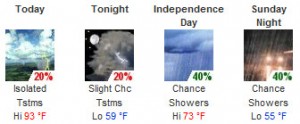
Thornton's weather forecast for the Independence Day weekend.
Thornton's weather forecast for the Independence Day weekend as of Saturday morning. Follow the link in the story for the latest forecast.

The holiday weekend is upon us and the weather looks to be a bit of a mixed bag. Plenty of heat will be on tap Saturday but the weather changes considerably on Independence Day, threatening those fireworks shows.

For Saturday, we have a day much like we saw yesterday. Partly cloudy skies will be overhead with high temperatures reaching the low to mid-90’s. This afternoon brings with it a slight chance for isolated thunderstorm and shower activity. Right now, we aren’t expecting any of those storms to turn severe in the metro area.

Independence Day is of course the big day as we celebrate the 234th birthday of our Great Nation. An upper level trough will be moving through late tonight and through Monday and with it comes cooler temperatures and increased chances of moisture.

Highs on Sunday look to be considerably cooler and only in the low to mid-70’s under mostly cloudy skies. The concern right now is the increased chance for rain showers that is expected to arrive in the afternoon and threatens to put a damper on fireworks shows. This will bear watching so check back tomorrow for an update.

On Monday we start to rebound a bit from the cooler weather but temperatures will remain below normal. Highs will be in the low to mid-80’s under partly cloudy skies and a slight chance for thunderstorms.

The balance of next week looks to continue a cooler-than-normal trend with temperatures hovering around 80 Tuesday through Thursday.

June 27 to July 3 – This week in Denver weather history

June 27 to July 3 - This week in Denver weather history

Closing out June and entering July our look back at this week in Denver weather history is marked by severe weather and scorching heat.  Damaging hail to dangerous lightning are two common occurrences as is record-setting heat waves.

From the National Weather Service:

21-3 

In 2002…the maximum temperature in Denver equaled or exceeded 90 degrees for 13 consecutive days…equaling the 5th longest such streak on record.  The record of 18 consecutive days was set during the summer of 1901.

26-27

In 1965…wind gusts to 38 mph were recorded in downtown Boulder…causing widespread minor damage.  A microburst wind gust to 41 mph was recorded at Stapleton International Airport.

27

In 1873…Pikes Peak was hidden from view by smoke from forest fires in the mountains to the southwest of the city.
 
In 1927…the temperature cooled to a low of only 72 degrees… The all-time record high minimum for the month.
 
In 1980…lightning injured 4 people on a baseball diamond in Broomfield.  The bolt seriously injured the pitcher while also striking (out) the batter…catcher and second baseman.
 
In 1987…a microburst wind gust to 53 mph was recorded at Stapleton International Airport.
 
In 1990…the temperature reached a high of 102 degrees… Setting a new record maximum for the date.
 
In 1993…thunderstorm winds gusted to 60 mph across parts of metro Denver.  A wind gust to 50 mph blew over a 30-foot canvas tent at an amusement park southeast of Denver. Fifteen people…mostly children…were injured.  Microburst wind gusts to 33 mph were recorded at Stapleton International Airport.
 
In 2002…heavy rain…up to 3/4 inch…fell across sections of the Hayman burn area near Cheeseman Reservoir.  Several forest service roads were washed out and many culverts were plugged by debris.
 
In 2004…heavy rain producing thunderstorms caused rock and mud slides across the overland fire burn area in Jamestown. An estimated 50 tons of sand…dirt…rock…and ash slid into town…filling a culvert under main street.  The slide covered 150 to 225 feet of Main Street.  The flood was produced by half an inch of rain in 30 minutes.  A deluge of very heavy rainfall from nearly stationary thunderstorms caused flooding and flash flooding problems over parts of Jefferson and Douglas counties.  An automated rain gage in Golden measured 3.60 inches of rainfall in one hour.  Numerous homes were flooded in Golden…including one that was 146 years old. The home was listed as a complete loss.  State Highway 93 had to be closed from the Pine Ridge subdivision to the Golden Gate Canyon Road.   At the height of the storm…about 4 feet of water covered State Highway 93 through Golden… Forcing its temporary closure.  Several intersections were also flooded and impassable.  Rock and mud slides were reported in Golden Gate Canyon State Park.  At the Deer Creek Golf Course at Colorado 470 and Kipling…the greens were completely inundated by floodwaters.  Some backyards near the golf course were partially washed out.  In Douglas County…water up to a foot deep covered the roadways in Roxborough State Park.  The Waterton Canyon Road also had to be closed due to high water.

Continue reading June 27 to July 3 – This week in Denver weather history

Tropical Storm Alex threatens Gulf of Mexico oil spill cleanup

Satellite image of Tropical Storm Alex as it prepares to cross the Yucatan Peninsula. (NOAA / Google Earth)  Click the image for a complete slideshow of the storm and its forecast path.
Satellite image of Tropical Storm Alex as it prepares to cross the Yucatan Peninsula. (NOAA / Google Earth) Click the image for a complete slideshow of the storm and its forecast path.

The first named storm of the 2010 hurricane season is being watched closely by not only areas at threat from landfall but also those working to clean up the Gulf oil spill. Tropical Storm Alex continued to move to the northwest where it threatens to find warmer water and become a hurricane.

The National Hurricane Center (NHC) places the center of Alex at the current time 75 miles east of Belize City. The storm is packing winds of 45 mph and moving to the west-northwest at 9mph.

On its current path, Alex will reach the coast of Belize and the Yucatan Peninsula late today and move across the peninsula on Sunday. By Sunday night or early Monday morning, it will have transited land and emerge in the Bay of Campeche.

Get all the latest on Tropical Storm Alex including amazing satellite animation video, forecasts and more from the Natural Disasters Examiner.

June 20 to June 26 – This week in Denver weather history

June 20 to June 26 - This week in Denver weather history

Late June weather is usually relatively calm but when it turns severe, it can do so in spades.  Hail, flooding rains, tornadoes and more are not unusual.  This week in Denver weather history we see plenty of each of those including a hail storm in 1993 that damaged dozens of planes at Denver International Airport. 

19-21

In 1875…smoke from several large forest fires in the mountains was visible from the city on each of these days.

20

In 1888…northwest winds were sustained to 44 mph.
 
In 1956…a microburst caused a brief wind gust to 58 mph at Stapleton Airport.
 
In 1964…hail up to 1 inch in diameter was reported 1 mile north of Stapleton International Airport.  A 3 minute hail storm at both Stapleton International Airport and Lowry Field piled small hail to one half inch deep.
 
In 1967…a strong thunderstorm dumped 1.95 inches of rain in less than an hour at Stapleton International Airport and produced a wind gust to 54 mph.  The storm caused some flooding in east Denver and Aurora.  There was widespread flooding to streets…basements…and store buildings and automobiles.  Hail stones to 3/4 inch in diameter were measured at Buckley Field in Aurora.  A tornado touched down just south of Littleton…damaging a barn and killing several head of cattle.
 
In 1985…a wind gust to 61 mph was reported at Golden Gate Canyon in the foothills west of Denver.
 
In 1986…a man was killed by lightning at Highlands Ranch south of Denver.
 
In 1987…several tornadoes were sighted across metro Denver.  A tornado touched down briefly 5 miles west of Parker.  A tornado was sighted just north of Chatfield Reservoir.  A tornado just northwest of Watkins was on the ground for 15 minutes.  A tornado near Barr Lake was taped by a television news crew.  It had a double vortex and was on the ground for about 10 minutes.  In addition to the 4 tornadoes…severe thunderstorms dumped large hail across metro Denver.  One inch hail was reported in southeast Aurora; 3/4 inch hail fell at the Denver technology center…Buckley Field…and Franktown.
 
In 1992…several short-lived tornadoes occurred in the vicinity of Barr Lake.  No injuries or damages were reported.  A water spout was sighted over the southern end of Barr Lake.  Funnel clouds were also sighted on the grounds of the rocky mountain arsenal by national weather service observers at Stapleton International Airport.
 
In 1994…hail up to dime size covered I-25 south of Denver and near Sedalia.  Heavy rain caused local flooding on the interstate highway.
 
In 1996…strong thunderstorm winds downed several large tree limbs in Boulder on the University of Colorado campus.  A stop light in the city was also blown down.
 
In 1999…lightning sparked an oil tank fire near Brighton.
 
In 2001…large hail driven by strong thunderstorm winds raked Denver international and Front Range airports.  Wind gusting to 54 mph along with hail as large 2 inches in diameter punched at least 14 thousand holes and cracks in the flat roofs of several buildings at Denver International Airport. In addition…93 planes and hundreds of cars were damaged. About 100 flights had to be cancelled…stranding 1500 travelers.  The airport was completely shut down for about 20 minutes.  The storm also damaged a ground avoidance radar used to track planes on the ground to prevent collisions. Damage was estimated at 10 million dollars…not counting the damage to the 93 airliners.  The storm moved south and struck Watkins with hail as large as 2 1/2 inches in diameter and winds gusting to 60 mph.  A least 30 private planes at Front Range airport were destroyed.  The radome protecting the national weather service doppler radar…which was tracking the storm…also sustained damage.  The large hail…damaging winds…and heavy rain pummeled a mobile home park near Watkins.  In the park…52 mobile homes…14 recreational vehicles…3 homes…and a commercial building were damaged.  Siding was riddled with holes and windows were broken.  Vehicles sustained extensive damage and car windows were shattered.  A handful of people were treated for minor cuts and bruises.  The strong winds also flipped a tractor trailer along I-70 near Watkins.  The storm caused power outages…which affected about 1200 residents. Excluding the damage at Denver International Airport…damage estimates totaled 49 million dollars…making the storm the costliest in the last 3 years and the 10th costliest since 1984.  A small tornado touched down just east of Brighton… But did no damage.  Hail as large as 2 inches in diameter fell near Fort Lupton with 3/4 inch hail measured in Bennett.  Precipitation from the storm totaled only 0.23 inch at Denver International Airport.
 
Continue reading June 20 to June 26 – This week in Denver weather history

Weather, natural disasters & climate news and information.