President Barack Obama’s former campaign organization turned political action committee called this month ‘Action August.’ When it comes to climate change however, not many are inclined to take action as demonstrated by a distinct lack of attendees at an event yesterday in Washington D.C. Read the rest of this story about the embarrassing turn out on Examiner.com
Many folks noticed the lack of new stories post last week other than a photo or two on our Facebook page. We took the week off for some much needed R & R and were able to enjoy one of our favorite parts of the state.
The image below was taken in Gunnison National Forest a little ways north of Taylor Reservoir. In the foreground is Lilly Pond, in the background the Collegiate Peaks.
The stunning greens and blues truly were as bright as the image shows. While rain was far too prevalent for our liking during our time in the area, the scenery was amazing.
Lilly Pond and the Collegiate Peaks in Gunnison National Forest (ThorntonWeather.com). Click for a larger view.
Following two hot and dry months in May and June, July brought some relief in the form of near normal temperatures and precipitation.
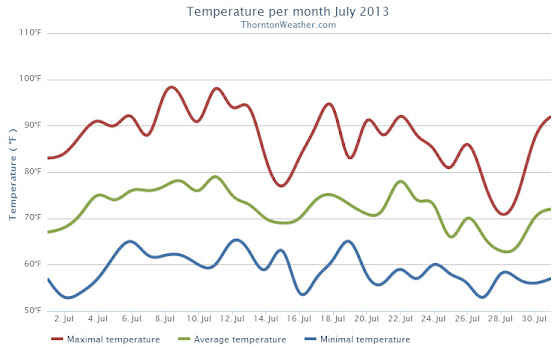
Cooler than normal temperatures started the month during the first couple of days of July. That changed for the following 10 days when temperatures bounced to above normal levels with Thornton recording eight 90+ degree days during the period.
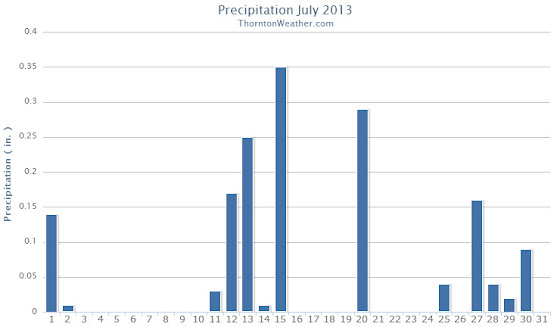
The next few days from the 14th to the 16th brought much cooler conditions and much-needed precipitation. Seasonal temperatures then settled in through the 23rd. As the month came to a close, temperatures became more moderate and we even saw three days (the 27th, 28th, and 29th) with highs in the 70s. Most notably we once again saw some precipitation.
Thornton saw an average temperature during July of 72.1 degrees. This was a good bit below the long term Denver historical average of 74.3 degrees. Officially at DIA the average temperature for the month was 74.2 degrees.
We recorded 14 days with temperatures at or equal to 90 degrees. Temperatures ranged from a high of 98.5 degrees on the 11th down to a low of 52.6 degrees on the 27th.
A reasonable 1.61 inches of precipitation fell into Thornton’s rain bucket during the month. This was a bit below the average for July of 2.16 inches. Out at the airport, Denver fared a bit better with 1.98 inches.
Thornton, Colorado July 2013 Temperatures.Thornton, Colorado July 2013 Precipitation.
CLIMATE REPORT
NATIONAL WEATHER SERVICE BOULDER, CO
210 AM MDT THU AUG 1 2013

...THE DENVER CO CLIMATE SUMMARY FOR THE MONTH OF JULY 2013...

CLIMATE NORMAL PERIOD 1981 TO 2010
CLIMATE RECORD PERIOD 1872 TO 2013

WEATHER         OBSERVED          NORMAL  DEPART  LAST YEAR`S
                 VALUE   DATE(S)  VALUE   FROM    VALUE  DATE(S)
                                          NORMAL
................................................................
TEMPERATURE (F)
RECORD
 HIGH             105   07/20/2005
 LOW               42   07/04/1903
                        07/31/1873
HIGHEST           100   07/11       105      -5      102  07/21
LOWEST             55   07/02        42      13       57  07/26
AVG. MAXIMUM     88.2              89.4    -1.2     94.4
AVG. MINIMUM     60.4              58.9     1.5     63.4
MEAN             74.3              74.2     0.1     78.9
DAYS MAX >= 90     17              16.0     1.0       27
DAYS MAX <= 32      0               0.0     0.0        0
DAYS MIN <= 32      0               0.0     0.0        0
DAYS MIN <= 0       0               0.0     0.0        0

PRECIPITATION (INCHES)
RECORD
 MAXIMUM         6.41   1965
 MINIMUM         0.01   1901
TOTALS           1.98              2.16   -0.18     0.48
DAILY AVG.       0.06              0.07   -0.01     0.02
DAYS >= .01         7               8.3    -1.3        6
DAYS >= .10         4               4.3    -0.3        2
DAYS >= .50         2               1.4     0.6        0
DAYS >= 1.00        0               0.7    -0.7        0
GREATEST
 24 HR. TOTAL    0.87   07/15 TO 07/15           07/06 TO 07/07
                        07/14 TO 07/15                    07/31 TO 07/31
                        07/15 TO 07/15                    07/31 TO 07/31
 STORM TOTAL       MM                                 MM
 (MM/DD(HH))            MM                    07/07(00) TO 07/07(00)
                                                 07/31(00) TO 07/31(00)1
                                                 07/31(00) TO 07/31(00)1

SNOWFALL (INCHES)
RECORDS
 TOTAL             MM   MM
TOTALS            0.0               0.0

DEGREE_DAYS
HEATING TOTAL       0                 6      -6        0
 SINCE 7/1          0                 6      -6        0
COOLING TOTAL     295               289       6      438
 SINCE 1/1        558               444     114      803

FREEZE DATES
RECORD
 EARLIEST     09/08/1962
 LATEST       06/08/2007
EARLIEST                        10/07
LATEST                          05/05
..................................................

WIND (MPH)
AVERAGE WIND SPEED              10.3
RESULTANT WIND SPEED/DIRECTION   3/163
HIGHEST WIND SPEED/DIRECTION    45/050    DATE  07/20
HIGHEST GUST SPEED/DIRECTION    58/040    DATE  07/20

SKY COVER
POSSIBLE SUNSHINE (PERCENT)   MM
AVERAGE SKY COVER           0.60
NUMBER OF DAYS FAIR            5
NUMBER OF DAYS PC             24
NUMBER OF DAYS CLOUDY          2

AVERAGE RH (PERCENT)     50

WEATHER CONDITIONS. NUMBER OF DAYS WITH
THUNDERSTORM              0     MIXED PRECIP               0
HEAVY RAIN                2     RAIN                       3
LIGHT RAIN               13     FREEZING RAIN              0
LT FREEZING RAIN          0     HAIL                       0
HEAVY SNOW                0     SNOW                       0
LIGHT SNOW                0     SLEET                      0
FOG                       6     FOG W/VIS <= 1/4 MILE      1
HAZE                     13

-  INDICATES NEGATIVE NUMBERS.
R  INDICATES RECORD WAS SET OR TIED.
MM INDICATES DATA IS MISSING.
T  INDICATES TRACE AMOUNT.
In this rare image taken on July 19, 2013, the wide-angle camera on NASA’s Cassini spacecraft has captured Saturn’s rings and our planet Earth and its moon in the same frame. Scroll down for a larger image or click to view the full size image. (NASA/JPL-Caltech/Space Science Institute)
Launched in 1997, NASA’s Cassini space probe arrived in Saturn orbit in 2004 and has provided valuable insight into the sixth planet in our solar system as well as others. On July 19 of this year the spacecraft took an extraordinary image of our home planet and moon as seen from nearly 900 miles away.
The image captured the planet around which Cassini is orbiting, its infamous rings and off in the distance, the planet Earth and our moon. The pale blue hue of our planet is almost unmistakable among the features in the photo. It truly does make one feel small when compared to the immensity of the heavens above.
“In the Cassini images Earth and the moon appear as mere dots — Earth a pale blue and the moon a stark white, visible between Saturn’s rings. It was the first time Cassini’s highest-resolution camera captured Earth and its moon as two distinct objects.
“It also marked the first time people on Earth had advance notice their planet’s portrait was being taken from interplanetary distances. NASA invited the public to celebrate by finding Saturn in their part of the sky, waving at the ringed planet and sharing pictures over the Internet. More than 20,000 people around the world participated.
“”We can’t see individual continents or people in this portrait of Earth, but this pale blue dot is a succinct summary of who we were on July 19,” said Linda Spilker, Cassini project scientist, at NASA’s Jet Propulsion Laboratory in Pasadena, Calif. “Cassini’s picture reminds us how tiny our home planet is in the vastness of space, and also testifies to the ingenuity of the citizens of this tiny planet to send a robotic spacecraft so far away from home to study Saturn and take a look-back photo of Earth.”
“Pictures of Earth from the outer solar system are rare because from that distance, Earth appears very close to our sun. A camera’s sensitive detectors can be damaged by looking directly at the sun, just as a human being can damage his or her retina by doing the same. Cassini was able to take this image because the sun had temporarily moved behind Saturn from the spacecraft’s point of view and most of the light was blocked.”
In this rare image taken on July 19, 2013, the wide-angle camera on NASA’s Cassini spacecraft has captured Saturn’s rings and our planet Earth and its moon in the same frame. Click to view the full size image. (NASA/JPL-Caltech/Space Science Institute)
Thornton 8 is now available for live, online streaming on the city’s website and ThorntonWeather.com. (City of Thornton)
The City of Thornton’s KTTV-8 television channel can be a great resource for information as to what is going on in our fine city. Unfortunately watching the channel required you subscribed to Comcast cable – until now.
We were browsing the city’s website today and noticed they have added a live Internet feed of the channel. This is a great development and one that allows all Thornton residents with Internet access to view the station and get the latest city news and information.
Alternatively, we have added a page on our website where you can watch the live feed. You will find it under the ‘Area Information’ button to the left or click here to view it.
Please note: ThorntonWeather.com is not endorsed by or an official website of the City of Thornton.
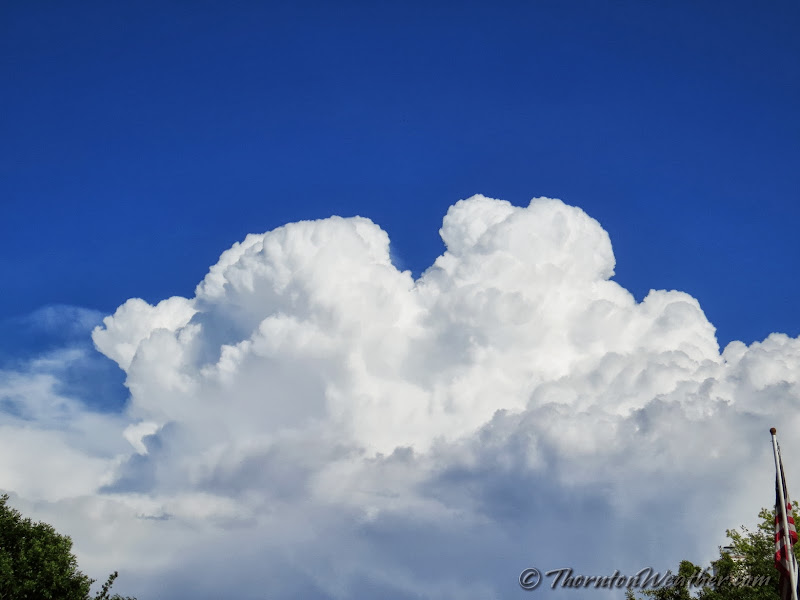
A view of the thunderstorm on Saturday, July 20, 2013 after it passed Thornton. View more imagery in the slideshow below. (ThorntonWeather.com)
The forecast called for a chance for thunderstorms and Mother Nature obliged on Saturday. Heavy rain and gusty winds struck the north metro area but what followed was perhaps more interesting.
In all, Thornton recorded 0.29” of rain in a very short period from 4:30 to 4:55pm. Some small hail accompanied the storm as did strong wind gusts. There were some reports of broken tree limbs from the powerful gusts.
After the storm moved to the southeast, it continued to intensify. From almost any vantage point in Thornton, the scene was amazing.
Initially the bright while tops of the storm cells were stark and beautiful to watch. A nearly full moon then began to rise in the east behind the storms and the scene was stunning. As the sun went down, the clouds turned a shade of amber providing a colorful scene with the rising moon.
The slideshow below has a nice little compilation of image taken by ThorntonWeather.com and some of our fans on Facebook.
Colorado lived up to its ranking as one of the most dangerous states in the union for lightning as 13 people were injured by bolts on Thursday. Afternoon thunderstorms unleashed the flashes causing the injuries across three locations. Read the rest of this story on Examiner.com
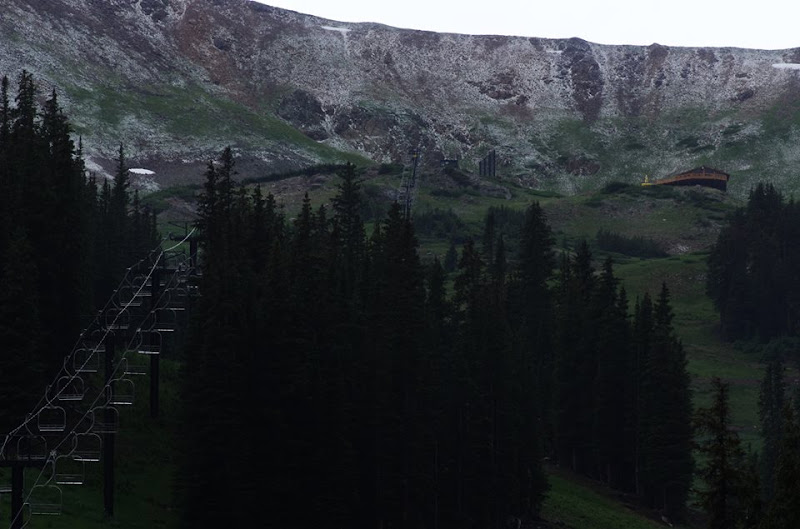
July 18, 2013 – Loveland Ski Area received a dusting of snow. While a bit unusual in mid-summer, certainly not unheard of given an altitude at the base of 10,800 feet. (Loveland Ski Area)
At an altitude of 10,800 feet, Loveland Ski Area is certainly in some rarified air. Yesterday the resort saw a dusting of snow while Colorado residents below in the Mile High City simmered in 90+ degree temperatures.
Snowfall can occur in Colorado’s high country any time of year, even in mid-summer, and yesterday’s event was not particularly unusual.
Here in Denver however there has never officially been snow in July. The key word though is ‘officially.’
Unofficially there has been snow in the Mile High City in July – almost exactly one year ago today in fact.
Check out this tidbit from the National Weather Service archives:
“On July 17, 1872…the U.S. Army Signal Service weather observer recorded snowfall during the early morning hours in the hand written daily weather journal: “rain commenced at 1:30 a.m. changing about 3 a.m. to snow & in about half an hour to rain again; it continued until 6 a.m.” This is the only recorded occurrence of snowfall in Denver in July…but this report is not included in the “official” station snowfall records…which did not begin in Denver until January 1…1882. The low temperature on this morning was 45 degrees…which is sufficiently cold for the occurrence of light stratiform snowfall.”
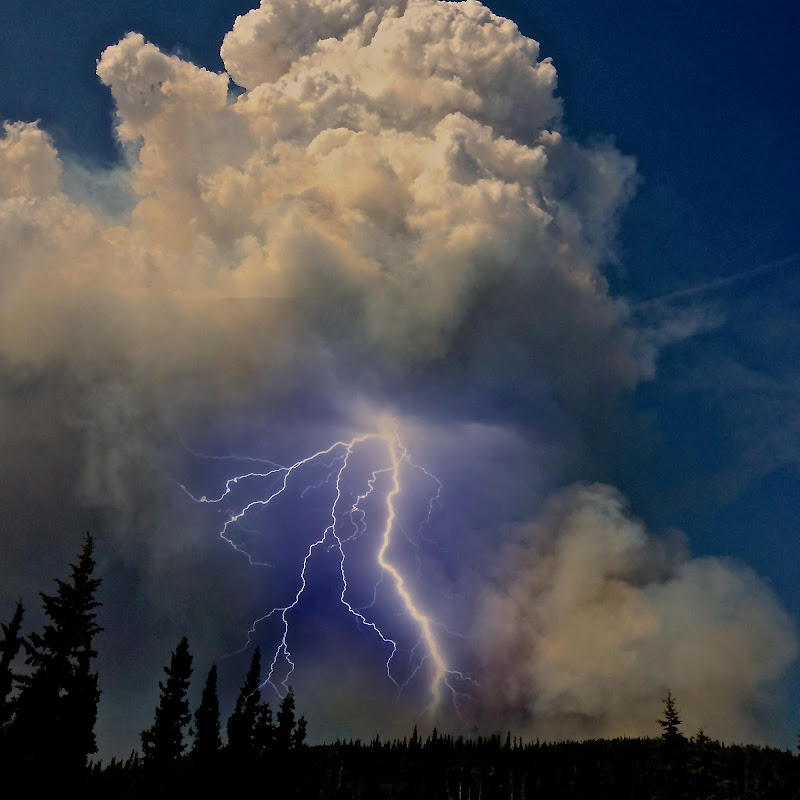
Weather of course clearly affects wildfires but fires themselves can literally create their own weather. One such phenomena are pyrocumulus clouds and a photo from a wildfire in Alaska provides a stunning example.
Pyrocumulus clouds are formed by fires or volcanos when the intense heat from the event rises from the surface. These clouds oftentimes look like dirty thunderstorm clouds directly over a blaze and can give rise to thunderstorm-like weather conditions.
Lightning from these clouds can occur and in particular when coupled with a volcanic eruption are absolutely amazing. With wildfires, the strong winds and lightning can result in dangerous and unpredictable expansion of a fire.
The Moon Lake Complex Fire is currently burning in eastern Alaska and has scorched over 18,000 acres. Inciweb posted a photo of a pyrocumulus cloud over the blaze near Tok that let loose a stunning bolt of lightning.
June 2, 2013 – A pyrocumulus cloud above the Moon Lake Complex Fire in Alaska unleashes a lightning bolt. (Inciweb)
Weather, natural disasters & climate news and information.