Tornado outbreak hits seven states, kills at least 18 in the South

A screen capture from video shot by a civilian drone shows the devastation caused by a tornado in Mayflower, Arkansas. (YouTube / briandjin2)

Tornado activity in the United States had been at record low levels before this weekend. Mother Nature came roaring back to life Sunday however spawning a deadly outbreak of twisters with more expected Monday.

The National Weather Service’s Storm Prediction Center accumulated reports of 31 tornadoes Sunday although the actual number will likely be less once analyzed. Seven states including Nebraska, Iowa, Kansas, Arkansas, Oklahoma, Louisiana, and Mississippi reported twisters.

Hardest hit were the towns of Mayflower and Vilonia near Little Rock, Arkansas. Entire sections of the towns were reduced to their base building materials as the twisters struck late in the day Sunday.

Read the rest of this story on Examiner.com

Video: NASA showcases weather and climate events of 2013 as seen from space

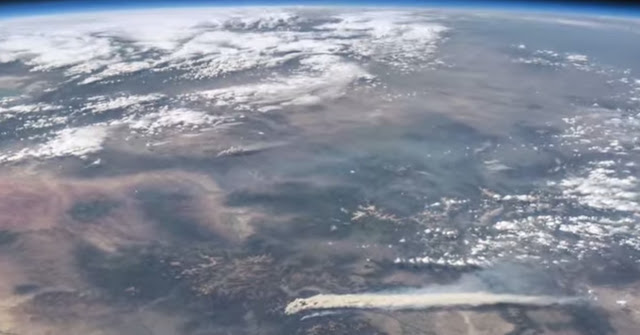
A scene from a new NASA video shows Colorado’s West Fork Fire in June 2013 among other area weather and climate events. (NASA / YouTube)

A stunning video released by NASA this week provides a bird’s eye view of some of the Earth’s most significant weather and climate events of last year.

Using images and movies from satellites and the International Space Station, scenes from across the globe are shown in the video titled “Earth from Orbit 2013.”

Colorado and surrounding states however will draw the most attention from many locally.

From their perch high above, imagery of Colorado’s West Fork Fire in June 2013 is seen as well as the effects of the September floods.

To our south, the drought in New Mexico is seen having taken its toll on Elephant Butte Reservoir in New Mexico.  The veritable explosion of storm cells that lea to devastation in Oklahoma during a May tornado outbreak are also shown.

Below the video you will find a description of each scene and links to more imagery.

From NASA – Published on Apr 21, 2014:

A fleet of orbiting satellites monitors Earth constantly. The satellites from NASA and other space agencies give us a fresh, wide perspective on things that we can see from the ground — and things that we can’t.

A look back at Earth in 2013 from the viewpoint of orbit reveals the kind of data gathering and technical achievement that are the reason NASA puts Earth-observing satellites in space. A visualization of satellite and computer model data shows how a cloud of dust from the Chelyabinsk meteor moved around the world. NASA satellites measured the intensity of wildfires, the salinity of the oceans and rainfall around the globe — whether it was too little or too much.
To learn more about NASA’s Earth science in 2014, please visit: www.nasa.gov/earthrightnow

Imagery used in this video, in order:
Views of a Distant Earth
http://earthobservatory.nasa.gov/IOTD…

Earth and Moon
http://svs.gsfc.nasa.gov/vis/a000000/…

Current Earth Observing Fleet
http://svs.gsfc.nasa.gov/vis/a030000/…

Term3_ISS From Night to Day to Night Again
http://eol.jsc.nasa.gov/Videos/CrewEa…

Astronaut View of Fires in Colorado
http://earthobservatory.nasa.gov/Natu…

Extensive Ice Fractures in the Beaufort Sea
http://earthobservatory.nasa.gov/IOTD…

Dune Movement Around Aorounga
http://earthobservatory.nasa.gov/IOTD…

San Francisco Region at Night
http://earthobservatory.nasa.gov/IOTD…

Whiting Event, Lake Ontario
http://earth.jsc.nasa.gov/debrief/ISS…

Dust Plumes over the Mediterranean
http://earthobservatory.nasa.gov/Natu…

Mt. St. Helens
http://earthobservatory.nasa.gov/IOTD…

El Paso
http://earthobservatory.nasa.gov/IOTD…

Close-Up of Flooding in Mozambique
http://earthobservatory.nasa.gov/IOTD…

Drought Dries Elephant Butte Reservoir
http://earthobservatory.nasa.gov/IOTD…

Oklahoma Tornadoes
http://earthobservatory.nasa.gov/Natu…

Floods in Colorado
http://earthobservatory.nasa.gov/Natu…

Pavlof Volcano
http://earthobservatory.nasa.gov/Natu…

Swirling Sediment Reveals Erosive Power of New England Storm
http://earthobservatory.nasa.gov/IOTD…

Never at Rest: The Air over Los Angeles
http://svs.gsfc.nasa.gov/vis/a000000/…

Measuring Soil Moisture from Space
http://svs.gsfc.nasa.gov/vis/a030000/…

Antarctic Bedrock
http://svs.gsfc.nasa.gov/vis/a000000/…

Seeing Photosynthesis from Space
http://svs.gsfc.nasa.gov/vis/a010000/…

Greenland’s Mega Canyon
http://svs.gsfc.nasa.gov/vis/a000000/…

Chelyabinsk Bolide Plume as seen by NPP and NASA Models
http://svs.gsfc.nasa.gov/vis/a000000/…

Narrated Distributed Water Balance of the Nile Basin
http://svs.gsfc.nasa.gov/vis/a010000/…

NEO Observations (various)
http://svs.gsfc.nasa.gov/cgi-bin/advs…

Total lunar eclipse to bring ‘blood moon’ on Tax Day

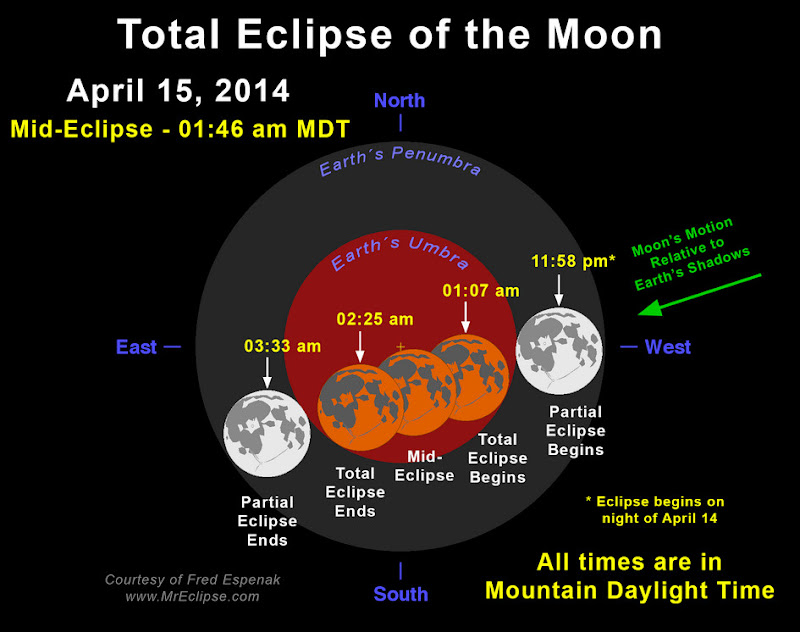
Diagram of the April 14 / 15, 2014 total lunar eclipse. Click for a larger view. ( Fred Espenak, http://www.MrEclipse.com)

For those willing to forgo a bit of sleep tonight, a gaze skyward will provide a look at the first lunar eclipse of 2014.

The entire celestial event will be visible from Colorado beginning at 11:58 pm tonight as the partial eclipse begins.  Totality occurs at 1:07 am MDT on the morning of April 15 and lasting until 2:25 am.  The event will be over at 3:33 am.

Current weather forecasts for Thornton and the Denver metro area show that we should have mostly clear skies tonight allowing prime viewing of the event.  It will however be quite cold with temperatures in the mid to upper 20s.  Check our 48 hour point forecast for what to expect.

During totality, the moon will be rendered orange / red as the Earth’s shadow envelops the moon.  Many are calling this a ‘blood moon’ but the meaning behind that term isn’t exactly clear.

As written on EarthSky.org, some attribute it to the lunar tetrad – four successive full lunar eclipses without any partial eclipses.  Tonight’s eclipse begins the lunar tetrad with each full lunar eclipse coming six months apart.

The blood moon as it pertains to these eclipses should not be confused with the October full moon which is also referred to as a blood moon in folklore.

Also note that Mars is at its closest point to Earth in 6 years.  The red planet will be visible at about the 2:00 position in relation to the fully eclipsed moon.

For more information:

National Weather Service announces storm spotter training dates for 2014

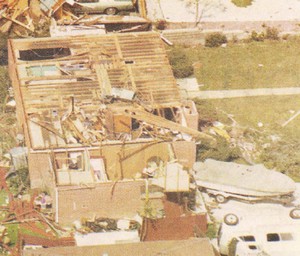
On June 3, 1981 a tornado struck Thornton in what is the worst twister to have struck the Denver metro area. Are you ready should disaster strike again? Image courtesy the City of Thornton archives.

Severe weather is a fact of life in Colorado – from blizzards to tornadoes we can and do see it all.  Each year the weather is responsible for claiming lives in our state and across the nation and the threat is very real.  Storm spotter training allows you to learn how to protect yourself and your family while providing a public service.

Education is key to knowing how to protect you and your family.  Whether you want to be an official storm spotter or maybe just want to learn more about severe weather, storm spotter training can provide you an incredible opportunity to learn.

The National Weather Service Denver / Boulder office has announced a series of Skywarn storm spotter training dates for Colorado for the 2013 season.

The storm spotter program is a nationwide program with more than 280,000 trained spotters.  These volunteers report weather hazards to their local National Weather Service office providing vital information when severe strikes.  Data from spotters include severe wind, rain, snow measurements, thunderstorms and hail and of course tornadoes.

Storm spotters are part of the ranks of citizens who form the Nation’s first line of defense against severe weather. There can be no finer reward than to know that their efforts have given communities the precious gift of time–seconds and minutes that can help save lives.

By completing one of these training classes you can become an official storm spotter.  When severe weather strikes, you can report it by calling a special toll free number or submit your report via the National Weather Service’s website.

These are great sessions for anyone wanting to learn more about the severe weather we experience in Colorado, whether you want to be an official spotter or not.  All training is free.  Topics include:

  • Basics of thunderstorm development
  • Fundamentals of storm structure
  • Identifying potential severe weather features
  • Information to report
  • How to report information
  • Basic severe weather safety

To learn more about the program, see here: http://www.crh.noaa.gov/bou/awebphp/spotter.php

Below are the dates, times and locations announced thus far with the first occurring on Sunday, February 16.  We will try to keep this updated but you can click here for any new dates on the National Weather Service website.

Schedule updated 4/6/14:

April, 2014 – Upcoming
Day City, State Time Location
07 Loveland, CO
(Larimer County)
9:00am MDT The Rialto Theater 228 E. Fourth Street Loveland, Colorado 80537
Contact Information: mialyp@ci.loveland.co.us
07 Fort Collins, CO
(Larimer County)
6:30pm MDT Fort Collins Police Services Building, Community Service Room 2221 S. Timberline Drive Fort Collins Colorado
Contact Information: migavin@poudre-fire.org
10 New Raymer , CO
(Weld County)
6:30pm MDT New Raymer Community Building 25 Shirley Ave. New Raymer, CO
Contact Information: dustin@dustinpricephotography.com
12 Kiowa, CO
(Elbert County)
9:00am MDT Old County Courthouse Second floor, 215 Comanche Street, Kiowa, CO 80117
Contact Information: brandon.lenderink@elbertcounty-co.gov
14 Akron, CO
(Washington County)
6:30pm MDT Washington County Fairgrounds Event Center 551 E. Second Street, Akron, CO
Contact Information: mmccaleb@co.washington.co.us
15 Greeley, CO
(Weld County)
6:30pm MDT Weld County Administration Building, 1150 O Street, Greeley, CO
Contact Information: gmarquez@co.weld.co.us
19 Commerce City, CO
(Adams County)
10:00am MDT Sheriff’s Substation Conference Room, 4201 E. 72nd Ave., Commerce City, CO 80022
Contact Information: r1@rampartsar.com
21 Centennial, CO
(Arapahoe County)
6:30pm MDT Arapahoe County Sheriff, 13101 East Broncoes Parkway, Centennial, CO
Contact Information: awallin@arapahoegov.com
24 Aurora, CO
(Arapahoe County)
6:00pm MDT Aurora Central Library 14949 E Alameda Pkwy, Aurora, CO 80012.
Contact Information: acox@auroragov.org
26 Strasburg, CO
(Adams County)
10:00am MDT Strasburg Fire Department Conference Room, 56281 E. Colfax Ave., Strasburg, CO 80136
Contact Information: tmccall@svfd8.org
28 Parker, CO
(Douglas County)
6:30pm MDT Parker Police 18600 Lincoln Meadows Pkwy Parker, CO 80134
Contact Information: khenry@parkeronline.org
29 Littleton, CO
(Jefferson County)
10:00am MDT Foothills Park and Recreation District 6612 S. Ward Street, Littleton, CO 80127.
Contact Information: lisan@fhprd.org
29 Denver, CO
(Denver County)
7:00pm MDT Red Cross facility 444 Sherman St., Denver Co
Contact Information: kc0mht@msn.com
May, 2014 – Upcoming
Day City, State Time Location
01 Hugo, CO
(Lincoln County)
2:00pm MDT Lincoln County Courthouse 103 3rd Street, Hugo, CO 80821
Contact Information: lclanduse@lincolncountyco.us
01 Hugo, CO
(Lincoln County)
6:30pm MDT Lincoln County Courthouse 103 3rd Street, Hugo, CO 80821
Contact Information: lclanduse@lincolncountyco.us
06 Boulder, CO
(Boulder County)
6:30pm MDT SHHQ TrainingRoom 5600 Flatiron Parkway, Boulder
Contact Information: fgonzales@bouldercounty.org
08 Thornton, CO
(Adams County)
6:00pm MDT Thornton City Hall 1st Floor Training Room, 9500 Civic Center Drive, Thornton, CO 80229
Contact Information: gene.putman@cityofthornton.net

March 2014 weather recap: Month saw near normal temperatures and precip, below normal snowfall.

Looking back at the month of March we see a period of relatively uneventful weather in the Denver area.  Temperatures were near normal as was the amount of liquid precipitation, this despite the fact we saw well below normal snowfall.

The month started very cold with the first two days failing to record readings above freezing and some light snowfall.  That did not last long however and four mild days followed.  A weak system then moved in with a couple more shots of snow over a three day period.

Entering the second week of the month temperatures moderated and we saw some of our warmest readings of the month.  Light snow on the 12th fell but did not cool things down too much.

Two more very light snowfalls occurred in the last 10 days of the month while temperatures overall remained at or above normal.

Thornton’s average temperature for the month came in at 41.1 degrees, 0.7 degrees above the Denver average for March of 40.4 degrees.  Out at Denver International Airport, the Mile High City saw an average monthly temperature of 40.9 degrees.

Our warmest temperature for the month occurred on the 9th when the mercury climbed to 75.0 degrees.  The coldest reading of 3.8 degrees happened on March 2.  Denver’s warmest and coldest temperatures were on the same days with readings of 73 degrees and 4 degrees.

Two days, the first and the second, saw high temperatures below freezing.  Low temperatures below freezing occurred on 22 of the 31 days.  Denver saw similar readings.

In terms of liquid precipitation, Thornton recorded 1.06 inches.  This was a bit above Denver’s March average of 0.92 inches.  Denver was drier than normal recording 0.83 inches.

The near normal precipitation came despite the fact we saw much less snow than normal.  March is typically our snowiest with an average of 10.7 inches of the white stuff.  Thornton saw a mere 6.5 inches and Denver 6.0 inches.

Click here to view Thornton’s March 2014 climate report.

March 2014 temperature summary for Thornton, Colorado. (ThorntonWeather.com)
March 2014 precipitation summary for Thornton, Colorado. (ThorntonWeather.com)


CLIMATE REPORT...CORRECTED
NATIONAL WEATHER SERVICE BOULDER, CO
725 PM MDT TUE APR 1 2014

..............CORRECTED FOR TYPOS FOR THE FOLLOWING.................
.....TEMPERATURES...SNOWFALL DEPARTURES AND PEAK WIND DIRECTION.....

...................................

...THE DENVER CO CLIMATE SUMMARY FOR THE MONTH OF MARCH 2014...

CLIMATE NORMAL PERIOD 1981 TO 2010
CLIMATE RECORD PERIOD 1872 TO 2014

WEATHER         OBSERVED          NORMAL  DEPART  LAST YEAR`S
                 VALUE   DATE(S)  VALUE   FROM    VALUE  DATE(S)
                                          NORMAL
................................................................
TEMPERATURE (F)
RECORD
 HIGH              84   03/26/1971
 LOW              -11   03/28/1886
HIGHEST            73   03/09        84     -11       76  03/15
LOWEST              4   03/02       -11      15        2  03/25
AVG. MAXIMUM     55.8              54.4     1.4     50.7
AVG. MINIMUM     25.9              26.4    -0.5     24.6
MEAN             40.9              40.4     0.5     37.7
DAYS MAX >= 90      0               0.0     0.0        0
DAYS MAX <= 32      2               1.9     0.1        3
DAYS MIN <= 32     23              23.6    -0.6       24
DAYS MIN <= 0       0               0.1    -0.1        0 
PRECIPITATION (INCHES) 
RECORD
  MAXIMUM         4.56   1983
  MINIMUM         0.03   2012 
TOTALS           0.83              0.92   -0.09     1.47 
DAILY AVG.       0.03              0.03    0.00     0.05 
DAYS >= .01         9               5.9     3.1        6
DAYS >= .10         2               2.4    -0.4        4
DAYS >= .50         0               0.3    -0.3        0
DAYS >= 1.00        0               0.1    -0.1        0
GREATEST
 24 HR. TOTAL    0.32   03/07 TO 03/07           03/22 TO 03/22
                                                          03/22 TO 03/22
                                                          03/22 TO 03/22
 STORM TOTAL       MM                                 MM
 (MM/DD(HH))            MM                    03/22(00) TO 03/22(00)
                                                 03/22(00) TO 03/22(00)2
                                                 03/22(00) TO 03/22(00)2

SNOWFALL (INCHES)
RECORDS
 TOTAL             MM   5
TOTALS            6.0              10.7

DEGREE_DAYS
HEATING TOTAL     739               763     -24      840
 SINCE 7/1       5258              5202      56     5112
COOLING TOTAL       0                 0       0        0
 SINCE 1/1          0                 0       0        0

FREEZE DATES
RECORD
 EARLIEST     09/08/1962
 LATEST       06/08/2007
EARLIEST                        10/07
LATEST                          05/05
...................................................

WIND (MPH)
AVERAGE WIND SPEED              11.5
RESULTANT WIND SPEED/DIRECTION   3/247
HIGHEST WIND SPEED/DIRECTION    45/350    DATE  03/18
HIGHEST GUST SPEED/DIRECTION    55/350    DATE  03/18

SKY COVER
POSSIBLE SUNSHINE (PERCENT)   MM
AVERAGE SKY COVER           0.60
NUMBER OF DAYS FAIR            6
NUMBER OF DAYS PC             18
NUMBER OF DAYS CLOUDY          7

AVERAGE RH (PERCENT)     50

WEATHER CONDITIONS. NUMBER OF DAYS WITH
THUNDERSTORM              0     MIXED PRECIP               0
HEAVY RAIN                0     RAIN                       2
LIGHT RAIN                3     FREEZING RAIN              0
LT FREEZING RAIN          1     HAIL                       0
HEAVY SNOW                0     SNOW                       6
LIGHT SNOW               10     SLEET                      0
FOG                      12     FOG W/VIS <= 1/4 MILE      5
HAZE                      5

-  INDICATES NEGATIVE NUMBERS.
R  INDICATES RECORD WAS SET OR TIED.
MM INDICATES DATA IS MISSING.
T  INDICATES TRACE AMOUNT.

Thornton’s April weather preview: Just about anything possible

Thornton's April weather previewApril marks a transition between winter and summer for most of the country but for Denver it is especially true as we can see a stunning variety of weather.

The proverbial April showers are certainly a possibility for Denver. Snow? Tornadoes? Thunderstorms? You bet – all can happen!

For good measure throw in a chance for hail and even dust storms and April gives every type of weather condition you could like – or hate.

March 2014 top shots: Monthly photo slideshow

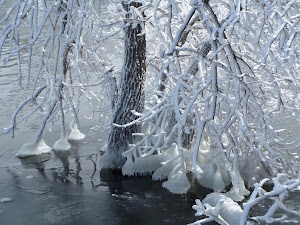
Wintry weather started the month of March in northeastern Colorado. View more images from the month in the slideshow below.   (Marla Winter)
Wintry weather started the month of March in northeastern Colorado. View more images from the month in the slideshow below. (Marla Winter)

March along the Colorado Front Range can be a very pleasant time as temperatures climb with the approach to and arrival of spring.  However the month is also Denver’s snowiest and wintry weather is not unusual.  This variety of conditions will be reflected in our March 2014 slideshow below.

  • Slideshow updated March 31, 2014

Showcasing images captured by ThorntonWeather.com readers as well as some of our own, our monthly slideshow covers the entire gamut of weather-related imagery.  Sunsets, sunrises, wildlife and of course snow are vividly depicted.

Throughout the month we will gather the images sent to us via email or shared with us via our various social media outlets and post them in the slideshow below.

To learn more about getting your photos added to our monthly slideshow, click here. 

Click the play button below and sit back and enjoy the images.

Before and after: NASA satellite imagery shows effects of Washington state landslide

As many as two dozen people were killed on Saturday, March 22, 2014 when a massive landslide swept down a rain-soaked hill near Oso, Washington. NASA satellite imagery taken before and after the event shows the extent of the event.

Using the ‘sliders’ on the image below you can compare how the area looks normally (left) versus how it looked after the landslide (right).

[wpw_ba_viewer width=”600″ height=”auto” anim_speed=”600″ start_percent=”0.5″ disable_intro=”false”]
[wpw_ba_img src=”http://lh6.googleusercontent.com/-I2mSOZBkFnQ/UzMQFKXi74I/AAAAAAAAB0s/tcA9N10o6cY/s600/wa-before.jpg” data_second=”http://lh5.googleusercontent.com/-VXmVfoDsFqQ/UzMQFPSNLNI/AAAAAAAAB0w/kIX2gla6sTA/s600/wa-after.jpg” title=”Satellite imagery comparison of the area near Oso, Washington before and after the March 22, 2014 landslide. (NASA EO)” data_info=”Satellite imagery comparison of the area near Oso, Washington before and after the March 22, 2014 landslide. (NASA EO)”]
[/wpw_ba_viewer]

From NASA:

On March 22, 2014, a rainfall-triggered landslide near Oso, Washington sent muddy debris spilling across the North Fork of the Stillaguamish River. The debris engulfed numerous homes, resulting in the deaths of at least 14 people. As of March 25, authorities reported that 176 people were still missing.

The slide left an earthen dam that blocked the river, causing a barrier lake to form. The Operational Land Imager (OLI) on Landsat 8 acquired this image of landslide debris and the barrier lake on March 23, 2014. An image of the same area acquired on January 18, 2014, is shown for comparison.

As water backed up, it raised fears of a potential flash flood. On March 23, water began to flow around the north side of the dam. However, as of the afternoon of March 25, a flash flooding watch issued by the National Weather Service remained in effect for parts of Snohomish county.

According to Durham University geologist Dave Petley, the landslide was a reactivation of an earlier landslide that caused problems in 1988 and 2006.

Weather, natural disasters & climate news and information.