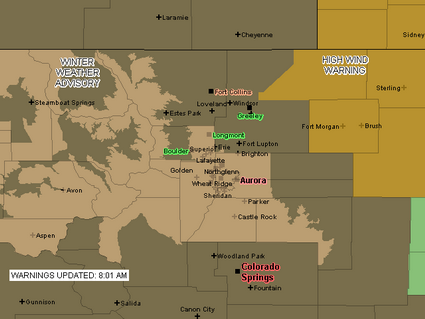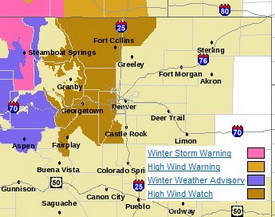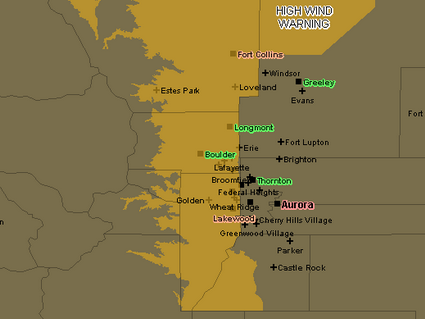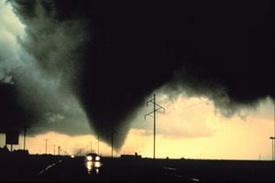
A major winter storm will hit Denver and the Front Range Thursday morning where some areas will be measuring snow in feet.
The National Weather Service has issued a Winter Storm Warning for Denver and much of northeastern Colorado in anticipation of a significant storm now approaching the state. The warning takes the place of the previously issued watch and signifies the increased potential for a major snow event. The warning goes into effect at 6:00am Thursday morning and runs through 6:00am Friday.
Computer models are beginning to coalesce around solutions that involve snow amounts that could exceed a foot along the Palmer Divide and the foothills. Snow will begin falling in the foothills in the morning and by midday will encompass the entire Front Range. By the time the storm ends, much of the metro area will have in excess of six inches of snow. Tomorrow afternoon’s commute is almost certainly going to be a rough one.
The spring snowstorm could be our biggest storm to date for the 2008 – 2009 winter season. We are desperately in need of moisture so while it may be troublesome, we really need the precipitation.
Schmitt recalled as a child in Silver City, New Mexico helping his father, also a geologist, take rain measurements. Those early experiments spurred the former astronaut’s interest in earth sciences at an early age. He recalled how later in life, while on the surface of the moon, he made weather forecasts for the southern hemisphere of the earth.
In wide ranging commentary, Dr. Schmitt made a point by point argument against many of the things that global warming advocates point to in support of the theory. In a similar vein to his comments last month, he continued to admonish scientists and politicians that have politicized the issue and said those that disagree do have a battle ahead of them.
Sunny skies on Wednesday, March 4th helped Denver break a 137 year old high temperature record.
Denver officially broke the high temperature record on Wednesday, March 4th. At 12:40pm the temperature at Denver International Airport reached 76 degrees, breaking the old record of 74 degrees set in 1872.
This marks the 4th weather record we have broken in just the week. In addition to Wednesday’s mark, we have had:
March 3rd sets new record high minimum. Overnight temperatures got down to only 47 degrees, beating the old record of 44 set in 1925.
We are very dry right now and could really use some significant precipitation as snowfall totals are less than half of what they normally are by this time of year. Is there hope? We remember back to 2003 when we were in a similar dry condition and two major storms helped to turn things around. Click here to read about that on Examiner.com.
The old Stapleton International Airport site and Denver International Airport are separated by 12 miles. Is it accurate to compare weather between the two locations?
These announcements are common and we all take notice when we hear them and they make for great water cooler chat topics but are these claims accurate?
In 1995 Denver finally opened its new airport, Denver International Airport, out on the plains east of the city. This new facility, 12 miles as the crow flies northeast of the old Stapleton International Airport, moved the airport from an urban environment to a rural one and more than 19 miles from the center of Denver. Following that move, the National Weather Service (NWS) began taking some of its official measurements at the glistening new airport. In doing so, some say Denver’s climate records have forever been altered and as such any weather record should have an asterisk attached to it.
Denver officially set a new record high temperature for March 2nd.
Updated, 5:30pm: Denver’s official high temperature today reached 74 degrees at 3:08pm, beating the old record of 72 degrees by two.
Original post, 2:39pm: Denver has officially broken the high temperature record for today, March 2nd. At 1:52pm the thermometer at Denver International Airport reached 73 degrees, besting the old record of 72 degrees set way back in 1901. Here in Thornton we were a touch warmer reaching a high of 74.1 degrees.
This afternoon there is a chance the temperature could go a degree or two higher thus further increasing the record.
Is this really a record? Since moving Denver’s official weather recording station to DIA, many weather enthusiasts believe our weather and climate records are being unduly altered. Examiner.com just launched an investigative feature into this problem today – check out part 1 of our series on Examiner.com: Do Denver weather and climate records have an asterisk attached?
March 1 to March 7 - This week in Denver weather history
Looking at this week in Denver weather history, it is easy to see why March is known as Denver’s snowiest month. There are numerous instances of major winter storms dumping snow on the city that was measured not in inches – but feet!
From the National Weather Service:
28-1
IN 1875…6 INCHES OF SNOW FELL FROM 3:15 PM ON THE 28TH TO 1:00 AM ON THE 1ST. PRECIPITATION FOR THE TWO DAYS WAS 0.50 INCH.
29-1
IN 1896…SNOWFALL TOTALED 5.5 INCHES IN THE CITY. NORTHEAST WINDS GUSTED TO 24 MPH.
IN 1948…SNOWFALL TOTALED 5.9 INCHES IN DOWNTOWN DENVER. NORTH WINDS WERE SUSTAINED TO 15 MPH.
1
IN 1904…WEST WINDS WERE SUSTAINED TO 42 MPH WITH GUSTS AS HIGH AS 58 MPH. THE CHINOOK WINDS WARMED THE TEMPERATURE TO A HIGH OF 67 DEGREES.
IN 1906…SNOWFALL WAS HEAVY AND TOTALED 7.5 INCHES OVER DOWNTOWN DENVER. NORTHEAST WINDS WERE SUSTAINED TO 37 MPH.
IN 1940…SNOWFALL WAS HEAVY AND TOTALED 7.7 INCHES IN DOWNTOWN DENVER.
IN 1943…6.0 INCHES OF SNOW FELL OVER DOWNTOWN DENVER. NORTH WINDS WERE SUSTAINED TO 19 MPH.
Want to be an official storm spotter or maybe just want to learn more about severe weather? Here’s your chance!
We have written before about the great opportunity the National Weather Service provides by giving storm spotter training during the start of the severe weather season. That time is now here and training sessions start in the coming week and new sessions have been added since we last reported on the topic.
The storm spotter program is a nationwide program with more than 280,000 trained spotters. These volunteers report weather hazards to their local National Weather Service office providing vital information when severe strikes. Data from spotters include severe wind, rain, snow measurements, thunderstorms and hail and of course tornadoes.
Storm spotters are part of the ranks of citizens who form the Nation’s first line of defense against severe weather. There can be no finer reward than to know that their efforts have given communities the precious gift of time–seconds and minutes that can help save lives.
By completing one of these training classes you can become an official storm spotter. When severe weather strikes, you can report it by calling a special toll free number or submit your report via the National Weather Service’s website.
These are great sessions for anyone wanting to learn more about the severe weather we experience in Colorado, whether you want to be an official spotter or not. All training is free. Topics include:
Denver and Thornton's March 2009 climatological preview
March in Denver typically means frequent and rapid weather changes. The days grow longer and we start enjoying more sunshine and sometimes summer-like weather. However, on occasion arctic air masses can still force their way south into Colorado dropping temperatures quickly and markedly.
These changes are due to Marches “in between” status – elements during the month have much in common with winter and spring. In addition to arctic fronts, Pacific storms frequently move across Colorado from the west and warm moist air streams up from the Gulf of Mexico northeastward into the state. When these cold fronts collide with the warmer air masses the result can be some crazy weather.
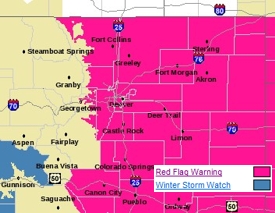
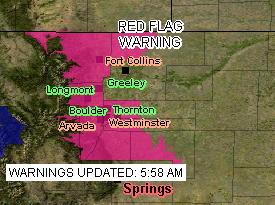
The entire eastern half of Colorado is under a Red Flag Warning through Friday evening.
The National Weather Service has updated the Red Flag Warning and it will now go into effect at 9:00am today and run through 9:00pm. Further, the warning now covers the entire eastern half of the state of Colorado and in fact extends to the south and east into parts of Nebraska, Kansas, Oklahoma, Texas and New Mexico. This of course covers the entire Denver metro area and the Front Range.
The extension and widening of the warning should serve to really drive home how dry things are and how serious the fire conditions are. Please be sure to take appropriate precautions as we certainly would like to avoid any wildfires.
RED FLAG WARNING
NATIONAL WEATHER SERVICE DENVER CO
456 AM MST FRI FEB 6 2009
…Dry and windy conditions across the plains and lower foothills today…
Very dry air will combine with strong winds to produce increased fire danger over the foothills and plains of northeast Colorado today. Winds will gust as high as 40 mph on the plains this afternoon with gusts to 50 mph in the foothills. Minimum humidities will range from 10 to 15 percent. Conditions will improve on the plains around sunset…with warm and breezy conditions lingering in and near the foothills through the early evening hours.
…Red Flag Warning now in effect from 9 am this morning to 9 pm mst this evening for gusty winds and low humidities…
The Red Flag Warning is now in effect from 9 am this morning to 9 pm mst this evening. A Red Flag Warning is now in effect for all of the plains and foothills areas of eastern Colorado… Including fire weather zones 235…236…and 238 through 251.
West winds of 20 to 35 mph will become widespread in and near the southern Front Range foothills this morning…and spread across the plains by afternoon. Gusts as high as 50 mph are possible in the foothills. Relative humidities will drop into the 8 to 15 percent range. The combination of the gusty winds…low humidities and dry fuels will create very high fire danger. The gusty winds will decrease and the relative humidities will increase this evening.
A Red Flag Warning means that critical fire weather conditions are either occurring or imminent. Please advise the appropriate officials and fire crews in the field of this Red Flag Warning.
The Denver weather has been nice but we are extremely dry and in need of some moisture.
This week we have had some extraordinarily nice weather and it has been great. The mountains are certainly having a great year for snow with all of the major basins exceeding 100% of average for snowpack. However, here along the Front Range and the plains, we are bone dry and well below normal for snowfall.
As of today, Denver has received only half of its normal amount of snow for this point in the snow season which runs from July through June. By the first of February, we normally should have received 33.3 inches. To date for the 2008 – 2009 season we have received a mere 16.9 inches of snow as measured at Denver International Airport. Closer to the central part of the city, Stapleton has been even drier with only 13.1 inches of the white stuff to date.
For a complete look at how bleak the moisture has been along the Front Range, check out the details in our Examiner.com story.