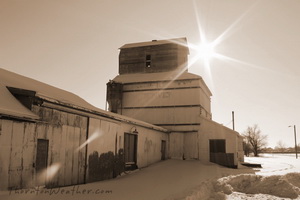
Happy holidays from ThorntonWeather.com! Image of the old Eastlake grain elevator, Christmas Eve 2009. (ThorntonWeather.com)
Mother Nature was kind enough to bring us a white Christmas this year and the city looks beautiful covered in a blanket of white as we sit here and write this. The holidays are a special time of year for us as we are sure it is for all of our visitors.
Other than a brief interruption courtesy of the U.S. Navy, we are life-long residents of the north metro area and have lived in Thornton more than 11 years. We are proud to call the city our home and believe it is one of the finest communities in the state. Over the past year ThorntonWeather.com has grown by leaps and bounds and thousands of area residents get their weather from us. We provide the site as a public service and it makes us happy to see so many people trust us to provide them with the latest news, information and forecasts.
Please take some time out of all the hustle and bustle of the coming days to remember our brave soldiers, sailors, airmen and Marines who are serving and protecting our nation at home and abroad. Many of them won’t be with their families this holiday and it is important that we keep them in our prayers and let them know that we are thinking about them. May God watch over all of them!
We wish all of you a safe and happy holiday season and new year and thank you for using ThorntonWeather.com. Having traveled the world, we truly believe there is nothing like a ‘Colorado Christmas’ and to demonstrate that, we offer up this video as proof. Happy holidays!
NASA’s Terra and Aqua satellites moved over the western half of the nation and captured amazing imagery showing how widespread the winter weather was.
A severe winter storm blustered its way across the United States on December 7 and 8, 2009. The storm dumped heavy snow from California to the Great Plains, and fierce winds added to the hazardous conditions. The storm was predicted to continue eastward in midweek, and blizzard warnings were in effect for Great Lakes states as of December 9.
This image shows the blanket of snow laid down by the storm across the West, along with the thick swirl of storm clouds over the Great Plains from North Dakota to Oklahoma. The image is made from a combination of images captured by the Moderate Resolution Imaging Spectroradiometer (MODIS) sensors on NASA’s Terra (most of the left side of the image) and Aqua (most of the right side) satellites on December 8.
It certainly could have been a lot worse. The Mile High City escaped relatively unscathed with only minor accumulations of snow from the storm that is now moving to the east. Its lingering effects will continue to be felt overnight however.
Some blue skies are starting to be seen which is a welcome sight and the Winter Weather Advisory that was in effect has been cancelled. Temperatures however remain in the single digits across the Front Range and are below zero in the high country according to the Rocky Mountain Weather Network. With the slight breezes wind chills are easily dipping near the zero degree mark.
Overnight tonight, the mercury will continue to drop and likely enter negative numbers. The only consolation we have is that we do gradually begin to warm up tomorrow and may very well start hitting normal temperatures by Saturday.
The winter storm system that impacted Colorado struck Arizona and California before arriving here and as it travels east it will cover a widespread swath of the nation. Check out the story from the Natural Disasters Examiner for more information. Also be sure to look at the slideshow below of the winter weather.
A massive winter storm covering nearly 1,700 miles has brought Arctic cold, record snowfall and blizzard conditions to a large swatch of the nation. From southwestern Utah, across the Rocky Mountains and Great Plains to northeastern Michigan winter weather warnings have been issued as Old Man Winter arrives two weeks early.
Starting in California, parts of the Sierra Nevada saw up to four feet of snow. In Arizona the storm brought high winds to the Phoenix area which downed power lines leaving 250,000 people without power. Flagstaff, Arizona and Reno, Nevada were covered in blankets of snow.
In Colorado, the entire state was feeling the effects of the storm. The southwestern part of the state was experiencing blizzard conditions while the Denver area, spared significant snowfall, suffered through single digit temperatures and wind chills dipping to 10 degrees below zero.
As if often the case, winter storm can turn deadly and this system has not been an exception. Two people were killed in New Mexico due to traffic accidents on dangerously slick roads and the state’s road crews were struggling to keep up with falling snow.
November 15 to November 21 - This week in Denver weather history
Any week in Denver weather history is filled with numerous notable weather events and this week is no different. We have everything from major snowstorms to damaging winds and much more. However, one item is particularly notable and historic. It was on the 20th of November in 1871 that the first, official weather observation took place in Denver. Henry Fenton, Observer Sergeant of the United States Army Signal Service, made the report at 5:43 am. The office was located on the 2nd floor of a building at the corner of Larimer and G Streets, now 16th Street. Scroll down to see what the report said.
From the National Weather Service:
From the 12th to the 15th:
In 1909…light snowfall totaled 6.7 inches in downtown Denver over the 4 days. This was the first measurable snowfall of the season. Northeast winds were sustained to 15 mph on the 12th.
From the 14th to the 15th:
In 1917…overnight rainfall was 0.03 inch. This was the only measurable precipitation of the month…making it the 5th driest November on record.
In 1985…3 to 6 inches of snow fell across metro Denver. Snowfall totaled 3.8 inches at Stapleton International Airport where northeast winds gusted to only 13 mph.
In 2005…a winter storm that brought heavy snow to the mountains also spread heavy snow into the foothills to the west of Denver. Snowfall totals included: 14 inches at aspen springs…13 inches near Pinecliffe…and 12 inches near Nederland. Interstate 70 along with U.S. Highway 40 had to be closed near Idaho Springs due to snow…poor visibility in blowing snow…numerous accidents…and an increased avalanche danger. High winds were recorded in the foothills on the 14th. Winds gusted to 89 mph at Georgetown and to 91 mph on Sugarloaf Mountain west of Boulder. Strong microburst winds associated with a dissipating rain shower gusted to 61 mph at Denver International Airport on the 14th.
From the 14th to the 18th:
In 1964…the first measurable snowfall of the season totaled 6.0 inches at Stapleton International Airport where northeast winds gusted to 32 mph on the 14th. Most of the snow…4.2 inches…fell on the 14th. This was the only measurable snow of the month.
On the 15th:
In 1902…4.0 inches of snow fell over downtown Denver. This was the only measurable snow of the month. Northeast winds were sustained to 18 mph with gusts to 20 mph.
In 1906…strong winds howled and roared across Boulder… Causing several thousand dollars in damage. The strong winds caused one fatality and minor injuries to others. West winds were sustained to 46 mph in downtown Denver where the strong Chinook winds warmed the temperature to a high of 74 degrees.
In 1944…the low temperature dipped to 32 degrees. This is the latest date of the first freeze in Denver.
In 1949…a trace of rain fell. Another trace of rain on the 11th was the only precipitation of the month…making the month one of the driest Novembers on record and the least snowiest with no snow. This was the first November since 1882 without snow.
In 1960…strong winds caused 2 thousand dollars damage to a new school building in Boulder where wind gusts were estimated to 70 mph. Wind gusts to 40 mph were recorded in downtown Denver. Damage occurred to utility lines…signs… And trees. Northwest winds gusted to 44 mph at Stapleton Airport.
In 1986…strong Chinook winds howled over the Front Range foothills. The highest wind gust…81 mph…was recorded at Table Mesa in Boulder. West winds gusted to 31 mph at Stapleton International Airport.
In 1987…the first measurable snow of the season was also a major snowstorm. The snow combined with strong winds to close I-70 east of Denver and I-25 to Colorado Springs. Snow accumulations ranged from 6 to 9 inches across metro Denver with 10 to 20 inches in the foothills. At Stapleton International Airport…6.1 inches of snow fell and north winds gusted to 47 mph reducing the visibility to as low as 1/8 mile in heavy snow. Strong north winds at 20 to 30 mph with frequent gusts to 40 mph and temperatures hovering around 30 degrees plunged wind chill temperatures to 5 below zero.
In 1988…the season’s first snow storm hit metro Denver. The storm dumped 2 to 5 inches of snow…which caused numerous traffic snarls and accidents. North wind gusts to 43 mph caused some blowing snow. Snowfall totaled 2.5 inches at Stapleton International Airport. This was the latest first snow of the season. No traces of snow had occurred earlier in the season.
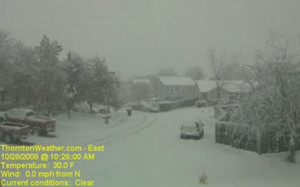
This image from the ThorntonWeather.com webcam was captured at the height of the storm.
A two-day storm that saw areas around Denver measuring snow in terms of feet has moved out of the area and onto the plains. The lingering effects of the storm will be felt Friday in terms of slick roads in Denver and blizzard conditions to the east.
The early winter storm, while not entirely unusual, was the first major snow storm of the season and put Coloradoans to the test. Mercifully, the snow never fell at a particularly heavy rate and while it lingered for a long time, it allowed road crews and residents time to stay on top of the snowfall. Most schoolchildren were pleased to have received at least one snow day from the storm and many were the recipients of two unplanned days off.
At Denver International Airport, initial success at holding the storm’s effects at bay on Wednesday began to whither under the white onslaught on Thursday as winds picked up and the storm shifted east. Hundreds of flights were canceled from the airport’s major carriers including United Airlines, Frontier Airlines and Southwest Airlines.
At the height of the storm’s effects, the airport was reduced to two operating runways from the usual six and delays of up to four hours were occurring. All airlines anticipate being able to operate a normal flight schedule today.
How much snow did the Denver area receive? Here are some of the snowfall totals:
Aurora: 16 inches
Boulder: 18.8 inches
Broomfield: 20 inches
Centennial: 17 inches
Coal Creek Canyon: 46 inches
Denver International Airport: 12 inches (as of 6:00am Thursday)
Evergreen: 30 inches
Highlands Ranch: 24.5 inches
Littleton: 28.5 inches
Longmont: 12.4 inches
Parker: 14.5 inches
Thornton: 14.1 inches Click here for a complete listing of storm reports.
The storm did push Denver into the record books and the ‘top 10 snowiest Octobers’ list. The National Weather Service will publish the official snow total from DIA for yesterday but even without the snow from yesterday, October 2009 makes the list. As of 6:00am on Thursday, DIA had recorded 14.5 inches for the month (12 inches from this storm). That makes it number 7 on the top 10 list for snowiest Octobers on record since 1882. Once today’s measurement is released, it is possible it will climb further.
From the evening of October 27, 2009 through October 29, 2009, the Denver metro area was struck by a major, early winter snowstorm. The mountains and foothills to the immediate west of Denver were measuring the snowfall in feet while in the city more than a foot of snow fell in less than 72 hours. Here in Thornton we recorded 14.1 inches of snow during the event.
This time lapse video below was captured by our east facing webcam. It begins early Tuesday morning (October 27th) and runs through midnight on Thursday, October 29th. As it starts, you can see the first day started out nice enough but by evening the wind was blowing and rain was falling. That soon changed to snow and the snowstorm was in full force for two days.
As the Colorado Rockies return home to play game 3 of the National League Divisional Series against the Philadelphia Phillies, the weather could prove to be a tougher opponent than the opposing team. As we forecast early this week, a major blast of Arctic air will be arriving over Colorado tonight and will send thermometers plunging, possibly into record setting territory.
Over the next 48 hours, Denver could break three, very chilly records:
The record low temperature for Denver on the 10th of October (Saturday), the day of the game, is 25 degrees. That was set more than 100 years ago in 1905. Tonight’s / tomorrow morning’s forecast low temperatures are expected to be in the low 20’s.
The record low maximum temperature for the 10th is 34 degrees, set in 2005. Tomorrow’s forecast high temperature is expected to be in the mid 30’s.
The record low temperature for the 11th of October (Sunday) is 22 degrees set in 1946. Current forecasts put the overnight low Saturday / Sunday morning as possibly hitting down to 17 degrees.
Of the three, it seems pretty likely we will break the first and the third record listed. The second one is a bit up in the air.
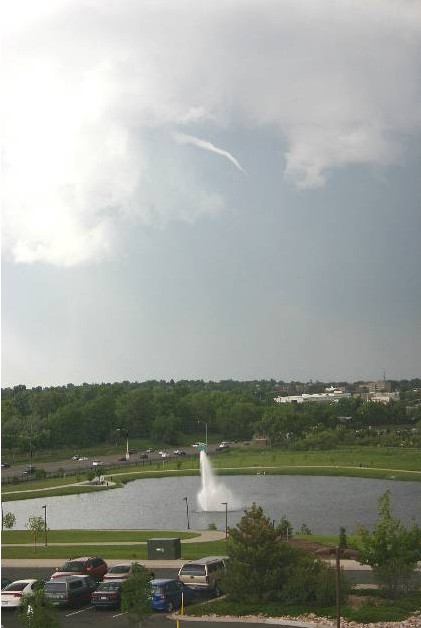
This funnel cloud was seen from the Thornton Civic Center (looking north) on June 10th. Image courtesy Lisa Wilson, the City of Thornton.
As summer 2009 comes to a close, it is perhaps most fitting that fall arrives with nearly winter-like weather. We ushered in the summer a month early with a record setting high temperature and soon followed that up with a near constant stream of severe weather for weeks. In fact, most of the events during what was a very active summer season actually occurred in the weeks leading up to the official start of summer.
Even though the official start of summer was a month away, May 19th seemed to be an unofficial start as the mercury climbed to 90 degrees that day setting a new record for the date. The very next day in perhaps what was a sign of things to come, a tornado touched down in Mesa County – only the ninth to strike in that county since 1950.
After a couple weeks of relative calm, the severe weather once again appeared and on June 7th funnel clouds and tornadoes seemed to be appearing everywhere. From the north metro area in Broomfield to Aurora, most of the Front Range had some sort of direct severe weather threat. Most notably,the Southlands Shopping Center was struck by an EF1 tornado where extensive damage to the mall occurred.
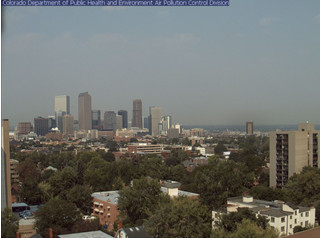
The view of the Rocky Mountains from Denver is obscured by haze caused by smoke from wildfires burning across the western United States.
Update, 5:30pm – The Colorado Department of Public Health and Environment has issued a smoke health advisory for northwest and north-central Colorado. The department warns that residents may wish to limit outside activity, particularly those with heart disease, respiratory illnesses, the very young, and the elderly.
Read the advisory in its entirety at the bottom of this story.
The National Interagency Fire Center (NIFC) reported 17 fires burning in states from Colorado west. Seven fires in California, three in Utah and two in Colorado are the primary ones causing smoke over the Mile High City.
The largest of the blazes, the Station Fire in the foothills near Los Angeles, exploded to more than 120,000 acres in recent days. In Utah, the Mill Flats Fire burning in the Dixie National Forest grew to more than 10,000 acres.
Colorado reports two wildfires, the largest of which has been dubbed the Tabaguache Creek Fire in the Uncompahgre and Gunnison National Forests. That blaze is six miles north of Nucla and has scorched 1,260 acres.
Altogether, the fires that are actively burning have burned more than 150,000 acres of land. For the entire fire season which runs during the calendar year, 65,140 wildfires have been reported and an estimated 5,303,691 acres – more than 8,000 square miles – have been burned.
Tuesday the smoke has eased some over the Front Range and it should dissipate this evening.
From the Colorado Department of Public Health and Environment:
COLORADO SMOKE ADVISORY & OUTLOOK:
Significant smoke from fires in Canada, Utah, Colorado, California and other western states will cause widespread haze in Colorado on Tuesday and from time-to-time this week. Fine Particulate levels are in the Unhealthy-for-Sensitive-Groups category in Garfield County and are probably in the Unhealthy-for-Sensitive-Groups range in other areas across Northwest and North-central Colorado due to the smoke from the forest fires. The highest concentrations are expected to occur in Northwest and North-central Colorado, generally north of I-70, possibly as far east as the Front Range. Much of the rest of Colorado will see concentrations in the Moderate range. IF VISIBILITY IS LESS THAN 5 MILES IN SMOKE IN YOUR NEIGHBORHOOD, SMOKE HAS REACHED LEVELS THAT ARE UNHEALTHY. If smoke is thick or becomes thick in your neighborhood you may want to remain indoors. This is especially true for those with heart disease, respiratory illnesses, the very young, and the elderly. Consider limiting outdoor activity when moderate to heavy smoke is present. Consider relocating temporarily if smoke is present indoors and is making you ill. Smoke should gradually diminish later this evening in most areas.
Moderate to heavy smoke is also possible in the vicinity of a fire 6 miles north of Nucla, especially in areas down-valley of the fire during the nighttime and morning hours.
FRONT RANGE AIR QUALITY FORECAST:
Ozone is expected to be in the Moderate to Unhealthy-for-Sensitive-Groups range Tuesday afternoon and evening (with the highest readings in the Denver metro area) and in the Moderate category on Wednesday. Active children, active adults, and people with respiratory illnesses should limit prolonged outdoor exertion from 2 PM until midnight tonight.
Visibility is expected to remain in the Poor Category on Tuesday and Wednesday.
Carbon monoxide levels are expected to remain in the Good category along the Front Range on Tuesday.
Fine particulate matter levels are expected to be in the Moderate category along the Front Range on Tuesday and Wednesday
Weather, natural disasters & climate news and information.