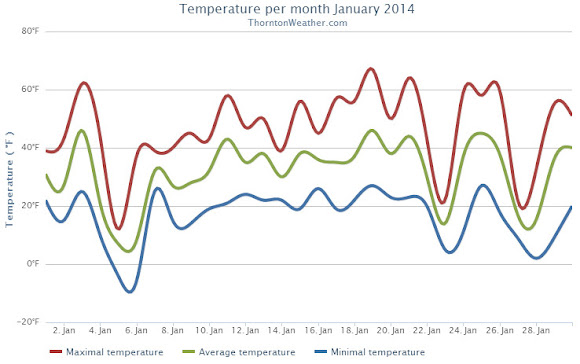
As we begin the new year the winter chill begins to set in. While January can see its share of extremes, the month historically sees stable temperatures and is usually relatively dry.
January ranks as the second coldest month in Denver next to December with average temperatures remaining virtually the same from the start to the end of the month. In terms of snowfall, the month only ranks as the fourth snowiest and it is not uncommon for it to be quite dry.
What does January 2013 hold for us? Indications are that we may very well continue the recent pattern of below normal temperatures and relatively dry conditions.
Thornton and the Denver area closed out 2013 with a display of typically highly variable weather. We recorded some record low temperatures followed by unseasonably warm conditions. One thing that was lacking was snow.
The first three days of the month started out quite mild with highs well above normal. That changed quickly midday on the third as low pressure moved in bringing an extended Arctic blast.
For six straight days high temperatures remained stubbornly below freezing and lows dipped into the single digits. The cold snap was notable but not record-setting in terms of length. Two daily low temperature records were tied or broken however.
Warmer weather returned on the 10th as the mercury finally started to climb. Unseasonably warm temperatures became the rule for the next nine days that included a record high temperature on the 18th.
The last third of the month was a bit more variable with its ups and downs but overall warmer than normal conditions.
Overall Thornton’s monthly average temperature came in at 29.2 degrees. Out at Denver International Airport where the Mile High City’s official stats are recorded, it was a bit cooler with an average of 28.4 degrees. Both were below Denver’s December average of 30.0 degrees.
Thornton recorded nine days with high temperatures that failed to reach 32 degrees. On five days, low temperatures dropped below zero. Denver saw eight days with highs below freezing, six with lows below zero.
The warmest temperature of the month in Thornton came on the 18th when we recorded 66.8 degrees. Our coldest was -9.3 degrees on the 5th. Denver’s warmest day was on the 18th as well with a high of 68 degrees. Its lowest temperature was -15 degrees on the 5th.
Four temperature records were tied or broken in Denver.
The low temperature of -13 degrees on December 4th shattered the old record low for the date of -5 degrees last set in 2008. The following day, on December 5th, the low temperature of -15 degrees tied the record low last set in 1972.
The mild weather December 18 saw two records. The high of 68 degrees broke the previous high temperature record for the date of 66 degrees last set in 1979. Also, the day tied the record high minimum for the 18th of 40 degrees set in 1917.
Precipitation for the month of December 2013 was not as noteworthy as the temperatures. Thornton recorded only 0.24 inches in our bucket while Denver received 0.25 inches. Both were a good bit below the December average of 0.35 inches.
Snow was similarly less than extraordinary. Thornton measured 5.7 inches of the white stuff while Denver lagged that with 4.7 inches. Both totals were below the normal for December of 8.5 inches. Seasonal snowfall totals at this point are about half of what they normally are.
Thornton’s December 2013 Temperatures.Thornton’s December 2013 Precipitation.
CLIMATE REPORT
NATIONAL WEATHER SERVICE BOULDER, CO
200 AM MST WED JAN 1 2014
...................................
...THE DENVER CO CLIMATE SUMMARY FOR THE YEAR OF 2013...
CLIMATE NORMAL PERIOD 1981 TO 2010
CLIMATE RECORD PERIOD 1872 TO 2013
WEATHER OBSERVED NORMAL DEPART LAST YEAR`S
VALUE DATE(S) VALUE FROM VALUE DATE(S)
NORMAL
................................................................
TEMPERATURE (F)
RECORD
HIGH 105 06/26/2012
06/25/2012
07/20/2005
LOW -29 01/09/1875
HIGHEST 100 07/11 64 36 105 06/26
06/11 06/25
LOWEST -15 12/05 36 -51 -6 01/11
AVG. MAXIMUM 63.9 64.7 -0.8 68.4
AVG. MINIMUM 36.3 36.3 0.0 39.3
MEAN 50.1 50.5 -0.4 53.9
DAYS MAX >= 90 54 39.6 14.4 73
DAYS MAX <= 32 29 20.0 9.0 19
DAYS MIN <= 32 169 156.9 12.1 132
DAYS MIN <= 0 11 5.8 5.2 4
PRECIPITATION (INCHES)
RECORD
MAXIMUM 23.31 1196
MINIMUM 7.29 2008
TOTALS 17.60 14.30 3.30 10.11
DAILY AVG. 0.05 0.04 0.01 0.03
DAYS >= .01 82 79.7 2.3 52
DAYS >= .10 42 34.9 7.1 23
DAYS >= .50 8 7.6 0.4 9
DAYS >= 1.00 3 2.3 0.7 1
GREATEST
24 HR. TOTAL 2.39 MM 12/31 TO 12/31
12/31 TO 12/31
12/31 TO 12/31
STORM TOTAL MM MM
(MM/DD(HH)) MM 12/31(00) TO 12/31(00)
12/31(00) TO 12/31(00)1
SNOWFALL (INCHES)
RECORDS
TOTAL MM 5
24 HR TOTAL MM
SNOW DEPTH MM MM
TOTALS 74.1 53.8 20.3 38.5
LIQUID EQUIV 7.41 5.40 2.01 3.85
SINCE 7/1 8.1 22.5 -14.4 12.4
LIQUID 7/1 0.81 2.20 -1.39 1.24
SNOWDEPTH AVG. 0 MM MM 0
DAYS >= TRACE 60 33.3 26.7 36
DAYS >= 1.0 20 16.3 3.7 13
GREATEST
SNOW DEPTH 9 02/25 11 02/04
24 HR TOTAL 9.1 MM 12/31 TO 12/31
12/31 TO 12/31
12/31 TO 12/31
STORM TOTAL MM MM
(MM/DD(HH)) MM 12/31(00) TO 12/31(00)
12/31(00) TO 12/31(00)1
DEGREE_DAYS
HEATING TOTAL 6302 6059 243 5198
SINCE 7/1 MM 2468 MM MM
COOLING TOTAL 999 0 999 1236
SINCE 1/1 999 769 230 1236
FREEZE DATES
RECORD
EARLIEST 09/08/1962
LATEST 06/08/2007
EARLIEST 10/07
LATEST 05/05
..................................................
WIND (MPH)
AVERAGE WIND SPEED 9.7
RESULTANT WIND SPEED/DIRECTION 2/201
HIGHEST WIND SPEED/DIRECTION 64/060 DATE 06/18
HIGHEST GUST SPEED/DIRECTION 97/040 DATE 06/18
SKY COVER
POSSIBLE SUNSHINE (PERCENT) MM
AVERAGE SKY COVER 0.60
NUMBER OF DAYS FAIR 69
NUMBER OF DAYS PC 232
NUMBER OF DAYS CLOUDY 64
AVERAGE RH (PERCENT) 52
WEATHER CONDITIONS. NUMBER OF DAYS WITH
THUNDERSTORM 0 MIXED PRECIP 0
HEAVY RAIN 14 RAIN 25
LIGHT RAIN 80 FREEZING RAIN 0
LT FREEZING RAIN 4 HAIL 0
HEAVY SNOW 11 SNOW 23
LIGHT SNOW 58 SLEET 0
FOG 105 FOG W/VIS <= 1/4 MILE 33
HAZE 88
- INDICATES NEGATIVE NUMBERS.
R INDICATES RECORD WAS SET OR TIED.
MM INDICATES DATA IS MISSING.
T INDICATES TRACE AMOUNT.
November was an unseasonably warm and unusually dry month. As we look into December, that trend looks to change, particularly when it comes to temperatures.
The month brings with it the official start to winter and the month usually brings with it our first real taste of Arctic temperatures. Precipitation can be hit or miss with monster snowstorms possible but we have also seen starkly dry years.
Current long range forecasts indicate that for at least the first half of the month we will see unusually cold temperatures and have the potential for better than average levels of precipitation.
Thornton and Denver’s October 2013 was overall a relatively un-noteworthy month in terms of weather. Temperatures were below normal and we did receive our first measurable snowfall of the season.
We started the first two days of the month with temperatures in the 70s. That was followed by a cold front moving through and delivering 0.8” of snow in Thornton on the 4th while Denver recorded only a trace at DIA.
We then saw five days of dry conditions with temperatures warming back up into the 70s. On the 10th the next system arrived and rain was recorded on four of the next five days in Thornton. Cooler than normal temperatures were notable during the period and lasted for the next eight days.
On the 18th another shot winter-like weather arrived and Thornton saw its biggest snowfall yet of the season: 2.4 inches. Out at the airport, Denver recorded 1.4 inches.
The next nine days from the 19th to the 27th were largely pleasant days but with light rain on two days during that time. On the 28th another cold front and storm system moved in and chilly temperatures returned. Thornton recorded a dusting of snow on the 30th.
Overall temperatures for the month averaged 47.7 degrees as measured officially at DIA. Here in Thornton our average temperature was slightly cooler at 45.9 degrees. Both marks were considerably cooler than the historical October average temperature of 50.9 degrees.
Temperatures in Thornton ranged from a high of 79.5 degrees on the 8th down to a low of 25.5 degrees on the 16th. Denver’s high and low were similar with 79 degrees also on the 8th and 27 degrees on the 5th and 16th.
One temperature record was set in Denver during the month. On October 5 the low temperature reading of 28 degrees tied the record low for the date last set in 1877.
In terms of precipitation, Thornton recorded 1.21 inches between rainfall and snowmelt. Denver was drier recording only 0.72 inches. The Mile High City historically averages 1.02 inches so Thornton was above average, Denver below.
With only small snowfalls recorded, it wasn’t a particularly white month. Thornton measured a total of 3.3 inches while Denver recorded only 1.4 inches. Both were below the October average of 4.0 inches.
CLIMATE REPORT
NATIONAL WEATHER SERVICE BOULDER, CO
240 AM MDT FRI NOV 1 2013
...................................
...THE DENVER CO CLIMATE SUMMARY FOR THE MONTH OF OCTOBER 2013...
CLIMATE NORMAL PERIOD 1981 TO 2010
CLIMATE RECORD PERIOD 1872 TO 2013
WEATHER OBSERVED NORMAL DEPART LAST YEAR`S
VALUE DATE(S) VALUE FROM VALUE DATE(S)
NORMAL
................................................................
TEMPERATURE (F)
RECORD
HIGH 90 10/01/1892
LOW -2 10/29/1917
HIGHEST 79 10/08 90 -11 83 10/03
LOWEST 27 10/16 -2 29 24 10/27
10/05
AVG. MAXIMUM 60.0 65.3 -5.3 62.2
AVG. MINIMUM 35.5 36.6 -1.1 35.9
MEAN 47.7 50.9 -3.2 49.0
DAYS MAX >= 90 0 0.0 0.0 0
DAYS MAX <= 32 0 0.4 -0.4 1
DAYS MIN <= 32 12 8.5 3.5 11
DAYS MIN <= 0 0 0.0 0.0 0
PRECIPITATION (INCHES)
RECORD
MAXIMUM 4.17 1969
MINIMUM T 1934
TOTALS 0.72 1.02 -0.30 1.22
DAILY AVG. 0.02 0.03 -0.01 0.04
DAYS >= .01 8 5.3 2.7 5
DAYS >= .10 3 2.4 0.6 3
DAYS >= .50 0 0.5 -0.5 2
DAYS >= 1.00 0 0.1 -0.1 0
GREATEST
24 HR. TOTAL 0.25 10/18 TO 10/18 10/24 TO 10/25
10/03 TO 10/04 10/25 TO 10/25
10/25 TO 10/25
STORM TOTAL MM MM
(MM/DD(HH)) MM 10/25(00) TO 10/25(00)
10/25(00) TO 10/25(00)5
SNOWFALL (INCHES)
RECORDS
TOTAL MM MM
TOTALS 1.4 4.0
DEGREE_DAYS
HEATING TOTAL 525 440 85 488
SINCE 7/1 608 581 27 557
COOLING TOTAL 0 5 -5 1
SINCE 1/1 999 769 230 1236
FREEZE DATES
RECORD
EARLIEST 09/08/1962
LATEST 06/08/2007
EARLIEST 10/04 10/07
LATEST 05/05
......................................................
WIND (MPH)
AVERAGE WIND SPEED 8.8
RESULTANT WIND SPEED/DIRECTION 1/180
HIGHEST WIND SPEED/DIRECTION 40/270 DATE 10/10
HIGHEST GUST SPEED/DIRECTION 48/270 DATE 10/10
SKY COVER
POSSIBLE SUNSHINE (PERCENT) MM
AVERAGE SKY COVER 0.50
NUMBER OF DAYS FAIR 12
NUMBER OF DAYS PC 14
NUMBER OF DAYS CLOUDY 5
AVERAGE RH (PERCENT) 61
WEATHER CONDITIONS. NUMBER OF DAYS WITH
THUNDERSTORM 0 MIXED PRECIP 0
HEAVY RAIN 0 RAIN 3
LIGHT RAIN 9 FREEZING RAIN 0
LT FREEZING RAIN 1 HAIL 0
HEAVY SNOW 1 SNOW 2
LIGHT SNOW 4 SLEET 0
FOG 13 FOG W/VIS <= 1/4 MILE 9
HAZE 4
- INDICATES NEGATIVE NUMBERS.
R INDICATES RECORD WAS SET OR TIED.
MM INDICATES DATA IS MISSING.
T INDICATES TRACE AMOUNT.
Looking back at last month we certainly do recall the unseasonably warm temperatures that seemed to dominate August 2013. While the high temperatures were indeed high, somehow Thornton managed to end up with a relatively average temperature and precipitation short of normal.
The month started with temperatures into the 90s and much-needed precipitation on two of the first three days. Thunderstorms on the third provided a bit of excitement including strong winds and some hail.
From there the month turned a good bit cooler with seasonal temperatures on many days and even two days (the 7th and 8th) when highs were in the 70s. The latter half of the month however saw a return of the heat with 13 of the final 16 days of the month registering high temperatures at or above 90 degrees.
Looking at the statistics one can easily see how different weather conditions can be across a relatively small area. While Thornton saw a monthly average temperature near normal, Denver was considerably warm. Similarly, our precipitation was below the Denver long term average but out at the airport it was well above average.
In terms of temperatures, the August average temperature in Thornton was 72.0 degrees. This was right near the 1981 to 2010 Denver average for the month of 72.5 degrees. Out at DIA however, the average temperature was a considerably higher 74.6 degrees.
Thornton’s highest temperature of the month was 97.6 degrees on the 20th. Our lowest was 50.2 degrees on the 15th. Officially, Denver’s highest temperature recorded was 99 degrees on the 20th and its lowest 52 degrees on that same day.
Three temperature records were broken in Denver during August 2013.
A new record high of 97 degrees was recorded on August 17 (96 degrees, 1994). On August 20 a record high of 99 degrees was recorded as well (98 degrees, 1987). Also on the 20th, a record high minimum of 70 degrees was set (67 degrees, 2007).
Denver’s long term precipitation for the month of August is 1.69 inches. Thornton fell short of that mark as we registered 1.37 inches in our rain bucket. More than an inch of that was the result of thunderstorms on two days (the 3rd and the 21st).
Denver was able to best us by a large margin recording 2.78 inches of precipitation in August 2013. The bulk of the Mile High City’s precipitation fell on the 22nd when they registered 1.94 inches from a slow moving thunderstorm, one which missed Thornton entirely.
One precipitation record was set in Denver during August 2013. The 1.94 inches of rainfall on the 22nd was a record for the date, easily besting the old record of 0.75 inches set in 1953.
Thornton, Colorado August 2013 Temperatures.Thornton, Colorado August 2013 Precipitation.
...THE DENVER CO CLIMATE SUMMARY FOR THE MONTH OF AUGUST 2013...
CLIMATE NORMAL PERIOD 1981 TO 2010
CLIMATE RECORD PERIOD 1872 TO 2013
WEATHER OBSERVED NORMAL DEPART LAST YEAR`S
VALUE DATE(S) VALUE FROM VALUE DATE(S)
NORMAL
................................................................
TEMPERATURE (F)
RECORD
HIGH 105 08/08/1878
LOW 40 08/26/1910
08/25/1910
08/24/1910
HIGHEST 99 08/20 105 -6 98 08/27
08/03
08/06
LOWEST 52 08/09 40 12 47 08/17
AVG. MAXIMUM 89.4 87.2 2.2 91.0
AVG. MINIMUM 59.8 57.9 1.9 58.9
MEAN 74.6 72.5 2.1 75.0
DAYS MAX >= 90 16 11.5 4.5 20
DAYS MAX <= 32 0 0.0 0.0 0
DAYS MIN <= 32 0 0.0 0.0 0
DAYS MIN <= 0 0 0.0 0.0 0
PRECIPITATION (INCHES)
RECORD
MAXIMUM 5.85 1979
MINIMUM 0.02 1924
TOTALS 2.78 1.69 1.09 0.11
DAILY AVG. 0.09 0.05 0.04 0.00
DAYS >= .01 7 8.6 -1.6 1
DAYS >= .10 2 4.3 -2.3 1
DAYS >= .50 2 1.2 0.8 0
DAYS >= 1.00 1 0.3 0.7 0
GREATEST
24 HR. TOTAL 1.95 08/21 TO 08/22 08/11 TO 08/11
08/10 TO 08/11
08/11 TO 08/11
STORM TOTAL MM MM
(MM/DD(HH)) MM 08/11(00) TO 08/11(00)
08/11(00) TO 08/11(00)1
SNOWFALL (INCHES)
RECORDS
TOTAL MM MM
TOTALS 0.0 0.0
DEGREE_DAYS
HEATING TOTAL 0 10 -10 0
SINCE 7/1 0 16 -16 0
COOLING TOTAL 308 244 64 319
SINCE 1/1 866 688 178 1122
FREEZE DATES
RECORD
EARLIEST 09/08/1962
LATEST 06/08/2007
EARLIEST 10/07
LATEST 05/05
..................................................
WIND (MPH)
AVERAGE WIND SPEED 8.8
RESULTANT WIND SPEED/DIRECTION 3/204
HIGHEST WIND SPEED/DIRECTION 43/110 DATE 08/03
HIGHEST GUST SPEED/DIRECTION 55/060 DATE 08/03
SKY COVER
POSSIBLE SUNSHINE (PERCENT) MM
AVERAGE SKY COVER 0.60
NUMBER OF DAYS FAIR 4
NUMBER OF DAYS PC 23
NUMBER OF DAYS CLOUDY 4
AVERAGE RH (PERCENT) 48
WEATHER CONDITIONS. NUMBER OF DAYS WITH
THUNDERSTORM 0 MIXED PRECIP 0
HEAVY RAIN 2 RAIN 3
LIGHT RAIN 11 FREEZING RAIN 0
LT FREEZING RAIN 0 HAIL 0
HEAVY SNOW 0 SNOW 0
LIGHT SNOW 0 SLEET 0
FOG 4 FOG W/VIS <= 1/4 MILE 2
HAZE 10
- INDICATES NEGATIVE NUMBERS.
R INDICATES RECORD WAS SET OR TIED.
MM INDICATES DATA IS MISSING.
T INDICATES TRACE AMOUNT.
Significant Climate Events – July 2013 (NOAA). Click for larger view.
The National Oceanic and Atmospheric Administration (NOAA) released its July 2013 State of the Climate report saying that while the average U.S. temperature was warmer than normal, precipitation was higher than normal.
As we reported earlier, here in the Denver area temperatures were largely average during the month. Precipitation was close to normal but fell short of that mark.
The SOTC’s larger view shows the contiguous United States’ average temperature was 0.8° above the 20th century average. This ranks it as the 30th warmest July on record.
In terms of precipitation, the nation enjoyed a wetter than average month, one that ranks it as the 5th wettest July since record-keeping began.
The average temperature for the contiguous U.S. during July was 74.3°F, 0.8°F above the 20th century average, and ranked as the 30th warmest such month on record.
The western U.S. was warmer than average, where Idaho, Nevada, Oregon, and Utah each had a top ten warm month. Several cities, including Salt Lake City, Utah, and Reno, Nev., had their warmest July on record.Seven states across the Northeast also had July temperatures ranking among the ten warmest on record, including Massachusetts and Rhode Island, each of which had a record warm July.
The Alaska statewide average temperature was 1.7°F above the 1971-2000 average and ranked as the fifth warmest July on record for the state. Anchorage had its fourth warmest July, and the city set a record with 14 consecutive days above 70°F.
The nationally-averaged July precipitation total of 3.47 inches was 0.71 inch above average and was the 5thwettest July on record for the contiguous United States.
Wetter-than-average conditions stretched from California, through the Southwest and Plains, and along the Eastern Seaboard. In the Southwest, seasonal monsoonal flow brought above average precipitation to several states, where Arizona and California both had July precipitation totals ranking among their ten wettest. During this time of year in parts of the Southwest, even light precipitation can result in above-average monthly totals but have minimal impacts on alleviating drought conditions.
In the East, 13 states had one of their ten wettest Julys on record, with the highest precipitation totals across the Southeast. Florida had its wettest July on record, with 12.38 inches of rainfall, 4.91 inches above average. The above-average precipitation in the Southeast resulted in widespread flooding and significant damage to crops.
The Northwest was particularly dry. Oregon had its driest July on record with only 0.03 inch of rainfall accumulating, 0.41 inch below average. Washington had its eighth driest July. Below-average precipitationwas also observed in the Upper Mississippi River Valley, where Iowa had its tenth driest July.
According to the July 30 U.S. Drought Monitor report, 45.6 percent of the contiguous U.S experienced drought conditions, up slightly from the beginning of July. Drought remained entrenched throughout much of the West and in parts of the Central and Southern Plains, and drought expanded into parts of the Lower Mississippi River Valley and Midwest. Over 20 percent of Alaska was in drought at the end of July, with severe drought developing in central parts of the state.
The components of the U.S. Climate Extremes Index (USCEI) that examine extremes in warm night time temperatures, the spatial extent of wetness and drought, and extremes in days with rainfall were all above average. When combined with the other components of the index, the USCEI, as a whole, was only slightly above average. The USCEI is an index that tracks the highest and lowest 10 percent of extremes in temperature, precipitation, tropical cyclones, and drought across the contiguous United States.
On a local basis, the number of record warm daily highs and lows (2560) during July was roughly the same as the number of record cool daily highs and lows (2846), although there were slightly more cool records.
The year-to-date contiguous U.S. temperature of 51.8°F was 0.5°F above the 20th century average and tied with 1952 as the 42nd warmest January–July on record. Above-average temperatures were observed in the West and Northeast, where California, New Hampshire, and Vermont had one of their top ten warmest year-to-date periods. Below-average temperatures stretched from the Northern Plains to the Southeast.
The year-to-date contiguous U.S. precipitation total of 19.14 inches was 1.54 inches above average and tied with 1997 as the 22nd wettest January–July on record. However, rainfall was not evenly distributed across the country. Dry precipitation extremes were observed in the West and wet precipitation extremes were observed in the East.
California, Idaho, Nevada, and Oregon each had a top ten dry year-to-date period. California’s precipitation total of 4.58 inches was record low for the seven-month period at 9.82 inches below average, and 1.69 inches less than the previous record dry January–July of 1898.
Above-average precipitation was observed across most locations east of the Rockies, with ten states having one of their ten wettest year-to-date periods. Michigan was record wet with 24.35 inches of precipitation, 6.92 inches above average, and 2.30 inches above the previous record wet January–July of 1950. Several cities, from Fargo, North Dakota to Greenville, South Carolina, had a record wet January–July.
Based on NOAA’s Residential Energy Demand Temperature Index (REDTI), the contiguous U.S. temperature-related energy demand during January–July was below average and ranked as the 47th lowest January–July value in the 119-year period of record.
The components of the USCEI that examine extremes in the spatial extent of drought, as well as 1-day precipitation totals and days with rainfall were much above average for the year-to-date. When combined with the other components of the index, the USCEI, as a whole, was only slightly above average.
Average temperatures were generally below normal in the east and above normal in the west across the High Plains Region this month. Temperature departures of 2.0-4.0 degrees F (1.1-2.2 degrees C) below normal occurred in eastern Kansas, central South Dakota, western North Dakota, and a few pockets of Nebraska. Meanwhile, western portions of Colorado and Wyoming had temperature departures of 3.0-5.0 degrees F (1.7-2.8 degrees C) above normal. The cooler temperatures in the east were in stark contrast to last year, when a good portion of the area had temperature departures of 6.0-8.0 degrees F (3.3-4.4 degrees C) above normal. Although monthly records were not set, a few stations did manage to sneak in to the top 10 rankings for warmest or coolest July. On the cool side, long-term station Wamego 4 W, which is located in northeastern Kansas, had its 5th coolest July with an average temperature of 75.6 degrees F (24.2 degrees C). The coolest July at Wamego 4 W was 72.0 degrees F (22.2 degrees C) in 1950 (period of record 1912-2013). On the warm side, Lander, Wyoming had its 10th warmest July with 74.2 degrees F (23.4 degrees C). Interestingly, 7 of the top 10 warmest Julys have occurred since 2000 in Lander and the top spot of 75.9 degrees F (24.4 degrees C) occurred in both 2003 and 2006 (period of record 1891-2013). While monthly extremes were not common, numerous daily records occurred throughout the month. One notable record was for the July all-time coolest maximum temperature in Concordia, Kansas. On July 28th, Concordia’s high temperature only reached 62.0 degrees F (16.7 degrees C) and beat out the old record of 63.0 degrees F (17.2 degrees C) which occurred back in 1979 and 1988 (period of record 1885-2013).
July precipitation was hit or miss across the High Plains Region. Areas receiving at least 150 percent of normal precipitation included central Kansas, central South Dakota, central and western Colorado, and scattered pockets in eastern Wyoming, north central Nebraska, southwestern South Dakota, and northern North Dakota. While rain was needed to help alleviate ongoing drought conditions, some storms brought heavy rain which caused mudslides in fire burn scars in Colorado and flash flooding in parts of Colorado, Kansas, and Wyoming. Areas which missed out included eastern and central Nebraska, eastern and central North Dakota, and central Wyoming. These areas received less than 50 percent of normal precipitation. Because of the wide range in precipitation, there were stations which ranked in the top 10 driest or wettest Julys on record. With only 11 percent of normal precipitation, Omaha, Nebraska had its 2nd driest July on record with 0.44 inches (11 mm) of precipitation (period of record 1871-2013). The driest on record occurred only last year with 0.01 inches (0 mm). Meanwhile, precipitation in central Kansas helped alleviate drought conditions there, although long-term deficits were still high. For instance, Wichita, Kansas had measurable precipitation on 17 days in July, which broke the old record of 16 in 1950 (period of record 1888-2013). On average, Wichita has about 8 days with measurable precipitation in July. By the end of the month, Wichita received 7.69 inches (195 mm) of precipitation making this July its 4th wettest. Although 232 percent of normal, this was not nearly enough to beat the top spot of 13.37 inches (340 mm) in 1950.
The latest U.S. Drought Monitor showed both improvements and degradations over the past month. At the end of July, approximately 64 percent of the Region was in moderate (D1) to exceptional (D4) drought – down just slightly from 67 percent at the end of June. An expansion of abnormally dry conditions (D0) occurred in east-central North Dakota and eastern parts of Kansas, Nebraska, and South Dakota. In addition, two new areas of D1 were introduced in far southeastern South Dakota and northeastern Kansas. One category improvements were made in some areas of north-central and eastern Colorado. There was quite a bit of jostling of drought conditions in Kansas where some areas had improvements, while others had degradations. By the end of the month, 25 percent of the state remained in the D4 designation, however. Wyoming had an increase in severe (D2) and extreme (D3) drought coverage, going from about 47 percent of the state to 52 percent of the state. According to the U.S. Seasonal Drought Outlook released July 18th, the only area of drought expected to improve was in southwestern Colorado. Drought conditions were expected to develop in north-central Colorado and persist elsewhere through October 2013.
Following two hot and dry months in May and June, July brought some relief in the form of near normal temperatures and precipitation.
Cooler than normal temperatures started the month during the first couple of days of July. That changed for the following 10 days when temperatures bounced to above normal levels with Thornton recording eight 90+ degree days during the period.
The next few days from the 14th to the 16th brought much cooler conditions and much-needed precipitation. Seasonal temperatures then settled in through the 23rd. As the month came to a close, temperatures became more moderate and we even saw three days (the 27th, 28th, and 29th) with highs in the 70s. Most notably we once again saw some precipitation.
Thornton saw an average temperature during July of 72.1 degrees. This was a good bit below the long term Denver historical average of 74.3 degrees. Officially at DIA the average temperature for the month was 74.2 degrees.
We recorded 14 days with temperatures at or equal to 90 degrees. Temperatures ranged from a high of 98.5 degrees on the 11th down to a low of 52.6 degrees on the 27th.
A reasonable 1.61 inches of precipitation fell into Thornton’s rain bucket during the month. This was a bit below the average for July of 2.16 inches. Out at the airport, Denver fared a bit better with 1.98 inches.
Thornton, Colorado July 2013 Temperatures.Thornton, Colorado July 2013 Precipitation.
CLIMATE REPORT
NATIONAL WEATHER SERVICE BOULDER, CO
210 AM MDT THU AUG 1 2013
...THE DENVER CO CLIMATE SUMMARY FOR THE MONTH OF JULY 2013...
CLIMATE NORMAL PERIOD 1981 TO 2010
CLIMATE RECORD PERIOD 1872 TO 2013
WEATHER OBSERVED NORMAL DEPART LAST YEAR`S
VALUE DATE(S) VALUE FROM VALUE DATE(S)
NORMAL
................................................................
TEMPERATURE (F)
RECORD
HIGH 105 07/20/2005
LOW 42 07/04/1903
07/31/1873
HIGHEST 100 07/11 105 -5 102 07/21
LOWEST 55 07/02 42 13 57 07/26
AVG. MAXIMUM 88.2 89.4 -1.2 94.4
AVG. MINIMUM 60.4 58.9 1.5 63.4
MEAN 74.3 74.2 0.1 78.9
DAYS MAX >= 90 17 16.0 1.0 27
DAYS MAX <= 32 0 0.0 0.0 0
DAYS MIN <= 32 0 0.0 0.0 0
DAYS MIN <= 0 0 0.0 0.0 0
PRECIPITATION (INCHES)
RECORD
MAXIMUM 6.41 1965
MINIMUM 0.01 1901
TOTALS 1.98 2.16 -0.18 0.48
DAILY AVG. 0.06 0.07 -0.01 0.02
DAYS >= .01 7 8.3 -1.3 6
DAYS >= .10 4 4.3 -0.3 2
DAYS >= .50 2 1.4 0.6 0
DAYS >= 1.00 0 0.7 -0.7 0
GREATEST
24 HR. TOTAL 0.87 07/15 TO 07/15 07/06 TO 07/07
07/14 TO 07/15 07/31 TO 07/31
07/15 TO 07/15 07/31 TO 07/31
STORM TOTAL MM MM
(MM/DD(HH)) MM 07/07(00) TO 07/07(00)
07/31(00) TO 07/31(00)1
SNOWFALL (INCHES)
RECORDS
TOTAL MM MM
TOTALS 0.0 0.0
DEGREE_DAYS
HEATING TOTAL 0 6 -6 0
SINCE 7/1 0 6 -6 0
COOLING TOTAL 295 289 6 438
SINCE 1/1 558 444 114 803
FREEZE DATES
RECORD
EARLIEST 09/08/1962
LATEST 06/08/2007
EARLIEST 10/07
LATEST 05/05
..................................................
WIND (MPH)
AVERAGE WIND SPEED 10.3
RESULTANT WIND SPEED/DIRECTION 3/163
HIGHEST WIND SPEED/DIRECTION 45/050 DATE 07/20
HIGHEST GUST SPEED/DIRECTION 58/040 DATE 07/20
SKY COVER
POSSIBLE SUNSHINE (PERCENT) MM
AVERAGE SKY COVER 0.60
NUMBER OF DAYS FAIR 5
NUMBER OF DAYS PC 24
NUMBER OF DAYS CLOUDY 2
AVERAGE RH (PERCENT) 50
WEATHER CONDITIONS. NUMBER OF DAYS WITH
THUNDERSTORM 0 MIXED PRECIP 0
HEAVY RAIN 2 RAIN 3
LIGHT RAIN 13 FREEZING RAIN 0
LT FREEZING RAIN 0 HAIL 0
HEAVY SNOW 0 SNOW 0
LIGHT SNOW 0 SLEET 0
FOG 6 FOG W/VIS <= 1/4 MILE 1
HAZE 13
- INDICATES NEGATIVE NUMBERS.
R INDICATES RECORD WAS SET OR TIED.
MM INDICATES DATA IS MISSING.
T INDICATES TRACE AMOUNT.

Denver’s recent cold continued as this morning one low temperature record was broken, another tied.
In the wake of our May Day snowstorm, clear skies the following morning allowed temperatures to plummet and reach very winter-like levels. As the mercury bottomed out, Denver broke one low temperature record and tied another.
As measured at Denver International Airport, the temperature this morning dropped to 19 degrees at 6:41am. This easily breaks the previous record low temperature for May 2 of 22 degrees set in 1954.
Most notably, the 19 degree reading also tied the record for the lowest temperature ever recorded during the month of May since record keeping began in Denver in 1872. We have to go all the way back to May 3, 1907 to find a reading that low during May.
Here in Thornton we were quite cold as well although not quite as much as DIA. Our morning low temperature of 20.7 degrees was seen at 6:00am.
The cold and snowy start to May mimics what was seen during the month of April. Last month Denver recorded its fifth coldest and 11th snowiest April on record.
When we look back at April 2013 it will be remembered for two key things: the cold and the snow. By both measurements the month saw extremes with temperatures well below normal and well above normal snowfall, the third month in a row we experienced those conditions.
A series of storm systems moved through during April providing regular doses of cold and snow. Three systems from the 9th of the month through the 25th, each coming at the start of the workweeks, provided the notable conditions. Seventeen of those 18 days saw below normal temperatures.
Denver’s official average temperature for the month came in at 41.7 degrees. This was an impressive 5.7 degrees below the 1981 – 2000 historical average. This put April 2013 into the books as the fifth coldest April since recordkeeping began in Denver. Thornton was only slightly better with an April average temperature of 42.3 degrees.
On four days Denver failed to see high temperatures climb above freezing, Thornton registered three such days.
Five cold temperature records were setting during the month. Record lows were set on April 9th, April 10th and April 22nd. The record low was tied on April 16th. A record low maximum was recorded on the 9th as well.
Temperatures ranged from a high of 80 degrees on the 29th down to a low of 6 degrees on the 10th in Denver. Thornton’s temperatures were similar with a high of 81.7 degrees on the 29th and a low temperature for the month of 6.7 degrees on the 10th.
The precipitation was the second half of the April 2013 story with plenty of that falling, primarily in the form of snow.
Denver officially recorded 1.87 inches of liquid precipitation, just a bit above the April average of 1.71 inches. Thornton was just a touch drier with 1.77 inches of precipitation.
Snow was in abundance as Denver saw 20.4 inches of snowfall as measured at Denver International Airport. Thornton was trailing with 19.1 inches. Both marks were well above the Denver April normal of 6.8 inches. Denver’s measurement fell just short of making the list of 10 snowiest Aprils with April 2013 ranking as the 11th snowiest.
Thornton, Colorado April 2013 Temperatures.Thornton, Colorado April 2013 precipitation.
From the National Weather Service:
...THE DENVER CO CLIMATE SUMMARY FOR THE MONTH OF APRIL 2013...
CLIMATE NORMAL PERIOD 1981 TO 2010
CLIMATE RECORD PERIOD 1872 TO 2013
WEATHER OBSERVED NORMAL DEPART LAST YEAR`S
VALUE DATE(S) VALUE FROM VALUE DATE(S)
NORMAL
................................................................
TEMPERATURE (F)
RECORD
HIGH 90 04/30/1992
LOW -2 04/02/1975
HIGHEST 80 04/29 83 -3 88 04/24
LOWEST 6 04/10 -2 8 24 04/07
AVG. MAXIMUM 54.7 61.5 -6.8 68.6
AVG. MINIMUM 28.7 33.3 -4.6 37.9
MEAN 41.7 47.4 -5.7 53.3
DAYS MAX >= 90 0 0.0 0.0 0
DAYS MAX <= 32 4 0.3 3.7 0
DAYS MIN <= 32 17 13.0 4.0 4
DAYS MIN <= 0 0 0.0 0.0 0
PRECIPITATION (INCHES)
RECORD
MAXIMUM 8.24 1900
MINIMUM 0.03 1963
TOTALS 1.87 1.71 0.16 1.39
DAILY AVG. 0.06 0.06 0.00 0.05
DAYS >= .01 13 9.1 3.9 8
DAYS >= .10 7 4.5 2.5 4
DAYS >= .50 0 0.9 -0.9 0
DAYS >= 1.00 0 0.5 -0.5 0
GREATEST
24 HR. TOTAL 0.50 04/22 TO 04/23 04/26 TO 04/27
SNOWFALL (INCHES)
RECORDS
TOTAL 33.8 1933
TOTALS 20.4 6.8
DEGREE_DAYS
HEATING TOTAL 690 529 161 352
SINCE 7/1 5802 5731 71 5215
COOLING TOTAL 0 1 -1 6
SINCE 1/1 0 1 -1 6
FREEZE DATES
RECORD
EARLIEST 09/08/1962
LATEST 06/08/2007
EARLIEST 10/07
LATEST 05/05
....................................................
WIND (MPH)
AVERAGE WIND SPEED 11.0
RESULTANT WIND SPEED/DIRECTION 1/016
HIGHEST WIND SPEED/DIRECTION 49/290 DATE 04/14
HIGHEST GUST SPEED/DIRECTION 55/350 DATE 04/08
SKY COVER
POSSIBLE SUNSHINE (PERCENT) MM
AVERAGE SKY COVER 0.70
NUMBER OF DAYS FAIR 2
NUMBER OF DAYS PC 20
NUMBER OF DAYS CLOUDY 8
AVERAGE RH (PERCENT) 53
WEATHER CONDITIONS. NUMBER OF DAYS WITH
THUNDERSTORM 1 MIXED PRECIP 0
HEAVY RAIN 1 RAIN 3
LIGHT RAIN 10 FREEZING RAIN 0
LT FREEZING RAIN 0 HAIL 0
HEAVY SNOW 3 SNOW 6
LIGHT SNOW 8 SLEET 0
FOG 12 FOG W/VIS <= 1/4 MILE 5
HAZE 11
- INDICATES NEGATIVE NUMBERS.
R INDICATES RECORD WAS SET OR TIED.
MM INDICATES DATA IS MISSING.
T INDICATES TRACE AMOUNT.
Colorado’s famously highly variable weather seems to showcase itself during the month of May when a variety of weather conditions can be seen.
Winter-like temperatures and snow are possible as are mid-summer like temperatures or the more typical spring severe weather.
As the month starts out in 2013 we are going to receive a wintry blast with cold and snow. This is not entirely unusual as Denver averages 1.7 inches of snow during the month since records began.
More common however is severe weather, particularly in the latter half of the month. Thunderstorms become more frequent and their associated hazards – lightning, wind, hail and tornadoes – are usual visitors.