As summer vacations wind down and families prepare to send their kids back to school in August, Colorado weather also starts to settle down. The chances for severe weather decrease markedly during August and by the end of the month daytime temperatures are dropping quite a bit as well. Find out more about what lies ahead with Thornton’s August weather here.
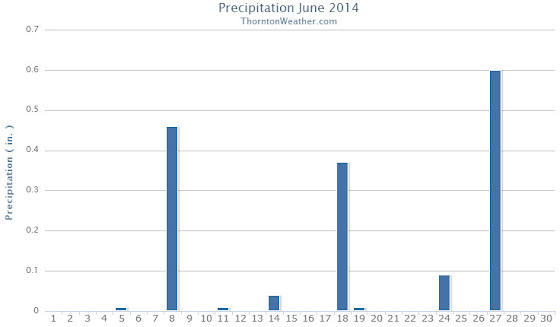
All-in-all, while temperatures and precipitation rain a bit lower than average, June 2014’s weather was pretty close to what we typically expect to see. Thunderstorms made their appearances as always but we were spared much in the way of severe weather.
A series of fronts and troughs moved through northern Colorado during the month. This helped to keep temperatures down and provided thunderstorms with a bit of regularity.
Thornton’s average temperature for the month came in at 66.5 degrees. This is less than one degree below Denver’s historical June average of 67.4 degrees. The Mile High City’s average came in slightly warmer at 67.3 degrees.
Temperatures in Thornton ranged from a high of 92.1 degrees on June 3rd down to a low of 38.2 degrees on the morning of the 9th. Denver was warmer on both measurements with a maximum reading of 94 degrees on the 26th and a low of 42 degrees on the 15th.
Six days saw temperatures top the 90 degree mark in Thornton and Denver. This is below the historical average of 7.9 days of 90 degree or warmer readings we expect to see.
No temperature records were set during the month.
In terms of precipitation, Thornton had 1.59 inches fall into our rain bucket. Denver was a bit wetter with 1.82 inches. Both fell below the June average of 1.98 inches. Thornton saw eight days with measurable precipitation, Denver nine.
Denver set a daily precipitation record of 0.51 inches on the 27th. This bested the old record for that date of 0.29 inches in 1949. Thornton recorded 0.60 inches on the same day.
Thornton, Colorado temperature summary for June 2014.Thornton, Colorado precipitation summary for June 2014.
...THE DENVER CO CLIMATE SUMMARY FOR THE MONTH OF JUNE 2014...

CLIMATE NORMAL PERIOD 1981 TO 2010
CLIMATE RECORD PERIOD 1872 TO 2014

WEATHER         OBSERVED          NORMAL  DEPART  LAST YEAR`S
                 VALUE   DATE(S)  VALUE   FROM    VALUE  DATE(S)
                                          NORMAL
................................................................
TEMPERATURE (F)
RECORD
 HIGH             105   06/26/2012
                        06/25/2012
                        54/01/2206
 LOW               30   06/02/1951
HIGHEST            94   06/26
LOWEST             42   06/15
AVG. MAXIMUM     83.4              82.4     1.0     87.8
AVG. MINIMUM     51.2              52.3    -1.1     54.3
MEAN             67.3              67.4    -0.1     71.1
DAYS MAX >= 90      6               7.9    -1.9       14
DAYS MAX <= 32      0               0.0     0.0        0
DAYS MIN <= 32      0               0.0     0.0        0
DAYS MIN <= 0       0               0.0     0.0        0

PRECIPITATION (INCHES)
RECORD
 MAXIMUM         4.96   1882
 MINIMUM            T   1890
TOTALS           1.82              1.98   -0.16     0.75
DAILY AVG.       0.06              0.07   -0.01     0.03
DAYS >= .01         9               8.4     0.6        4
DAYS >= .10         5               4.6     0.4        2
DAYS >= .50         1               1.4    -0.4        1
DAYS >= 1.00        0               0.3    -0.3        0
GREATEST
 24 HR. TOTAL    0.51   06/27 TO 06/27           06/23 TO 06/23
                        06/26 TO 06/27                    06/22 TO 06/23
                        06/27 TO 06/27                    06/23 TO 06/23
 STORM TOTAL       MM                                 MM
 (MM/DD(HH))            MM                    06/23(00) TO 06/23(00)
                                                 06/23(00) TO 06/23(00)3
                                                 06/23(00) TO 06/23(00)3

SNOWFALL (INCHES)
RECORDS
 TOTAL             MM   MM
TOTALS            0.0               0.0

DEGREE_DAYS
HEATING TOTAL      30                62     -32       29
 SINCE 7/1       6004              6058     -54     6084
COOLING TOTAL     106               133     -27      221
 SINCE 1/1        127               155     -28      263

FREEZE DATES
RECORD
 EARLIEST     09/08/1962
 LATEST       06/08/2007
EARLIEST      10/04             10/07
LATEST        05/14             05/05
....................................................

WIND (MPH)
AVERAGE WIND SPEED              10.5
RESULTANT WIND SPEED/DIRECTION   3/148
HIGHEST WIND SPEED/DIRECTION    39/300    DATE  06/18
HIGHEST GUST SPEED/DIRECTION    55/220    DATE  06/18

SKY COVER
POSSIBLE SUNSHINE (PERCENT)   MM
AVERAGE SKY COVER           0.50
NUMBER OF DAYS FAIR            8
NUMBER OF DAYS PC             21
NUMBER OF DAYS CLOUDY          1

AVERAGE RH (PERCENT)     53

WEATHER CONDITIONS. NUMBER OF DAYS WITH
THUNDERSTORM              0     MIXED PRECIP               0
HEAVY RAIN                3     RAIN                       3
LIGHT RAIN               12     FREEZING RAIN              0
LT FREEZING RAIN          0     HAIL                       3
HEAVY SNOW                0     SNOW                       0
LIGHT SNOW                0     SLEET                      0
FOG                       7     FOG W/VIS <= 1/4 MILE      4
HAZE                      4

-  INDICATES NEGATIVE NUMBERS.
R  INDICATES RECORD WAS SET OR TIED.
MM INDICATES DATA IS MISSING.
T  INDICATES TRACE AMOUNT.
The month of May was a relatively benign, uneventful month in terms of the weather in Thornton. Average temperatures were right on par with normal while precipitation was generous.
We started out the month with warming temperatures and by the third we were seeing highs in the 80s. This only lasted a few days before cooler than normal temperatures settled in for a 10 day period.
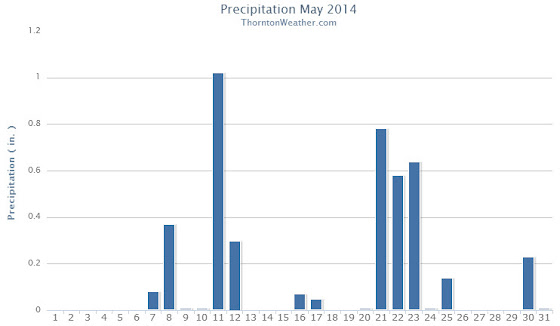
It was during that period that we recorded precipitation for six straight days. This included a good shot of snow on the 11th and 12th.
Temperatures bounced back on the 18th and 19th with highs above 80 degrees but then settled down again to predominantly cooler than normal conditions for the next week. The period from the 20th to the 25th also saw a return to wet conditions.
Warmer and dry conditions returned for a few days and then we closed out the month with cooler temperatures and some more rain.
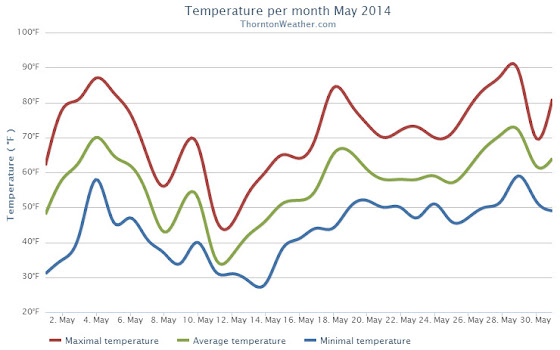
Thornton finished the month with an average temperature of 56.9 degrees. This was just a hair lower than Denver’s May average of 57.1 degrees. The Mile High City’s average temperature came in warmer at 57.5 degrees.
The hottest temperature recorded occurred on the 29th with a reading of 88.7 degrees. The coldest temperature of 28.5 degrees was on the 14th. Denver’s warmest reading was 85 degrees on the 4th and its coldest of 30 degrees was on the 12th.
In terms of precipitation, Thornton saw a healthy 4.26 inches of liquid precipitation. This was well above the May average of 2.12 inches. Similarly, Denver saw above normal precipitation with a reading of 3.51 inches.
Snow fell on two days and totaled 4.3 inches in Thornton. Out at DIA, only 1.1 inches was recorded. Average snowfall for May in Denver is 1.1 inches.
Click here to view Thornton’s May 2014 climate report.
The Thornton, Colorado temperature summary for May 2014. (ThorntonWeather.com)
The Thornton, Colorado precipitation summary for May 2014. (ThorntonWeather.com)
CLIMATE REPORT
NATIONAL WEATHER SERVICE BOULDER, CO
642 AM MDT SUN JUN 1 2014

...................................

...THE DENVER CO CLIMATE SUMMARY FOR THE MONTH OF MAY 2014...

CLIMATE NORMAL PERIOD 1981 TO 2010
CLIMATE RECORD PERIOD 1872 TO 2014

WEATHER         OBSERVED          NORMAL DEPART LAST YEAR`S
                 VALUE   DATE(S) VALUE   FROM    VALUE DATE(S)
                                          NORMAL
................................................................
TEMPERATURE (F)
RECORD
 HIGH              95   05/26/1942
 LOW               19   05/02/2013
                        05/03/1907
HIGHEST            87   05/28        95      -8       88 05/17
                        05/29
LOWEST             30   05/12        19      11      19 05/02
AVG. MAXIMUM     70.6              71.5    -0.9     71.7
AVG. MINIMUM     44.5              42.7     1.8     44.1
MEAN             57.5              57.1     0.4     57.9
DAYS MAX >= 90      0               0.8    -0.8        0
DAYS MAX <= 32      0               0.0     0.0        0
DAYS MIN <= 32      4               1.9     2.1        4
DAYS MIN <= 0       0               0.0     0.0        0

PRECIPITATION (INCHES)
RECORD
 MAXIMUM         8.57   1876
 MINIMUM         0.06   1974
TOTALS           3.51              2.12    1.39     0.82
DAILY AVG.       0.11              0.07    0.04     0.03
DAYS >= .01        13               9.4     3.6        7
DAYS >= .10         6               4.8     1.2        3
DAYS >= .50         3               1.2     1.8        0
DAYS >= 1.00        1               0.2     0.8        0
GREATEST
 24 HR. TOTAL    1.39   05/20 TO 05/21              0.33 05/07 TO 05/08

SNOWFALL (INCHES)
TOTALS            1.1               1.1              3.4

DEGREE_DAYS
HEATING TOTAL     244               265     -21      253
 SINCE 7/1       5974              5996     -22     6055
COOLING TOTAL      21                21       0       42
 SINCE 1/1         21                22      -1       42

FREEZE DATES
RECORD
 EARLIEST     09/08/1962
 LATEST       06/08/2007
EARLIEST                        10/07
LATEST                          05/05
.........................................................

WIND (MPH)
AVERAGE WIND SPEED              10.6
RESULTANT WIND SPEED/DIRECTION   1/181
HIGHEST WIND SPEED/DIRECTION    37/330    DATE 05/21
HIGHEST GUST SPEED/DIRECTION    42/330    DATE 05/21

SKY COVER
POSSIBLE SUNSHINE (PERCENT)   MM
AVERAGE SKY COVER           0.70
NUMBER OF DAYS FAIR            3
NUMBER OF DAYS PC             18
NUMBER OF DAYS CLOUDY         10

AVERAGE RH (PERCENT)     55

WEATHER CONDITIONS. NUMBER OF DAYS WITH
THUNDERSTORM              0     MIXED PRECIP               0
HEAVY RAIN                2     RAIN                       6
LIGHT RAIN               17     FREEZING RAIN              0
LT FREEZING RAIN          1     HAIL                       1
HEAVY SNOW                0     SNOW                       2
LIGHT SNOW                2     SLEET                      1
FOG                      11     FOG W/VIS <= 1/4 MILE      3
HAZE                      3

- INDICATES NEGATIVE NUMBERS.
R INDICATES RECORD WAS SET OR TIED.
MM INDICATES DATA IS MISSING.
T INDICATES TRACE AMOUNT.
Extreme weather can occur during in month in Colorado we well know. June however is when traditional spring severe weather arrives in the state oftentimes with hail, damaging wind and tornadoes.
Over 40 percent of the tornadoes that occur in Colorado happen during the month of June. Far more common are thunderstorms with hail and wind, each responsible for extensive damage each year.
While severe weather is common, so too are brilliantly sunny and mild days as we close out spring and enter summer. If you are looking for cold, it isn’t likely but it is possible as the Denver area has seen freezing temperatures and yes, even snow, during the month.
Colorado’s famously highly variable weather seems to showcase itself during the month of May when a variety of weather conditions can be seen.
Winter-like temperatures and snow are possible as are mid-summer like temperatures or the more typical spring severe weather.
As the month starts out in 2014 we are going to enjoy a mild period with unseasonably warm temperatures and dry conditions. Long range forecasts predict a relatively ‘normal’ May.
However the month can bring extremes. Snow is not entirely uncommon during the month, oftentimes causing damage to newly bloomed trees. More common however is severe weather, particularly in the latter half of the month. Thunderstorms become more frequent and their associated hazards – lightning, wind, hail and tornadoes – are usual visitors.
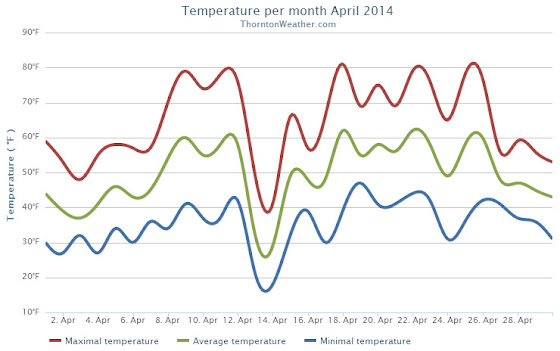
The month of April lacked much in the way of drama for northeastern Colorado. Overall temperatures were warmer than normal and precipitation and snow were lacking a bit.
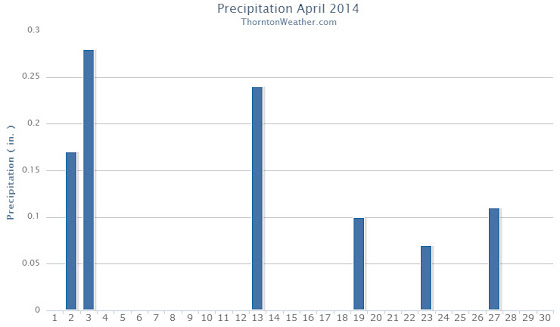
April started out on the cool side and brought the first snow of the month on the 3rd. By the 8th temperatures had rebounded and we enjoyed a five-day stretch of high temps in the 70s.
A storm system and cold front cooled things down on the 13th and we saw a couple of days of light snowfall. As always the weather bounced back and Thornton recorded its first 80+ degree day of the year on the 18th.
The final four days of the month saw things turn cool again. Some light rain was seen but the bigger story was a period of unusually windy conditions.
Denver’s average April temperature is 47.4 degrees (1981 – 2010). For April 2014, the average temperature in Thornton was more than two degrees higher at 49.6 degrees. Out at Denver International Airport, the average came in a bit cooler at 49.0 degrees.
Temperatures in Thornton ranged from a high of 81.3 degrees on the 18th down to a low of 17.6 degrees on the 14th. DIA saw its warmest reading of 80 degrees on the 22nd and its coldest of 18 degrees on the 14th.
Low temperatures dropped below freezing on 11 days in Thornton. No readings below zero were recorded.
In terms of precipitation, Thornton measured 0.97 inch in the bucket. This is a good ways below the Denver April average of 1.71 inches. DIA saw more precipitation than us with a reading of 1.24 inches.
Similarly, snowfall fell short of normal in Thornton and Denver. On average the Mile High City sees 6.8 inches in April. Thornton recorded only 5.5 inches and DIA 5.6 inches.
April 2014 Temperature Summary for Thornton, Colorado. (ThorntonWeather.com)April 2014 Precipitation Summary for Thornton, Colorado. (ThorntonWeather.com)
CLIMATE REPORT
NATIONAL WEATHER SERVICE BOULDER, CO
603 AM MDT THU MAY 1 2014

...................................

...THE DENVER CO CLIMATE SUMMARY FOR THE MONTH OF APRIL 2014...

CLIMATE NORMAL PERIOD 1981 TO 2010
CLIMATE RECORD PERIOD 1872 TO 2014

WEATHER         OBSERVED          NORMAL  DEPART  LAST YEAR`S
                 VALUE   DATE(S)  VALUE   FROM    VALUE  DATE(S)
                                          NORMAL
................................................................
TEMPERATURE (F)
RECORD
 HIGH              90   04/30/1992
 LOW               -2   04/02/1975
HIGHEST            80   04/22        90     -10       80  04/29
LOWEST             18   04/14        -2      20        6  04/10
AVG. MAXIMUM     62.8              61.5     1.3     54.7
AVG. MINIMUM     35.2              33.3     1.9     28.7
MEAN             49.0              47.4     1.6     41.7
DAYS MAX >= 90      0               0.0     0.0        0
DAYS MAX <= 32      0               0.3    -0.3        4
DAYS MIN <= 32     10              13.0    -3.0       17
DAYS MIN <= 0       0               0.0     0.0        0
PRECIPITATION (INCHES)
RECORD
 MAXIMUM         8.24   1900
 MINIMUM         0.03   1963
TOTALS           1.24              1.71   -0.47     1.87
DAILY AVG.       0.04              0.06   -0.02     0.06
DAYS >= .01         6               9.1    -3.1       13
DAYS >= .10         5               4.5     0.5        7
DAYS >= .50         0               0.9    -0.9        0
DAYS >= 1.00        0               0.5    -0.5        0
GREATEST
 24 HR. TOTAL    0.48   04/02 TO 04/03              0.50
                                                04/22 TO 04/23
SNOWFALL (INCHES)
TOTAL             5.6               6.8

DEGREE_DAYS
HEATING TOTAL     472               529     -57      690
 SINCE 7/1       5730              5731      -1     5802
COOLING TOTAL       0                 1      -1        0
 SINCE 1/1          0                 1      -1        0

FREEZE DATES
RECORD
 EARLIEST     09/08/1962
 LATEST       06/08/2007
EARLIEST                        10/07
LATEST                          05/05
......................................................

WIND (MPH)
AVERAGE WIND SPEED              12.9
RESULTANT WIND SPEED/DIRECTION   2/299
HIGHEST WIND SPEED/DIRECTION    49/340    DATE  04/29
HIGHEST GUST SPEED/DIRECTION    66/340    DATE  04/29

SKY COVER
POSSIBLE SUNSHINE (PERCENT)   MM
AVERAGE SKY COVER           0.70
NUMBER OF DAYS FAIR            1
NUMBER OF DAYS PC             22
NUMBER OF DAYS CLOUDY          7

AVERAGE RH (PERCENT)     50

WEATHER CONDITIONS. NUMBER OF DAYS WITH
THUNDERSTORM              0     MIXED PRECIP               0
HEAVY RAIN                0     RAIN                       3
LIGHT RAIN                8     FREEZING RAIN              0
LT FREEZING RAIN          0     HAIL                       1
HEAVY SNOW                2     SNOW                       3
LIGHT SNOW                6     SLEET                      0
FOG                       8     FOG W/VIS <= 1/4 MILE      2
HAZE                      1

-  INDICATES NEGATIVE NUMBERS.
R  INDICATES RECORD WAS SET OR TIED.
MM INDICATES DATA IS MISSING.
T  INDICATES TRACE AMOUNT.
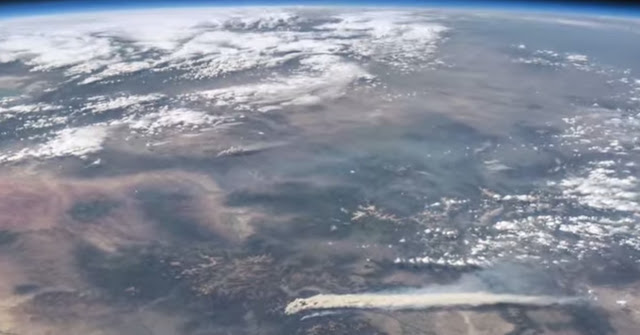
A scene from a new NASA video shows Colorado’s West Fork Fire in June 2013 among other area weather and climate events. (NASA / YouTube)
A stunning video released by NASA this week provides a bird’s eye view of some of the Earth’s most significant weather and climate events of last year.
Using images and movies from satellites and the International Space Station, scenes from across the globe are shown in the video titled “Earth from Orbit 2013.”
Colorado and surrounding states however will draw the most attention from many locally.
From their perch high above, imagery of Colorado’s West Fork Fire in June 2013 is seen as well as the effects of the September floods.
To our south, the drought in New Mexico is seen having taken its toll on Elephant Butte Reservoir in New Mexico. The veritable explosion of storm cells that lea to devastation in Oklahoma during a May tornado outbreak are also shown.
Below the video you will find a description of each scene and links to more imagery.
From NASA – Published on Apr 21, 2014:
A fleet of orbiting satellites monitors Earth constantly. The satellites from NASA and other space agencies give us a fresh, wide perspective on things that we can see from the ground — and things that we can’t.
A look back at Earth in 2013 from the viewpoint of orbit reveals the kind of data gathering and technical achievement that are the reason NASA puts Earth-observing satellites in space. A visualization of satellite and computer model data shows how a cloud of dust from the Chelyabinsk meteor moved around the world. NASA satellites measured the intensity of wildfires, the salinity of the oceans and rainfall around the globe — whether it was too little or too much.
To learn more about NASA’s Earth science in 2014, please visit: www.nasa.gov/earthrightnow
Looking back at the month of March we see a period of relatively uneventful weather in the Denver area. Temperatures were near normal as was the amount of liquid precipitation, this despite the fact we saw well below normal snowfall.
The month started very cold with the first two days failing to record readings above freezing and some light snowfall. That did not last long however and four mild days followed. A weak system then moved in with a couple more shots of snow over a three day period.
Entering the second week of the month temperatures moderated and we saw some of our warmest readings of the month. Light snow on the 12th fell but did not cool things down too much.
Two more very light snowfalls occurred in the last 10 days of the month while temperatures overall remained at or above normal.
Thornton’s average temperature for the month came in at 41.1 degrees, 0.7 degrees above the Denver average for March of 40.4 degrees. Out at Denver International Airport, the Mile High City saw an average monthly temperature of 40.9 degrees.
Our warmest temperature for the month occurred on the 9th when the mercury climbed to 75.0 degrees. The coldest reading of 3.8 degrees happened on March 2. Denver’s warmest and coldest temperatures were on the same days with readings of 73 degrees and 4 degrees.
Two days, the first and the second, saw high temperatures below freezing. Low temperatures below freezing occurred on 22 of the 31 days. Denver saw similar readings.
In terms of liquid precipitation, Thornton recorded 1.06 inches. This was a bit above Denver’s March average of 0.92 inches. Denver was drier than normal recording 0.83 inches.
The near normal precipitation came despite the fact we saw much less snow than normal. March is typically our snowiest with an average of 10.7 inches of the white stuff. Thornton saw a mere 6.5 inches and Denver 6.0 inches.
March 2014 temperature summary for Thornton, Colorado. (ThorntonWeather.com)March 2014 precipitation summary for Thornton, Colorado. (ThorntonWeather.com)
CLIMATE REPORT...CORRECTED
NATIONAL WEATHER SERVICE BOULDER, CO
725 PM MDT TUE APR 1 2014

..............CORRECTED FOR TYPOS FOR THE FOLLOWING.................
.....TEMPERATURES...SNOWFALL DEPARTURES AND PEAK WIND DIRECTION.....

...................................

...THE DENVER CO CLIMATE SUMMARY FOR THE MONTH OF MARCH 2014...

CLIMATE NORMAL PERIOD 1981 TO 2010
CLIMATE RECORD PERIOD 1872 TO 2014

WEATHER         OBSERVED          NORMAL  DEPART  LAST YEAR`S
                 VALUE   DATE(S)  VALUE   FROM    VALUE  DATE(S)
                                          NORMAL
................................................................
TEMPERATURE (F)
RECORD
 HIGH              84   03/26/1971
 LOW              -11   03/28/1886
HIGHEST            73   03/09        84     -11       76  03/15
LOWEST              4   03/02       -11      15        2  03/25
AVG. MAXIMUM     55.8              54.4     1.4     50.7
AVG. MINIMUM     25.9              26.4    -0.5     24.6
MEAN             40.9              40.4     0.5     37.7
DAYS MAX >= 90      0               0.0     0.0        0
DAYS MAX <= 32      2               1.9     0.1        3
DAYS MIN <= 32     23              23.6    -0.6       24
DAYS MIN <= 0       0               0.1    -0.1        0
PRECIPITATION (INCHES)
RECORD
  MAXIMUM         4.56   1983
  MINIMUM         0.03   2012
TOTALS           0.83              0.92   -0.09     1.47
DAILY AVG.       0.03              0.03    0.00     0.05
DAYS >= .01         9               5.9     3.1        6
DAYS >= .10         2               2.4    -0.4        4
DAYS >= .50         0               0.3    -0.3        0
DAYS >= 1.00        0               0.1    -0.1        0
GREATEST
 24 HR. TOTAL    0.32   03/07 TO 03/07           03/22 TO 03/22
                                                          03/22 TO 03/22
                                                          03/22 TO 03/22
 STORM TOTAL       MM                                 MM
 (MM/DD(HH))            MM                    03/22(00) TO 03/22(00)
                                                 03/22(00) TO 03/22(00)2
                                                 03/22(00) TO 03/22(00)2

SNOWFALL (INCHES)
RECORDS
 TOTAL             MM   5
TOTALS            6.0              10.7

DEGREE_DAYS
HEATING TOTAL     739               763     -24      840
 SINCE 7/1       5258              5202      56     5112
COOLING TOTAL       0                 0       0        0
 SINCE 1/1          0                 0       0        0

FREEZE DATES
RECORD
 EARLIEST     09/08/1962
 LATEST       06/08/2007
EARLIEST                        10/07
LATEST                          05/05
...................................................

WIND (MPH)
AVERAGE WIND SPEED              11.5
RESULTANT WIND SPEED/DIRECTION   3/247
HIGHEST WIND SPEED/DIRECTION    45/350    DATE  03/18
HIGHEST GUST SPEED/DIRECTION    55/350    DATE  03/18

SKY COVER
POSSIBLE SUNSHINE (PERCENT)   MM
AVERAGE SKY COVER           0.60
NUMBER OF DAYS FAIR            6
NUMBER OF DAYS PC             18
NUMBER OF DAYS CLOUDY          7

AVERAGE RH (PERCENT)     50

WEATHER CONDITIONS. NUMBER OF DAYS WITH
THUNDERSTORM              0     MIXED PRECIP               0
HEAVY RAIN                0     RAIN                       2
LIGHT RAIN                3     FREEZING RAIN              0
LT FREEZING RAIN          1     HAIL                       0
HEAVY SNOW                0     SNOW                       6
LIGHT SNOW               10     SLEET                      0
FOG                      12     FOG W/VIS <= 1/4 MILE      5
HAZE                      5

-  INDICATES NEGATIVE NUMBERS.
R  INDICATES RECORD WAS SET OR TIED.
MM INDICATES DATA IS MISSING.
T  INDICATES TRACE AMOUNT.
April marks a transition between winter and summer for most of the country but for Denver it is especially true as we can see a stunning variety of weather.
The proverbial April showers are certainly a possibility for Denver. Snow? Tornadoes? Thunderstorms? You bet – all can happen!
For good measure throw in a chance for hail and even dust storms and April gives every type of weather condition you could like – or hate.
Satellite imagery provides bird’s eye view of Earth at the change of seasons.
Pretty neat imagery and explanation from NASA:
Enjoy the Equinox!
Every year, there are two equinoxes. One is in March; the other is in September. In 2014, the March equinox falls on March 20, 2014. On the equinoxes, the sun shines directly on the equator and the length of day and night is nearly equal. Seasons are opposite on either side of the equator, so the March equinox is called the spring (or vernal) equinox in the northern hemisphere. But in the southern hemisphere, it’s known as the fall (autumnal) equinox. What do equinoxes look like from space? The Spinning Enhanced Visible and Infrared Imager (SEVIRI) on EUMETSAT’s Meteosat-9 captured these four views of Earth from geosynchronous orbit. The images show how sunlight fell on the Earth on December 21, 2010 (upper left), and March 20 (upper right), June 21 (lower left), and September 20, 2011 (lower right). Each image was taken at 6:12 a.m. local time. Notice how on March 20 and September 20, the terminator — the divide between day and night — is a straight north-south line, and the Sun is said to sit directly above the equator. Equinox means “equal night” in Latin, capturing the idea that daytime and nighttime are equal lengths everywhere on the planet.


 Extreme weather can occur during in month in Colorado we well know. June however is when traditional spring severe weather arrives in the state oftentimes with hail, damaging wind and tornadoes.