Denver and Thornton's March 2009 climatological preview
March in Denver typically means frequent and rapid weather changes. The days grow longer and we start enjoying more sunshine and sometimes summer-like weather. However, on occasion arctic air masses can still force their way south into Colorado dropping temperatures quickly and markedly.
These changes are due to Marches “in between” status – elements during the month have much in common with winter and spring. In addition to arctic fronts, Pacific storms frequently move across Colorado from the west and warm moist air streams up from the Gulf of Mexico northeastward into the state. When these cold fronts collide with the warmer air masses the result can be some crazy weather.
A recent analysis of climate models shows they are falling outside acceptable scientific limits.
Last month former vice president Al Gore made a well publicized appearance before a Senate committee warning of the dangers of global warming. Lesser known is the appearance of a climatologist before a House subcommittee two weeks later that called into question the models on which anthropogenic [manmade] global warming advocates use to base their assertions on.
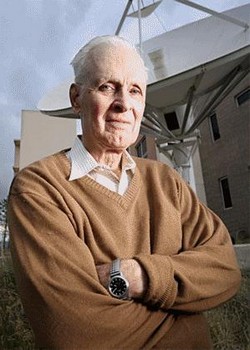
We include his resume as it is significant because it shows that this is someone with a deep background in climatology and a wealth of experience. When someone of this caliber discusses climate change and anthropogenic global warming we can and should take notice.
In testimony to the U.S. House of Representatives Subcommittee on Energy and Environment, Dr. Michaels testified on the little known fact that the scientific models used to predict global warming are starting to fall outside acceptable scientific limits. They have been unable to accurately predict temperature increases and when used to model historical increases, they fail as well.
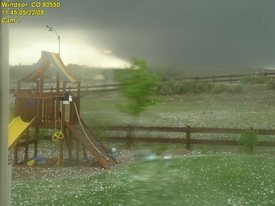
The Weather Channel's new season of Storm Stories will feature the Windsor Tornado from May 2008. This scary image was taken by the webcam of MyWindsorWeather.com as the twister tore through the town on May 22, 2008.
This Sunday, February 22nd at 6:00pm MST, the Weather Channel will premiere the new season of its series Storm Stories. Most notably, the first episode will highlight a weather event from last year that struck very close to home – the May 22nd Windsor Tornado.
For those that haven’t seen Storm Stories, it is an exciting, sometimes scary and sad series discussing significant weather events as seen through the eyes of those that experienced it firsthand. For the Sunday episode, renowned storm tracker Jim Cantore from the Weather Channel will tell the story of the twister using footage from a variety of sources, including the video most have seen from KUSA (see below).
The kickoff of the new season of Storm Stories is actually the beginning as well of the Weather Channel’s ‘Tornado Week’ in which twisters are front and center. Other episodes of note during the week:
Monday – the “Parkersburg, IA, Tornado” on May 25, 2008, killed seven people and demolished the southern half of the town; first-hand accounts are given by residents.
Tuesday – the “Greensburg, KS, Tornado” on May 5, 2008, wiped out the entire town. The story is told through the experiences of next-door neighbors who saved a mother and her baby from the rubble.
Wednesday – “Super Tuesday” tornadoes cut a swath over a wide area Feb. 5, 2008; touching stories come from people that were affected in Arkansas, Kentucky and Tennessee.
Thursday – the “Boy Scouts Tornado” hit the Little Sioux Scout Ranch in western Iowa last June, catching everyone off guard. The surviving scouts are forced to put their training to use in the midst of a terrifying situation to help keep injured scouts alive in the aftermath.
Hot or not? Are the global climate models accurate or are they full of hot air?
The science behind the theory of anthropogenic global warming (AGW), or manmade climate change, has been said to be ‘settled’. The United Nation’s Intergovernmental Panel on Climate Change (IPCC), Al Gore, and Dr. James Hansen make up a triumvirate of climate change advocates. Wielding studies, computer models, and various charts and analyses, they believe man is heading down the road to self-destruction of we do not reverse course immediately and do everything and anything to stop what they believe is an unnaturally warming climate.
We continue our analysis of not only the battle between Dr. William Gray and Dr. James Hansen but the larger issue of anthropogenic global warming. In his letter Dr. Gray raises some very interesting arguments about Hansen’s research and about the science behind the theory of AGW. Today we take a closer look at the science as Dr. Gray sees it.
The new exhibit will cover the entire gamut of major natural disasters including earthquakes, hurricanes, tornadoes, and volcanoes. A special ‘Colorado Connections’ section will take a look at the Colorado’s volcanic history as well as the various types of severe weather that affect the state. Drought, floods, wildfire, blizzards, climate change and tornadoes are all discussed in depth.
According the museum:
From earthquakes and volcanoes to hurricanes and tornadoes, nature’s forces have shaped our dynamic planet. Throughout history, these catastrophic phenomena have affected people around the world. Now, uncover the causes of these natural disasters and find out how people cope and adapt in the aftermath. In this captivating, interactive new exhibition all of nature’s power is on display at the Denver Museum of Nature & Science.
In addition to the exhibits, the museum has lined up a great slate of additional events including lectures on the following:
Grand Canyon Adventure: River at Risk
Storm Chasing
Natural Disasters on Other Planets
Natural Disasters in Film
Also not to be missed are tours they have arranged for:
NCAR Mesa Lab in Boulder
National Oceanic and Atmospheric Administration (NOAA) in Boulder
Dr. William Gray is a vocal opponent of the anthropogenic global warming theory and recently took issue with Dr. James Hansen of NASA's GISS.
Last week we wrote about an extremely strongly worded letter from William Gray to the American Meteorological Society (AMS) objecting to their awarding James Hansen their highest award. This letter pits two of the giants in meteorology and climatology against each other in the debate over manmade climate change and global warming.
The letter itself (available here on icecap.us) takes issue with some of the decision making processes within the AMS which is not particularly relevant to us. What is revealing however is Dr. Gray’s arguments against the global warming theory and Dr. Hansen’s research. Today we will take a look at the discussion in the letter about Dr. Hansen himself and his credentials.
For those that aren’t familiar with him, Dr. Gray is a Professor Emeritus of Colorado State University who is best known for his hurricane forecasts. He is a highly trained and respected meteorologist with decades of practical experience in monitoring the earth and its climate.
In the letter he points out that Dr. Hansen, head of NASA’s Goddard Institute for Space Studies (GISS), is not a trained climatologist nor a meteorologist. His formal background is actually in astronomy which does make one wonder how he has become one of the primary mouthpieces for anthropogenic global warming (AGW), or manmade climate change.
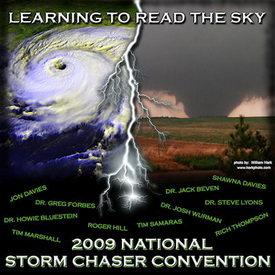
Denver will host the 11th annual National Storm Chaser Convention from February 13th to February 15th.
The 11th annual National Storm Chaser Convention hits town this weekend as some of the nation’s premier storm chasers converge on Denver. Whether you are a seasoned chaser or just someone with an interest in the weather, this is an extraordinary opportunity to mingle with and hear from some of the biggest names in severe weather. The event is organized every year by two of the biggest names in storm chasing – Roger Hill and Tim Samaras.
Held at the Red Lion Inn in Parker, the event kicks off Friday night with an ice-breaker and a chance to mingle with other weather enthusiasts. Saturday morning the event starts in earnest with an extraordinary slate of speakers covering an array of topics. Saturday night is the infamous video night where videos and photos from last year’s record setting year of tornadoes are sure to play a big part and Sunday the convention continues with additional speakers.
Battle of the climate scientists - William Gray versus James Hansen.
Certainly the debate over manmade climate change and global warming can get heated at times (pun intended). Today that went to a new level pitting William (Bill) Gray, Professor Emeritus of Colorado State University who is best known for his hurricane forecasts against James Hansen of NASA’s GISS division and devout climate change advocate.
Bill Gray has long been warning that the threat of manmade climate change is not real. In his own words, “I am of the opinion that this is one of the greatest hoaxes ever perpetrated on the American people. I’ve been in meteorology over 50 years. I’ve worked damn hard, and I’ve been around. My feeling is some of us older guys who’ve been around have not been asked about this. It’s sort of a baby boomer, yuppie thing.”
On the other side James Hansen has become Al Gore’s best friend thanks to his sometimes outlandish claims about the effects of global warming. He recently warned that President Obama has ‘four years to save the world’ and was quoted as saying, “We cannot afford to put off change any longer. We have to get on a new path within this new administration. We have only four years left for Obama to set an example to the rest of the world. America must take the lead.”
The latest battle is over the decision of the American Meteorological Society (AMS) to grant its highest award, the Rossby Research Medal, to Hansen. In a seven page letter to the AMS titled “On The Hijacking of the American Meteorological Society,” Mr. Hansen no longer seems willing to be outshouted in the debate over global warming.
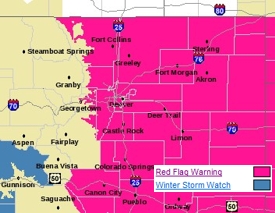
The entire eastern half of Colorado is under a Red Flag Warning through Friday evening.
The National Weather Service has updated the Red Flag Warning and it will now go into effect at 9:00am today and run through 9:00pm. Further, the warning now covers the entire eastern half of the state of Colorado and in fact extends to the south and east into parts of Nebraska, Kansas, Oklahoma, Texas and New Mexico. This of course covers the entire Denver metro area and the Front Range.
The extension and widening of the warning should serve to really drive home how dry things are and how serious the fire conditions are. Please be sure to take appropriate precautions as we certainly would like to avoid any wildfires.
RED FLAG WARNING
NATIONAL WEATHER SERVICE DENVER CO
456 AM MST FRI FEB 6 2009
…Dry and windy conditions across the plains and lower foothills today…
Very dry air will combine with strong winds to produce increased fire danger over the foothills and plains of northeast Colorado today. Winds will gust as high as 40 mph on the plains this afternoon with gusts to 50 mph in the foothills. Minimum humidities will range from 10 to 15 percent. Conditions will improve on the plains around sunset…with warm and breezy conditions lingering in and near the foothills through the early evening hours.
…Red Flag Warning now in effect from 9 am this morning to 9 pm mst this evening for gusty winds and low humidities…
The Red Flag Warning is now in effect from 9 am this morning to 9 pm mst this evening. A Red Flag Warning is now in effect for all of the plains and foothills areas of eastern Colorado… Including fire weather zones 235…236…and 238 through 251.
West winds of 20 to 35 mph will become widespread in and near the southern Front Range foothills this morning…and spread across the plains by afternoon. Gusts as high as 50 mph are possible in the foothills. Relative humidities will drop into the 8 to 15 percent range. The combination of the gusty winds…low humidities and dry fuels will create very high fire danger. The gusty winds will decrease and the relative humidities will increase this evening.
A Red Flag Warning means that critical fire weather conditions are either occurring or imminent. Please advise the appropriate officials and fire crews in the field of this Red Flag Warning.
The Denver weather has been nice but we are extremely dry and in need of some moisture.
This week we have had some extraordinarily nice weather and it has been great. The mountains are certainly having a great year for snow with all of the major basins exceeding 100% of average for snowpack. However, here along the Front Range and the plains, we are bone dry and well below normal for snowfall.
As of today, Denver has received only half of its normal amount of snow for this point in the snow season which runs from July through June. By the first of February, we normally should have received 33.3 inches. To date for the 2008 – 2009 season we have received a mere 16.9 inches of snow as measured at Denver International Airport. Closer to the central part of the city, Stapleton has been even drier with only 13.1 inches of the white stuff to date.
For a complete look at how bleak the moisture has been along the Front Range, check out the details in our Examiner.com story.