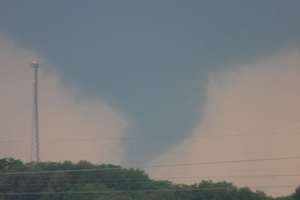
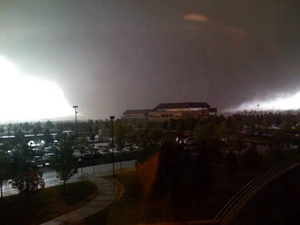
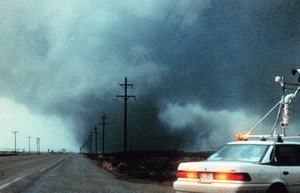
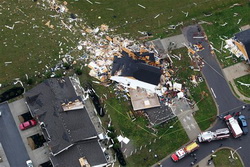
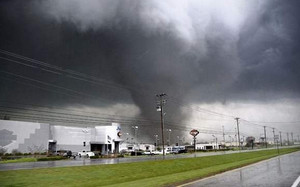
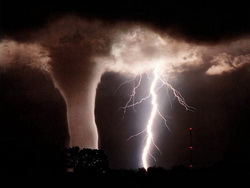
A tornado tears through Adair County Wednesday evening. This photograph was taken by Dr. Curtis Roof from Highway 6, facing west. The tornado traveled on a northeastern path, damaging several homes along the way. (Dr. Curtis Roof/Kirksville Daily Express)
The quiet rural area of Kirksville, Missouri was ripped apart Wednesday evening by four tornadoes that destroyed and damaged homes and claimed the lives of three people. The first of the series of tornadoes was reported at 5:49pm local time near this town 120 miles northeast of Kansas City.
Adair County bore the brunt of the line of severe storms as they moved northeast across the nation’s midsection. Two twisters were reported near Novinger, one near Troy Mills and the most damaging one in Kirksville. The Kirksville tornado destroyed at least one house and damaged 30 – 40 others as well as a car dealership.
Two victims were killed in Adair County according to the Missouri State Highway Patrol. No details on the circumstances or their names have been released other than to say they were tornado related. One woman was killed in neighboring Sullivan County when a tornado struck her mobile home.
Last year's Windsor tornado highlighted just how dangerous weather in Colorado can be. Are you and your family prepared?
As is customary, the governor has declared this week Severe Weather Awareness Week. This is an opportunity for the public to get reacquanted with the dangers severe weather presents in Colorado.
Tornadoes, lightning, hail, severe wind and flooding are very real hazards that Coloradoans face every year during severe weather season. It is important that you know what to do to protect you and your family.
In conjunction with the National Weather Service, Examiner.com will be publishing our Severe Weather 101 series. Each day this week a weather hazard will be discussed in depth and we will outline protective measures you can take to keep yourself and your family safe. Please be sure to check back every day to read these important message.
Thunderstorm hazards around the corner…are you prepared?
Severe thunderstorm season will be soon upon us. Do you know how to stay safe around tornadoes, flash floods, lightning, hail, and damaging winds? This is the week to learn. This week, April 19th to 25th, is Colorado severe weather awareness week. This is the time to learn more about severe weather in Colorado, develop severe weather preparedness plans, and test vital communications.
Can we learn lessons from the past severe weather events? Just last year on may 22nd an EF3 tornado raced north through Weld and Larimer counties resulting in one fatality. Several injuries and destroyed or heavily damaged hundreds of homes. Two years ago, on March 28, 2007 the town of Holly was heavily damaged by another EF3 tornado that resulted in two fatalities. Twelve years ago on July 28, 1997 a devastating flash flood occurred in Fort Collins resulting in 5 fatalities and millions of dollars in damage.
Each year for the past 20 years there have been an average of 50 tornadoes in Colorado, 3 people killed by lightning and another 15 injured by lightning.
The National Weather Service offices which cover Colorado will issue a series of public information statements during the week covering the following topics:
Monday…Watches and warnings
Tuesday… Tornadoes and tornado safety
Wednesday…Flash floods and flash flood safety
Thursday…Downburst wind and hail
Friday…Lightning and lightning safety
Saturday…A review of the week
A time to test your warning reception and communications systems is planned. Each national weather service office serving Colorado will send test tornado warnings on Tuesday April 21 between the hours of 8 am MDT and 11 am MDT. These test warnings will be sent to the emergency alert system, the internet, NOAA weather radio and law enforcement communications systems.
Safety information, watches, warnings, forecasts, past weather and much more information is available at your local National Weather Service web sites:
The VORTEX2 tornado research project will be the largest in-field study of tornadoes ever.
The single largest and most ambitious field study to increase our understanding of tornadoes is set to kick off next month. The Verification of Origin of Rotation in Tornadoes EXperiment2 (VORTEX2 or V2) will feature more than 50 scientists utilizing 40 vehicles, 10 mobile radar units and an Unmanned Aerial Vehicle (UAV).
The study which will run from May 10 to June 13 will become the largest mobile in-field laboratory ever assembled to study tornadoes. In a statement Louis Wicker, research meteorologist with NOAA’s National Severe Storms Laboratory and V2 co-principal investigator said, “Data collected from V2 will help researchers understand how tornadoes form and how the large-scale environment of thunderstorms is related to tornado formation.”
The VORTEX2 tornado research project will be the largest in-field study of tornadoes ever.
Operations will be controlled at the National Weather Center in Norman, Oklahoma while the mobile units chase tornadoes across Tornado Alley and the central Great Plains. The target area for the study ranges from southern South Dakota through Nebraska, Kansas, Oklahoma and the Texas Panhandle. Eastern Colorado, home of many tornadoes, is included in the study.
This unprecedented gathering of scientists and technology hold incredible promise for the research that will be gathered. The original VORTEX program which happened from 1994 to 1995 documented the entire life cycle of a tornado from start to finish, the first time that had ever been done. That research greatly enhanced our understanding of twisters and led to much improved tornado warnings that help to save lives today.
VORTEX2 seeks to build on that research and the research that has taken place since. According to the project website it will seek to answer such important questions as: How do tornadoes form? What exactly causes the wind to spin into a concentrated funnel? How can we tell exactly when a tornado will form and when it will die, or how long it will last? Why do some thunderstorms produce tornadoes and others do not? What is the structure of tornadoes? What is the relationship of tornadic winds to damage?
An important finding from the original VORTEX experiment was that the factors responsible for causing tornadoes happen on smaller time and space scales than scientists had thought. New advances will allow for a more detailed sampling of a storm’s wind, temperature and moisture environment and lead to a better understanding of why tornadoes form – and how they can be more accurately predicted.
– Stephan Nelson, NSF program director for physical and dynamic meteorology.
VORTEX2 features scientists and students from the United States, Canada and Australia in collaboration with government agencies, private industry and educational institutions. Many luminaries within the storm chasing and severe weather research community will participate including Dr. Josh Wurman of the Discovery Channel’s Storm Chasers TV show. Some of the notable participating organizations include Center for Severe Weather Research, Rasmussen Systems, NOAA National Severe Storms Laboratory, OU/NOAA Cooperative Institute for Mesoscale Meteorological Studies, NSF-sponsored National Centers for Atmospheric Research, Penn State University, University of Oklahoma, Texas Tech University, Lyndon State College, University of Colorado, Purdue University, North Carolina State University, University of Illinois, University of Massachusetts, University of Nebraska, Environment Canada, and the Australian Bureau of Meteorology.
Thus far the 2009 tornado season has been quiet compared to years past.
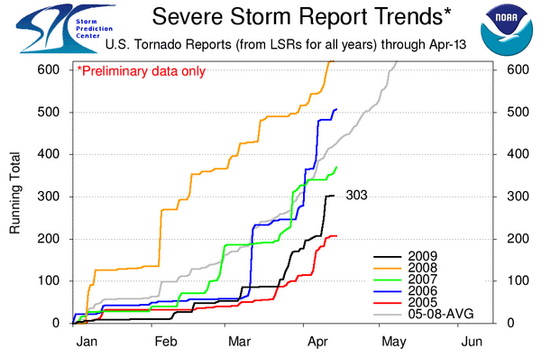
The severe weather season has started in earnest now and last week’s deaths of five people from tornadoes highlight the danger this time of year brings. Thus far however, 2009 is below the three year average not only in the total number of tornadoes reported but also in the number of tornado related deaths.
In terms of the number of tornado reports, through yesterday there have been 303 preliminary reports in 2009. Over the last three years the United States has averaged 391 per year through April 13th. That means that 2009 is thus far 23% below average.
Tornado Reports by Year Through April 13th
2009
2008
2007
2006
3yr Avg
303
494
286
392
391
It is important to note that all of those counts are based on preliminary tornado reports. The actual number of tornadoes that occurred typically is reduced by about 15 percent as duplicate reports are eliminated. Nevertheless, this does show 2009 is running well below average.
In terms of fatalities caused by twisters, there have been 14 thus far this year. This too is below the three year average of 54 per year through April 13th. That is a large 75% reduction which is notable and something certainly to be thankful for.
Tornado Fatalities by Year Through April 13th
2009
2008
2007
2006
3yr Avg
14
70
52
50
57
It is important to note that while this year shows promise for being a less deadly and less destructive tornado season, the season is far from over. May and June are typically the most active months of the season and one large outbreak could radically change these numbers.
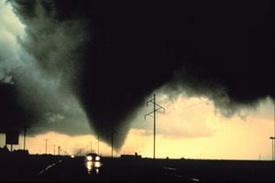
A tornado rips through Murfreesboro, TN where a mother and child lost their lives in the twister.
The end of the week saw severe weather claim the lives of seven people across the nation on Thursday and Friday.
Mena, Arkansas Tornado Claims Three Lives
Daylight Friday in the western Arkansas town of Mena brought a devastating sight after a tornado tore through the town killing three people and injuring at least 24. Reports are that hundreds of homes and businesses have been destroyed in the town of 5,000.
Tornado sirens blared yesterday evening in the town warning of the coming danger. At about 8:30pm local time the twister struck. Two women and one man lost their lives in the storm. One victim died in a collapsed house, another in a front yard and the third in a Masonic Lodge.
Wildfires in Texas and Oklahoma Wildfires Claim Two Lives, Injure Dozens
Wind-driven wildfires in Texas And Oklahoma proved deadly Thursday afternoon as a Texas couple was killed in the blazes and dozens more injured. The fires in western and central Oklahoma injured at least 34 people and burned over 100 homes. In Texas, a former television reporter and his wife were killed.
High winds, low humidity and an abundance of dry fuels sparked the wildfires and made for prime conditions for them to quickly burn out of control. In Oklahoma the fires started along I-35 and forced its closure for a time although it is now open. Entire towns were evacuated including Healdton, Sparks, Velma, Wellston and Midwest City.
Mother and child killed by tornado in Murfreesboro, Tennessee
A mother and her three month old baby were killed in Murfreesboro, Tennessee today when a tornado went through the central part of the state Friday. The Tennessee Emergency Management Agency reports that 30 were also injured by the twister as a line of storms stretching from Alabama, across Tennessee and into Kentucky wreaked havoc. The deadly twister comes on the heels of one that killed three people in Arkansas Thursday.
The mother and child whose lives were lost were taken to Middle Tennessee Medical center but were dead when they arrived. The city of 105,000 saw roofs ripped from homes and trees downed as the twister struck the northern and western parts of the city.
Want to be an official storm spotter or maybe just want to learn more about severe weather? Here’s your chance!
We have written before about the great opportunity the National Weather Service provides by giving storm spotter training during the start of the severe weather season. That time is now here and training sessions start in the coming week and new sessions have been added since we last reported on the topic.
The storm spotter program is a nationwide program with more than 280,000 trained spotters. These volunteers report weather hazards to their local National Weather Service office providing vital information when severe strikes. Data from spotters include severe wind, rain, snow measurements, thunderstorms and hail and of course tornadoes.
Storm spotters are part of the ranks of citizens who form the Nation’s first line of defense against severe weather. There can be no finer reward than to know that their efforts have given communities the precious gift of time–seconds and minutes that can help save lives.
By completing one of these training classes you can become an official storm spotter. When severe weather strikes, you can report it by calling a special toll free number or submit your report via the National Weather Service’s website.
These are great sessions for anyone wanting to learn more about the severe weather we experience in Colorado, whether you want to be an official spotter or not. All training is free. Topics include:
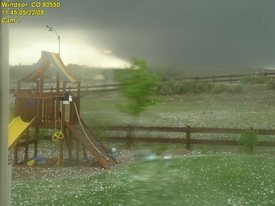
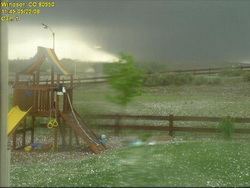
The Weather Channel's new season of Storm Stories will feature the Windsor Tornado from May 2008. This scary image was taken by the webcam of MyWindsorWeather.com as the twister tore through the town on May 22, 2008.
This Sunday, February 22nd at 6:00pm MST, the Weather Channel will premiere the new season of its series Storm Stories. Most notably, the first episode will highlight a weather event from last year that struck very close to home – the May 22nd Windsor Tornado.
For those that haven’t seen Storm Stories, it is an exciting, sometimes scary and sad series discussing significant weather events as seen through the eyes of those that experienced it firsthand. For the Sunday episode, renowned storm tracker Jim Cantore from the Weather Channel will tell the story of the twister using footage from a variety of sources, including the video most have seen from KUSA (see below).
The kickoff of the new season of Storm Stories is actually the beginning as well of the Weather Channel’s ‘Tornado Week’ in which twisters are front and center. Other episodes of note during the week:
Monday – the “Parkersburg, IA, Tornado” on May 25, 2008, killed seven people and demolished the southern half of the town; first-hand accounts are given by residents.
Tuesday – the “Greensburg, KS, Tornado” on May 5, 2008, wiped out the entire town. The story is told through the experiences of next-door neighbors who saved a mother and her baby from the rubble.
Wednesday – “Super Tuesday” tornadoes cut a swath over a wide area Feb. 5, 2008; touching stories come from people that were affected in Arkansas, Kentucky and Tennessee.
Thursday – the “Boy Scouts Tornado” hit the Little Sioux Scout Ranch in western Iowa last June, catching everyone off guard. The surviving scouts are forced to put their training to use in the midst of a terrifying situation to help keep injured scouts alive in the aftermath.
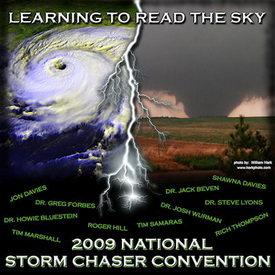
Denver will host the 11th annual National Storm Chaser Convention from February 13th to February 15th.
The 11th annual National Storm Chaser Convention hits town this weekend as some of the nation’s premier storm chasers converge on Denver. Whether you are a seasoned chaser or just someone with an interest in the weather, this is an extraordinary opportunity to mingle with and hear from some of the biggest names in severe weather. The event is organized every year by two of the biggest names in storm chasing – Roger Hill and Tim Samaras.
Held at the Red Lion Inn in Parker, the event kicks off Friday night with an ice-breaker and a chance to mingle with other weather enthusiasts. Saturday morning the event starts in earnest with an extraordinary slate of speakers covering an array of topics. Saturday night is the infamous video night where videos and photos from last year’s record setting year of tornadoes are sure to play a big part and Sunday the convention continues with additional speakers.
2008 will go down as the second most active year for tornadoes on record.
According to the latest data from the Storm Prediction Center, the number of confirmed tornadoes in 2008 will finish well above average. Final numbers through the end of October count 1,621 twisters, exceeding the average over the last ten years of 1,270 per year.
Once the data is finalized, the year will most likely go down as the second most active tornado year on record since record keeping began in 1950. 2004 was the most active year with 1,871 and the number three year was 1998 with 1,424.
While some alarmists may look to climate change as a reason for what seems to be an increase in the number of twisters, the explanation is actually much simpler than that. Technology like radar now allows us to ‘see’ tornadoes in rural areas that normally would have gone unreported. Further, as population grows, there are simply more people living in areas that were unpopulated before and thus twisters are spotted more often.
What about Colorado? Certainly we all remember the Windsor tornado in May. Beyond that, there were a total of 61 tornado reports in 2008. The actual number of twisters will certainly be lower than that once duplicate reports are removed and the tally is official.
TORNADO TOTALS AND RELATED DEATHS...THROUGH 12/31/2008
NWS STORM PREDICTION CENTER NORMAN OK
0726 AM CST THU JAN 01 2009

    ...NUMBER OF TORNADOES...            NUMBER OF        KILLER
                                       TORNADO DEATHS    TORNADOES
     ..2008..  ..2007.. 2006 2005  3YR            3YR            3YR
    PREL  ACT PREL  ACT  FIN  FIN   AV 08 07 06 05 AV 08 07 06 05 AV
JAN  136   84   29   21   47   33   34  7  2  1  4  2  4  1  1  2  1
FEB  230  148   87   52   12   10   25 59 22  0  0  7 12  3  0  0  1
MAR  150  126  214  171  150   62  128  4 27 11  1 13  3 10  7  1  6
APR  189  189  187  165  245  132  181  0  9 38  0 16  0  3  9  0  4
MAY  597  460  282  250  139  123  171 43 14  3  0  6 10  4  1  0  2
JUN  394  289  152  128  120  316  188  7  0  0  0  0  4  0  0  0  0
JUL  120   94   55   69   71  138   93  1  0  0  0  0  1  0  0  0  0
AUG  145   99   87   73   80  123   92  0  1  1  4  2  0  1  1  3  2
SEP  133  111   63   51   84  133   89  2  0  1  1  1  1  0  1  1  1
OCT   28   21  115   87   76   18   60  0  5  0  0  2  0  3  0  1  1
NOV   20    -    7    7   42  150   66  2  0 10 28 13  2  0  3  5  3
DEC   50    -   22   19   40   26   33  0  1  2  0  1  0  1  2  0  1
    ----  --- ---- ---- ---- ---- ---- --- -- -- -- -- -- -- -- -- --
SUM 2192 1621 1300 1093 1106 1264 1159 125 81 67 38 62 37 26 25 13 21

PREL = 2009 PRELIMINARY COUNT FROM NWS LOCAL STORM REPORTS.
ACT = ACTUAL COUNT BASED ON NWS STORM DATA SUBMISSIONS.

TORNADO-RELATED FATALITY NUMBERS ARE ENTERED WHEN CONFIRMED BY NWS
FORECAST OFFICES.
This amazing image of the Windsor tornado was taken from a backyard webcam. Image courtesy MyWindsorWeather.com.
May 22, 2008 started like most other spring days in Colorado. That Thursday morning had dawned with relatively mild temperatures and a touch of humidity in the air. That moisture in the air was a warning sign as moist air from the Gulf of Mexico was entering the state and a signal of the potential for severe storms. No one knew though just what was in store for a small town in northeastern Colorado.
As temperatures rose in the morning, the moist air near the ground mixed with fast moving dry air aloft and created conditions ideal for supercell thunderstorms and tornadoes. Hail began to fall around 11:20am near Platteville, a harbinger of things to come. As the weather situation became much more excited and confused, reports of a twister on the ground near Gilcrest at 11:29 rolled in.
A classic wedge tornado had formed and was moving to the north-northwest at a leisurely 30 mph wreaking havoc and destruction all along its path. Examiner.com soon posted a special report at 11:30 warning of the twister and showing its expected path. It narrowly missed the town of Milliken, dumping baseball sized hail on it instead. The twister was now a full mile wide with winds in excess of 136 mph and at 11:57am, the storm struck Windsor, home to 16,000 Coloradoans. By the time it was done with the town, it had claimed one life, destroyed 80 homes and damaged nearly 770 others.
For a total of nearly 45 minutes the storm carved a 35 mile long path of devastation and all along its path it left the evidence – houses with nothing but a foundation left, power poles snapped like matchsticks, semi-trailers overturned like toy cars, mangled pieces of metal and shards of wood.
Tornadoes in Colorado are not uncommon with an average of 60 per year, although most do occur on the eastern plains in more rural areas. The storm was only the second deadly tornado in Colorado in the last 10 years (the Holly tornado in 2007 being the other) but it served to highlight that the Front Range is on the western edge of Tornado Alley. Weld County is in fact Colorado’s own tornado capital having had more twisters than any other county since 1950.
When it was over, Coloradoans showed their sense of community in helping the affected areas. The Red Cross immediately went into action as did the state government in calling out the National Guard to help. Donations poured in and other relief agencies provided food and shelter to those left homeless. While the Windsor Tornado was an example of the worst of Mother Nature, the storm also showed us the best of mankind. No other weather event comes close to being Colorado’s biggest weather story of 2008.
Below is some amazing raw video from 9News of the tornado as it moved north.
Weather, natural disasters & climate news and information.