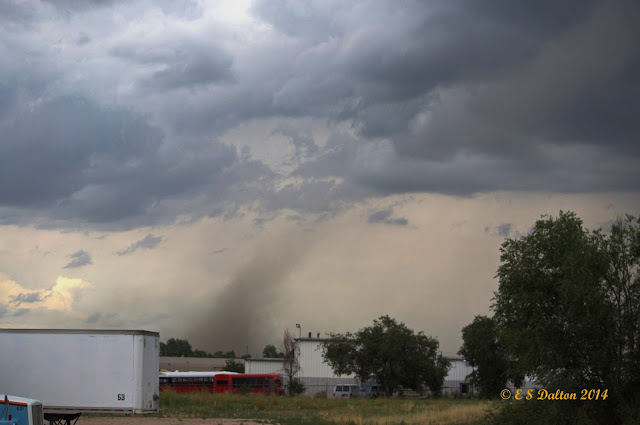
July 28, 2014 – Image of the tornado at the Rocky Mountain Arsenal. (Ed Dalton) Click for a larger view.
Monday’s forecast called for a chance for thunderstorms but Mother Nature threw in a couple of wildcards in the form of two tornadoes in the area. The landspout tornadoes caused minor damage in north Denver and were widely seen across much of the area.
The first tornado was reported at 3:53pm just across the Adams County line in Weld County near Fort Lupton. The twister was the better defined of the two but appears to have struck farmland with no damage reported.
Videos: Watch amazing footage of the Weld County tornado below
At 4:09pm a second tornado was reported near the Rocky Mountain Arsenal National Wildlife Refuge in Adams County. A diesel repair shop near 51st and Havana had one of its garage doors ripped off and some material thrown about.
Denver International Airport sent travelers to shelters for a period of time and warning sirens were sounded in Brighton, Commerce City and other nearby locations.
Three people on a small boat on Barr Lake were overturned by the strong thunderstorm winds. The trio managed to swim to shore and were not injured.
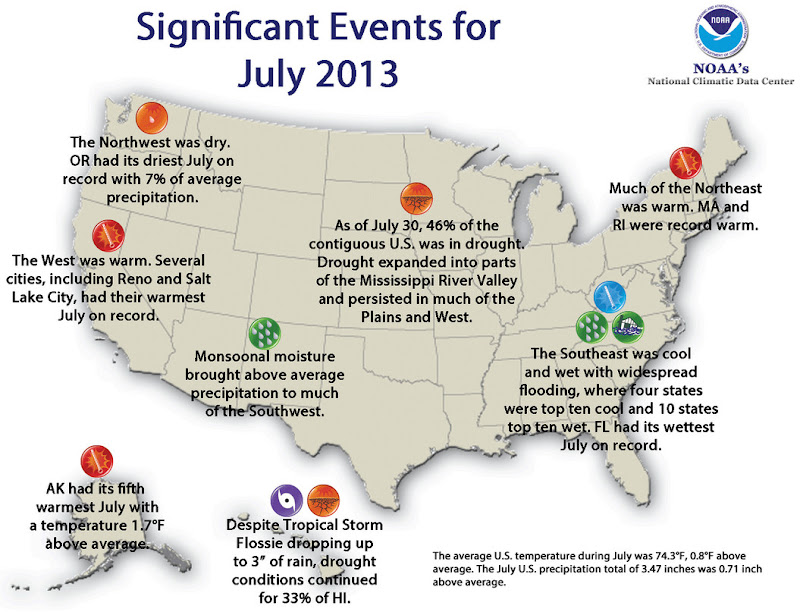
Significant Climate Events – July 2013 (NOAA). Click for larger view.
The National Oceanic and Atmospheric Administration (NOAA) released its July 2013 State of the Climate report saying that while the average U.S. temperature was warmer than normal, precipitation was higher than normal.
As we reported earlier, here in the Denver area temperatures were largely average during the month. Precipitation was close to normal but fell short of that mark.
The SOTC’s larger view shows the contiguous United States’ average temperature was 0.8° above the 20th century average. This ranks it as the 30th warmest July on record.
In terms of precipitation, the nation enjoyed a wetter than average month, one that ranks it as the 5th wettest July since record-keeping began.
The average temperature for the contiguous U.S. during July was 74.3°F, 0.8°F above the 20th century average, and ranked as the 30th warmest such month on record.
The western U.S. was warmer than average, where Idaho, Nevada, Oregon, and Utah each had a top ten warm month. Several cities, including Salt Lake City, Utah, and Reno, Nev., had their warmest July on record.Seven states across the Northeast also had July temperatures ranking among the ten warmest on record, including Massachusetts and Rhode Island, each of which had a record warm July.
The Alaska statewide average temperature was 1.7°F above the 1971-2000 average and ranked as the fifth warmest July on record for the state. Anchorage had its fourth warmest July, and the city set a record with 14 consecutive days above 70°F.
The nationally-averaged July precipitation total of 3.47 inches was 0.71 inch above average and was the 5thwettest July on record for the contiguous United States.
Wetter-than-average conditions stretched from California, through the Southwest and Plains, and along the Eastern Seaboard. In the Southwest, seasonal monsoonal flow brought above average precipitation to several states, where Arizona and California both had July precipitation totals ranking among their ten wettest. During this time of year in parts of the Southwest, even light precipitation can result in above-average monthly totals but have minimal impacts on alleviating drought conditions.
In the East, 13 states had one of their ten wettest Julys on record, with the highest precipitation totals across the Southeast. Florida had its wettest July on record, with 12.38 inches of rainfall, 4.91 inches above average. The above-average precipitation in the Southeast resulted in widespread flooding and significant damage to crops.
The Northwest was particularly dry. Oregon had its driest July on record with only 0.03 inch of rainfall accumulating, 0.41 inch below average. Washington had its eighth driest July. Below-average precipitationwas also observed in the Upper Mississippi River Valley, where Iowa had its tenth driest July.
According to the July 30 U.S. Drought Monitor report, 45.6 percent of the contiguous U.S experienced drought conditions, up slightly from the beginning of July. Drought remained entrenched throughout much of the West and in parts of the Central and Southern Plains, and drought expanded into parts of the Lower Mississippi River Valley and Midwest. Over 20 percent of Alaska was in drought at the end of July, with severe drought developing in central parts of the state.
The components of the U.S. Climate Extremes Index (USCEI) that examine extremes in warm night time temperatures, the spatial extent of wetness and drought, and extremes in days with rainfall were all above average. When combined with the other components of the index, the USCEI, as a whole, was only slightly above average. The USCEI is an index that tracks the highest and lowest 10 percent of extremes in temperature, precipitation, tropical cyclones, and drought across the contiguous United States.
On a local basis, the number of record warm daily highs and lows (2560) during July was roughly the same as the number of record cool daily highs and lows (2846), although there were slightly more cool records.
The year-to-date contiguous U.S. temperature of 51.8°F was 0.5°F above the 20th century average and tied with 1952 as the 42nd warmest January–July on record. Above-average temperatures were observed in the West and Northeast, where California, New Hampshire, and Vermont had one of their top ten warmest year-to-date periods. Below-average temperatures stretched from the Northern Plains to the Southeast.
The year-to-date contiguous U.S. precipitation total of 19.14 inches was 1.54 inches above average and tied with 1997 as the 22nd wettest January–July on record. However, rainfall was not evenly distributed across the country. Dry precipitation extremes were observed in the West and wet precipitation extremes were observed in the East.
California, Idaho, Nevada, and Oregon each had a top ten dry year-to-date period. California’s precipitation total of 4.58 inches was record low for the seven-month period at 9.82 inches below average, and 1.69 inches less than the previous record dry January–July of 1898.
Above-average precipitation was observed across most locations east of the Rockies, with ten states having one of their ten wettest year-to-date periods. Michigan was record wet with 24.35 inches of precipitation, 6.92 inches above average, and 2.30 inches above the previous record wet January–July of 1950. Several cities, from Fargo, North Dakota to Greenville, South Carolina, had a record wet January–July.
Based on NOAA’s Residential Energy Demand Temperature Index (REDTI), the contiguous U.S. temperature-related energy demand during January–July was below average and ranked as the 47th lowest January–July value in the 119-year period of record.
The components of the USCEI that examine extremes in the spatial extent of drought, as well as 1-day precipitation totals and days with rainfall were much above average for the year-to-date. When combined with the other components of the index, the USCEI, as a whole, was only slightly above average.
Average temperatures were generally below normal in the east and above normal in the west across the High Plains Region this month. Temperature departures of 2.0-4.0 degrees F (1.1-2.2 degrees C) below normal occurred in eastern Kansas, central South Dakota, western North Dakota, and a few pockets of Nebraska. Meanwhile, western portions of Colorado and Wyoming had temperature departures of 3.0-5.0 degrees F (1.7-2.8 degrees C) above normal. The cooler temperatures in the east were in stark contrast to last year, when a good portion of the area had temperature departures of 6.0-8.0 degrees F (3.3-4.4 degrees C) above normal. Although monthly records were not set, a few stations did manage to sneak in to the top 10 rankings for warmest or coolest July. On the cool side, long-term station Wamego 4 W, which is located in northeastern Kansas, had its 5th coolest July with an average temperature of 75.6 degrees F (24.2 degrees C). The coolest July at Wamego 4 W was 72.0 degrees F (22.2 degrees C) in 1950 (period of record 1912-2013). On the warm side, Lander, Wyoming had its 10th warmest July with 74.2 degrees F (23.4 degrees C). Interestingly, 7 of the top 10 warmest Julys have occurred since 2000 in Lander and the top spot of 75.9 degrees F (24.4 degrees C) occurred in both 2003 and 2006 (period of record 1891-2013). While monthly extremes were not common, numerous daily records occurred throughout the month. One notable record was for the July all-time coolest maximum temperature in Concordia, Kansas. On July 28th, Concordia’s high temperature only reached 62.0 degrees F (16.7 degrees C) and beat out the old record of 63.0 degrees F (17.2 degrees C) which occurred back in 1979 and 1988 (period of record 1885-2013).
July precipitation was hit or miss across the High Plains Region. Areas receiving at least 150 percent of normal precipitation included central Kansas, central South Dakota, central and western Colorado, and scattered pockets in eastern Wyoming, north central Nebraska, southwestern South Dakota, and northern North Dakota. While rain was needed to help alleviate ongoing drought conditions, some storms brought heavy rain which caused mudslides in fire burn scars in Colorado and flash flooding in parts of Colorado, Kansas, and Wyoming. Areas which missed out included eastern and central Nebraska, eastern and central North Dakota, and central Wyoming. These areas received less than 50 percent of normal precipitation. Because of the wide range in precipitation, there were stations which ranked in the top 10 driest or wettest Julys on record. With only 11 percent of normal precipitation, Omaha, Nebraska had its 2nd driest July on record with 0.44 inches (11 mm) of precipitation (period of record 1871-2013). The driest on record occurred only last year with 0.01 inches (0 mm). Meanwhile, precipitation in central Kansas helped alleviate drought conditions there, although long-term deficits were still high. For instance, Wichita, Kansas had measurable precipitation on 17 days in July, which broke the old record of 16 in 1950 (period of record 1888-2013). On average, Wichita has about 8 days with measurable precipitation in July. By the end of the month, Wichita received 7.69 inches (195 mm) of precipitation making this July its 4th wettest. Although 232 percent of normal, this was not nearly enough to beat the top spot of 13.37 inches (340 mm) in 1950.
The latest U.S. Drought Monitor showed both improvements and degradations over the past month. At the end of July, approximately 64 percent of the Region was in moderate (D1) to exceptional (D4) drought – down just slightly from 67 percent at the end of June. An expansion of abnormally dry conditions (D0) occurred in east-central North Dakota and eastern parts of Kansas, Nebraska, and South Dakota. In addition, two new areas of D1 were introduced in far southeastern South Dakota and northeastern Kansas. One category improvements were made in some areas of north-central and eastern Colorado. There was quite a bit of jostling of drought conditions in Kansas where some areas had improvements, while others had degradations. By the end of the month, 25 percent of the state remained in the D4 designation, however. Wyoming had an increase in severe (D2) and extreme (D3) drought coverage, going from about 47 percent of the state to 52 percent of the state. According to the U.S. Seasonal Drought Outlook released July 18th, the only area of drought expected to improve was in southwestern Colorado. Drought conditions were expected to develop in north-central Colorado and persist elsewhere through October 2013.
Following two hot and dry months in May and June, July brought some relief in the form of near normal temperatures and precipitation.
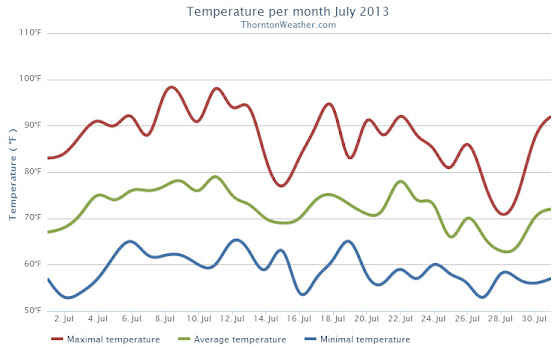
Cooler than normal temperatures started the month during the first couple of days of July. That changed for the following 10 days when temperatures bounced to above normal levels with Thornton recording eight 90+ degree days during the period.
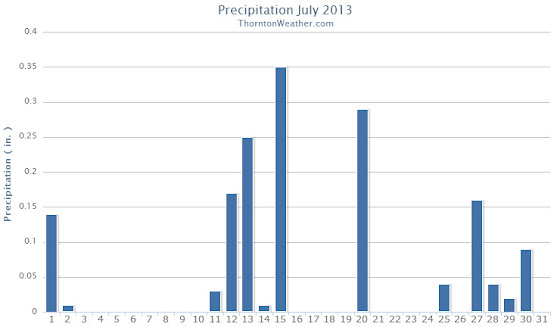
The next few days from the 14th to the 16th brought much cooler conditions and much-needed precipitation. Seasonal temperatures then settled in through the 23rd. As the month came to a close, temperatures became more moderate and we even saw three days (the 27th, 28th, and 29th) with highs in the 70s. Most notably we once again saw some precipitation.
Thornton saw an average temperature during July of 72.1 degrees. This was a good bit below the long term Denver historical average of 74.3 degrees. Officially at DIA the average temperature for the month was 74.2 degrees.
We recorded 14 days with temperatures at or equal to 90 degrees. Temperatures ranged from a high of 98.5 degrees on the 11th down to a low of 52.6 degrees on the 27th.
A reasonable 1.61 inches of precipitation fell into Thornton’s rain bucket during the month. This was a bit below the average for July of 2.16 inches. Out at the airport, Denver fared a bit better with 1.98 inches.
Thornton, Colorado July 2013 Temperatures.Thornton, Colorado July 2013 Precipitation.
CLIMATE REPORT
NATIONAL WEATHER SERVICE BOULDER, CO
210 AM MDT THU AUG 1 2013

...THE DENVER CO CLIMATE SUMMARY FOR THE MONTH OF JULY 2013...

CLIMATE NORMAL PERIOD 1981 TO 2010
CLIMATE RECORD PERIOD 1872 TO 2013

WEATHER         OBSERVED          NORMAL  DEPART  LAST YEAR`S
                 VALUE   DATE(S)  VALUE   FROM    VALUE  DATE(S)
                                          NORMAL
................................................................
TEMPERATURE (F)
RECORD
 HIGH             105   07/20/2005
 LOW               42   07/04/1903
                        07/31/1873
HIGHEST           100   07/11       105      -5      102  07/21
LOWEST             55   07/02        42      13       57  07/26
AVG. MAXIMUM     88.2              89.4    -1.2     94.4
AVG. MINIMUM     60.4              58.9     1.5     63.4
MEAN             74.3              74.2     0.1     78.9
DAYS MAX >= 90     17              16.0     1.0       27
DAYS MAX <= 32      0               0.0     0.0        0
DAYS MIN <= 32      0               0.0     0.0        0
DAYS MIN <= 0       0               0.0     0.0        0

PRECIPITATION (INCHES)
RECORD
 MAXIMUM         6.41   1965
 MINIMUM         0.01   1901
TOTALS           1.98              2.16   -0.18     0.48
DAILY AVG.       0.06              0.07   -0.01     0.02
DAYS >= .01         7               8.3    -1.3        6
DAYS >= .10         4               4.3    -0.3        2
DAYS >= .50         2               1.4     0.6        0
DAYS >= 1.00        0               0.7    -0.7        0
GREATEST
 24 HR. TOTAL    0.87   07/15 TO 07/15           07/06 TO 07/07
                        07/14 TO 07/15                    07/31 TO 07/31
                        07/15 TO 07/15                    07/31 TO 07/31
 STORM TOTAL       MM                                 MM
 (MM/DD(HH))            MM                    07/07(00) TO 07/07(00)
                                                 07/31(00) TO 07/31(00)1
                                                 07/31(00) TO 07/31(00)1

SNOWFALL (INCHES)
RECORDS
 TOTAL             MM   MM
TOTALS            0.0               0.0

DEGREE_DAYS
HEATING TOTAL       0                 6      -6        0
 SINCE 7/1          0                 6      -6        0
COOLING TOTAL     295               289       6      438
 SINCE 1/1        558               444     114      803

FREEZE DATES
RECORD
 EARLIEST     09/08/1962
 LATEST       06/08/2007
EARLIEST                        10/07
LATEST                          05/05
..................................................

WIND (MPH)
AVERAGE WIND SPEED              10.3
RESULTANT WIND SPEED/DIRECTION   3/163
HIGHEST WIND SPEED/DIRECTION    45/050    DATE  07/20
HIGHEST GUST SPEED/DIRECTION    58/040    DATE  07/20

SKY COVER
POSSIBLE SUNSHINE (PERCENT)   MM
AVERAGE SKY COVER           0.60
NUMBER OF DAYS FAIR            5
NUMBER OF DAYS PC             24
NUMBER OF DAYS CLOUDY          2

AVERAGE RH (PERCENT)     50

WEATHER CONDITIONS. NUMBER OF DAYS WITH
THUNDERSTORM              0     MIXED PRECIP               0
HEAVY RAIN                2     RAIN                       3
LIGHT RAIN               13     FREEZING RAIN              0
LT FREEZING RAIN          0     HAIL                       0
HEAVY SNOW                0     SNOW                       0
LIGHT SNOW                0     SLEET                      0
FOG                       6     FOG W/VIS <= 1/4 MILE      1
HAZE                     13

-  INDICATES NEGATIVE NUMBERS.
R  INDICATES RECORD WAS SET OR TIED.
MM INDICATES DATA IS MISSING.
T  INDICATES TRACE AMOUNT.
Sweltering, unseasonably warm temperatures gripped much of the contiguous United States last month breaking many records. In the final analysis of the month, NOAA announced that July was the hottest month ever recorded in the U.S. How hot was it? Read the rest of this story on Examiner.com
Much of the Lower 48 states saw above average temperatures during July 2012. Click the image to view the story and slideshow. (NOAA)
Thornton recorded its hottest month of the past six years during July 2012.
For the second month in a row, Thornton saw extraordinarily warm temperatures in July. The month not only was the warmest July ever recorded by ThorntonWeather.com, it was the warmest month recorded since we began operation.
The average temperature for July 2012 was an astonishing 75.5 degrees. This was 1.8 degrees above Thornton’s average for July over the past six years, a significant increase.
Temperatures ranged from a high of 98.7 degrees on July 1 down to a low of 56.6 degrees on July 11.
In all we recorded 23 days with high temperatures at or above 90 degrees. We did however manage to escape the month without breaking the century mark.
In terms of precipitation Thornton didn’t fare too poorly. We recorded 1.92 inches of precipitation in our rain bucket. This was only 0.03” below the six year average of 1.95 inches.
July 29 to August 4 - This Week in Denver Weather History
The effects of our annual monsoon season are portrayed in detail in our look back at this week in Denver weather history. Numerous cases of flooding resulting from heavy rainfall are seen as are other severe weather events including hail and even tornadoes.
From the National Weather Service:
13-5
In 2008…a streak of 24 consecutive days of 90 degrees shattered the previous record of 18 consecutive days established in 1901 and 1874. Ironically…no new single day record high temperatures were set in the month of July. In August however…a record of 104 degrees was set on the 1st…and another record of 103 degrees was set on the 2nd. In addition…a record low min of 70 degrees was set on August 2nd.
18-2
In 1987…a streak of 16 consecutive days of 90 degrees ranked 4th on the list of hot streaks. The record of 24 consecutive days was established in the summer of 2008.
27-31 in 1956…96 percent of the total precipitation for the month of July occurred over the last five days of the month. Heavy thunderstorms produced 4.00 inches of rainfall at Stapleton Airport. This amount of precipitation in 5 days or less had been exceeded only 3 times in previous record. The last time had been in December of 1913 as snow. Considerable property damage occurred across metro Denver from flooding.
28-30
In 1889…dense smoke from forest fires in the mountains obscured the sun over the city for three days.
In 1971…a vigorous cold front late on the 28th produced northeast wind gusts to 39 mph and record breaking cold temperatures on the 29th and 30th. The temperature dipped to 47 degrees on the 29th and 43 degrees on the 30th… Setting record minimums for the dates. Upslope cloudiness along with rain and fog early on the 29th helped set a record low maximum temperature of 58 degrees for the date.
29
In 1878…a total eclipse of the sun was observed at 2:20 pm. From before to during the eclipse…the temperature in the sun fell from 114 degrees to 82 degrees…while the shade temperature fell from 89 degrees to 83 degrees.
In 1880…heavy thunderstorm rain and hail flooded streets and ditches.
In 25 minutes…0.76 inch of rain fell on the city along with large hail to 3/4 inch in diameter. There were no strong winds with the storm.
In 1890…a thunderstorm produced sustained west winds to 48 mph with gusts to 60 mph…but only 0.01 inch of rain.
In 1956…heavy rain and hail fell over west and north Denver.
In 1964…hail to 3/4 inch in diameter fell at Lowry Airfield.
In 1978…a small tornado was sighted just east of Parker. No damage was reported.
In 1989…heavy rain drenched all areas of the Front Range… Both in the foothills and adjacent plains. Amounts of 1 to 3 inches were general over the area. Damage was confined to a few minor road washouts and some street…basement…and crop flooding. Thunderstorm rainfall totaled 1.44 inches at Stapleton International Airport where north winds gusted to 43 mph. Lightning struck a 250 thousand dollar home near Nederland and started a fire which destroyed all of it except two garages. Lightning started a fire in a home in Evergreen. It reached the house by hitting a tree…then traveling through a metal clothesline strung between the tree and the building.
In 1995…thunderstorm winds gusted to 59 mph in Brighton. Thunderstorm winds from the south-southeast gusted to 41 mph at Denver International Airport. High temperature of 99 degrees was a new record maximum for the date in Denver.
In 1997…heavy rain caused flooding in an apartment building in Westminster. Several residents had to be evacuated from their apartments. A woman in aspen park received minor injuries…when lightning passed through an office window and struck her. She suffered temporary blindness for about 15 minutes.
In 2003…hail as large as 1 inch in diameter pelted Conifer… Highlands Ranch…and Franktown.
July 15 to July 21 - This Week in Denver Weather History
Denver’s weather is rarely boring and our look back at this week in Denver weather history shows that. There have certainly been many notable thunderstorms with hail and damaging wind. However the most interesting item is the first – and only – recorded instance of snow during the month of July in the Mile High City.
7-25
In 1934…a streak of 15 consecutive days of 90 degrees ranked 5th on the list of hot streaks. The record of 24 consecutive days was established in the summer of 2008.
13-5
In 2008…a streak of 24 consecutive days of 90 degrees shattered the previous record of 18 consecutive days established in 1901 and 1874. Ironically…no new single day record high temperatures were set in the month of July. In August however…a record of 104 degrees was set on the 1st…and another record of 103 degrees was set on the 2nd. In addition…a record low min of 70 degrees was set on August 2nd.
14-15
In 1985…thunderstorms dumped heavy rain and hail at numerous locations along the Front Range from Denver north. Some of the heaviest rain fell in northern and western suburbs of Denver. Up to 2.6 inches of rain drenched Arvada…and Thornton was soaked with 2 inches in 45 minutes. At least 5 homes in Arvada suffered extensive damage from water and mud…and many streets and basements were flooded. In southern Jefferson County…11 homes were struck by lightning.
15
In 1879…a terrific hail storm occurred in the vicinity of Buffalo Station on the south park railroad in the South Platte River canyon about 39 miles south of Denver. Stones as large as hen’s eggs fell thick and fast and broke nearly every pane of glass in the windows of the building. A “waterspout” or cloudburst caused much loss of property from flash flooding on a nearby gulch. The torrent of water caused a deafening roar as it uprooted trees and carried huge Boulders and other debris. It struck the house and sawmill simultaneously and carried them away like straws…leaving little behind. The water continued to rush down the gulch for several hours. Serious damage was done to the south park railroad. The track and roadbed were destroyed for several miles. At about the same time…heavy rains in the vicinity of the headwaters of Cherry Creek produced a rapid rise in the creek…which drowned a few head of cattle and washed away two footbridges and some fences. Only 0.10 inch of rainfall was recorded in Denver.
In 1896…a thunderstorm produced sustained southwest winds to 40 mph with gusts to 46 mph.
In 1902…the temperature reached a high of 100 degrees in downtown Denver…which was a record maximum for the date.
In 1929…a thunderstorm did considerable damage to property in the eastern portion of the city. Heavy hail ranging in size from 1/4 to 3/4 inch in diameter…severe lightning… And high winds accompanied the heavy rain. Basements were flooded…and streets were impassable in places for several hours due to the heavy rainfall. Lightning damaged several telephone poles. Hail did extensive damage to gardens and flowers. The hail was up to a foot deep in places. There was no estimate of damage from the storm. A thunderstorm produced only a trace of rain and east winds to 24 mph in downtown Denver.
In 1959…thunderstorm rain totaled 0.41 inch in 8 minutes and winds gusted to an estimated 50 mph near downtown Aurora where half inch diameter hail was also reported. After the storm moved to the east…complete double rainbows were observed from the weather bureau office at Stapleton Airport.
In 1962…hail pelted the area in Adams County around Henderson and Brighton…causing extensive damage to corn…grain…beets…and row crops. Crop damage was estimated at 250 thousand dollars.
In 1963…a man received severe burns when struck by lightning while painting a building in south Denver.
In 1965…a state patrolman sighted a tornado near Bennett. It touched down over open ground…but caused no damage.
In 1967…heavy rains flooded streets and underpasses in south Denver. Heavy rain and minor wind damage were reported in wheat ridge…Aurora…Englewood…and Littleton. Basements were flooded and power disrupted. The clouds and rain resulted in a high temperature of only 72 degrees…which was a record low maximum for the date.
In 1974…a severe lightning storm damaged several homes and caused a number of power outages in both Denver and western Arapahoe counties.
In 1975…lightning killed a girl west of Boulder.
In 1982…winds gusted to 60 mph at Stapleton International Airport…and strong winds blew down walls at a construction site in Aurora where a nearby tree was uprooted.
In 1985…0.79 inch of rain fell in 30 minutes at Castle Rock. Much of the town lost power when lightning struck the town’s transformer.
In 1992…a man was struck by lightning while horseback riding near Castle Rock. Two people were struck by lightning near Highlands Ranch in south metro Denver. A man was struck by lightning while riding in the back of a pick-up truck in Franktown. All received minor injuries. Strong thunderstorms moved through east metro Denver…producing large hail and flash flooding. Hail up to 1 1/4 inches in diameter fell near Buckley Air National Guard base. Rainfall of 1 to 3 inches fell in Aurora in less than an hour…leaving water up to 18 inches deep in some areas. Thunderstorm rainfall was measured at 0.97 inch at Stapleton International Airport…where 3/8th inch diameter hail fell and south winds gusted to 44 mph.
July 8 to July 14 - This Week in Denver Weather History
In looking back at this week in Denver weather history, one cannot be struck by the hail storms listed, if not for sheer number then by the damage they caused. The biggest of these storms occurred in 1990 and stands in the books as the most damaging hailstorm in United States history.
From the National Weather Service:
29-15
In 2000…the 29th marked the beginning of a near record hot streak for metro Denver. The high temperatures…as recorded at Denver International Airport…exceeded the 90 degree mark for 17 consecutive days from June 29th through July 15th. The record of 24 consecutive 90 degree or above days was set from July 13th through August 5th…2008.
29-15
In 2000…the 29th marked the beginning of a near record hot streak for metro Denver. The high temperatures…as recorded at Denver International Airport…exceeded the 90 degree mark for 17 consecutive days from June 29th through July 15th. The record of 24 consecutive 90 degree or above days was set from July 13th through August 5th…2008.
1-18
In 1874…a streak of 18 consecutive days of 90 degrees tied for second with another streak that was later set in the summer of 1901. The record of 24 consecutive days was established in the summer of 2008.
4-8
In 1989…one of the most intense heat waves on record roasted metro Denver. The temperature reached 100 degrees or more on 5 consecutive days. The city had previously never recorded more than 2 straight 100-degree days since records began in 1872. Water and electricity usage reached all time highs. The heat wave created extremely dry weather conditions…which contributed to a major forest fire in Boulder canyon on July 9th. The temperature reached 103 degrees on the 8th…and the mercury climbed to 101 degrees on both the 4th and 5th…and to 102 degrees on both the 6th and 7th. The low temperature of 68 degrees on the 8th equaled the record high minimum for the date.
6-23
In 1901…a streak of 18 consecutive days of 90 degrees tied for second with another streak set in the summer of 1874. The record of 24 consecutive days was established in the summer of 2008.
7-25
In 1934…a streak of 15 consecutive days of 90 degrees ranked 5th on the list of hot streaks. The record of 24 consecutive days was established in the summer of 2008.
8
In 1905…a thunderstorm produced 0.82 inch of rainfall and northeast winds sustained to 48 mph.
In 1977…strong winds turned over 2 light aircraft at Arapahoe County Airport…now centennial airport.
In 1987…a weak tornado was observed near Bennett.
In 1988…three separate tornadoes were sighted near Bennett. No damage was reported. One inch diameter hail was also reported.
In 1991…lightning started three house fires in Castle Rock. Damage totaled 13 thousand dollars. No injuries were reported.
In 1993…a dry thunderstorm microburst wind gust to 55 mph briefly reduced the surface visibility to 3 miles at Stapleton International Airport.
In 1997…one construction worker was killed and two others injured when a strong thunderstorm wind gust caused the scaffolding they were standing on to collapse near Parker. A dry microburst produced a wind gust to 54 mph at Denver International Airport.
In 1998…heavy thunderstorm rain forced the closure of Hampden Avenue between I-25 and Havana Street in southeast Denver. The high water made 2 or 3 lanes of the street impassable.
In 2001…severe thunderstorms produced large hail…damaging winds…and heavy rain across south metro Denver. Two people received minor injuries when a severe thunderstorm wind gust to 58 mph blew over several tents at the Cherry Creek Arts Festival. The same storm caused the roof of a hardware store in Tamarac Square to collapse. One employee received minor injuries when she was struck in the head by falling debris. The combination of intense rain and wind downed trees and power lines. Electrical power outages affected 35 thousand homes and businesses. At least 50 trees in city parks across south Denver were damaged. Up to 4.50 inches of thunderstorm rain fell across portions of southeast metro Denver. The underpass at I-25 and Parker road was inundated with 5 feet of water. Several other streets and underpasses in Aurora were also closed due to high water. Heavy rain caused extensive damage to several exhibits at the Cherry Creek Arts Festival. Flash flooding occurred when heavy thunderstorm rainfall caused toll gate creek to jump its banks. Several underpasses across south Denver had to be closed due to high water. A man received minor injuries when lightning struck a nearby tree at the Wellshire Golf Course. Hail as large as 1 1/4 inches in diameter fell in Englewood with 1 inch hail in the city of Denver…and 3/4 inch hail in Littleton. Thunderstorm winds gusted to 63 mph at Denver International Airport and to 62 mph in Englewood.
In 2005…a tornado touched down briefly near Brighton…but caused no damage.
In 2011…severe thunderstorms produced hail…up to 1 inch in diameter…and wind gusts to 60 mph across parts of Adams…Broomfield and Denver counties. At Denver International Airport…a peak wind gust to 59 mph from the west.
July 1 to July 7 - This Week in Denver Weather History
As Colorado seems intent on starting a potentially record-setting streak of hot days, we see similar streaks in our look back at this week in Denver weather history. Also notable are the number of lightning and hail events that have injured, killed and caused extensive damage.
From the National Weather Service
29-2
In 1990…almost a year to date after the record breaking heat in early July 1989…the third longest heat wave in Denver history started. From June 29th through July 2nd the temperature reached 100 degrees or more on four consecutive days. The highest reading of 102 degrees occurred on the 29th…30th…and 1st. Combined with the 102 degree reading on June 27th this would have been the longest heat wave on record…but the temperature climbed to only 98 degrees on June 28th.
29-15
In 2000…the 29th marked the beginning of a near record hot streak for metro Denver. The high temperatures…as recorded at Denver International Airport…exceeded the 90 degree mark for 17 consecutive days from June 29th through July 15th. The record of 24 consecutive 90 degree or above days was set from July 13th through August 5th…2008.
30-1
In 1873…heavy rainfall overnight totaled 1.42 inches. Mountain peaks to the southwest of the city were covered with fresh snow on the morning of the 1st.
1
In 1915…northeast winds sustained to 41 mph with gusts to 50 mph occurred just before a thundershower in the evening. Rainfall was only 0.07 inch.
In 1941…unusually heavy thunderstorm rains flooded basements and blocked traffic. Water was curb high on many downtown streets. The thunderstorm also pelted the city with hail of unknown size. Rainfall in downtown Denver totaled 0.72 inch…but greater amounts likely occurred in other parts of the city.
In 1960…a severe dust devil moving through an Adams County suburban area blew over a fireworks stand…injuring an 11- year-old boy customer and two women operators of the stand. The boy was found under the demolished stand 100 feet away.
In 1961…hail as large as 1 1/4 inches in diameter was reported over east Denver.
In 1967…golf ball size hail fell over portions of metro Denver. Hail stones to 2 inches in diameter damaged roofs and broke windows in northeast Boulder. Marble to golf ball size hail fell at the Boulder airport. A funnel cloud was sighted over the foothills near Boulder. Hail stones of 1 to 2 inches in diameter were measured at Jefferson County Airport near Broomfield. Marble size hail fell in the vicinity of Arvada and Westminster.
In 1982…severe thunderstorms dropped large hail in Denver… Boulder…Commerce City…Lakewood…Wheat Ridge…Golden…and Arvada. Most locations reported hail size from 3/4 to 1 1/4 inches in diameter.
In 1990…the high temperature reached 102 degrees at Stapleton International Airport.
In 1998…hail to 1 1/2 inches in diameter fell near Bennett.
In 2001…the temperature climbed to a high of 101 degrees at Denver International Airport.
1-18
In 1874…a streak of 18 consecutive days of 90 degrees tied for second with another streak that was later set in the summer of 1901. The record of 24 consecutive days was established in the summer of 2008.
Denver easily broke the 24 hour precipitation record for July 13th.
It is readily apparent that July has thus far been a wet month given that we have seen eight straight days of thunderstorms. Yesterday the storms set a record for precipitation and Denver is on pace to make the month one of the wettest Julys on record.
Out at Denver International Airport yesterday, 1.03” of precipitation was recorded. This set the record for the date easily besting the old record of 0.45” set in 1993.
Here in Thornton we recorded 0.45” yesterday so a good bit less than out at the airport but still a decent shot of precipitation.
This brings Denver’s official total to 3.19” for the month so far. Average for the entire month of July is 2.16” so we are far ahead of that.
Number 10 on the ‘top 10 wettest Julys’ occurred in 1985 with 3.71”. Given the fact that the forecast continues to contain daily thunderstorms for the foreseeable future, there is a good chance we will exceed that before the month is over.
Thornton is ahead of the game in comparison to DIA as we have recorded 4.52” so far this month.
Weather, natural disasters & climate news and information.