Denver tied a 78 year old record temperature for February 8th.
We of course knew it was cold yesterday but now we know exactly how cold. At Denver International Airport the high temperature yesterday only climbed to 8 degrees. This ties the record low maximum for the date last set in 1933.
Highlighting that is the fact that the “high” temperature occurred soon after midnight at 12:28am. It was all downhill from there throughout the day as cold air settled in. Daytime highs in Denver were only around 6 degrees.
Here in Thornton we virtually matched the official Denver high as we climbed to 8.3 degrees. That occurred right at midnight.
February 6 to February 12 - This week in Denver weather history
Cold, snow and wind mark this week in our look back at Denver weather history. Numerous notable events including a period of 69 hours when the temperatures remained below zero – the fourth longest on record.
30-7
In 1985…a cold front on the 29th produced a protracted cold spell as arctic air remained entrenched across metro Denver. While the only daily temperature record set was a low maximum reading of 2 degrees on February 3rd…minimum temperatures plunged well below zero on 9 consecutive days. The coldest readings were 15 degrees below zero on January 31st and 14 degrees below zero on February 5th.
31-8
In 1963…warm weather that began with the strong Chinook winds on the 31st and 1st continued through the 8th. Maximum temperatures through the period ranged from 52 degrees on the 2nd to 76 degrees on the 5th…which was a new record high for that date.
31-12
In 1899…a protracted cold spell lasted almost two weeks. Low temperatures plunged below zero on all days but February 9th with a reading of 6 degrees. The coldest low temperature of 22 degrees below zero on February 6th was a record low for the date. Low temperatures of 20 degrees below zero occurred on both February 11th and 12th… But only the 11th remains as the record minimum for the date. High temperature of only 5 degrees below zero on February 11th was a record low maximum for the date. High temperatures climbed to only zero degrees on both February 2nd and 3rd…but were not records. Intermittent light snow or flurries fell during the period. The most snowfall…2.0 inches…occurred on February 2nd.
ThorntonWeather.com tested the theory that boiling water turns to ice crystals when thrown into sub-zero air. It worked! Check out the video below. (ThorntonWeather.com)
To say it has been cold would be a major understatement. Yesterday Denver’s “high” temperature only reached -2 degrees and this morning DIA dropped to -17 degrees, one degree shy of the record low temperature for the date. We decided to have a little fun with the cold weather in our Thornton backyard yesterday.
One fun experiment to do when the temperatures is so cold is to demonstrate how boiling hot water instantly freezes when thrown in the air. We figured it would make a great story for our work on Examiner.com and thought we would share the results here.
Your intrepid local weather geek conducted the experiment at a time when the sun was partially shining but the temperature was a bone chilling 1.4 degrees below zero. For what it is worth, with a 9 mph wind that was generating a wind chill of 14 degrees below!
The experiment is conducted simply using a pot of boiling water. When the water is taken outside in zero degree or colder weather and thrown into the air, the water instantly freezes in a cloud of ice crystals.
It is interesting to note that if you do this with cold water, you simply end up dumping water everywhere – it doesn’t freeze! That of course begs the question, how does boiling hot water freeze faster than cold water?
This phenomenon actually has a name – the Mpemba effect – named after Erasto Mpemba, a student in Tanzania in the 1960s who studied it. While it is named after Mpemba, other luminaries including Aristotle spent time analyzing it.
Dr. Joe Larsen, a chemist at the Rockwell Science Center in Los Angeles, explains that the hot water breaks into tiny droplets when it is thrown because it is close to being steam. The heat from the small droplets freezes virtually instantly resulting in the ice crystal cloud.
This doesn’t happen with cold water because it is thicker and in a closer to solid state (or at least not as close to turning to evaporative gas as the boiling water is). As such, it doesn’t break up as easily and falls to the ground in blobs.
So, for those of you with kids at home because school is canceled, you can now put their time to good use by conducting a science experiment in the cold!
Category 5 Tropical Cyclone Yasi moves inland over flood ravaged Queensland, Australia. Click the image to view more satellite photos on Examiner.com (CIMSS)
Devastating flooding over the past month and a half inundated hundreds of thousands of square miles in the Australian state of Queensland. The last thing the weary residents needed was more stormy weather but that is what came in the form of Severe Tropical Cyclone Yasi.
Just a few days ago Tropical Cyclone Anthony made landfall on Australia’s northeast coast. Mercifully it was a relatively small storm. The same cannot be said of Yasi.
Yasi landed at midnight local time on Thursday as a powerful Category 5 storm packing wind gusts to 186 mph. Tens of thousands of residents fled the storm as it approached and reports of down trees, roofs ripped off homes and widespread power outages are being seen.
“This is a cyclone of savagery and intensity,” warned Prime Minister Julia Gillard. “People are facing some really dreadful hours in front of them.”
Accompanying the damaging wind was destructive storm surge more than six feet high that will likely submerge low lying coastal areas. Rains from the storm are sure to drench ground already saturated from the massive flooding Queensland has seen in recent weeks and new flooding is likely.
The storm has moved inland and is near the town of Georgetown. It still is packing powerful punch as a Category 3 cyclone with gusts in excess of 127 mph (205 kph).
Continued cold in Thornton and across northeastern Colorado. The weather will remain unsettled through at least the first part of next week. (ThorntonWeather.com)
The big freeze that sent the temperatures in the Mile High City plummeting far below zero is not over yet. Continued cold weather is expected on Wednesday and the overall pattern in the longer term will be unsettled.
Yesterday the temperature at Denver International Airport only reached a high of -2 degrees. This broke the previous record low maximum for the date and is the first time in 14 years that Denver’s high temperature was below zero. Click here for more details on that record.
Yet another record may fall today – that of the coldest temperature for this date. The record is -18 degrees set just four years ago in 2007. As of 6:00am the coldest it had gotten today at DIA was -17 degrees so it is a bit hit or miss as to whether or not we break the record.
Here in Thornton, as of this writing, the lowest temperature today has been -14.6 degrees. This is the coldest temperature recorded at ThorntonWeather.com since we came online in October 2006. The previous coldest temperature we recorded was -14.1 degrees on December 15, 2008.
For today we are going to continue to see below freezing temperatures as while we start a warm up, it won’t amount to much. Further, a Wind Chill Advisory remains in effect until 9:00am as breezy conditions will allow wind chill temperatures as low as -25 degrees.
The extended forecast for Thornton beginning Wednesday, February 2, 2011.
Skies will gradually clear today and there will be sun above but we will still only reach a high temperature of 8 degrees. Overnight lows tonight will drop to around zero degrees, perhaps even a bit lower given clear skies.
On Thursday we do finally expect to see temperatures climb above freezing but not by a lot. Highs will be around 36 degrees and a weak system gives us just the slightest chance to see a snow flurry although no accumulation is expected.
Friday will bring the warmest day of the week as temperatures climb to the mid 40s. That however will be short lived.
Another Arctic air mass is forecast to impact the weekend weather sending the mercury down and again bringing us a chance for snow. Mercifully this system is not going to be as cold as the one we are pulling out of today. Snow amounts again don’t look to be anything extraordinary but some models are pointing toward a more significant snow event. We will know more as it gets closer.
Denver set a record low maximum temperature for this date.
With bone chilling cold having settled in along the Colorado Front Range, we knew a weather record had to fall and one did. Denver set a record low maximum temperature for February 1.
The official high temperature as measured at Denver International Airport only climbed to a high of -1 degrees. This broke the previous record low maximum for this date of 2 degrees set in 1985. Here in Thornton we fared a bit better hitting 2.7 degrees at 1:07pm.
As noted by the National Weather Service, this is the first time since January of 1997 that Denver saw a high temperature below zero degrees. On January 12th and 13th of the year, the high only reached to -1 degrees.
Will more records fall with this cold spell? It is definitely possible. Low temperatures overnight on Tuesday and into Monday morning are forecast to approach 18 degrees below zero. The record low temperature for February 2nd is -17 set way back in 1901.
For all the latest, follow us on Twitter and join us on Facebook
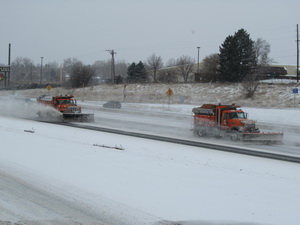
CDOT snowplows work on I-25 near 104th Avenue Monday afternoon. Arctic cold will be a major hazard as wind chills could dip to 35 degrees below zero over the next 36 hours. (ThorntonWeather.com)
Storm update, 4:30pm – The thermometer only knows one way through the rest of today and tonight – down! Thus far Thornton has dipped to 6 degrees with wind chill values around -3 and it is far from done dropping.
In terms of snow we will continue to see a pretty steady stream of light snowfall through the extended period but accumulations will be light. Most areas will see a couple inches additional accumulation with higher amounts south and west in the foothills and along the Palmer Divide.
For all the latest, follow us on Twitter and join us on Facebook
The cold continues to be the real story. Temperatures overnight will be dropping to five below zero with some places possibly getting even colder. Couple the cold air with gusty winds to 25 mph and wind chill readings will be between 15 and 35 degrees below zero.
These temperatures will be very dangerous for anyone caught outside in the cold. Hypothermia and frostbite can settle in very quickly and everyone needs to be aware.
Roads continue to be icy and snowpacked and the afternoon and morning rush hour are going to be rough around the metro area. Drivers should exercise extreme caution.
All Thornton area school districts have announced they will be closed on Tuesday including Adams 12, Adams 14, Adams 50, Mapleton, and Brighton 27J.
A Winter Weather Advisory will go into effect at 6:00am on Monday as snow and bitter cold arrive. (ThorntonWeather.com)
A major winter storm is set to impact nearly two thirds of the nation starting tomorrow including Thornton and the rest of northeastern Colorado. The National Weather Service has issued a Winter Weather Advisory for our area warning of blowing snow and dangerous cold.
For all the latest, follow us on Twitter and join us on Facebook
The service is warning of total snow accumulations of 3 to 7 inches for the event from tomorrow morning through Tuesday. Snow is expected to start lightly on Monday morning then increase in intensity in the afternoon and continue overnight into Tuesday morning.
Arctic cold will be a prominent feature of this system sending the mercury plummeting into areas that present a very real danger to people and property. Monday will see temperatures at about 26 degrees at 6:00am but then decreasing continually throughout the day and overnight when it will drop below zero.
Tomorrow’s afternoon commute and the Tuesday morning commute are likely to be rough ones so you will want to plan accordingly.
Tuesday’s high temperature will struggle to even get above zero and overnight temperatures on Tuesday could drop all the way to 15 degrees below zero. Wednesday will warm only slightly with highs of around 10 degrees.
January 30 to February 5 - This week in Denver weather history
The end of January and the first week of February have historically been an active period in Denver weather. We see many high wind events which are common this time of year as well as the usual snowstorms. Given the extreme cold we are set to experience this week, one event 22 years ago serves as a timely reminder of the dangers of cold. In 1989 one Arctic cold event turned deadly and dangerous.
26-1
In 1888…a protracted warm spell lasted a week. Maximum temperatures ranged from 62 degrees on the 29th to an all time record high for the month of 76 degrees on the 27th. Daily record high temperatures of 76…69…and 71 occurred on the 27th…28th…and 30th respectively. Record high minimum temperatures of 47 and 34 occurred on the 26th and 27th.
27-31
In 1951…a major storm dumped 10.1 inches of snowfall at Stapleton Airport. Most of the snow…8.3 inches…fell on the 29th. Cold arctic air accompanied the snow. Several temperature records were set…including record low maximum temperatures of 4 on the 28th and 4 below zero on the 29th and record low temperatures of 12 below zero on the 29th and 24 below zero on the 31st. Temperatures were below zero for 45 consecutive hours.
28-30
In 1887…winds were strong and gusty for three days in the city. West and northwest winds were sustained to 56 mph on both the 28th and 29th and to 44 mph on the 30th. Temperatures warmed to a high of 57 degrees on the 29th.
29-30
In 1985…an arctic air mass with snow closed I-70 for a time in Denver and east of Denver. Snowfall totaled 5.4 inches at Stapleton International Airport where north winds gusted to 29 mph on the 29th.
Volcanic lightning is seen above the erupting Mount Shimnoe in Japan. Watch video of the eruption below. (Takaharu Town Office)
This week a significant eruption of Mount Shimnoe on the island of Kyushu in Japan sent ash billowing 15,000 feet into the atmosphere. The mountain, part of a complex of 20 volcanoes, will be familiar to fans of James Bond movies.
Shimnoe-dake (Shimnoe Peak) began to erupt on Wednesday prompting some flight cancelations from area airports and covering nearby cities in a coating of ash. The Japanese government raised the alert level for the volcano and banned entry to an area in a one mile radius around the peak.
According to the Global Volcanism Program, Shinmoe is part of a group of 20 volcanoes north of Kagoshima Bay called Kirishima. Eruptions in the area have occurred four times in the past 40 years however this recent is the largest in more than 50 years. The most recent significant even occurred on February 13, 1959 with others since 1900 occurring in 1946, 1923, 1913 and 1903.
James Bond fans may recall the volcano from “You Only Live Twice.” In the 1967 movie the villain, Ernst Blofeld, maintains a secret lair underneath the mountain.
Among the most impressive images are ones that have captured volcanic lightning, a phenomena which is not entirely understood. You can learn more about it in this story on the Natural Disasters Examiner.
The video below captures the eruption – be sure to take note of the impressive flashes of pyroclastic lightning.
Weather, natural disasters & climate news and information.