Disasters claimed thousands of lives in 2012 in the form of floods, earthquakes, tropical storms and tornadoes. This week NOAA released its list of top 10 global weather and climate events and natural disasters took their place in a number of spots. Drought in North America which we of course have seen here in Colorado makes the list as do many other notable disasters.
Following on the release of data showing the United States saw its hottest year on record, the nation’s agencies responsible for monitoring climate said this week that 2012 temperatures globally were similarly well above normal.
Using slightly different methodology, NASA and NOAA ranked global temperatures in 2012 as the 9th and 10th warmest on record respectively. The difference in ranking is considered irrelevant and has global warming alarmists touting the figures as proof of man’s impact on the Earth’s climate.
This map represents global temperature anomalies averaged from 2008 through 2012. (NASA) Click the image to view a slideshow of maps and data from the reports.
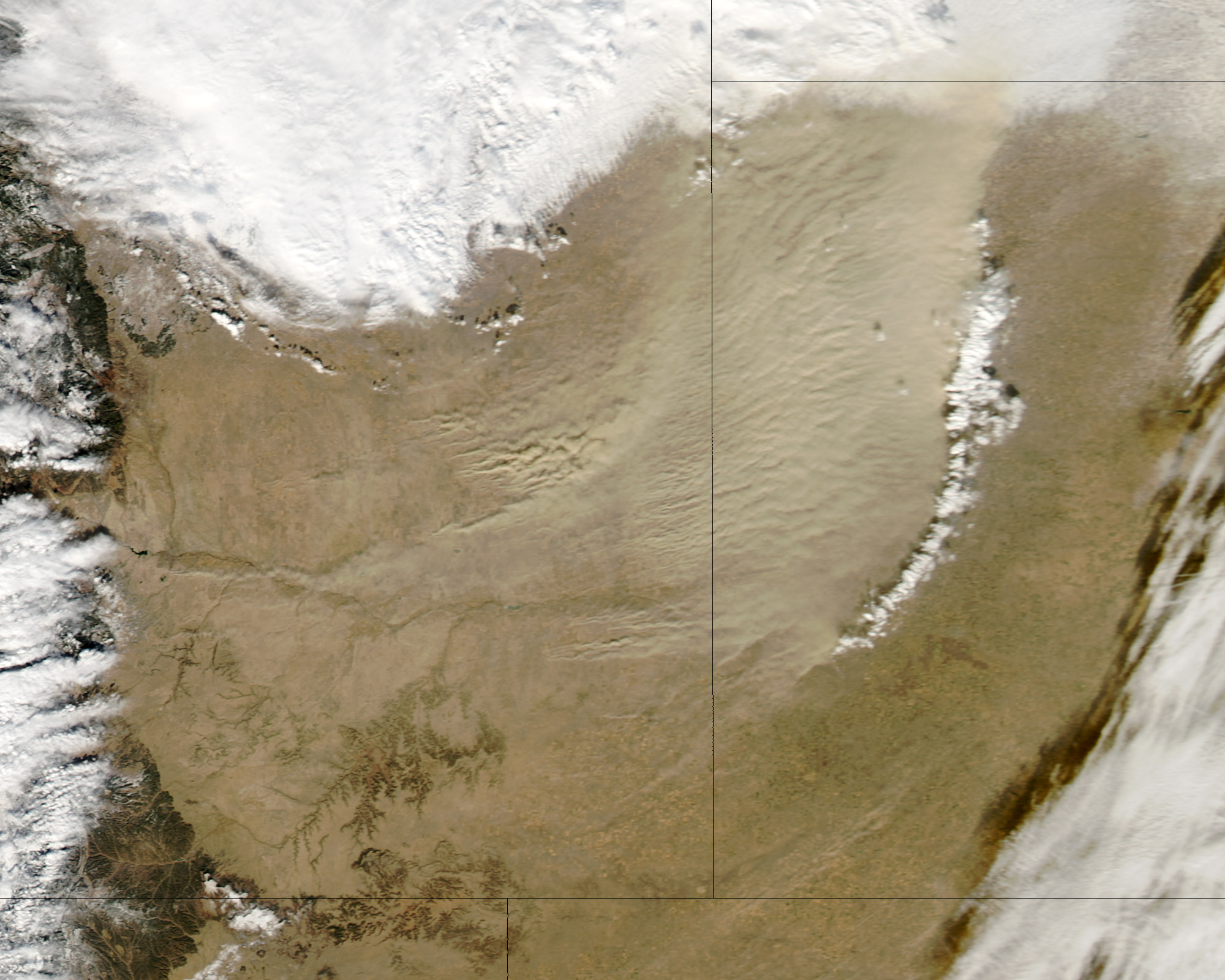
When a cold front pushed through Colorado late last week not only did it bring bitter cold temperatures, it also brought a great deal of wind to the state’s southeastern plains. NASA’s Aqua satellite was able to capture images of the ensuing dust storm as the cold front pushed through.
As wind speeds increased dust was thrown aloft in southeastern Colorado on Friday, January 11. The intensity of the dust storm was undoubtedly aided by the dry landscape in what is the most parched part of the state.
Satellite imagery captured the dust storm as it moved into Kansas.
NASA writes:
Although the dust was thickest in western Kansas, many of the source points for the storm were in Colorado. One dust plume arose roughly 70 kilometers (40 miles) south of Colorado Springs. In Kansas, the eastern edge of the dust storm spanned 240 kilometers (150 miles) and the dust was thick enough to completely hide the land surface below, especially east of Goodland. Salina.com reported that the blowing dust reduced visibility to a quarter of a mile (0.4 kilometers).
The Moderate Resolution Imaging Spectroradiometer (MODIS) on NASA’s Aqua satellite captured this image of a dust storm in southeastern Colorado and western Kansas on January 11, 2013. (NASA)
A golden eagle flies over Rocky Mountain Arsenal National Wildlife Refuge with the snow-capped Rockies in the background. Image taken in March 2011. (ThorntonWeather.com)
There was a time activity at the Rocky Mountain Arsenal was centered on our nation’s defense as a location responsible for manufacturing chemical and conventional weapons. Now a National Wildlife Refuge, the site is one of the hidden gems of the Colorado Front Range when it comes to wildlife viewing.
As the Cold War wound down, the government began to clean the site up. It was an expensive project but one that saw the contaminated site transform into one that must be seen.
Encompassing more than 15,000 acres, Rocky Mountain Arsenal National Wildlife Refuge is home to a wide variety of native animals, birds and reptiles. Deer, hawks, eagles and even buffalo are seen daily at the site in the heart of Denver.
A new visitor’s center opened at the refuge last year and now visitors can drive their own vehicles along nine miles of roads through the interior. In the past touring the facility required riding on a bus operated by the facility.
If you have never been, the Rocky Mountain Arsenal National Wildlife Refuge is a ‘must see’ for everyone.
While northeastern Colorado deals with unusually cold temperatures stubbornly dropping below freezing and even 0°, California has been seeing their own spell of “bitter cold” weather. Of course their definition of “cold” and ours are quite different as highlighted in a clip from Jimmy Kimmel Live.
Somehow we here at ThorntonWeather.com aren’t feeling too much sympathy for those in the Golden State. 😉
January 13 to January 19: This Week in Denver Weather History
Cold, snow and wind are expected this time of year in northeastern Colorado as we have seen many notable events with those conditions in our past. Notably in our look back at this week in Denver weather history we see that extreme versions of these can lead to injury and even death.
From the National Weather Service:
10-13
In 1963…an arctic cold wave plunged temperatures well below zero across metro Denver. Temperatures were below zero for a total of 64 consecutive hours. Low temperatures reached 25 degrees below zero on both the 11th and 12th. The high temperature of 9 degrees below zero on the 11th was the coldest ever recorded at Stapleton Airport and equaled the record low maximum for the month first set on January 19…1883…in downtown Denver. The high temperature on the 12th reached only 1 degree below zero. On the 12th…an 18-year-old youth died of exposure from the extreme cold in Denver. There were many losses and damage to property from frozen water systems…stalled cars…and over-burdened heating systems. Light snow accompanied the arctic blast. At Stapleton Airport…2.3 inches of snow fell on the 10th and 11th.
11-14
In 1997…cold arctic air plunged temperatures below zero across metro Denver. The temperature was below zero for 60 consecutive hours from the afternoon on the 11th to around daybreak on the 14th. The high temperature of only 1 degree below zero on the 12th equaled the record low maximum for the date last set in 1963. The low temperature dipped to 14 degrees below zero on the 12th.
12-13
In 1936…strong winds in Boulder blew roofs off homes. Wind gusts over 60 mph were recorded at the University of Colorado and a gust to 55 mph measured at Valmont.
In 2002…high winds developed in the foothills on the 12th and spread over the plains on the 13th. Winds gusted to 76 mph at the National Center for Atmospheric Research on the mesa in Boulder on the 12th. Northwest winds gusted to 49 mph…the highest wind of the month…at Denver International Airport on the 13th. The strongest winds were north and northeast of metro Denver.
13
In 1875…the low temperature dipped to 20 degrees below zero… A record low for the date and climbed to a high of only 2 degrees below zero…a record low maximum for the date.
In 1880…the worst wind storm ever experienced in Boulder caused some damage and personal injuries.
In 1893…northwest winds were sustained to 42 mph in the city.
In 1904…northwest winds were sustained to 40 mph with gusts as high as 50 mph. The Chinook winds warmed the temperature to a high of 63 degrees. The low temperature remained above freezing…dipping to only 34 degrees.
In 1919…snowfall was 1.8 inches in downtown Denver. Melted snow resulted in only 0.12 inch of precipitation. This was the only snowfall and precipitation for the month.
In 1932…snowfall totaled 3.4 inches in downtown Denver. North winds gusted to 22 mph.
In 1967…high winds in Boulder gusted to 70 mph downtown. Some damage occurred. Northwest winds gusting to 38 mph at Stapleton International Airport produced some blowing dust.
In 1988…high winds occurred in Boulder with a wind gust to 70 mph at Table Mesa. In the foothills a wind gust to 82 mph was measured at Rollinsville. West winds gusted to 33 mph at Stapleton International Airport.
13-14
In 1960…snowfall totaled only 4.4 inches and northeast winds gusted to 28 mph at Stapleton Airport…while over southeast Colorado a near blizzard closed roads with drifts 3 to 6 feet deep.
Record-setting heat and tinder dry conditions have brought devastating bushfires to Australia in recent weeks, hitting the island state of Tasmania the hardest. One family’s harrowing escape was captured in terrifying detail with pictures of them fleeing to water to avoid the fast moving flames. Read the rest of this story on Examiner.com and check out the amazing photos.
Tammy Holmes and her grandchildren seek shelter in the water from devastating wildfires near Dunalley, Tasmania Australia. (Tim Holmes)
Colorado witnessed an absolutely devastating wildfire season in 2012. We were not alone however as many locations across the U.S. saw a year of record burning and yesterday NOAA named the wildfire activity one of its top weather and climate events of 2012. Read the rest of this story on Examiner.com
New Mexico's Whitewater-Baldy Complex Fire and many others across the western U.S. contributed to the season being named one of the worst on record. (USFS)
If you thought last year was warmer than normal the National Oceanic and Atmospheric Administration (NOAA) says you thought correctly. The agency announced yesterday that the contiguous United States experienced its hottest year since record-keeping began in 1895. Read the rest of this story on Examiner.com.
Not only did 2012 go into the record books as the hottest on record, it was notable for many weather and climate related events. (NOAA)
January brings the NFL playoffs and in Denver that oftentimes means difficult weather conditions for players and fans. Today’s divisional playoff game between the Denver Broncos and the Baltimore Ravens will be less notable for snow than for the bitter cold. Get the complete forecast for the game on Examiner.com
A dropping thermometer and a chance for snow could impact today's game. Click the image for details.
Weather, natural disasters & climate news and information.