The United States returns to Standard Time at 2:00am Sunday as Daylight Saving Time comes to an end.
The biannual ritual of changing our clocks to adjust for Daylight Saving Time occurs tonight providing yet another signal of the changing of seasons. The United States will ‘fall back’ one hour at 2:00am Sunday morning as we return to Standard Time.
The ritual of changing our clocks twice a year can be met with some resistance as some people struggle to adjust their body’s internal clock. Others actually like the return to standard time as they get to enjoy an extra hour of sleep.
The time change definitely has big effects on the dawning of daylight and how early it gets dark in the evening.
Sunrise on Saturday occurs at 7:30am but on Sunday it will be at 6:29am. Similarly, sunset will occur at 5:55pm on Saturday but on Sunday the sun will disappear over the horizon at 4:54pm.
For many this means that when they get home from work it will now be dark and outdoor activities will be significantly curtailed as a result.
Arizona and Hawaii are the only states that do not observe Daylight Saving Time and remain on Standard Time year round. The U.S. territories of Puerto Rico, American Samoa, Guam, Northern Mariana Islands, and the United States Virgin Islands also do not observe the event.
It won’t be all that long though before Daylight Saving Time returns. On March 9, 2014 we will ‘spring forward.’
Daylight Saving Time Schedule
The mandated beginning and end of Daylight Saving Time has changed in the United States over the years.
The most recent schedule was set by the Energy Policy Act of 2005 and took effect in 2007. We now ‘spring forward’ to begin Daylight Saving Time on the second Sunday in March and ‘fall back’ with the return to Standard Time on the first Sunday in November.
Scary weather on Halloween in Denver? While it is oftentimes thought to be, that isn’t usually the case. (iStockPhoto)
Longtime residents of the Mile High City oftentimes have a belief that the weather on Halloween is frightful more often than not. A look at the empirical data shows that while some years have seen scary weather, most times it isn’t too bad.
Denver has been recording snowfall since 1882. In the 131 Halloweens from then until 2012, snow has fallen on October 31 just 22 times, or a mere 17%. That means historically there is less than a 1 in 6 chance of snow on All Hallows’ Eve.
Interestingly enough, there are better chances of snow falling on the day before Halloween and the day after. October 30 has recorded snowfall 21% of the time (28 times) and November 1 on 22% of the days (29 times).
Snow depth, measurable snow on the ground in the morning, has been recorded in the Mile High City since 1921. During those 91 years, snow was on the ground on Halloween morning 16% of the time (15 days).
Here again, there was snow on the ground more often on October 30 and November 1 than on Halloween itself. October 30 comes in with snow on the ground 17% of the time (16 times) and November 1 21% of the time (19 times).
However, when you combine the number of times snow was on the ground the day before, the day after or on Halloween itself, you can see where the perception of snowy Halloweens began. Totaling the three yields 50 days or 55% of the years.
Average temperatures on Halloween are actually relatively comfortable. Daytime highs average 51 degrees and lows dip to 31 degrees on average.
The highest temperature on the date was 79 degrees in 1950. The record low temperature for October 31 was recorded in 1991 at 10 degrees.
A few of the more notable Halloweens on record:
2004 – The most recent time Denver received snow on Halloween when 1.4 inches was recorded.
2002 – A white Halloween and a very cold one! 1.2 inches of snow was recorded and temperatures during prime trick-or-treating time were only in the mid to upper teens. The high temperature that day, 19 degrees, stands as the record low maximum temperature for October 31.
1972 – The snowiest Halloween on record. The high temperature that day was only 30 degrees with a low of 15 degrees. Eight inches of snow fell that day followed by an additional 5.8 inches on November 1.
Don’t miss a thing when it comes to our ever-changing weather! Be sure to ‘like’ us on Facebook, follow us on Twitter and add us to your Google+ circles.
Recovery from Colorado’s devastating floods last month will take a very long time and be a very expensive endeavor. Thanks to a gift from the NFL Referees Association however, the Estes Park School District’s will be a bit easier.
In a ceremony before the Denver Broncos and Washington Redskins game yesterday, the NFL Referees Association presented the district with a check for $10,000. The money will help to rebuild the district’s damaged athletics facilities.
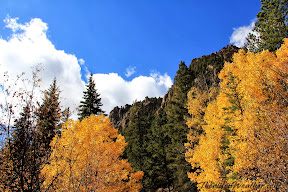
Golden leaves, green pine, and blue sky in Pike National Forest. See more images of the autumn weather and colors in the slideshow below. (ThorntonWeather.com)
The changing of the seasons into fall brings with it some of Colorado’s most pleasant – and varied – weather conditions. Certainly the autumn colors are oftentimes the highlight but many other types of beauty abound.
The higher parts of the mountains began to see the leaves change at the end of September. That was accompanied by snowfall which made for some stark and amazing photos.
Gorgeous moonrises and sunrises wrapped up the month and as we started out October, snow entered the forecast for the Thornton area. While we received little more than a dusting (0.8”), it was enough to count as our first snowfall.
As colder temperatures set in, lower elevations of the high country and foothills began to see their colors change. Here in town, trees are slowly beginning to turn golden.
The images below were taken by some of ThorntonWeather.com’s fans and shared with us as well as some we have taken ourselves.
One day earlier than average, the National Park Service closed Trail Ridge Road through Rocky Mountain National Park in Colorado. The highway through the park is one of Colorado’s premier destinations and travelers won’t be able to drive it again until next spring. Read the rest of this story on Examiner.com
Wintry conditions prompted the closure of Trail Ridge Road today, one day earlier than average. (Rocky Mountain National Park)
Sunday morning the virtually full moon brightened the landscape. Captured just before dawn, the image below is technically two days late to be one of the truly full Hunter’s moon but it still appears fully lit.
The Hunter’s Moon is the traditional term for the second full moon of autumn, following the Harvest Moon, the first of the season. Typically this makes it the full moon we see in October but it can sometimes fall in November.
The name is popularly attributed to Native Americans and said to be named such because it meant it was time to go hunting and prepare for the arrival of winter.
More than folklore, there is something unique about the Hunter’s Moon. See below the image for more details.
A very bright moon lights up the landscape two days after the full Hunter’s Moon. Click the image for a larger view. (ThorntonWeather.com)
But the Hunter’s Moon is also more than just a name. Nature is particularly cooperative around the time of the autumn equinox to make the full moonrises unique around this time.
Here’s what happens. On average, the moon rises about 50 minutes later each day. But when a full moon happens close to the autumnal equinox – either a Harvest or a Hunter’s Moon – the moon (at mid-temperate latitudes) rises only about 30 to 35 minutes later daily for several days before and after the full moon.
Why? The reason is that the ecliptic – or the moon’s orbital path – makes a narrow angle with the evening horizon around the time of the autumn equinox. The narrow angle of the ecliptic results in a shorter-than-usual rising time between successive moonrises around the full Hunter’s Moon.
These early evening moonrises are what make every Hunter’s Moon special. Every full moon rises around sunset. After the full Hunter’s Moon, you’ll see the moon ascending in the east relatively soon after sunset for a few days in a row at northerly latitudes.
National Weather Service forecasters in Alaska hid a very timely message to President Barack Obama and Congress about the government shutdown in their Friday forecast discussion.
The 5:00 a.m. forecast discussion from the Anchorage, Alaska office of the National Weather Service looked innocuous enough. It contained the usual meteorological information about the coming day’s weather.
With a Freeze Warning in place following yesterday’s cold front, we knew it was going to be cold and it certainly has been. In fact, it was record-setting.
Just before midnight, the mercury at Denver International Airport dropped to 28 degrees. This tied the record low temperature for the date, October 4, last set 136 years ago in 1877.
The storm system that moved through brought snow to a good part of the Denver metro area. Here in Thornton we measured 0.8”, our first snowfall of the season. A total 0.39″ of liquid precipitation (rain and snow melt) was recorded in our bucket.
Inexplicably, the National Weather Service is showing no snow was measured at DIA yesterday morning. This despite the fact that numerous firsthand accounts and pictures posted to social media showed the airport did indeed have measureable snowfall.
We are reaching out to the NWS to get an explanation for the discrepancy and will update this post if / when we receive a response.
Don’t miss a thing when it comes to our ever-changing weather! Be sure to ‘like’ us on Facebook, follow us on Twitter and add us to your Google+ circles.
September 28 to October 5: This Week in Denver Weather History
While it appears Denver will escape September snow, our look back at this week in weather history shows that isn’t always the case. Additionally, while not common, even early fall can bring severe weather with damaging wind, lightning and even tornadoes.
From the National Weather Service:
28-29
In 1959…one of the heaviest September snow storms of record began as rain and changed to heavy wet snow. The storm caused heavy damage to trees and shrubbery…which were still in full leaf. The storm dumped 10.6 inches of snow at Stapleton Airport…the third heaviest September snow amount to date. Falling trees and limbs disrupted traffic…broke power and communication lines…and damaged buildings and cars. One man was killed in Denver by a falling tree limb…and four others died of heart attacks while shoveling snow or trying to move heavy tree limbs. Direct costs of the storm for cleaning up debris…repairing utility lines…and damage to buildings and other property across all of eastern Colorado were estimated to be over a half million dollars. The value of trees destroyed or damaged was estimated to exceed five million dollars. North-northeast winds gusted to 32 mph at Stapleton Airport on the 28th.
In 1985…an unusually cold air mass for this time of year settled over the area. Metro Denver received 8 to 12 inches of powdery snow. The 8.7 inches of snow that fell at Stapleton International Airport was the first measurable snow of the season and the city’s heaviest September snowfall since 1971. The snow caused flight delays of over 2 hours at Stapleton International Airport. I-70 was closed for a time west of Denver. Snow-laden tree limbs snapped over all of metro Denver…causing widespread power outages. Ten thousand people were without electricity for a time in Boulder. The morning of the 29th saw mid-winter temperatures along the Front Range. The temperature dipped to 17 degrees…the lowest temperature ever recorded in September in Denver. The high temperature of only 29 degrees on the 29th was a new record low maximum for the date and lowest ever recorded during the month of September. The low temperature of 21 degrees on the evening of the 28th set a new record low for the date. The cold weather persisted through the 1st with record minimum temperatures of 25 degrees set on the 30th and 27 degrees set on October 1st.
29
In 1966…a vigorous cold front moved thru metro Denver. North winds gusting to 51 mph kicked up billows of blowing dust…which briefly reduced the visibility to 1 mile at Stapleton International Airport. The cold air caused temperatures to drop rapidly from a high of 86 degrees to a low of 46 degrees by days end.
In 1985…the lowest temperature ever recorded in September… 17 degrees…occurred. The high temperature warmed to only 29 degrees…the all-time record low maximum for the month.
In 1994…the temperature reached a high of 91 degrees at Stapleton International Airport. This was the 60th day of the year that the temperature had reached 90 degrees or more…establishing a new record at that time. The previous record of 52 “90 degree days” occurred in 1978. Only 43 “90 degree days” were recorded at Denver International Airport during 1994.
In 1995…lightning struck a couple in Aurora as they were walking in the rain. The bolt struck the umbrella the man was carrying…injuring both the man and his wife.
In 2000…late afternoon thunderstorms produced strong wind gusts to 76 mph in Westminster…to 69 mph near Boulder…and to 60 mph at Jefferson County Airport near Broomfield. No damage was reported.
30
In 1898…south winds were sustained to 41 mph with gusts to 54 mph.
In 1940…a late season thunderstorm in the city caused one lightning death.
In 1944…the month ended with a trace of rain on this date and for the month. A trace of rain also occurred on the 4th…9th…and 10th. There was no measurable precipitation for the month. The total of a trace of precipitation for the month equaled the driest September on record first set in 1892.
In 2009…a trained spotter in Coal Creek Canyon…recorded a peak wind gust to 88 mph.






 With a Freeze Warning in place following yesterday’s cold front, we knew it was going to be cold and it certainly has been. In fact, it was record-setting.