August 7, 2014 – A butterfly enjoys blooming flowers in Thornton. (Bobby Hake)
August’s weather typically consists of warm daytime temperatures followed by afternoon and evening thunderstorms. Those storms provide excellent photo opportunities as do the various flora and fauna we see around this time of year.
Thornton’s spring and summer have been relatively wet allowing for a very lush, green landscape. Flowers are blooming and butterflies, bees and birds are all taking advantage of them. The near daily thunderstorms offer rain as well as lightning and sometimes hail. All make for prime photo subjects.
Slideshow updated August 31, 2014
To learn more about how to send your photo to us for inclusion in the slideshow, see below the slideshow.
Showcasing images captured by ThorntonWeather.com readers as well as some of our own, our monthly slideshow covers the entire gamut of weather-related imagery.
Sunsets, sunrises, wildlife and of course every type of weather condition are vividly depicted in images captured from yours and our cameras.
Click the play button below and sit back and enjoy the images.
What is missing in the slideshow above? Your photo!
Our monthly photo slideshow is going to feature images that we have taken but more importantly images that you have captured. The photos can be of anything even remotely weather-related.
Landscapes, current conditions, wildlife, pets, kids. Whimsical, newsy, artsy. Taken at the zoo, some other area attraction, a local park, a national park or your backyard. You name it, we want to see and share it!
Images can be taken in Thornton, Denver or anywhere across the extraordinary Centennial State. We’ll even take some from out of state if we can tie it to Colorado somehow.
We’ll keep the criteria very open to interpretation with just about any image eligible to be shown in our slideshows.
What do you win for having your image in our slideshow? We are just a ‘mom and pop’ outfit and make no money from our site so we really don’t have the means to provide prizes. However you will have our undying gratitude and the satisfaction that your images are shared on the most popular website in Thornton.
To share you images with us and get them included in the slideshow just email them to us or share them with ThorntonWeather.com on any of the various social media outlets. Links are provided below.
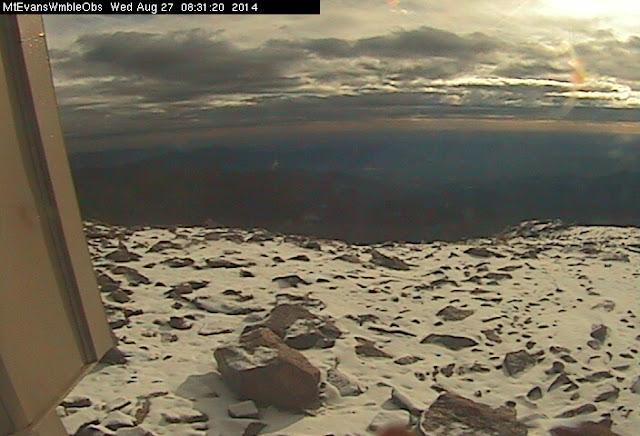
August 27, 2014 – Dawn reveals fresh snow on top of Mount Evans. (DU)
Snow at the Centennial State’s elevations can occur any time of year and last night Mother Nature delivered a white reminder that fall and winter are not far behind.
On Monday, the Colorado Department of Transportation closed the road to the top of Mount Evans due to the potential for snowfall. That potential was realized overnight last night as the observatory webcam this morning showed a couple of inches of snow on the ground.
This morning CDOT’s website reports the road is, “Closed from Summit Lake to top of Mount Evans due to adverse conditions. There is no estimated time of opening.”
The highest paved road in North America, the road to the summit of Mount Evans usually remains open until the first weekend of October when conditions prevent it from being maintained. It doesn’t reopen until the Friday before Memorial Day.
Other areas of the high country saw light doses of snow last night.
At 8:20pm last night the National Weather Service reported that 13,495 foot high Berthoud Pass was reporting 34 degrees. Moderate snow was falling and visibility had been reduced to 1/2 mile.
Snowfall above timberline will be possible tonight with potential accumulations of 1 to 2 inches in some locations.
Stay up to date with the dynamic weather: Be sure to ‘like’ us on Facebook, follow us on Twitter and add us to your Google+ circles.
Longtime Denver residents well know that earthquakes here are not unheard of.
From the late 1960s to the early 1980s, small quakes in the Denver area were relatively common. The majority of those have been attributed to the injection of liquid waste into the Earth out at the Rocky Mountain Arsenal.
Similar manmade processes are believed to be the source of recent earthquake activity in Oklahoma and possibly the earthquakes seen in May and June of this year near Greeley.
Southern Colorado near Trinidad routinely sees small earthquakes. Some of the activity there may be related to mining. However the area is also home to the Northern Sangre de Christo Fault and the Southern Sawatch Fault, both of which have been sources of activity in the past.
Looking farther back, it was on November 7, 1882 that the largest known quake in the state’s history occurred. A temblor estimated at magnitude 6.6 struck near Rocky Mountain National Park. Contemporary news accounts of the day indicate damage was seen in Boulder and the quake was felt as far away as Salina, Kansas and Salt Lake City, Utah.
As summer vacations wind down and families prepare to send their kids back to school in August, Colorado weather also starts to settle down. The chances for severe weather decrease markedly during August and by the end of the month daytime temperatures are dropping quite a bit as well. Find out more about what lies ahead with Thornton’s August weather here.
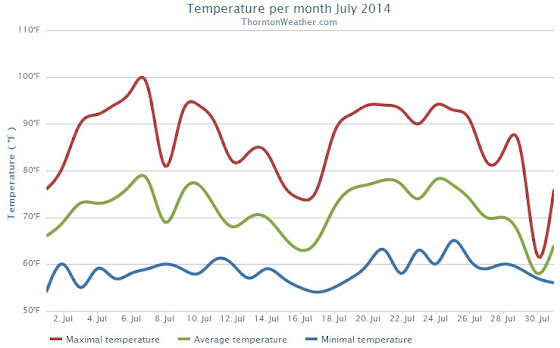
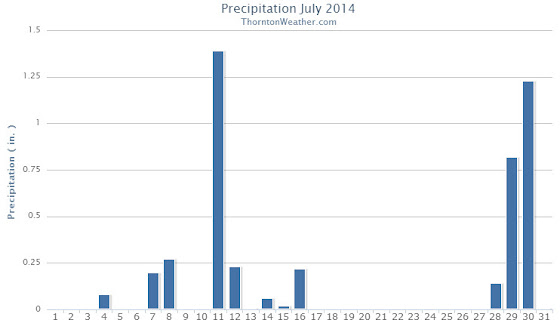
July 2014 will go into the history books as one of the wettest on record in the Mile High City. A healthy monsoon flow also contributed to overall below normal temperatures.
The month started out cooler than normal but the third of the month brought a string of 90 plus degree days that lasted until the 11th of the month with only one day not reaching the mark during that time.
Cooler temperatures arrived for the next seven days with three of those seeing highs only in the 70s. A healthy shot of moisture on the 11th turned lawns green.
We bounced right back to the 90s on the 19th but then saw the cool weather return on the 27th. Light rain on the 28th was followed by heavy rain on the 29th and 30th pushing the month into the rain fall record books.
The 30th of the month was notable for a record setting low maximum temperature with a reading more like we would expect to see in April or October.
Thornton saw an overall average temperature for July 2014 of 71.5 degrees. This is well below the Denver July average of 74.2 degrees.
As measured at Denver International Airport, the Mile High City’s official reading was warmer than ours with an average of 74.5. The airport’s location further east allows it to hold off seeing the typical afternoon clouds for a bit longer than areas to the west and thus it typically sees warmer temperatures.
Our warmest temperature reading of the month was 98.2 degrees on the 7th. Thornton recorded 16 days of 90 degree or warmer temperatures. Conversely, our coldest reading was 54.1 degrees on the first of the month.
Denver’s maximum reading also occurred on the 7th but was warmer at 100 degrees. The airport saw 17 days with reading of 90 degrees or higher. The lowest reading of the month was 55 degrees on the 16th and 17th.
One temperature record was set during July. On the 30th the maximum temperature only reached 62 degrees (Thornton recorded 62.2 degrees). This broke the record low maximum for the date of 64 degrees set in 2009.
In terms of precipitation, there was plenty of it across the board.
Denver averages 2.16 inches during July. In Thornton we recorded a healthy 4.69 inches while Denver officially saw 3.85 inches.
For both locations, nearly half of those totals came on the 29th and 30th. The Denver total puts it into the books as one of the wettest Julys on record. Additionally, the Denver total on the 29th set a record for that date.
Thornton, Colorado July 2014 Temperature Summary. (ThorntonWeather.com)Thornton, Colorado July 2014 Precipitation Summary. (ThorntonWeather.com)
CLIMATE REPORT
NATIONAL WEATHER SERVICE BOULDER, CO
550 AM MDT FRI AUG 1 2014

...................................

...THE DENVER CO CLIMATE SUMMARY FOR THE MONTH OF JULY 2014...

CLIMATE NORMAL PERIOD 1981 TO 2010
CLIMATE RECORD PERIOD 1872 TO 2014

WEATHER         OBSERVED          NORMAL  DEPART  LAST YEAR`S
                 VALUE   DATE(S)  VALUE   FROM    VALUE  DATE(S)
                                          NORMAL
................................................................
TEMPERATURE (F)
RECORD
HIGH             105   07/20/2005
LOW               42   07/04/1903
                        07/31/1873
HIGHEST           100   07/07       105      -5      100  07/11
LOWEST             55   07/17        42      13       55  07/02
                        07/16
AVG. MAXIMUM     88.3              89.4    -1.1     88.2
AVG. MINIMUM     60.6              58.9     1.7     60.4
MEAN             74.5              74.2     0.3     74.3
DAYS MAX >= 90     17              16.0     1.0       17
DAYS MAX <= 32      0               0.0     0.0        0
DAYS MIN <= 32      0               0.0     0.0        0
DAYS MIN <= 0       0               0.0     0.0        0

PRECIPITATION (INCHES)
RECORD
MAXIMUM         6.41   1965
MINIMUM         0.01   1901
TOTALS           3.85              2.16    1.69     1.98
DAILY AVG.       0.12              0.07    0.05     0.06
DAYS >= .01         8               8.3    -0.3        7
DAYS >= .10         6               4.3     1.7        4
DAYS >= .50         2               1.4     0.6        2
DAYS >= 1.00        2               0.7     1.3        0
GREATEST
24 HR. TOTAL    2.85   07/29 TO 07/30

SNOWFALL (INCHES)
RECORDS
TOTAL            0.0
TOTALS            0.0               0.0

DEGREE_DAYS
HEATING TOTAL       5                 6      -1        0
SINCE 7/1          5                 6      -1        0
COOLING TOTAL     304               289      15      295
SINCE 1/1        431               444     -13      558

FREEZE DATES
RECORD
EARLIEST     09/08/1962
LATEST       06/08/2007
EARLIEST                        10/07
LATEST                          05/05
......................................................

WIND (MPH)
AVERAGE WIND SPEED              9.7
RESULTANT WIND SPEED/DIRECTION   3/193
HIGHEST WIND SPEED/DIRECTION    51/310    DATE  07/11
HIGHEST GUST SPEED/DIRECTION    51/290    DATE  07/11

SKY COVER
POSSIBLE SUNSHINE (PERCENT)   MM
AVERAGE SKY COVER           0.60
NUMBER OF DAYS FAIR            4
NUMBER OF DAYS PC             24
NUMBER OF DAYS CLOUDY          3

AVERAGE RH (PERCENT)     51

WEATHER CONDITIONS. NUMBER OF DAYS WITH
THUNDERSTORM              0     MIXED PRECIP               0
HEAVY RAIN                2     RAIN                       7
LIGHT RAIN               13     FREEZING RAIN              0
LT FREEZING RAIN          0     HAIL                       0
HEAVY SNOW                0     SNOW                       0
LIGHT SNOW                0     SLEET                      0
FOG                       8     FOG W/VIS <= 1/4 MILE      1
HAZE                      7

-  INDICATES NEGATIVE NUMBERS.
R  INDICATES RECORD WAS SET OR TIED.
MM INDICATES DATA IS MISSING.
T  INDICATES TRACE AMOUNT.
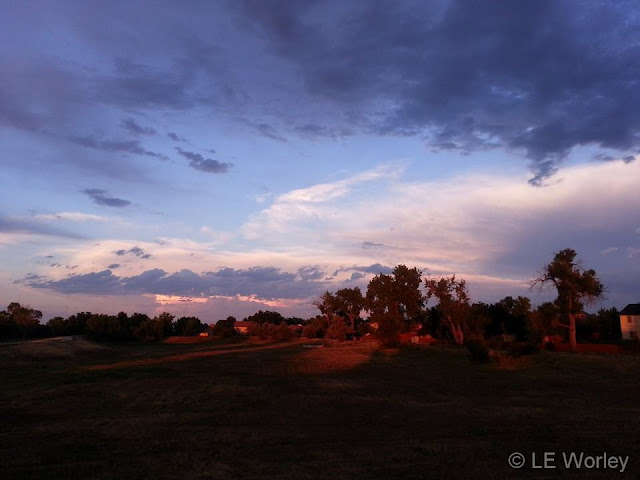
July 3, 2014 – A gorgeous July sunset. (LE Worley)
The month of July typically brings a pretty tried and true daily weather pattern with hot days and afternoon thunderstorms. Like any month of the year in Colorado, a wide variety of subjects will be presented for photo opportunities.
Flowers are now in full bloom, wildlife is abundant with many creatures showing their young for the first time, and then of course there is the weather. Scorching heat, damaging thunderstorms, heavy rains and more are all possible during the month.
Slideshow updated July 31, 2014
To learn more about how to send your photo to us for inclusion in the slideshow, see below the slideshow.
Showcasing images captured by ThorntonWeather.com readers as well as some of our own, our monthly slideshow covers the entire gamut of weather-related imagery.
Sunsets, sunrises, wildlife and of course every type of weather condition are vividly depicted in images captured from yours and our cameras.
Click the play button below and sit back and enjoy the images.
What is missing in the slideshow above? Your photo!
Our monthly photo slideshow is going to feature images that we have taken but more importantly images that you have captured. The photos can be of anything even remotely weather-related.
Landscapes, current conditions, wildlife, pets, kids. Whimsical, newsy, artsy. Taken at the zoo, some other area attraction, a local park, a national park or your backyard. You name it, we want to see and share it!
Images can be taken in Thornton, Denver or anywhere across the extraordinary Centennial State. We’ll even take some from out of state if we can tie it to Colorado somehow.
We’ll keep the criteria very open to interpretation with just about any image eligible to be shown in our slideshows.
What do you win for having your image in our slideshow? We are just a ‘mom and pop’ outfit and make no money from our site so we really don’t have the means to provide prizes. However you will have our undying gratitude and the satisfaction that your images are shared on the most popular website in Thornton.
To share you images with us and get them included in the slideshow just email them to us or share them with ThorntonWeather.com on any of the various social media outlets. Links are provided below.
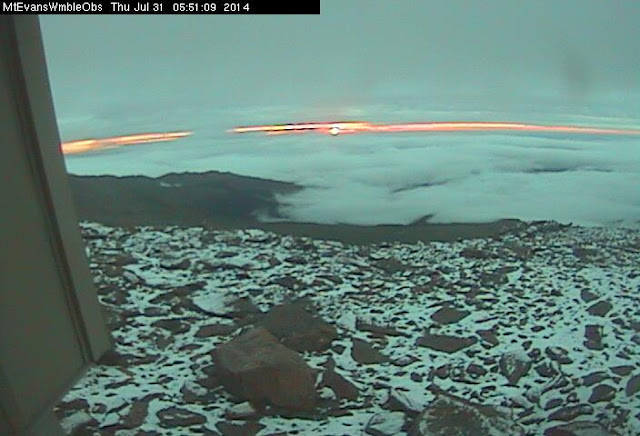
July 31, 2014 – Sunrise snow on Mount Evans. (DU Observatory)
With monsoonal moisture streaming into the state and cool air coming in from the north, Denver set its second weather record in as many days.
Denver’s official high temperature yesterday, July 30, as measured at DIA topped out at 62 degrees. This sets a new record low maximum for the date easily besting the previous mark of 64 degrees set in 2009.
The reading is more akin to what we expect to see in April and October and well below the average high temperature for the date of 90 degrees.
Here in Thornton we matched that reading with 62 degrees as well.
Ironically, Al Gore’s Climate Reality Project was in Denver the past two days for EPA hearings. The group pushed the theme “I’m too hot” while serving up ice cream from Ben & Jerry’s. Similar hearings were held in Washington DC and Atlanta and both cities saw below normal temperatures.
Perhaps not quite too hot, eh? It would appear the “Gore Effect” has proven itself again.
Late afternoon thunderstorms and showers began falling yesterday and continued through midnight. Areas to the east and north, including Denver International Airport, saw more precipitation than other locations and DIA set a daily rainfall record as a result.
Denver’s official rainfall total for July 29 came in at a healthy 1.80 inches. The previous 24 hour precipitation record for the date was 1.44 inches back in 1989. Precipitation records in Denver began in 1872.
Here in Thornton we recorded 0.82 inches for the date. While well short of Denver’s number, that is still a great deal of rain.
Stay up to date with the dynamic weather: Be sure to ‘like’ us on Facebook, follow us on Twitter and add us to your Google+ circles.
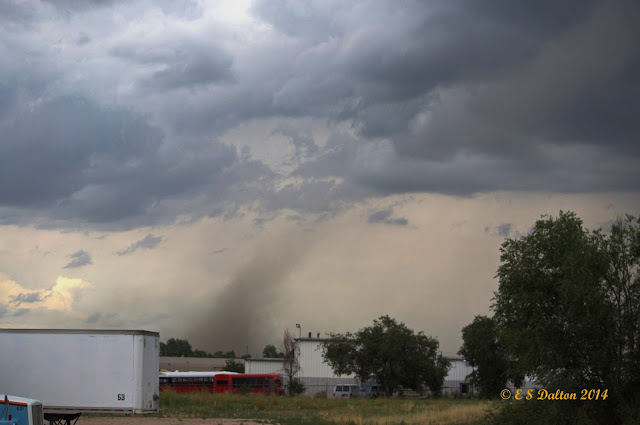
July 28, 2014 – Image of the tornado at the Rocky Mountain Arsenal. (Ed Dalton) Click for a larger view.
Monday’s forecast called for a chance for thunderstorms but Mother Nature threw in a couple of wildcards in the form of two tornadoes in the area. The landspout tornadoes caused minor damage in north Denver and were widely seen across much of the area.
The first tornado was reported at 3:53pm just across the Adams County line in Weld County near Fort Lupton. The twister was the better defined of the two but appears to have struck farmland with no damage reported.
Videos: Watch amazing footage of the Weld County tornado below
At 4:09pm a second tornado was reported near the Rocky Mountain Arsenal National Wildlife Refuge in Adams County. A diesel repair shop near 51st and Havana had one of its garage doors ripped off and some material thrown about.
Denver International Airport sent travelers to shelters for a period of time and warning sirens were sounded in Brighton, Commerce City and other nearby locations.
Three people on a small boat on Barr Lake were overturned by the strong thunderstorm winds. The trio managed to swim to shore and were not injured.
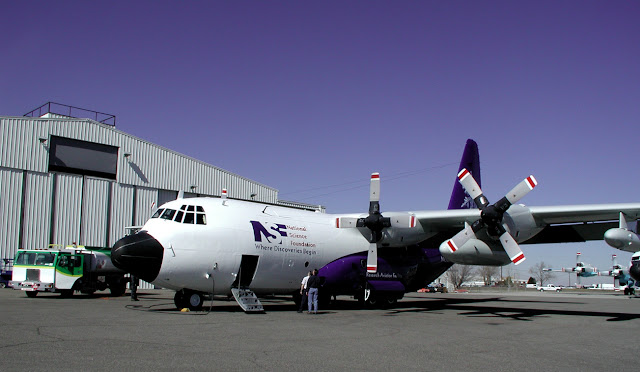
Over the past week you may have noticed a relatively persistent ‘drone’ of aircraft over the Denver area and seen a relatively large aircraft flying overhead. The plane is a specially outfitted C-130 taking part in a major field study of the Front Range’s ozone.
Scientists at the National Center for Atmospheric Research (NCAR) will be using the aircraft, radar, balloons and other sensors and systems in the coming weeks. The project has many goals including mapping possible sources of ozone pollution and using the data to better interpret satellite data.
SCIENTISTS LAUNCH FAR-RANGING CAMPAIGN TO DETAIL FRONT RANGE AIR POLLUTION
BOULDER – Scientists at the National Center for Atmospheric Research (NCAR) and partner organizations are launching a major field project across the northern Front Range of Colorado this month to track the origins of summertime ozone, an invisible but harmful pollutant.
The researchers will use specially equipped aircraft, mobile radars, balloon-mounted sensors, and sophisticated computer simulations to measure local and far-flung pollution sources. Results from the month-long study will provide needed information to officials seeking to ensure that air in the region is healthy to breathe.
It marks one of the largest research projects to look at summertime air pollution on the northern Front Range, including Denver, which often exceeds federal standards for safe levels of ground-level ozone pollution despite efforts to reduce emissions. Ozone can lead to increased asthma attacks and other respiratory ailments. It also damages vegetation, including crops.
“Our goal is to produce an accurate and detailed view of all the diverse sources of ozone pollution along the Front Range,” said NCAR scientist Gabriele Pfister, a principal investigator on the project. “We want to fingerprint where the pollution comes from and analyze what happens when it mixes in the atmosphere.”
Known as the Front Range Air Pollution and Photochemistry Experiment (FRAPPÉ), the study will track emissions from both human-related activities and natural sources. It will focus on the urban corridor from south of Denver, north to Fort Collins, as well as the adjacent plains and mountains. Scientists also want to determine how much pollution comes from upwind areas, including other states and countries.
Funded through a federal-state partnership, FRAPPÉ is supported by the Colorado Department of Public Health and Environment and by the National Science Foundation, which is NCAR’s sponsor.
TWO MAJOR PROJECTS CONVERGE
To provide additional detail across the region, scientists will closely coordinate FRAPPÉ with a second air quality mission taking place on the Front Range at the same time. DISCOVER-AQ (Deriving Information on Surface Conditions from Column and Vertically Resolved Observations Relevant to Air Quality) is a major study led by NASA that seeks to improve the ability of satellites to usefully assess our air quality.
“What we learn from these flights will help us to better interpret satellite remote sensing of air quality from geostationary orbit in the future,” said NASA scientist Jim Crawford, a principal investigator on DISCOVER-AQ. “It also will help us to define the best combination of instruments on the ground to connect air quality monitoring networks with satellite information.”
The DISCOVER-AQ flights and ground observations will focus on the northern Front Range, while FRAPPÉ will gather measurements from the surrounding region.
In all, approximately 200 scientists, technicians, pilots, and students from around the country will converge on the Front Range for the combined projects.
The researchers will quantify emissions from industrial facilities, power plants, motor vehicles, agricultural operations, oil and gas drilling, fires, and other sources. They also will measure naturally occurring emissions from trees and other plants that then combine with emissions generated by human activity to form ozone and other pollutants.
PROFILING AIR QUALITY IN THREE DIMENSIONS
Colorado, like other states, relies on a limited number of ground-based stations to monitor air quality and help guide statewide policies and permitting. But a full, three-dimensional picture of the processes that affect air quality, including conditions far upwind and high up in the atmosphere, requires a three-pronged approach with measurements from aircraft, satellites, and the ground.
“By bringing together aircraft, satellites, and ground-based instruments, we can analyze the amounts and types of pollutants that are emitted in the Front Range as well as transported from other places, how they evolve, and how air circulation patterns near the mountains move them around,” said NCAR scientist Frank Flocke, a principal investigator on FRAPPÉ.
During the projects, which run from July 16 to mid-August, Front Range residents may notice occasional low-flying research aircraft that are taking measurements of the atmosphere. The aircraft will spiral down at times, taking samples of air as they spiral directly above ground instruments that will be measuring air at the surface and observing the atmosphere above.
Ozone, a principal component of smog, forms from the reaction of hydrocarbons and carbon monoxide in the presence of nitrogen oxides (NOx) and sunlight. It peaks during summer months when sunlight is strongest and air conditions are more likely to be stagnant.
Although the scientists will focus on ozone, they will also measure the size and chemical composition of airborne particles to better quantify particle pollution and track its sources. Microscopic airborne particles can have a major impact on people’s respiratory health.
The data gathered by the projects will go through a quality assurance process and then become publicly available in about six months. Scientists will use the data to begin publishing research results in about a year.
AN ARMADA OF INSTRUMENTS
FRAPPÉ and DISCOVER-AQ will use similar payloads for their aircraft. The teams will conduct wingtip-to-wingtip intercomparison flights several times during the project, sampling air in the same place to make sure the instrument readings are comparable.
A network of instruments on towers, rooftops, and other sites will continuously monitor ozone and the gases that react to form it. Other ground-based activities, such as measurements from tethered balloons and from lidars (laser-based radars), will be closely coordinated with the flights. The researchers will draw on forecasts and nowcasts of both weather and air quality from a large number of computer models to assess daily conditions and make final decisions on when to fly and where to gather atmospheric samples.
“This is a unique opportunity for the state to work with others on a study that combines ground-based measurements with aircraft-borne sensing,” said Will Allison, director of the Colorado Department of Public Health and Environment’s Air Pollution Control Division. “It will help us more fully understand complex questions such as the factors contributing to ozone formation in the region. And that will help us continue to implement effective measures to reduce air pollution.”
“FRAPPÉ is a major collaborative study that will produce the most complete picture ever of summertime air pollution on the Front Range,” said Thomas Bogdan, president of the University Corporation for Atmospheric Research, which manages NCAR. “This effort will dramatically advance our understanding of air quality and its potential impacts. The results have the potential to help not only people living on Colorado’s Front Range, but residents of other metropolitan areas with similar conditions, too.”
In addition to NCAR and the Colorado Department of Public Health and Environment, the FRAPPÉ team includes scientists from the National Oceanic and Atmospheric Administration; Cooperative Institute for Research in Environmental Sciences; National Park Service; Regional Air Quality Council; Global Ozone Project; Western Regional Air Partnership; Environmental Protection Agency; University of Colorado Boulder; Colorado State University; University of California, Berkeley; University of Wisconsin; University of Cincinnati; Georgia Institute of Technology; University of California, Riverside; Aerodyne Inc.; U.S. Naval Academy; University of Rhode Island; University of California, Irvine; and Princeton University.
Weather, natural disasters & climate news and information.



 Late afternoon thunderstorms and showers began falling yesterday and continued through midnight. Areas to the east and north, including Denver International Airport, saw more precipitation than other locations and DIA set a daily rainfall record as a result.