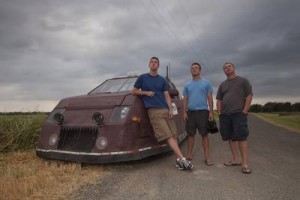
The Dominator team led by Reed Timmer are one of three groups of chasers in this season of Storm Chasers. (Discovery Channel)
Every spring and summer storm chasers take to the Great Plains on a single-minded quest to experience a tornado up close and personal. While many people may find this odd, the cast of the Discovery Channel series Storm Chasers relishes the annual ritual and the channel is set to kick off the fourth season of the hit series.
The 1996 movie Twister brought storm chasing on to the big screen and to the forefront of the public consciousness. On the small screen, Storm Chasers has become one of the most popular shows on Discovery Channel as camera crews follow teams of professional chasers hunting tornadoes. Both have been responsible for the increasing interest in “tornado tourism” during severe weather season.
For the 2010 season the show sees the return of familiar faces for those that have seen the show before but also a notable one appears to be missing.
Hurricane Igor is scene in this view from the International Space Station. See more images in the slideshow below.
A truly rare event is occurring in the Atlantic Ocean where for the first time in 84 years two Category 4 hurricanes are churning at the same time. Yesterday astronaut Douglas Wheelcock snapped stunning images of Hurricane Igor and Hurricane Julia from his perch 220 miles above the Earth aboard the International Space Station.
View the pictures in the slideshow below
Anthony Watts of the popular website Watts Up With That? determined that only three times in the past have two major hurricanes (defined as Category 3 or higher) occurred at the same time.
Given that Igor and Julia are now both Category 4 storms with 135 mph winds, two storms of that strength occurring simultaneously has only happened once – on September 26, 1926.
Of greatest immediate concern is Hurricane Igor. The storm is currently 540 miles east-northeast of St. Martin and appears to be headed for a direct strike on Bermuda sometime Sunday night.
Hurricane Julia is much farther east, approximately 500 miles west of the Cape Verde islands. Julia’s forecast path has her turning to the north and, hopefully, not presenting a danger to land.
The Expedition 24 crew on board the International Space Station includes West Point graduate and Army colonel Douglas Wheelcock. During his time on board the ISS, Wheelcock has captured some astounding images and posted them to Twitter, including photos of Hurricane Earl two weeks ago.
The new images posted today were snapped over the past 24 hours as the ISS passed over the storms. The image of Hurricane Igor is arguably the most impressive as it provides a clear view vertically down into and through the eye of the storm.
The slideshow below from the Natural Disasters Examiner contains the images taken by Colonel Wheelcock as well as images of previous hurricanes taken by International Space Station and Space Shuttle crews and NASA satellites.
NASA Astronaut Douglas Wheelcock captured this image of Hurricane Earl on Monday. Click the image for a slideshow of hurricanes as seen from space. (NASA)
A slightly weakened but still powerful Hurricane Earl continues on its path drawing nearer to the United States East Coast. In recent days, astronauts aboard the International Space Station have been afforded stunning views of the storm from their 220 mile high perch.
According to the National Hurricane Center (NHC), Hurricane Earl’s forecast path will bring it dangerous close to the East Coast from South Carolina through Maine. The center of the storm is expected to remain at sea however the centers “cone of uncertainty” includes much of the coast.
Astronaut Douglas Wheelcock is the commander of the Expedition 24 crew now on board the space station. The West Point graduate and Army colonel previously logged hundreds of hours aboard the Space Shuttle and is in the third month of a six-month stay commanding the ISS.
Like other recent visitors to the space station, Wheelcock is keeping the public up to date with the crew’s activities via Twitter. As the user ‘Astro_Wheels’, Wheelcock has used the messaging service to report on repairs to the station and ongoing experiments and now has posted extraordinary photos of Hurricane Earl.
The two images of the powerful hurricane span roughly 17 hours. The first, taken over the central Atlantic on Monday shows Earl when it was a Category 2 storm with loose, rotating bands. The second, taken this morning, shows how much more organized – and powerful – the storm has become.
The slideshow below contains the images taken by Colonel Wheelcock as well as images of previous hurricanes taken by International Space Station and Space Shuttle crews and NASA satellites.
August 31, 2010 - Hurricane Earl passes to the north of Puerto Rico. The major hurricane is a threat to the United States from the mid-Atlantic to New England.
Hurricane Earl continues its slow trek toward the west-northwest after pummeling parts of the Caribbean yesterday. Today it looks like most areas will be spared the worst of the storm but a forecasted turn to the north may put parts of the East Coast at risk.
The eye of Earl is currently 146 miles north of San Juan, Puerto Rico and the storm is packing 135 mph winds making it a Category 4 hurricane. A bit more strengthening is expected over the next 24 hours as the storm continues to encounter warm waters and favorable conditions.
Of particular concern is the path that Earl may take. It is expected to gradually turn north and eventually to the northeast. Within its forecast cone is a vast area stretching from South Carolina to Maine. With many large population centers within the possibility for landfall, the potential for a major disaster are great.
Colorado storm chaser Roger Hill was shown on the Drudge report and that led to appearances on most major TV networks.
Roger Hill is considered quite famous among storm chasers as he has a proven, uncanny ability to place himself right where severe weather will strike. A recent headline on the Drudge Report featuring Hill has now shined the national media spotlight on him and his profession as co-owner of a storm chasing tour company.
Hill is no stranger to the media as his amazing videos and photos have been featured on the Weather Channel, Discovery Channel, National Geographic and all major news networks. For nearly a decade Hill and his company Silver Lining Tours have been showing thrill seekers what it is like to experience severe weather at closer range than what may be possible otherwise. Interest in “storm chasing tours” however has hit a fevered pitch in recent weeks.
Crews from Inside Edition and Nightline then followed by riding along with Hill and Silver Lining Tours as they crisscrossed the Great Plains on the hunt for tornadoes.
The Nightline piece aired this past Friday and gave a good idea of what it is like to be on tour with Hill (watch the video below). From the frenzied pace to the seemingly endless ingestion of fast food and of course the thrill of the tornado chase, reporter Eric Hong experienced it all.
Comparison of updated 2010 Atlantic hurricane season forecasts.
Despite what seems like a slow start to the Atlantic hurricane season, forecasters are warning that the worst is yet to come. In updates to their annual predictions released last week, Colorado State University (CSU) forecasters and the National Oceanic and Atmospheric Administration (NOAA) are sticking to their earlier forecasts of an above normal level of activity for 2010.
On Wednesday the professional team of Dr. Philip J. Klotzbach and Dr. William M. Gray at CSU said they were sticking with their original prediction of 18 named storms, 10 hurricanes and 5 major hurricanes (Category 3 or higher). The pair warns, “We anticipate a well above-average probability of United States and Caribbean major hurricane landfall.”
NOAA updated their annual forecast Thursday saying, “The Atlantic Basin remains on track for an active hurricane season” and that there was a “90% chance of an above normal season.” Warmer than average water temperatures in the Atlantic and Caribbean and low wind shear are expected to help storm generation. The agency did slightly lower its forecast to 14 – 20 named storms, 8 – 12 hurricanes and 4 – 6 major hurricanes.
Hurricane Alex became a tropical storm on June 26th and a hurricane on the 29th. The storm became a Category 2 hurricane before making landfall in northeastern Mexico.
Tropical Storm Bonnie formed on July 22nd followed by Tropical Storm Colin on July 30th. Colin only survived for 12 hours initially then reconstituted itself late last week only to fall apart as it passed over Bermuda.
The worst is yet to come
Hurricanes can occur at any time of year but the peak period is from August to October. (NOAA)
Experts reminded the public that August and September are historically the most active months with the peak occurring during the second week of September. Dr. Gerry Bell of NOAA’s Climate Prediction Center said, “All indications are for considerable activity during the next several months.”
Keeping the public safe and aware is one of the primary purposes of the forecasts and despite the slow start to the season, they warn coastal residents not to be complacent. NOAA Administrator Jane Lubchenco said, “August heralds the start of the most active phase of the Atlantic hurricane season and with the meteorological factors in place, now is the time for everyone living in hurricane prone areas to be prepared.”
Satellite imagery released by NASA clearly shows the extent of the smoke plume from wildfires burning in western Russia. (NASA) Click the image to view a slideshow of the wildfires as seen from space.
More than 600 wildfires burning across Russia have clouded the skies and claimed the lives of at least 50 people. NASA has trained its satellites on the nation capturing imagery of the blazes as they continue to burn.
Seven regions of Russia are under state of emergency as officials struggle to gain an upper hand against the fires. All told, estimates are that more than 484,000 acres (196,000 hectares) have been scorched with no end in sight.
President Dmitry Medvedev fired several military officials today for their inability to slow the fires. Thousands of people have lost their homes as the flames continue unabated. A naval base in Kolomna was destroyed last week and a nuclear research facility in Sarov is now threatened.
The choking smoke over places like Moscow has added to the misery of what has been an unusually hot summer. The plumes of smoke are so extensive they can easily be captured by NASA satellites orbiting 22,300 miles above the surface of the Earth.
The imagery below was captured by NASA’s Terra satellite yesterday. In the top image, the plumes of smoke from the fires in western Russia stretch more than 1,800 miles (3,000 km). The lower image shows a closer view of the fires burning southeast of Moscow.
Satellite image showing the extent of the smoke plume from fires burning in Russia (NASA)
Satellite image of smoke from wildfires burning southeast of Moscow (NASA)
Intense fires continued to rage in western Russia on August 4, 2010. Burning in dry peat bogs and forests, the fires produced a dense plume of smoke that reached across hundreds of kilometers. The Moderate Resolution Imaging Spectroradiometer (MODIS) captured this view of the fires and smoke in three consecutive overpasses on NASA’s Terra satellite. The smooth gray-brown smoke hangs over the Russian landscape, completely obscuring the ground in places. The top image provides a close view of the fires immediately southeast of Moscow, while the lower image shows the full extent of the smoke plume.
The fires along the southern edge of the smoke plume near the city of Razan, top image, are among the most intense. Outlined in red, a line of intense fires is generating a wall of smoke. The easternmost fire in the image is extreme enough that it produced a pyrocumulus cloud, a dense towering cloud formed when intense heat from a fire pushes air high into the atmosphere.
The lower image shows the full extent of the smoke plume, spanning about 3,000 kilometers (1,860 miles) from east to west. If the smoke were in the United States, it would extend approximately from San Francisco to Chicago. The MODIS sensor acquired the right section of the image starting at 5:55 UTC (10:55 a.m. local time, 8:55 a.m. in Moscow). The center section is from the overpass starting at 7:35 UTC (11:35 local time, 10:35 in Moscow), and the westernmost section was taken at 9:10 UTC (12:10 p.m. local time in Moscow).
Early analyses of data from the Multi-angle Imaging Spectroradiometer (MISR), another instrument on the Terra satellite, indicates that smoke from previous days has at times reached 12 kilometers (six miles) above Earth’s surface into the stratosphere. At such heights, smoke is able to travel long distances to affect air quality far away. This may be one reason that the smoke covers such a large area. The pyrocumulus cloud and the detection of smoke in the stratosphere are good indicators that the fires are large and extremely intense.
According to news reports, 520 fires were burning in western Russia on August 4. MODIS detected far fewer. It is likely that the remaining fires were hidden from the satellite’s view by the thick smoke and scattered clouds. High temperatures and severe drought dried vegetation throughout central Russia, creating hazardous fire conditions in July.
As of August 4, 48 people had died in the fires and more than 2,000 had lost their homes throughout central Russia, said news reports. The dense smoke also created hazardous air quality over a broad region. Visibility in Moscow dropped to 20 meters (0.01 miles) on August 4, and health officials warned that everyone, including healthy people, needed to take preventative measures such as staying indoors or wearing a mask outdoors, reported the Wall Street Journal. In the image, Moscow is hidden under a pall of smoke. Close to the fires, smoke poses a health risk because it contains small particles (soot) and hazardous gases that can irritate the eyes and respiratory system. Smoke also contains chemicals that lead to ozone production farther away from the fires.
The large image provides the full scene shown in the lower image at the sensor’s highest resolution (as shown in the top image). The MODIS Rapid Response Team provides the scene in additional resolutions.
NASA image courtesy Jeff Schmaltz, MODIS Rapid Response Team at NASA GSFC. Caption by Holli Riebeek with information courtesy Mike Fromm, Naval Research Laboratory.
Flooding in Pakistan is easily seen in this satellite image released by NASA. See larger images below. (NASA)
While Colorado has witnessed some pretty good rain showers in recent days due to the monsoon season, it is nothing compared to what Pakistan is experiencing. Seemingly endless monsoonal rains have flooded hundreds of thousands of acres in Pakistan that were easily spotted by NASA satellites.
The floods, said to be the worst in the nation since 1929, have claimed more than 1,500 lives and affected 3.2 million people. Entire villages have been submerged by the water that continues to rise across large swaths of the nation.
The images taken by NASA on July 31st show the Indus River in northwestern Pakistan clearly overflowing. The difference between the image taken this year versus one taken on August 1, 2009 provide a stark contrast that demonstrates how much worse this season is.
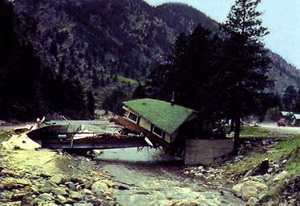
The Big Thompson Flood in 1976 claimed the lives of 143 Coloradoans in what is Colorado's deadliest natural disaster.
July 31, 1976 started like most other summer days in Colorado. It was 1976 and the nation was celebrating its bicentennial and Colorado was celebrating its centennial. What should have been a quiet summer day quickly turned disastrous as the Big Thompson Flood killed more than 100 people in Colorado’s deadliest natural disaster.
In terms of weather, the day started out much like one would expect but by late afternoon storm clouds loomed over the mountains. Mountain thunderstorms are an almost daily occurrence in Colorado but the storm that struck in the early evening that day was unlike any other.
With light winds aloft, the storm stalled over the upper portion of the Big Thompson basin where it sat dumping tremendous amounts of rain – nearly 8 inches in one hour and 12 inches over four hours. The rain came so fast that the water didn’t have time to be absorbed into the ground.
I’m stuck, I’m right in the middle of it, I can’t get out…about a half mile east of Drake on the highway. Get the cars out of the low area down below…
~ Radio transmission by Sergeant Willis Hugh Purdy, Colorado State Patrol. Purdy was never heard from again.
In the mid-sections of the canyon and lower, there was little indication of what was to come. The flash flood that resulted from the rain further up rushed down the canyon creating a wall of water that was 20 feet high in places. The flood scoured the canyon of everything – cars, homes, buildings and people.
The following day the Rocky Mountain News ran with the headline “Scores dead, hundreds hurt in Big Thompson flash flood.” A subheading said, “U.S. 34 west of Loveland is no more.”
When the flood was over, 143 people had lost their lives, more than in any other natural disaster in state history. 418 homes, 52 businesses and 400 cars were destroyed at a cost of over $40 million.
A magnitude 5.0 earthquake struck north of Anchorage, Alaska on Wednesday evening. (USGS)
Alaska is one of the most seismically active parts of the United States and early Thursday morning residents near Anchorage received a reminder of that fact. A magnitude 5.0 temblor stuck in the evening hours on Wednesday and was felt across the south-central area of the state.
Centered 50 miles north-northwest of Anchorage, the quake struck at 07:15pm and according to the U.S. Geological Survey (USGS) was at a depth of 12.9 miles below the surface.
The service said it had received reports of the temblor being felt as far away as Palmer and Valdez to the east and Skwentna to the west. Residents of Anchorage and Seward to the south also felt the shaking.
Being along the Pacific Ring of Fire, Alaska regularly experiences earthquakes although most are small and not felt. The boundary of the North American and Pacific tectonic plates that runs through south-central Alaska and the Aleutian Islands is where most of the activity occurs.
The Alaska Earthquake Information Center (AEIC) says that the state receives from 50 to 100 earthquakes a day. Three of the 10 largest earthquakes recorded in the world, all larger than magnitude 7.9, have been recorded in Alaska.



.jpg)