From the evening of October 27, 2009 through October 29, 2009, the Denver metro area was struck by a major, early winter snowstorm. The mountains and foothills to the immediate west of Denver were measuring the snowfall in feet while in the city more than a foot of snow fell in less than 72 hours. Here in Thornton we recorded 14.1 inches of snow during the event.
This time lapse video below was captured by our east facing webcam. It begins early Tuesday morning (October 27th) and runs through midnight on Thursday, October 29th. As it starts, you can see the first day started out nice enough but by evening the wind was blowing and rain was falling. That soon changed to snow and the snowstorm was in full force for two days.
Live CDOT webcam image from 120th & I-25 looking south.
Update, 6:10pm: As the storm starts to move to the east, blizzard conditions on the plains east of Denver are causing problems. I-70 remains closed from Airpark Road to Burlington and I-76 is closed from Lochbuie to Fort Morgan. Storm reports indicate blizzard conditions prevail with limited visibility and drifting snow. A Blizzard Warning is in effect for much of the northeastern Colorado plains and will remain so until 6:00am Friday.
Closer to town, things are finally starting to ease up along the Front Range and in the metro area. Gusty winds and cold temperatures will keep wind chills down into the teens and make it uncomfortable to be outside. Drifting snow on roadways is possible thanks to those gusty winds from the north. Additional light snow can be expected, mainly in areas to the west and south.
The Winter Storm Warning for the metro area was allowed to expire at 6:00pm as planned. However, roads are likely to get slick as temperatures drop overnight so please use caution.
Update, 12:38pm: October 2009 enters the record books as the 7th snowiest October on record in Denver. The National Weather Service reported that as of 6:00am today, the official station at Denver International Airport had recorded 14.5 inches of snow fall for this month. 10.6 inches of that had fallen in the previous 24 hours. With the early measurement and the fact the snow is expected to continue throughout the day, it is possible the month will climb further up the charts (see below).
It is also notable that Denver will likely finish the month as one of the coldest Octobers on record. Thus far the average temperature for October 2009 has been 43.9 degrees. Were the month to end today, that would place it in a tie for the third coldest October on record.
Update, 10:35am: The snow keeps falling! Light snow will continue across the urban corridor for the rest of the morning with 1 to 4 inches additional accumulation possible. Some areas south may see heavier snow rates, particularly to the south and east.
Blizzard-like conditions are possible in open areas where there is a good bit of wind blowing. Travel to the east is best avoided at this time due to low visibility and icy conditions. Chain laws are actually in effect on I-76 at Wiggins due to hazardous conditions. I-25 remains closed from Wellington to the Wyoming border.
At Denver International Airport, flight delays continue to mount. Delays of 3 to 4 hours are being experienced for arrivals and departures as DIA ground crews struggle to keep up with the falling snow. Frontier Airlines reports that additional cancelations are possible.
Storm spotters have reported amounts as high as 44 inches in Coal Creek Canyon and snowfall reaching near 3 feet is being seen in many places in the foothills. Closer to town, west and south are reporting up to 18 inches while central Denver is reporting close to one foot. ThorntonWeather.com has recorded 14.1″ so far! Click here for the latest storm reports from across the area.
ThorntonWeather.com is of course your source for local information on the storm as it develops. We will also be updating the Denver Weather Examiner site as things develop. Here are some quick links to pages you may find handy:
Update, 6:35am, Thursday, October 29, 2009: Thornton and a large portion of Colorado continue to be hammered by a two-day long storm that has dumped more than two feet of snow in the adjacent foothills and a foot across much of the metro area. At ThorntonWeather.com we have recorded 13.2 inches of snow thus far for the event. While the early winter storm has created its share of problems, the relatively slow snowfall rate has allowed it to be manageable by most standards.
Colorado is staged to be struck by a major early winter storm Wednesday and Thursday.
Update: Tuesday, October 27th, 2009 5:15pm
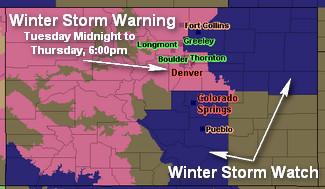
A major early winter storm is on track to become the state’s first major snowstorm of the season. Areas in the mountains adjacent to the Denver Front Range may be measuring the snow in feet while parts of the Denver area could see up to a foot.
A cold front and trough dipping down from the north combined with a low pressure system moving over southern Colorado will combine creating a ‘perfect storm’ of sorts. Showers will begin spreading from the mountains this evening initially in the form of rain. As temperatures cool, that will change to snow, likely after midnight. Initially most of the precipitation will be west of I-25.
By Wednesday morning, up to 2 inches may have fallen in the Denver area and 3 – 4 inches in the foothills. As dawn breaks, conditions become ripe for a major storm as the upslope flow starts to kick in. The morning rush hour might be tolerable but by the time the afternoon arrives, things will be much different. At times during the day areas may see snowfall rates of 1 to 2 inches PER HOUR. Gusty winds will make for low visibility conditions and blowing and drifting snow.
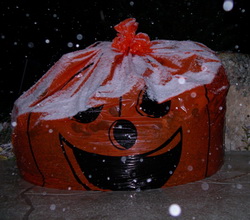
Snow on Halloween? Popular belief is that we seem to have a lot of snow when the trick or treaters are out on the street.
Conventional wisdom in the Denver area is that it always seems to rain or snow on Halloween. I know as a kid growing up here it seemed like Mother Nature always put a damper on our trick or treating.
But, is there any truth to this urban legend? Or is this just one of those times where our memory doesn’t serve us quite right?
This year it looks like we have nothing to worry about but the National Weather Service has been kind enough to compile weather statistics just for Halloween. As it turns out, the thought of snow and rain on Octboer 31st isn’t just in our minds!
October 25 to October 31 - This week in Denver weather history
Halloween week is historically pretty eventful when it comes to weather. Wind is always a factor this time of year as gusty Chinook winds can come flying down the mountians and foothills and cause a great deal of damage. Snow of course also becomes more frequent as we get closer to our second snowiest month (November).
From the National Weather Service:
From the 24th to the 25th:
In 1921…rainfall totaled 0.35 inch overnight behind an apparent cold front. North winds were sustained to 40 mph with gusts to 46 mph on the 25th. Temperatures plunged from a high of 73 degrees on the 24th to a low of 39 degrees on the 25th.
In 1923…rain overnight changed to snow during the morning. The heavy snowfall accumulated to 12.0 inches before ending on the morning of the 25th. Post-frontal north winds were sustained to 22 mph with gusts to 23 mph on the 24th.
In 1997…one of the worst and deadliest blizzards of the decade developed over eastern Colorado as deep east to northeast flow associated with a vigorous upper level low pressure system over the four corners…combined with a strong arctic air mass over the central great plains. Snowfall totals across metro Denver ranged from 14 to 31 inches. The heaviest snowfall occurred in the foothills west and southwest of Denver where 2 to 4 feet of snow were measured. Sustained winds to 40 mph with gusts as high as 60 mph produced zero visibilities and extremely cold wind chill temperatures from 25 below to 40 below zero. Winds whipped the snow into drifts 4 to 10 feet deep. Several major and interstate highways were closed as travel became impossible. Red cross shelters were set up for hundreds of travelers who became stranded when they had to abandon their vehicles. Four people died in northeastern Colorado as a result of the blizzard. None of the deaths were in metro Denver. At Denver International Airport…4 thousand travelers were stranded when the airport was forced to shut down. At least 120 cars were abandoned along Pena Blvd….the only arterial leading into and out of dia. The blizzard cost air carriers at least 20 million dollars. Thousands of cattle died in the storm over northeastern Colorado…resulting in losses totaling 1.5 million dollars. Some of the more impressive snowfall totals included: 51 inches at Coal Creek Canyon; 48 inches at silver spruce ranch…near ward; 42 inches at Intercanyon…in the foothills southwest of Denver; 37 inches at Sedalia; 35 inches at aspen springs and Conifer in the foothills west of Denver; 31 inches at Eldorado Springs… Southeast Aurora…and Englewood; and 30 inches on Table Mesa in Boulder. Snowfall totaled 21.9 inches at the site of the former Stapleton International Airport…setting a new 24-hour snowfall record of 19.1 inches for the month. Snowfall totaled only 14 inches at Denver International Airport where north winds gusted to 39 mph on the 24th. High temperature of only 21 degrees on the 25th equaled the record low maximum for the date first set in 1873. Low temperature of only 3 degrees on the 26th set a new record minimum for the date.
On the 25th:
In 1925…a vigorous cold front produced north winds sustained to 42 mph with gusts to 52 mph. Post-frontal snowfall was only 0.4 inch during the late afternoon and early evening.
In 1959…northwest winds gusted to 55 mph at Stapleton Airport.
In 1997…the high temperature warmed to only 21 degrees… The record low maximum for the month. The same temperature also occurred on October 30…1991.
Why does ThorntonWeather.com share stories and links with Examiner.com?
We are oftentimes asked why we have links to Examiner.com on ThorntonWeather.com and why we plug stories from them. The reasons stem from our interest on the topics at hand but also because by your visiting Examiner.com, you support ThorntonWeather.com.
Some background on Examiner.com might be useful. Examiner.com was launched in 2008 by Clarity Media Group, a company owned by Phillip Anschutz. The site is essentially a living example of ‘citizen journalism’ featuring local news stories on hundreds of topics written by people titled ‘Examiners’ who are knowledgeable in their given topic area. There are now hundreds of local editions of Examiner.com including of course Denver.
First and foremost it is because we are passionate about weather and climate and enjoy sharing news stories about those topics. Weather is one of the things that affect the lives of every single person on earth and that is fascinating to us.
By writing for Examiner.com, we have a pretty big stage on which to have our topic features – the site is one of the fastest growing on the Internet and now ranks 82nd in overall traffic on the Internet with more than 12 million people a month visiting it. That ranks higher than popular sites like drudgereport.com, cbs.com and newsweek.com!
Secondly, quite frankly we do get paid for writing for Examiner.com and that money directly supports and helps to pay for ThorntonWeather.com. The weather station hardware, software, lightning detectors, and more that we use here on ThorntonWeather.com is very expensive. Factor in computer costs, website services and more and it isn’t cheap. We don’t charge for ThorntonWeather.com and never will but Examiner.com helps to offset the very real costs we do incur in operating the site.
By reading an Examiner.com story we post in our news section or checking out the links on the left to our Examiner.com topic areas, you are supporting ThorntonWeather.com directly. So, if you like ThorntonWeather.com, we ask you to check out our stories on Examiner.com – not only is Examiner.com a great, local news source, it also is a great way to help us! You can also support us by checking out the few advertisers you see on the site.
If you ever have any questions about our site, Examiner.com or any weather-related topic, please contact us. Thank you as always for supporting ThorntonWeather.com.
Is global warming responsible for the pine beetle spread or is it something else?
Much has been said here in Colorado about the pine beetle outbreak in the beautiful mountains west of Denver. Anyone who travels in the high country has seen and most likely taken note of the patches of dead, brown pine trees.
More than one news story has reported that the beetles were a harbinger of things to come as a result of global warming and manmade climate change.
Interestingly enough, that isn’t necessarily the case. As reported in the Climate Change Examiner, man may be partially responsible but it isn’t CO2 emissions that are to blame. Mismanagement of forests and a ‘perfect storm’ of other items can be fingered as well.
From the Climate Change Examiner:
A tiny little bug about the size of a grain of rice has become a focal point in the debate about manmade climate change. Over the last 12 years, the mountain pine beetle has spread quickly through the Mountain West and Canada killing millions of acres of pine trees.
The beetle thrives when conditions are drier and warmer than average and some experts have blamed its spread on manmade climate change and a warming environment. From Canada south to Colorado, images of acres of dead, brown trees amongst their healthy neighbors make for a stark picture of what may be forests in decline.
Global warming activists have been quick to seize on the pine beetle ‘epidemic’ as a sign of things to come and an impending ecological disaster. In truth, drawing the line between manmade climate change and the pine beetle outbreak is a stretch that few experts make. Rather, most see the outbreak as a natural function of forests and in many ways it is Mother Nature correcting man’s previous mistakes.
Denver tied the record high temperature for the date today.
At 3:44pm today, the temperature at Denver International Airport reached 84 degrees. This tied the record high temperature for October 18th set in 2003 and 1958. The average temperature for this date is 68 degrees so we exceeded that by a large margin.
From record setting cold last week to record setting warmth this week – you have to love Colorado weather!
Here in Thornton we were actually a touch warmer reaching 85.9 degrees. We have one more day of above normal temperatures ahead on Monday before we see a change that will bring cooler temps and possibly rain and snow.
October 18 to October 24 - This week in Denver weather history
This week is an extremely eventful one in Denver weather history with a wide variety of conditions having been experienced in the past. Wind and snow are probably the two most dominant items, none more so than the blizzard that struck 12 years ago on the 24th. That storm ravaged the city, closed the airport and highways and was responsible for four deaths.
From the National Weather Service:
From the 17th to the 19th:
In 1908…a moist…heavy…wet snowfall totaled 13.0 inches in downtown Denver over the 3 days. Rain from early morning on the 17th changed to snow by late afternoon and continued through the late morning of the 19th. Due to temperatures in the 30’s and melting…the most snow on the ground was only 5.0 inches at 6:00 pm on the 18th. Northwest to northeast winds were sustained between 12 and 20 mph during the storm. Precipitation totaled 1.82 inches.
On the 18th:
In 1875…the haze was so dense that the mountains were not visible from downtown Denver for most of the day.
In 1937…a vigorous cold front produced north winds sustained to 32 mph with gusts to 41 mph. Rain and snow totaled 0.16 inch. Post-frontal snowfall of 0.8 inch was the only snowfall of the month.
In 1960…post-frontal upslope rain changed to snow. Snowfall was 2.2 inches at Stapleton Airport where precipitation (rain and melted snow) totaled 1.58 inches.
In 1971…wind gusts to 48 mph were recorded in downtown Boulder. West winds gusted to 30 mph at Stapleton International Airport.
In 1999…heavy snow developed in the foothills west of metro Denver with lesser amounts across the city. Snowfall totals included: 7 inches near Nederland…6 inches in Boulder…and 5 inches at Chief Hosa. Only 1.2 inches of snow were measured at the site of the former Stapleton International Airport.
From the 18th to the 23rd:
In 2003…an extended warm spell resulted in 5 new temperature records. The high temperature of 84 degrees on the 18th equaled the record high for the date. High temperatures of 86 degrees on the 19th…83 degrees on the 21st…and 84 degrees on the 22nd were record highs for the dates. Low temperature of 49 degrees on the 23rd was a record high minimum for the date. Low temperatures during the period were in the 40’s and lower 50’s.
On the 19th:
In 1887…northwest winds sustained to 42 mph were recorded in the city.
In 1982…3 to 6 inches of snow fell over northwest metro Denver…including Boulder. Only 1.2 inches of snowfall were recorded at Stapleton International Airport where north winds gusted to 35 mph. This was the first measurable snowfall of the season.
Sean Casey, Josh Wurman, Reed Timmer next to Storm Chasers vehicle, TIV2. (Discovery Channel)
Storm Chasers is the Discover Channel’s hit show that tracks a team of tornado chasers across Tornado Alley as they hunt for twisters. Entering its third season, the season premiere is this Sunday, October 18th at 8:00pm MDT.
This season the team features a number of changes over year’s past. Josh Wurman and his team of scientists manning the DOW (Doppler On Wheels) radar returns but now he is participating in the VORTEX2 project as well. Sean Casey and the TIV2 (Tornado Intercept Vehicle) return as well.
Last season’s new addition, the TornadoVideos.net team with Reed Timmer, join with an impressive new piece of hardware – the Dominator. Lastly, world renowned storm chaser Tim Samaras joins the show as he continues on his lifelong hunt and scientific quest.
Here is a preview video for the coming season. Be sure to tune in on Sunday!
Weather, natural disasters & climate news and information.


 Secondly, quite frankly we do get paid for writing for Examiner.com and that money directly supports and helps to pay for ThorntonWeather.com. The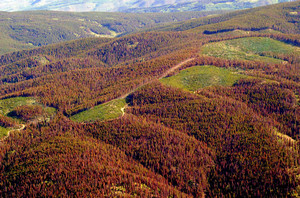
 Get the complete story on Examiner.com and find out why even state foresters aren’t blaming man entirely.