A screen capture from video shot by a civilian drone shows the devastation caused by a tornado in Mayflower, Arkansas. (YouTube / briandjin2)
Tornado activity in the United States had been at record low levels before this weekend. Mother Nature came roaring back to life Sunday however spawning a deadly outbreak of twisters with more expected Monday.
The National Weather Service’s Storm Prediction Center accumulated reports of 31 tornadoes Sunday although the actual number will likely be less once analyzed. Seven states including Nebraska, Iowa, Kansas, Arkansas, Oklahoma, Louisiana, and Mississippi reported twisters.
Hardest hit were the towns of Mayflower and Vilonia near Little Rock, Arkansas. Entire sections of the towns were reduced to their base building materials as the twisters struck late in the day Sunday.
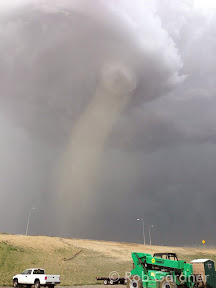
The tornado near DIA sent workers working on the terminal renovations scrambling. (Rob Gardner)
The tornado that struck on the grounds of Denver International Airport (DIA) on Tuesday, June 18, 2013 has been rated an EF1 with winds up to 109 mph. The twister came within a half mile of Concourses A and B and sent workers and travelers scrambling to tornado shelters.
Scroll down to see more photos of the tornado.
From the National Weather Service:
A tornado developed on Denver International Airport (DIA) grounds on the afternoon of June 18, 2013. The tornado formed around 2:19 PM just north of 70th Avenue. The tornado then moved slowly northwest between Runway 35R and 35L, and moved to within a half mile of Concourses A and B before dissipating at 2:36 PM. The tornado moved extremely close if not over the ASOS (Automated Surface Observation System) and another low level wind shear sensor at DIA. The ASOS weather observing system reported a 97 mph wind gust at 2:27 PM, while the wind shear sensor reported a wind gust to 109 mph at the same time – indicative of an EF1 tornado. There was only minor damage noted to this equipment. The storm responsible for this tornado first developed just south of the airport, and then drift slowly northward across the eastern side of DIA. At 2:05 PM, there was weak rotation beginning to develop underneath this storm as noted by the velocity data below. This rotation then strengthened quickly between 2:10 and 2:22 PM.
With its towering mountains and pristine mountain landscape, Colorado’s high country is not normally associated with tornadoes. Saturday however a rare high altitude twister appeared in the skies and touched down at the second highest altitude a tornado has ever been recorded at. Read the rest of this story on Examiner.com including amazing video.
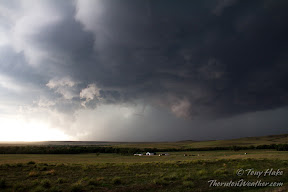
A massive storm churns near Simla, Colorado on Thursday, July 7, 2012. See more photos in the slideshow below.
Mother Nature brought severe weather to northeastern Colorado again yesterday but for the second day in a row Thornton missed out on the action. Since the storms wouldn’t come to us, ThorntonWeather.com went to the storms.
Thornton seems to be in a bit of a ‘storm drought’ of late with most thunderstorms passing us by and yielding little more than a few rain drops. Elsewhere along the Colorado Front Range the story has been much different over the last two days.
The setup was near perfect thanks to the formation of a Denver cyclone with moist air pulling in from the south meeting dry air from the north.
ThorntonWeather.com took off in mid-afternoon and headed east to Bennett, then on to Byers and east on Highway 36. The initial storm cell that was beginning to take shape broke in to three and decisions had to be made on which one to follow.
The southernmost cell seemed to hold the most promise so we headed south, through Limon and tracked the storm near Simla.
The storm would drop tennis ball size hail and push out wind gusts measured at 80mph. As many as four tornadoes were reported to have been caused by the storm, a number which will be confirmed and finalized later today.
In Elbert County, emergency agencies are conducting damage assessments from at least one of the twisters that tore through the central part of the county. Extensive damage to as many as seven homes west of Simla was seen. One person received minor injuries.
Satellite imagery released by the USGS and NASA (below) shows the scar the EF3 tornado left on the earth as it ripped a path 39 miles long. The image taken by Landsat shows the path of the half-mile wide tornado as it cut through Sturbridge and beyond.
The twister first touched down near Westfield and then moved into Springfield after crossing the Connecticut River. Both areas saw extensive damage to buildings and homes as the twister moved through.
As it moved east the tornado debarked trees and struck the town of Monson where extensive damage was seen. It eventually hit Brimfield Sate Forest and then the Southbridge Airport.
When it was done, four people were killed and 200 injured. Latest estimates put the damage cost at $90 million making it the most costly natural disaster in the state’s history.
Two smaller, EF1 rated tornadoes also struck nearby on the same day. One caused a damage path 3.6 miles long and the other 1.3 miles long.
Image taken by the Landsat satellite on June 5, 2011 showing the damage path from an EF3 tornado that struck Massachusetts on June 1, 2011. Click the image for a larger version. (USGS / NASA)
Tornadoes and other forms of severe weather have caused extraordinary damage and loss of life this spring across the nation.
Tornadoes, damaging wind, hail and flooding rains are a fact of life in the United States in the springtime. This season however has seen an absolutely devastating series of storms systems that have brought extraordinary levels of destruction and loss of life.
Among our writing assignments for Examiner.com we are the Natural Disasters Examiner. Of late the vast majority of our coverage has centered on the severe weather. Below are some of the stories we have written in recent days about the outbreaks. Follow the links for greater detail including photos and videos.
Deadly severe weather season continues as 13 killed across three states Mother Nature continues to pile on more severe weather in what has been a particularly devastating and deadly spring in the United States. Tornadoes, hail, and damaging wind struck the central and southern U.S. yesterday killing at least 13 people.
2011 tornado statistics provide chilling empirical evidence of a deadly season The scenes of utter devastation have been played out across the nation this spring as tornadoes rip across the landscape. The latest statistics for the tornado season show clearly that the death toll has been staggering and the number of twisters record-setting.
Tornado statistics: Top 25 deadliest tornadoes in U.S. history With an average of 1,200 tornadoes per year, more twisters strike the United States than any other nation in the world. These storms can strike with deadly effects with a single twister covering more than a hundred miles, wiping out entire towns and claiming dozens of lives.
Cars and debris are strewn about in front of the devastated St. John's Regional Medical Center in Joplin, Missouri. Click the image to view a slideshow of the devastation. (Twitpic / borntorunnergrl)
Following on last month’s devastating bout of severe weather the month of May had started out much quieter. That silence from Mother Nature however was shattered yesterday as a massive tornado ripped through Joplin, Missouri killing at least 89 people.
Late afternoon brought storm clouds to southwestern Missouri and a tornado warning soon sounded. Residents of Joplin had 20 minutes to find cover before the massive tornado struck the heart of town.
Scroll down for amazing video of the Joplin tornado as it grows with amazing speed. Also be sure to check out the slideshow of images of the devastation.
As frightened residents huddled in basements and bathrooms, the twister destroyed as much as 75% of the town. The high school, regional medical center, an elementary school as well as thousands of other homes and businesses were destroyed.
The human toll from the tornado was devastating. At latest report 89 people were killed and emergency crews continue to search for survivors as the death toll is expected to climb.
The National Guard has been activated by Missouri Gov. Jay Nixon to help with recovery efforts. Relief agencies across the nation were deploying personnel and supplies to assist as well.
The tornado that struck Joplin was part of a larger set of storms that struck multiple states on Sunday. In all, 48 tornadoes were reported including one near Minneapolis that claimed the life of one person.
Extensive damage seen at St. Louis airport after tornado strikes. View more images in the slideshow below. (Twitpic / LakishaJackson)
Severe weather struck the St. Louis area Friday evening bringing large hail, damaging winds and powerful tornadoes. One twister tore a lengthy pass through the city hitting the airport and causing extensive damage to the facility and nearby homes.
The most significant component of the storm system was a powerful EF4 tornado packing winds of more than 166mph at its peak and causing damage nearly one-half mile wide at the widest point. Initially touching down west of Lambert-St. Louis International Airport, the tornado followed a 22 mile long path destroying homes and causing extensive damage at the airport.
At the airport tornado sirens were sounded as the storm approached and many of the estimated 500 travelers at the airport sought shelter. The powerful tornado struck and blew out 60 percent of the windows in the main terminal building and partially lifted the roof on Concourse C.
On the grounds of the airport baggage carts were tossed about and the tarmacs were littered with debris. Parking areas saw cars smashed and thrown into each other like toys.
Residential areas to the west of the airport where the tornado first touched down bore the brunt of the damage, particularly in the community of Bridgton. Many homes were reduced to piles of wood and cinder while trees and power lines were downed.
After crossing the airport the tornado continued on its path damaging other buildings and homes. Extensive roof damage was caused to the First Baptist Church of Ferguson and a Little Caesars Restaurant saw its roof torn completely off.
The tornado then crossed the Mississippi River into Illinois. Three homes saw their roofs torn off while others sustained significant damage.
Despite the twister’s lengthy path of destruction and powerful nature, no fatalities were reported. At the airport five people were treated for relatively minor injuries.
Do you know what to do to protect yourself and your family when severe weather strikes? The same type of events that struck in recent days can and do occur in Colorado. Check out our Severe Weather Awareness series for more:
When faced with a tornado what would you do? Do the smart thing and drop the camera and seek shelter.
Just as we were wrapping up Severe Weather Awareness Week on ThorntonWeather.com, disaster struck the nation’s south. Dozens of tornadoes brought death and destruction and at the same time Mother Nature allowed us to learn valuable lessons.
Extreme weather events have gotten more and more attention thanks to Twitter, YouTube, Facebook and other forms of social media. Television shows like Discovery’s Storm Chasers and shows on the Weather Channel feed a seemingly insatiable desire to see these events. They give the impression that anyone can stare down major storms with few repercussions but that is far from the truth.
Professional weather watchers, meteorologists and storm chasers cringe at some of what we see when these events happen. People with seemingly no clue of the destructive and unpredictable nature of what they are looking at put themselves in harm’s way for 60 seconds of fame.
The severe weather outbreak of recent days highlights the folly of those uninitiated and untrained in these phenomena. One particularly striking video has emerged of a man in Wilson, North Carolina watching as a tornado approaches, talking on the phone and shooting video.
The video (below) is scary to watch as the man is oblivious to what is coming toward him at 50mph. We implore all ThorntonWeather.com readers to do the smart thing – seek shelter when severe weather. Don’t become a statistic for a photo or a video.
Saturday evening the stage was set for severe weather across the nation’s heartland and Mother Nature came through in spades. More than a dozen tornadoes were reported as were scores of significant hail events.
Despite the number of events most resulted in little damage. However one tornado, by some accounts as big as three quarters of a mile wide, struck the town of Mapleton, Iowa. This massive wedge tornado struck at 7:21 CDT and caused significant damage in the town.
The video below was captured by storm chasers as they tracked the dangerous tornado.