
 The Western Hemisphere will be given a bit of an astronomical treat Wednesday with a total lunar eclipse. A lunar eclipse occurs whenever the moon passes through some portion of the Earth’s shadow – basically when the Earth is between the moon and the sun.
Best up all for those of us in the Rocky Mountain area, the eclipse will occur at a good time for watching (see below). For more information, please see the table below for viewing times and the links for more information.
Update, 2/20/08 @ 10:30am – Unfortunately it appears cloud cover in the Denver metro area may inhibit the ability to see the eclipse. It is worth trying to get a glimpse though.
NASA Website About Tonight’s Eclipse
AFP News Story – How an Eclipse Saved Columbus
| Total Lunar Eclipse of February 20, 2008 | |||||||
|---|---|---|---|---|---|---|---|
| North America | Other | ||||||
| Event | EST | CST | MST | PST | AST | GMT | |
| Partial Eclipse Begins: | 08:43 pm | 07:43 pm | 06:43 pm | 05:43 pm | 04:43 pm | 01:43 am* | |
| Total Eclipse Begins: | 10:01 pm | 09:01 pm | 08:01 pm | 07:01 pm | 06:01 pm | 03:01 am* | |
| Mid-Eclipse: | 10:26 pm | 09:26 pm | 08:26 pm | 07:26 pm | 06:26 pm | 03:26 am* | |
| Total Eclipse Ends: | 10:51 pm | 09:51 pm | 08:51 pm | 07:51 pm | 06:51 pm | 03:51 am* | |
| Partial Eclipse Ends: | 12:09 am* | 11:09 pm | 10:09 pm | 09:09 pm | 08:09 pm | 05:09 am* | |
* Event occurs on morning of February 21, 2008
 An interesting editorial recently in Investor’s Business Daily addresses concerns among many scientists no about global warming – but global cooling. These scientists of course don’t receive the press that Al Gore and the “man made climate change” groups do but their voice is starting to be heard. They don’t necessarily dispute that man can have an effect on the climate but they do dispute the amount of effect and they caution that there may be other, greater forces at work – solar activity for one. From the article:
 An interesting
  Updated 2/14/08, 4:45pm – In the end, a pretty typical late winter storm. A decent bit of moisture in the snow that fell and it is already mostly melted. 🙂 ThorntonWeather.com recorded 2.6 inches of the white stuff which is below the low end of what was originally forecast. It was a pretty stark contrast though between Wednesday when we reached a high of 69 and today with a high of only 32 – a difference of 37 degrees in just a single day!
  This past Tuesday saw over 40 tornadoes touch down across Tennessee, Arkansas, Missouri, Kentucky, Alabama and Mississippi. The death toll from these storms currently stands at 57 making it one of the 15 worst tornado death tolls since 1950, and the nation’s deadliest swarm of tornadoes since 76 people were killed in Pennsylvania and Ohio on May 31, 1985.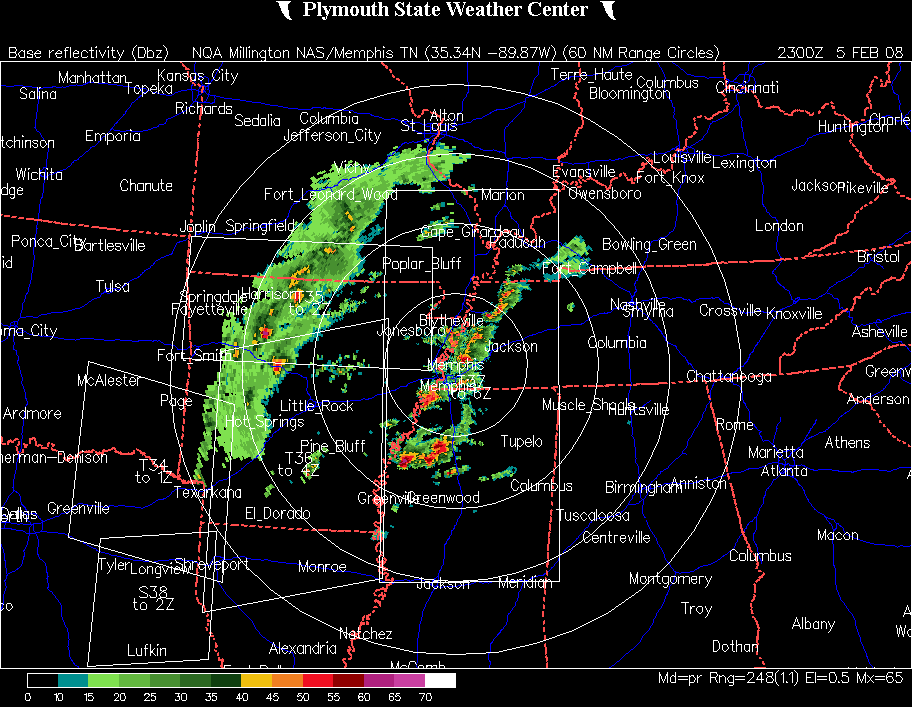
 Denver and Thornton wrapped on the first month of 2008 dry. Official measurements at Stapleton and at ThorntonWeather.com recorded only 0.08 inch of precipitation making it the 7th driest January since recordkeeping began in 1872. This was 0.43 inch below the 0.51 normal, so a pretty big drop. Only two days had measurable precipitation in the form of snow at Stapleton while in Thornton we recorded four.