Earth Hour set to highlight climate change

On March 28th, 1,500 cities worldwide will particpate in Earth Hour to draw attention to climate change.  See the video below for details.
On March 28th, 1,500 cities worldwide will particpate in Earth Hour to draw attention to climate change. See the video below for details.

On March 28th at 8:30pm local time, cities across the globe will participate in Earth Hour by turning off their lights for one hour.  More than 1,500 cities around the globe have committed to taking the measure to highlight worries about climate change.  U.N. Secretary-General Ban Ki-moon has asked for support for the endeavor saying,”It promises to be largest demonstration of public concern about climate change ever attempted.”

Organized by the World Wildlife Fund (WWF), last year’s event saw an estimated 50 million people worldwide participate.  Organizers hope for a much more significant event this year with a goal of 1 billion as a way to ‘send a strong message to our political leaders that we want them to take meaningful action on climate change.’

Acknowledging that the event will not do anything to decrease the world’s carbon footprint, the WWF likens it to other symbolic events such as the Boston Tea Party or the protests of the 1960’s.

I urge citizens everywhere to join us.  We are on a dangerous path, the planet is warming and we must change our ways.
– U.N. Secretary-General Ban Ki-moon

Berlin, Beijing, Copenhagen, Dubai, Hong Kong, London, Mexico City, Moscow, Paris, Sydney and Toronto are some of the international cities that have committed to participate.  Here in the United States many major cities have agreed to turn their lights out including Albuquerque, Boston, Chicago, Dallas, Las Vegas, Los Angeles, New York, Washington D.C. and more.

Colorado as well has six cities participating including Boulder, Commerce City, Denver, Fort Collins, Silverthorne, and Westminster.  Denver will darken four public buildings:  the Wellington Webb Building, the City and County Building, the Human Services Building on Federal Boulevard and the McNichols Building.

For more information, visit Earth Hour’s website here:  http://www.earthhourus.org

City of Thornton will plow residential streets in wake of blizzard

City of ThorntonThe city has annnounced that they will be plowing residential streets in accordance with their snow removal plan.
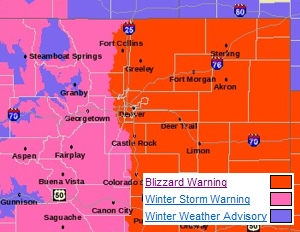
From the City of Thornton:

City of Thornton officials have rated this a Class 3 storm (potential to last more than 24 hours; accumulations of over nine inches) and are treating it as such. This means that the city is bringing in on-call contractors to supplement the city truck efforts. While City Crews are staying on arterials, contractors have plowed secondary streets and are commencing plowing operations in residential neighborhoods.

For more information from the city, please see their storm update page.

Continue reading City of Thornton will plow residential streets in wake of blizzard

Major snowstorm starts to hit Thornton, Blizzard Warning issued

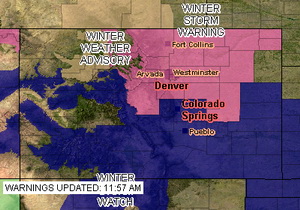
A Blizzard Warning is in effect for all of eastern Colorado, including Thornton.

Thornton and Denver are preparing for what will be its biggest snowstorm of the season today as the National Weather Service has now issued a Blizzard Warning for all of eastern Colorado.  The major storm we had been watching in recent days is now arriving over the Front Range and snow is starting to fall and will become widespread by 7:00am.  Initially the snow will melt as it hits the ground but as it gets heavier, it will begin to accumulate.

March is our snowiest month and this is setting up to be a classic late winter / early spring storm with lots of Pacific moisture and a Canadian cold front dipping down from the north.  Winds are now starting to come out of the east and northeast providing the required upslope conditions that will slow the storm down and hold it over the Front Range.

Between noon and about 9:00pm the snow will be at its heaviest as will the wind which will cause significant drifting and road travel will become treacherous – the afternoon rush hour is almost certainly going to be a big mess.  Road closures are likely to happen at some point later today, particularly south and east.  Areas along the Palmer Divide, the foothills and the south metro area will have the most snow with lower amounts as you move north.  The Denver metro area can look for snowfall totals between 8 and 16 inches while there could be up to two feet of snow in areas south and west.

Remember, a Blizzard Warning means that severe conditions are expected and winds can gust in excess of 35 mph coupled with significant snowfall.  Visibilities may be reduced to a quarter of a mile or less and travel will be extremely dangerous and is discouraged.  Be sure you are prepared if you do travel and should you get stranded, stay with your vehicle – do not head out and seek help!  Going through these storms is always a major task.  We ask that you please be careful if you are on the roads and if you have folks in your area that need a bit of help digging out, lend them a hand.

Since January, Denver has had 15% of its normal precipitation and for the snow season we are at a mere 41%.  While the snow will be troublesome, we are truly in need of moisture so this is a welcome sight in some respects.

Major storm continues on path, Denver could get 12+ inches of snow

A major spring storm could bring more than 12 inches of snow to Denver and Thornton.

The major winter storm we have been tracking for the last couple of days continues on its path toward Denver and the Front Range and before it is over, Denver could see more than a foot of snow.  The latest computer models indicate the storm is coming a bit further north than previously thought which increases the changes for what will be a very significant snow event for us. 

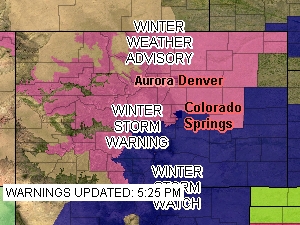
Snow in the mountains tonight will begin to spread to Denver and the Front Range Thursday morning and it will last through Thursday evening and beyond.  Highlighting the significance of the storm, the National Weather Service has issued a Winter Storm Warning (see below for text of warning) for all of northeastern Colorado including Denver. 

The NWS is forecasting snow totals from 8 to 15 inches for the metro area (see image below) and from 1 to 2 feet along the Palmer Divide.  I think that may be a bit optimistic myself but there is little doubt we are in for our biggest storm of the snow season.  Areas south and west like Highlands Ranch, Parker and Golden will almost certainly experience the most snow in the metro area.  See the image below for potential snow totals.

Continue reading Major storm continues on path, Denver could get 12+ inches of snow

Winter Storm Warning issued in anticipation of major storm

A major winter storm will hit Denver and the Front Range Thursday morning where some areas will be measuring snow in feet.

The National Weather Service has issued a Winter Storm Warning for Denver and much of northeastern Colorado in anticipation of a significant storm now approaching the state.  The warning takes the place of the previously issued watch and signifies the increased potential for a major snow event.  The warning goes into effect at 6:00am Thursday morning and runs through 6:00am Friday.

Computer models are beginning to coalesce around solutions that involve snow amounts that could exceed a foot along the Palmer Divide and the foothills.  Snow will begin falling in the foothills in the morning and by midday will encompass the entire Front Range.  By the time the storm ends, much of the metro area will have in excess of six inches of snow.  Tomorrow afternoon’s commute is almost certainly going to be a rough one.

The spring snowstorm could be our biggest storm to date for the 2008 – 2009 winter season.  We are desperately in need of moisture so while it may be troublesome, we really need the precipitation. 

Click here to get all the details on our warning page.

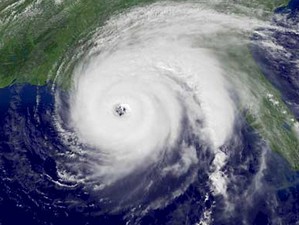
Global hurricane activity at 30 year low

Florida researches believe a strong La Nina event is responsible for reduced global hurricane activity.

Researchers at Florida State University announced that global hurricane activity continues to decrease and is now at levels not seen since 1977.  The researchers say that, “Tropical cyclone (TC) activity worldwide has completely and utterly collapsed during the past 2 to 3 years.”

Last November we reported that hurricane activity in the northern hemisphere was at 30 year lows.  Now, in this follow-up research, we see that when including the southern hemisphere global hurricane energy has sunk to 30 year lows. 

Using a measurement called the Accumulated Cyclone Energy index (ACE), researchers see a tremendous drop in cyclone energy for the globe as a whole.  While the north Atlantic saw above normal levels of ACE in 2008, it represents a relatively small amount of the global hurricane energy and as such cannot compensate for the much reduced levels elsewhere on Earth. 

Just as there are active periods of hurricane activity around the globe, there are inactive periods, and we are currently experiencing one of the most impressive inactive periods, now for almost 3 years.
– Florida State University researchers

You can find complete coverage of this story as well as an incredible slideshow of hurricanes as seen from space on our Examiner.com weather news page.  Click here to go there. 

For all the details, read the rest of this story on our Denver Weather Examiner page. Examiner.com - Get inside Denver weather

Astronaut Harrison Schmitt: Climate change alarmists ‘intentionally mislead’

Dr. Harrison "Jack" Schmitt as a trained geologist was the first scientist-astronaut and walked on the moon with the Apollo 17 lunar mission.

Last month Apollo 17 astronaut and moonwalker Harrison Schmitt added his voice to the growing chorus of scientists speaking out against the anthropogenic [manmade] global warming (AGW) theory.  In strongly worded comments he said the theory was a ‘political tool.’  Now, in a speech at the International Conference on Climate Change he outlined his argument in great detail saying, “the science of climate change and its causes is not settled.”

Schmitt recalled as a child in Silver City, New Mexico helping his father, also a geologist, take rain measurements.  Those early experiments spurred the former astronaut’s interest in earth sciences at an early age.  He recalled how later in life, while on the surface of the moon, he made weather forecasts for the southern hemisphere of the earth. 
 
In wide ranging commentary, Dr. Schmitt made a point by point argument against many of the things that global warming advocates point to in support of the theory.  In a similar vein to his comments last month, he continued to admonish scientists and politicians that have politicized the issue and said those that disagree do have a battle ahead of them. 

Get the rest of this story on Examiner.com.

For all the details, read the rest of this story on our Denver Weather Examiner page. Examiner.com - Get inside Denver weather

Have a headache? Blame the weather!

Have a headache? The weather may be the cause!

We have oftentimes heard headache sufferers, particularly those that get migraines, attribute their pain to the weather.  These had sometimes been dismissed as an old wives tale but a new study shows that there is a great deal of truth to this. 

The Beth Israel Deaconess Medical Center (BIDMC) in Boston has recently completed the first large-scale study showing how environmental conditions like weather and air pollution can influence headache pain.  Over 7,000 patients were studied in order to see if there is a link.

Kenneth Mukamal, MD, MPH, one of the authors of the study and a physician at BIDMC explains that, “Air temperature, humidity and barometric pressure are among the most frequent reasons that people give for their headache pain.  But none of these reasons have been consistently verified. We wanted to find out if we could verify this ‘clinical folklore’.”

Mukamal and his coauthors compared levels of pollutants and meterological variables at the time of the patient’s hospital visit with corresponding levels on preceding days and subsequent weeks.  Using meteorlogical and pollutant monitors they compared measurements of factors such as air temperature, barometric pressure, humidity, and dioxides from the three days prior to a patients’ visit to see if there was a correlation between these items and the patients’ headaches. 

The results of the study seem to prove that this old wives tale is true.  Of the factors considered, higher air temperature in the 24 hours just prior to a patient’s visit to the hospital was most associated with the headache symptoms.  There was a 7.5 percent higher risk of severe headaches for each increase of nine degrees in temperature.  Although not as profound, lower barometric pressure in the 48 to 72 hour period before a hospital visit also was seen to trigger headaches. 

Dr. Mukamal says, “Certainly our results are consistent with the idea that severe headaches can be triggered by external factors.  These findings help tell us that the environment around us does affect our health and, in terms of headaches, may be impacting many, many people on a daily basis.”

The next time you have a headache, if it was a good bit warmer the day before or the barometric pressure was lower a couple days before, you may have found the cause of your headache! 

Four weather records broken in recent days

Sunny skies on Wednesday, March 4th helped Denver break a 137 year old high temperature record.

Denver officially broke the high temperature record on Wednesday, March 4th.  At 12:40pm the temperature at Denver International Airport reached 76 degrees, breaking the old record of 74 degrees set in 1872.  

This marks the 4th weather record we have broken in just the week. In addition to Wednesday’s mark, we have had:

We are very dry right now and could really use some significant precipitation as snowfall totals are less than half of what they normally are by this time of year.  Is there hope?  We remember back to 2003 when we were in a similar dry condition and two major storms helped to turn things around.  Click here to read about that on Examiner.com.

Are these really records and is it fair to compare these measurements with historical data?  Check out our Examiner.com investigation to see why some say these records should have an asterisk attached to them. 

Do Denver weather and climate records have an asterisk attached?

The old Stapleton International Airport site and Denver International Airport are separated by 12 miles.  Is it accurate tto compare weather between the two locations?
The old Stapleton International Airport site and Denver International Airport are separated by 12 miles. Is it accurate to compare weather between the two locations?

February 2009 is Denver’s least snowiest February on record.  A new record high temperature is recorded on January 21, 2009.  Record low temperatures are recorded on December 14th and 15th of last year

These announcements are common and we all take notice when we hear them and they make for great water cooler chat topics but are these claims accurate? 

In 1995 Denver finally opened its new airport, Denver International Airport, out on the plains east of the city.  This new facility, 12 miles as the crow flies northeast of the old Stapleton International Airport, moved the airport from an urban environment to a rural one and more than 19 miles from the center of Denver.  Following that move, the National Weather Service (NWS) began taking some of its official measurements at the glistening new airport.  In doing so, some say Denver’s climate records have forever been altered and as such any weather record should have an asterisk attached to it. 

On Examiner.com we have launched a three part investigative series on this topic.  It is a fascinating read – click here to read the rest of the story.

For all the details, read the rest of this story on our Denver Weather Examiner page. Examiner.com - Get inside Denver weather

Weather, natural disasters & climate news and information.