Denver's weather in November can bring a wide variety of conditions. What can we expect in 2010? (iStockphoto / johnnyscriv)
Typically November is a quiet weather month with plenty of nice, fall days but it can also turn wet with plenty of snow and moisture. Just like Forest Gump’s proverbial box of chocolates, you never quite know what you are going to get.
Looking into the weather history books, we see that November is actually Denver’s second snowiest month, second only to March (April is third). Historically we average 10.7 inches of snow during the month.
One little known fact… November is the area’s least sunny month, tying with May with only 64 percent sunshine. September is the sunniest month with sunshine 74 percent of the time.
Get all the details on Denver’s November weather including a look back through history, a recap of last year and the statistics in our November weather preview.
Many long-time Denver residents believe it always snows on Halloween. Is it fact or fiction?
As a kid growing up in Denver it always seemed like Mother Nature put a damper on our trick-or-treating. Conventional wisdom in the Denver area is that it always seems to rain or snow on Halloween.
But, is there any truth to this urban legend? Or is this just one of those times where our memory doesn’t serve us quite right?
This year it looks like we have nothing to worry about but the National Weather Service has been kind enough to compile weather statistics just for Halloween. As it turns out, the thought of snow and rain on Octboer 31st isn’t just in our minds!
October 31 to November 6 - This week in Denver weather history
Frightening weather does not seem to be in the cards for our Halloween or the immediate future. That however is not always the case as we look back at this week in Denver weather history.
28-31
In 1929…rain changed to snow on the afternoon of the 28th and continued until midday on the 30th followed by intermittent light snow which continued through the 31st. Snowfall over the four days totaled 16.2 inches in the city. Most of the snow…8.5 inches…fell on the 29th with 6.1 inches on the 30th. Temperatures hovered in 20’s during most of the storm.
29-31
In 1889…the first snowfall of the season totaled 14.0 inches over the three days in downtown Denver. Snowfall was 8.0 inches on the 29th and 5.0 inches on the 31st. North to northeast winds gusted to 30 mph on the 29th.
In 1950…a warm spell resulted in five daily temperature records. Record highs of 84…80…and 79 degrees occurred on the 29th…30th…and 31st…respectively. Low temperature of 49 degrees on the 30th was the record high minimum for the date.
In 1991…the second surge of cold arctic air in a matter of days plunged metro Denver into the deep freeze. While low temperatures remained above zero…high temperatures were only in the 20’s. Three temperature records were set: record lows of 7 degrees on the 30th and 10 degrees on the 31st and a record low maximum of only 21 degrees on the 30th. Snowfall was light with only 1.9 inches recorded at Stapleton International Airport where east winds gusted to 23 mph.
In 2002…snowfall totaled 4.3 inches at the site of the former Stapleton International Airport. North winds gusted to 32 mph on the 29th behind a cold front…which plunged temperatures well below seasonal normals. High temperatures of 18 degrees on the 30th and 19 degrees on the 31st were record low maximums for each date. Low temperatures dipped to 12 degrees on the 30th and 15 degrees on the 31st.
Indonesia's Mount Merapi erupted multiple times in the past week even as the nation is recovering from a tsunami. View photos of the eruption in the slideshow below.
One major natural disaster is bad enough but the nation of Indonesia is struggling to recover from two that struck in the past week. A major earthquake caused a tsunami late Monday and Tuesday the nation’s most active volcano erupted.
Off the nation’s western coast, a magnitude 7.7 earthquake triggered a tsunami with 10 foot waves on Monday. Villages on the islands of Pagai and Silabu were destroyed and the death toll from that event stands at more than 400 with nearly 200 still missing.
Evacuations had been issued prior to the first eruption however many ignored the warnings. Further, after the initial blast, many residents returned home only to find themselves in danger from subsequent eruptions.
View the slideshow below for images from the erupting volcano and the aftermath. For complete coverage of the tsunami and volcano -and all forms of natural disasters – please visit the Natural Disasters Examiner.
Merapi, one of Indonesia’s most active volcanoes, lies in one of the world’s most densely populated areas and dominates the landscape immediately north of the major city of Yogyakarta. Merapi is the youngest and southernmost of a volcanic chain extending NNW to Ungaran volcano.
Growth of Old Merapi volcano beginning during the Pleistocene ended with major edifice collapse perhaps about 2000 years ago, leaving a large arcuate scarp cutting the eroded older Batulawang volcano. Subsequently growth of the steep-sided Young Merapi edifice, its upper part unvegetated due to frequent eruptive activity, began SW of the earlier collapse scarp.
Pyroclastic flows and lahars accompanying growth and collapse of the steep-sided active summit lava dome have devastated cultivated lands on the volcano’s western-to-southern flanks and caused many fatalities during historical time. The volcano is the object of extensive monitoring efforts by the Merapi Volcano Observatory.
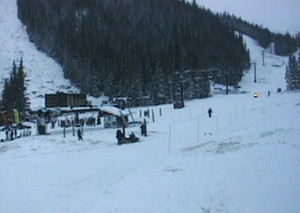
Snow covers Loveland Ski Area this morning as they prepare to open for the first time of the season. (Loveland Ski Area)
Down here along the Front Range we continue waiting for our first snow but in the high country Mother Nature brought white gold in recent days. The 2010 ski season will kick off this morning as Loveland Ski Area opens and Arapahoe Basin will follow suit tomorrow.
The annual race to be the first ski area in Colorado to open is running a bit behind schedule as warmer than normal weather postponed the openings. The contest usually comes down to Loveland and A-Basin and for the second year in a row Loveland will be the winner.
Check out the announcement from Loveland in the video below
Loveland recorded five inches of snow Friday night and more throughout the day Saturday to add to their manmade base. Overnight Saturday and into Sunday morning snow has continued to fall assuring conditions will be more than adequate for the scheduled 9:00am opening.
On the other side of the Continental Divide in Summit County, A-Basin will open at 9:00am on Monday. The resort will also be opening with its new Black Mountain Express high speed chairlift.
A series of winter weather systems are forecast to move across the Colorado mountains in the coming days helping to add to the snow totals and pushing other areas closer to their openings. Winter Storm Warnings have been posted for mountain areas west of the Divide and Winter Storm Watches for the north central mountains on the west side.
October 24 to October 30 - This week in Denver weather history
This year Denver is still waiting for its first snow and we have already passed the average date we see it (October 19). That however isn’t always the case and October can bring monster snowstorms as we see in our look back at this week in Denver weather history.
From the National Weather Service:
23-24
In 1887…the first measurable snowfall of the season totaled 3.1 inches. North winds to 20 mph were recorded on the 23rd. This was the only measurable snow of the month.
In 1932…post-frontal snowfall from the late evening of the 23rd continued through the late afternoon of the 24th and totaled 6.2 inches. Southeast winds were sustained to 25 mph with gusts to 26 mph on the 23rd. Temperatures cooled from a high of 68 degrees on the 23rd to a low of 25 degrees on the 24th…the coldest reading of the month that year. Many trees that had not shed their leaves became heavily laden by the wet snow. Many branches were broken… And a few trees toppled under the weight of the snow. The landscape became one of rare beauty.
24
In 1956…southwest winds gusted to 56 mph and produced some blowing dust at Stapleton Airport. A cold front produced a thunderstorm with 1/8 inch hail. Rain later changed to snow. Precipitation totaled only 0.11 inch and snowfall only 0.3 inch.
In 1973…strong winds raked the eastern foothills…causing damage in Boulder and Jefferson counties. The heaviest damage occurred in the Boulder area where 20 to 25 mobile homes were hit…some power and telephone lines were blown down…and a store was damaged. A wind gust to 76 mph was recorded in Boulder at the National Bureau of Standards. Northwest winds gusted to 46 mph at Stapleton International Airport.
24-25
In 1921…rainfall totaled 0.35 inch overnight behind an apparent cold front. North winds were sustained to 40 mph with gusts to 46 mph on the 25th. Temperatures plunged from a high of 73 degrees on the 24th to a low of 39 degrees on the 25th.
In 1923…rain overnight changed to snow during the morning. The heavy snowfall accumulated to 12.0 inches before ending on the morning of the 25th. Post-frontal north winds were sustained to 22 mph with gusts to 23 mph on the 24th.
In 1997…one of the worst and deadliest blizzards of the decade developed over eastern Colorado as deep east to northeast flow associated with a vigorous upper level low pressure system over the Four Corners…combined with a strong arctic air mass over the central Great Plains. Snowfall totals across metro Denver ranged from 14 to 31 inches. The heaviest snowfall occurred in the foothills west and southwest of Denver where 2 to 4 feet of snow were measured. Sustained winds to 40 mph with gusts as high as 60 mph produced zero visibilities and extremely cold wind chill temperatures from 25 below to 40 below zero. Winds whipped the snow into drifts 4 to 10 feet deep. Several major and interstate highways were closed as travel became impossible. Red Cross shelters were set up for hundreds of travelers who became stranded when they had to abandon their vehicles. Four people died in northeastern Colorado as a result of the blizzard. None of the deaths were in metro Denver. At Denver International Airport…4 thousand travelers were stranded when the airport was forced to shut down. At least 120 cars were abandoned along Pena Blvd….the only arterial leading into and out of DIA. The blizzard cost air carriers at least 20 million dollars. Thousands of cattle died in the storm over northeastern Colorado…resulting in losses totaling 1.5 million dollars. Some of the more impressive snowfall totals included: 51 inches at Coal Creek Canyon; 48 inches at Silver Spruce Ranch…near Ward; 42 inches at Intercanyon…in the foothills southwest of Denver; 37 inches at Sedalia; 35 inches at Aspen Springs and Conifer in the foothills west of Denver; 31 inches at Eldorado Springs… Southeast Aurora…and Englewood; and 30 inches on Table Mesa in Boulder. Snowfall totaled 21.9 inches at the site of the former Stapleton International Airport…setting a new 24-hour snowfall record of 19.1 inches for the month. Snowfall totaled only 14 inches at Denver International Airport where north winds gusted to 39 mph on the 24th. High temperature of only 21 degrees on the 25th equaled the record low maximum for the date first set in 1873. Low temperature of only 3 degrees on the 26th set a new record minimum for the date.
NOAA's winter 2010 temperature outlook forecasts warmer than normal temperatures for Colorado. (NOAA)
The National Oceanic and Atmospheric Administration released its winter 2010 outlook yesterday and the effects of La Niña are forecast to bring extremes to many places. Closer to home Colorado’s outlook is for a warm winter with equal chances of above, near or below normal precipitation.
La Niña conditions have been strengthening in the Pacific which means that water temperatures are cooler than normal. By contrast, El Niño is the opposite – warmer than normal sea temperatures. These conditions can have a big effect on weather patterns and can lead to extreme weather events.
“La Niña is in place and will strengthen and persist through the winter months, giving us a better understanding of what to expect between December and February,” said Mike Halpert, deputy director of the Climate Prediction Center – a division of the National Weather Service. “This is a good time for people to review the outlook and begin preparing for what winter may have in store.”
The outlook forecasts a colder and wetter than normal winter for the Pacific Northwest stretching across to the northern Rockies. Much of the south and southwest is expected to see warmer and drier than normal conditions.
NOAA says Colorado can expect warmer than average conditions in the period through February 2011. In terms of precipitation, the service does not see any factors that would push us toward one extreme or the other. As such we have equal chances of above, near or below normal precipitation – essentially a 33 1/3% chance of each.
The precipitation outlook gives Colorado equal chances of above, near and below normal precipitation for the upcoming winter season. (NOAA)
Highlights from other regions include:
Pacific Northwest: colder and wetter than average. La Niña often brings lower than average temperatures and increased mountain snow to the Pacific Northwest and western Montana during the winter months, which is good for the replenishment of water resources and winter recreation but can also lead to greater flooding and avalanche concerns;
Southwest: warmer and drier than average. This will likely exacerbate drought conditions in these areas. All southern states are at risk of having above normal wildfire conditions starting this winter and lasting into the spring;
Northern Plains: colder and wetter than average. Likely to see increased storminess and flooding;
Southern Plains, Gulf Coast States & Southeast: warmer and drier than average. This will likely exacerbate drought conditions in these areas. All southern states are at risk of having above normal wildfire conditions starting this winter and lasting into the spring;
Florida: drier than average, with an equal chance for above-, near-, or below-normal temperatures. Above normal wildfire conditions;
Ohio and Tennessee Valleys: warmer and wetter than average. Likely to see increased storminess and flooding;
Northeast and Mid-Atlantic: equal chances for above-, near-, or below-normal temperatures and precipitation. Winter weather for these regions is often driven not by La Niña but by weather patterns over the northern Atlantic Ocean and Arctic. These are often more short-term, and are generally predictable only a week or so in advance. If enough cold air and moisture are in place, areas north of the Ohio Valley and into the Northeast could see above-average snow;
Central U.S.: equal chances of above-near-or below normal temperatures and precipitation;
Hawaii: drier than normal through November, then wetter than normal December through February. Statewide, the current drought is expected to continue through the winter, with several locations remaining on track to become the driest year on record. Drought recovery is more likely on the smaller islands of Kauai and Molokai, and over the windward slopes of the Big Island and Maui;
Alaska: odds favor colder than average temperatures with equal chances of above or below normal precipitation. The interior and southern portions of the state are currently drier than normal. A dry winter may set Alaska up for a greater chance of above normal wildfire conditions in the spring.
A weather balloon launched by a father and son from Brooklyn captured high definition video from the stratosphere. (Luke Geissbuhler)
How hard would it be to send a craft into space and capture video? Apparently it isn’t all that difficult as evidenced by a father and son who launched a weather balloon carrying an iPhone and high definition video camera to an astounding altitude of nearly 100,000 feet.
Calling themselves the Brooklyn Space Program, Luke Geissbuhler and his seven-year-old son Max created the craft that flew into the stratosphere. The flight lasted 102 minutes, reached an altitude 19 miles and landed 30 miles from its launch location in rural New York.
On board the craft was a high definition video camera that captured all but the final two minutes of the flight. Tracking of the balloon was done using an Apple iPhone with a GPS application that allowed for a real time tracking and a quick recovery.
Geissbuhler said he had always been one to tinker and enjoyed working on projects with his son. He had not given this endeavor a very good chance telling the U.K.’s Daily Mail, “Even after months of research and testing – we only had a 30 per cent chance it would work. We got very lucky.”
You can watch the amazing video from the flight below.
October 17 to October 23 – This week in Denver weather history
This year Denver is still waiting for its first snowfall but that certainly has not been the case throughout history. Many times in our past we have seen not only snow around this time of October but heavy snow as well, oftentimes damaging in nature.
15-17
In 1989…an autumn snowstorm hit metro Denver with 2 to 6 inches of snow. Snowfall totaled 4.4 inches at Stapleton International Airport where the maximum snow depth on the ground was only 3 inches due to melting and north winds gusted to 25 mph on the 15th. The heavy wet snow caused leafy branches to sag onto power lines…resulting in a number of power outages. Five thousand homes were blacked out in Boulder on the 16th. Up to a foot of snow fell in the higher foothills with 19 inches recorded at Echo Lake.
16-17
In 1990…strong downslope winds raked the eastern foothills. Wind gusts from 60 to 75 mph were common. Strong winds in metro Denver resulted in wave damage to a dock used to moor several private sail boats at Cheery Creek Reservoir. Damage was confined to the dock and two anchor cables. A northwest wind gust to 43 mph was recorded at Stapleton International Airport.
17
In 1878…strong winds reached sustained speeds of 48 mph.
In 1988…a wind gust to 62 mph was recorded in central Boulder. The strong winds caused a few brief power outages. An old smoldering brush fire in the foothills west of Boulder was re-ignited by the wind gusts.
In 1994…winds gusted to 85 mph atop Squaw Mountain…5 miles south of Idaho Springs.
In 2006…a potent storm system brought heavy snowfall to the mountains and eastern foothills. Snowfall totals in the foothills included: 14 inches at Blackhawk…13.5 inches near Idaho Springs…13 inches at cabin creek…12.5 inches at Aspen Springs and Echo Lake…11.5 inches at Georgetown and Rollinsville…10.5 inches near Jamestown…and 10 inches at grant and Lake Eldora. Lesser snow amounts…from 4 to 9 inches…were recorded elsewhere in the foothills. Snowfall totaled only 3.5 inches in the Denver Stapleton area. At Denver International Airport…north winds gusted to 31 mph.
October 10 to October 16 – This week in Denver weather history
The farther we get into fall the more we start seeing significant snow events in our look back at the week in history. None of these is more famous than the “Bronco Blizzard” of 1984 that saw the Mile High City buried under nearly a foot of snow – on live television.
From the National Weather Service:
9-10
In 2005…a major winter storm brought heavy…wet snowfall to the Front Range mountains…eastern foothills…portions of metro Denver…and the Palmer Divide. Snow accumulations ranged from 8 to 26 inches with drifts from 3 to 4 feet in places. The heaviest snow occurred to the east and southeast of the city…closing most major highways in that area…including I-70 from Denver to Limon. The Red Cross opened four shelters for people who were stranded along I-70 in eastern Colorado. Since many trees had not yet shed their leaves…the storm caused significant tree damage. One woman in Denver was killed when a tree branch… 8 to 10 inches in diameter…snapped under the weight of the heavy…wet snow and struck her as she was shoveling her driveway. Xcel Energy reported power outages to about 35 thousand customers. Several incoming flights were delayed at Denver International Airport. Snow totals included: 16 inches in the foothills near Boulder…12 inches at Genesee and near Golden…22 inches near Watkins…19 inches near Bennett…17 inches southeast of Aurora…14 inches near Parker…13 inches near Castle Rock…12 inches in centennial… 11 inches in Parker…and 10 inches at Denver International Airport and in Littleton. While many areas of metro Denver received heavy snow…others experienced almost entirely rain. This included west and northwest metro Denver…Boulder…and Longmont. Rainfall amounts were significant as storm totals ranged between 1.50 and 2.50 inches. The steady rainfall triggered 3 rockslides in foothills canyons. Two of the slides occurred on State Highway 119 in Boulder canyon and the longest slide…7 feet in length…on State Highway 74 in Bear Creek Canyon at Idledale. North winds were sustained to around 23 mph with gusts to 31 mph at Denver International Airport on the 9th. The high temperature of only 34 degrees on the 10th was a record low maximum for the date. The low temperature on both days was 32 degrees.
10
In 1901…an evening thunderstorm produced east winds to 43 mph with gusts to 48 mph.
In 1949…strong winds believed to be the worst in Boulder’s history at the time caused over 100 thousand dollars damage in the city. Peak winds were estimated to 85 mph at Valmont…just east of Boulder. High winds also occurred over most of metro Denver and caused damage to trees…window glass…and utility lines. The damage was most pronounced over the northwest metro area…including north Denver and Lakewood. Falling tree branches caused damage to parked autos and houses. Wind gusts to 70 mph were recorded at Stapleton Airport.
In 1964…lightning struck and killed a 13-year-old boy…while he was riding his bicycle along a tree-lined residential street in south Denver. Apparent microburst winds gusted to 54 mph at Stapleton International Airport.