Saturday evening the stage was set for severe weather across the nation’s heartland and Mother Nature came through in spades. More than a dozen tornadoes were reported as were scores of significant hail events.
Despite the number of events most resulted in little damage. However one tornado, by some accounts as big as three quarters of a mile wide, struck the town of Mapleton, Iowa. This massive wedge tornado struck at 7:21 CDT and caused significant damage in the town.
The video below was captured by storm chasers as they tracked the dangerous tornado.
Forecasters are warning of a very active hurricane season and an increased potential for landfall in the United States. (Natural Disasters Examiner)
Forecasters at Colorado State University released an updated 2011 Atlantic hurricane forecast that if it holds true, portends a very eventful season. The forecast warns of a 175 percent above normal level of activity and most troubling warns that the United States is overdue to get struck by a major hurricane.
CSU forecasters are calling for 16 named storms during the 2011 Atlantic hurricane season. Of those they expect nine will become hurricanes and five of those will be major hurricanes (Category 3 or higher).
These estimates far exceed the historical 1950 to 2000 average. During that period the Atlantic averaged 9.6 named storms per year, 5.9 hurricanes and 2.3 major hurricanes.
This story was originally posted on the Natural Disasters Examiner – Visit there for all the latest natural disaster news
The team warned that whether a hurricane forecast calls for above or below normal activity, residents should always be equally prepared. Dr. Phil Klotzbach said, “It takes only one landfall event near you to make this an active season.”
Breaking down the team’s analysis further, they gave a 72 percent chance that at least one major hurricane will make landfall along the U.S. coastline. By comparison, the long-term average probability is 52 percent.
This recent 9 of 11-year period without any major landfall events should not be expected to continue.
~ Dr. William Gray
By region CSU forecasters put a 48% chance on the probability that a major hurricane will strike the East Coast. Nearly matching that they said there was a 47% probably a major hurricane would hit on the U.S. Gulf Coast.
Dr. William Gray noted that overall the Atlantic Basin is primed for significant hurricane activity. He said that since 1999, only the 2004 and 2005 seasons saw a major hurricane make landfall in the U.S. and this scenario is not likely to continue. Gray warns, “This recent 9 of 11-year period without any major landfall events should not be expected to continue.”
More hurricane news from the Natural Disasters Examiner:
April 10 to April 16 - This Week in Denver Weather History
April can be a very eventful weather month and we see that in our look back at this week in Denver weather history. Particularly notable are many major snow events including two in recent history – one in 2001 and another in 2005.
From the National Weather Service:
7-12
In 1959…snow falling over a 5-day period totaled 20 to 30 inches just east of the mountains…while over the plains blizzard conditions closed schools and blocked highways. The second big storm in two weeks dumped 16.4 inches of snowfall on Stapleton Airport with the most…11.6 inches… Occurring on the 8th. East winds gusted to 37 mph on the 9th. Temperatures dipped into the single digits on the mornings of the 7th and 12th when 7 degrees were registered. Low temperature records for the dates were set on the 9th…10th…and 12th. The cold temperatures caused streets to glaze with ice…resulting in the death of a pedestrian who was struck by a car in Denver. Three people died from heart attacks while shoveling the heavy… Wet snow.
8-10
In 1999…a windstorm caused 20 million dollars in damage along the Front Range urban corridor from Fort Collins south to pueblo and to the east over the plains…making the storm equal to the costliest windstorm ever…which occurred in Boulder on January 17…1982. In metro Denver… Several homes were damaged as shingles were blown off roofs. Large pieces of a roof torn off a strip mall in Lakewood damaged several cars in a parking lot. Most of the damage to homes consisted of broken fences…awnings…doors…and windows. Scores of automobiles suffered broken or cracked windshields and paint damage from flying debris. Multiple accidents were triggered as several tractor-trailer rigs were blown on their sides by the strong cross-winds. Blowing dust and dirt caused near zero visibilities at times. Both I-25 and I-76 were closed north and northeast of Denver. State Highway 93 was closed between Golden and Boulder. Several trees…power poles…and power lines were downed…causing a number of outages as well as sparking a few small grass fires. Highest wind gusts reached 112 mph atop Niwot Ridge near the continental divide west of Boulder…102 mph at Wondervu…100 mph at the National Center for Atmospheric Research mesa lab in Boulder…98 mph at the national wind technology center near Broomfield…96 mph on Rocky Flats…92 mph at Jefferson County Airport near Broomfield and on the University of Colorado campus in Boulder…and 90 mph at Highlands Ranch in southwest metro Denver. Winds gusted to 48 mph at Denver International Airport.
9-10
In 1900…rain changed to heavy snow and totaled 6.8 inches in downtown Denver overnight. A thunderstorm occurred on the 9th. North winds were sustained to 32 mph with gusts to 38 mph on the 10th. Precipitation totaled 1.39 inches.
In 1933…post-frontal heavy snowfall totaled 9.4 inches in downtown Denver. East winds were sustained to 21 mph with gusts to 22 mph on the 9th.
In 1944…7.0 inches of snow fell on downtown Denver. Northeast winds were sustained to 24 mph on the 9th.
In 1977…the two warmest days of the month resulted in two temperature records being set. High temperature of 81 degrees on the 9th set a new record maximum for the date. High temperature of 80 degrees on the 10th equaled the record maximum for the date. The unusually warm weather for so early in April produced a late afternoon thunderstorm on the 10th.
In 1993…strong downslope winds occurred along the Front Range. While the strongest winds were in the foothills north of Denver…wind gusts to 69 mph were recorded at Jefferson County Airport in Broomfield. Northwest winds gusted to 39 mph at Stapleton International Airport.
In 2004…a spring storm brought heavy snow to metro Denver. The heaviest snow fell in the foothills and over and near higher terrain. Snowfall totals included: 20 inches near Jamestown; 18 inches atop gold hill; 17 inches near Evergreen; 15 inches at Nederland and Eldora; 13 inches at Blackhawk; 11 inches at Aspen Springs; 9 inches in Louisville; 8 inches at Ken Caryl; 6 inches at Niwot… Near Sedalia…and in Thornton; 5 inches in Lakewood… Lyons…and Westminster. Snowfall was 4.4 inches at Denver Stapleton. Northwest winds gusted to 21 mph at Denver International Airport.
In 2008…a very moist storm brought heavy snow to parts of the Front Range foothills. Storm totals included: 12.5 inches at Aspen Springs…11 inches…4 miles west- southwest of conifer; with 10.5 inches…3 miles north of central city and 6 miles southwest of Evergreen. Lesser amounts of 5 to 9 inches were observed elsewhere. North winds gusted to 43 mph at Denver International Airport on the 10th…and 1.8 inches of snow fell at the former Stapleton International Airport.
April 3 to April 9 - This Week in Denver Weather History
As we pointed out in our April weather preview, the month can bring just about any type of weather condition and we see that in our look back at this week in Denver weather history. From powerful, damaging winds to Arctic cold to heavy snowfall this has been an eventful week in the past.
From the National Weather Service:
31-3
In 1979…total snowfall of 6.6 inches was measured at Stapleton International Airport where north winds gusted to 31 mph on the 31st. The greatest accumulation of snow on the ground was 3 inches on the 1st.
31-4
In 1905…much rain and some snow occurred over the 5 days behind an apparent cold front. Precipitation totaled 2.00 inches. There was a thunderstorm on the 3rd. Snowfall totaled 3.0 inches on the 4th. North winds were sustained to 34 mph on the 1st and 2nd and to 30 mph on the 3rd. High temperatures during the period ranged from the upper 30’s to the lower 40’s. Low temperatures were in the upper 20’s and lower 30’s.
1-3
In 1945…snow fell across metro Denver for a total of 51 consecutive hours. While the storm was not accompanied by excessive snow…the long duration made the event a heavy snow producer. Snowfall totaled 10.7 inches in downtown Denver with 9.5 inches recorded at Stapleton Airport. North winds were sustained to 21 mph on the 1st; otherwise winds were not strong. The air mass was very cold for April. The high temperatures of 26 on the 2nd and 17 on the 3rd were record low maximums for the dates. The latter was also a record low maximum for the month. Warm weather following the storm quickly melted the snow.
In 1973…heavy snow fell at Stapleton International Airport where 8.7 inches were measured. Snow began late on the 1st and continued through early morning on the 3rd. Thunder accompanied the snow during the late morning and afternoon of the 2nd. North winds gusted to 33 mph on the 2nd and 37 mph on the 3rd. Snow only accumulated to a depth of 5 inches on the ground due to melting.
In 1977 a foot of snow fell in Boulder and Broomfield. The Denver-Boulder turnpike was closed for an hour after numerous minor traffic accidents. At Stapleton International Airport…snowfall totaled 4.7 inches and southeast winds gusted to 32 mph on the 2nd. The greatest depth of snow on the ground was only 3 inches due to melting.
2-3
In 1955…strong west to southwest winds raked metro Denver on both days. Sustained winds as high as 37 mph with gusts to 60 mph were recorded at Stapleton Airport where the visibility was reduced to 1/4 mile in blowing dust.
In 1974…a heavy snowfall of 6.7 inches was accompanied by northeast wind gusts to 33 mph which produced some blowing snow across metro Denver. Over eastern Colorado many highways and schools were closed due to near-blizzard conditions from the storm.
In 1986…the worst snow storm of the season blasted metro Denver. Heavy snow and high winds combined to close roads… Schools…and airports. Portions of all interstate Highways out of Denver were closed at times. The snow came after an exceptionally mild late winter and early spring; trees and bushes had already bloomed and leafed out. The snow and wind snapped many of these…causing power outages. Total snowfall amounts in metro Denver ranged from 1 to 2 feet with 2 to 3 feet in the foothills. Snowfall totaled 12.6 inches at Stapleton International Airport where north winds gusting to 39 mph reduced the visibility to 1/8 mile in snow and blowing snow. Most of the snow fell on the 3rd when temperatures hovered around 30 degrees for most of the day. The heavy snow halted traffic and closed businesses. A 59- year-old man was found dead from exposure in northwest Denver. The roof of a toy store in Northglenn collapsed. A 100 thousand square foot section of a greenhouse roof collapsed in Golden…destroying over a million dollars worth of plants.
In 2000…a combination of strong instability and moist upslope winds allowed for a heavy…wet spring snowstorm to develop in and near the Front Range foothills. The heaviest snow occurred in southern Jefferson County. Storm totals included: 14 inches near conifer…12 inches near Evergreen and on Floyd hill; 11 inches near Blackhawk…Morrison…and tiny town; 10 inches at Aspen Springs and Eldora Ski Area; 9 inches at Chief Hosa; and 8 inches at both Golden Gate Canyon and Rollinsville. Only 2.1 inches of snow fell at the site of the former Stapleton International Airport. North winds gusted to 36 mph at Denver International Airport on the 2nd.
Denver easily broke the record high temperature for April 2nd.
We knew Saturday was going to be a warm one that would likely break the high temperature record for April 2nd but it far exceeded the forecast.
The record high temperature for today’s date was 76 degrees, last set in 1996. At 1:22pm today the temperature at Denver International Airport hit 84 degrees thus easily eclipsing the old record. Warm winds and plenty of sun helped the Mile High City reach the mark.
Thornton fared even warmer as we hit a high temperature of 86.4 degrees at 3:14pm. Some cloud cover has moved in as of this writing and the temperature has dropped a bit so that may be tops for the day.
Highlighting the contrasting conditions that Denver weather can exhibit at any time, we will follow the record setting warmth today with a blast of winter-like conditions arriving tomorrow. We are expecting a quick shot of snow that will bring some much needed precipitation to the Denver metro area.
Denver is having a pitiful snow season - the third worst in the city's history. (Denver Weather Examiner)
March 31 was the last day of what is historically Denver’s snowiest month but like every other month this season, it fell dismally short in terms of the amount of snowfall. In fact, as it stands now, the Mile High City and Thornton area experiencing their third worst season of snow since record keeping began.
In a normal snow season, through the end of March, Denver historically averages 51.3 inches of snow – a healthy total needed for water supplies, irrigation and to help keep the wildfire danger down.
For the 2010 to 2011 season we are far behind that mark. As of yesterday Denver has recorded a paltry 20.6 inches of snow this season at DIA; a total more than 30 inches below normal. Only two other seasons have seen lower snow totals at this point in the season since record keeping began in 1882 – and those were more than 125 years ago.
For the season Thornton has fared worse than the official Denver totals as we have recorded a mere 19.7 inches (click here for the latest totals). Stapleton has recorded 22.8 and Denver City Park has fared the best with 26.8.
Only one month in this snow season has Denver seen at or above normal snowfall. That occurred in January when we recorded 8.0 inches of snow versus the average for the month of 7.7 inches.
By comparison, the Mile High City’s two snowiest months – March and November respectively – saw very little snowfall. In March a mere 2.5 inches fell in contrast to 11.7 inches on average. November 2010 saw only 1.5 inches of snow versus the November average of 10.7 inches.
The long range climate forecasts from the National Weather Service predict continued drier and warmer than normal weather for the month. April is however historically our third snowiest month so there may be hope, especially given the history of the two seasons on record that were worse than this one.
During the 1883 to 1884 season, April brought 18 inches of snow and the 1884 to 1885 season saw an astounding 32 inches of snowfall in the month. While both snow seasons finished below average, they made up a lot of ground in 30 days.
We can only hope that this season follows suit or we will be in for a very dry – and dangerous – summer.
April marks a transition between winter and summer for most of the country but for Denver it is especially true as we can see a stunning variety of weather. The proverbial April showers are certainly a possibility for Denver.

Snow? Tornadoes? Thunderstorms? You bet – all can happen! For good measure throw in a chance for hail and even dust storms and April gives every type of weather condition you could like – or hate.
Temperatures into the 70s and even the 80s aren’t entirely unheard of during the month. Conversely, April is our third snowiest month so we certainly have the potential for plenty of the white stuff as well.
March 27 to April 2 - This Week in Denver Weather History
With March being historically our snowiest month we would expect to see plenty of snow events this week in Denver weather history and we do indeed. Also notable however is the other extreme – that of dangerously dry conditions. We see one event, in 1963, that scorched 25,000 acres of ranchland in Weld County.
25-27
In 1904…heavy snowfall totaled 7.0 inches in downtown Denver.
26-27
In 1886…heavy snowfall totaled 7.1 inches in downtown Denver.
In 1911…post-frontal north winds were sustained to 48 mph on the 26th and to 47 mph on the 27th.
In 1931…a cold front brought snow and very cold weather to the city. Snowfall totaled 7.3 inches over downtown Denver with most of the snow…6.4 inches…occurring on the 26th… When northwest winds were sustained to 38 mph with gusts to 44 mph. High temperature of 31 degrees on the 26th equaled the low temperature of the previous day as the temperature plunged to a low of 1 degree below zero. High temperature of only 15 degrees on the 27th was a record low maximum for the date. Low temperature of 2 degrees below zero on the 27th was not a record.
In 1975…a major pre-Easter blizzard…the worst since the vicious storm of 1949…battered northeastern Colorado and left livestock losses in millions of dollars…but metro Denver escaped the main brunt of the storm and received only 5.0 inches of snowfall. North winds gusted to 38 mph at Stapleton International Airport where temperatures plunged from a high of 50 degrees to 18 degrees by midnight on the 26th.
In 1991…heavy snow fell over portions of the eastern foothills with 9 inches recorded at Lake Eldora west of Boulder. The snow spread across metro Denver…but snowfall totaled only 1.7 inches at Stapleton International Airport where north to northeast winds gusting to 31 mph on both days produced some blowing snow.
27
In 1873…a severe wind and sand storm damaged buildings in the city. At 11:00 am brisk west winds blew clouds and sand into the city…which continued for an hour when it abated some. At 2:00 pm another terrific sand storm blew a gale from the west. The storm lasted 30 minutes…but winds remained brisk the rest of the day.
In 1884…a windstorm struck the city at mid-morning and lasted until midnight. Sustained winds of 40 to 60 mph unroofed some buildings and blew others down. A few people were injured…but none fatally.
In 1896…southwest winds sustained to 60 mph with gusts as high as 70 mph warmed the temperature to a high of 59 degrees.
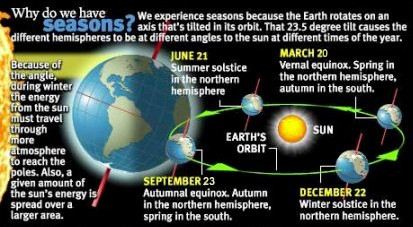
Why do we have seasons? It is all thanks to the tilt of the Earth's axis. (NASA / NOAA)
We are now in the waning hours of winter as spring is set to arrive in Thornton later today – at 5:21pm to be exact. The changing of the seasons from winter to spring means longer days, warmer temperatures and a greening landscape.
The Earth experiences seasons thanks to its 23 1/2 degree tilt. As the planet circles the sun, a process that takes 365 1/4 days, different parts of the Earth are tilted closer to or farther away from the sun.
The vernal equinox (the first day of spring) is the day on which the sun is directly over the Earth’s equator and daylight lasts 12 hours in both the Northern and Southern Hemisphere. This is because at this point the Earth’s axis is 90 degrees away from the sun.
From now until the summer solstice, those of us in the Northern Hemisphere get closer to the sun and thus enjoy the warming temperatures and experience spring and summer. In the Southern Hemisphere they experience the opposite and for them today is the first day of autumn.
The vernal equinox brings nearly equal daytime and nighttime across the globe.
Here is Colorado, thanks to our northern latitude, we have already passed the point of 12 hours of equal daytime and nighttime, something that occurred just a few days ago. Today in fact daytime will last 12 hours and 7 minutes.
Did you know that there is a difference between the astronomical seasons that we are discussing here and meteorological seasons?
Meteorological seasons differ slightly and are geared toward matching the calendar with the annual temperature cycle. This is done primarily for meteorological observing and forecasting.
For the Northern Hemisphere, the meteorological spring covers the months of March, April and May. Summer brings the hottest months of the year and so meteorological summer is June, July and August. Meteorological fall then is September, October and November followed by the coldest months of December, January and February as meteorological winter.
March 20 to March 26 - This Week in Denver Weather History
The Colorado Front Range continues to wait for any sort of real, measurable snow this season. That isn’t always the case as we can see looking back at this week in Denver weather history. March is historically our snowiest month and many significant snowstorms have occurred during this period including one just last year on the 23rd and 24th. Read more about that event and others below.
18-21
In 1907…a warm spell resulted in 6 daily temperature records. Record maximum temperatures of 82 degrees occurred on the 18th with 81 degrees on the 19th and 80 degrees on the 20th. Record high minimum temperatures of 52 degrees occurred on the 19th and 20th with 54 degrees on the 21st.
19-20 in 1912…post-frontal heavy snowfall of 6.3 inches was measured in downtown Denver. North winds were sustained to 28 mph with gusts to 30 mph on the 19th. The strong cold front plunged temperatures from a high of 60 degrees on the 19th to a low of 1 degree on the 20th.
In 1959…a major storm dumped heavy snowfall of 7.7 inches on Stapleton Airport where north winds gusting to 44 mph caused much blowing and drifting snow. Many highways were blocked…and there was damage to phone lines along the South Platte River. The storm started as rain and changed to heavy wet snow…which froze on the lines causing the poles to break. The storm caused 2 deaths over eastern Colorado.
In 2006…strong northerly winds…associated with a surface low pressure system that intensified as it moved into the central Great Plains…brought heavy wet snow to the eastern foothills and northeastern plains of Colorado. The hardest hit areas included the foothills of Boulder and Gilpin counties. Storm totals included: 15 inches at Rollinsville… 14 inches at Aspen Springs…12.5 inches near Nederland…and 5.7 inches in the Denver Stapleton area. Strong winds…heavy snow…and poor visibility forced the closure of interstate 70 from Denver east to the Kansas state line. North winds gusted to 32 mph at Denver International Airport on the 19th.
19-21
In 1888…heavy snowfall totaled 8.6 inches over downtown Denver. North winds were sustained to 27 mph on the 19th.
20
In 1915…north winds were sustained to 40 mph with gusts to 42 mph. Only a trace of snow fell.
In 1989…2 to 6 inches of snow fell along the Front Range urban corridor with up to 9 inches in Boulder. Only 1.6 inches of snowfall were measured at Stapleton International Airport where north winds gusted to 36 mph.
20-21
In 1878…warm days with high temperatures in the lower 70’s in the city…caused snow to melt on the palmer divide…which caused the waters in Cherry Creek to rise. The high…rapid running water damaged a home and eroded bridge footings and abutments. Some bridges became unsafe for the passage of trains.
In 1904…southwest winds sustained to 48 mph with gusts to 60 mph warmed the temperature to a high of 68 degrees on the 20th. The high was only 42 degrees on the 21st behind a cold front…which produced 1.3 inches of snow and northeast winds sustained to 27 mph overnight.
In 1923…post-frontal rain changed to heavy snow and totaled 8.2 inches over the city. North winds were sustained to 27 mph with gusts to 29 mph on the 20th. This was the second major snow in a week.
In 1932…rain changed to heavy snow…which totaled 6.2 inches in downtown Denver. North winds gusted to 22 mph on the 21st.
In 1948…heavy snowfall totaled 7.2 inches over downtown Denver.
In 1952…a major snow storm produced north wind gusts to 35 mph and dumped 16.9 inches of snowfall on Stapleton Airport. The maximum snow depth on the ground was 13 inches due to melting.
In 2000…heavy snow fell in and near the foothills of Douglas and Jefferson counties. Snowfall totals included: 9 inches near tiny town and 7 inches in Littleton. Snowfall totaled only 1.8 inches at the site of the former Stapleton International Airport. North winds gusted to 34 mph at Denver International Airport on the 20th.