With an official high temperature in Denver today of 94 degrees, the Mile High City has tied the record for most 90 degree seasonal days. With weather forecasts calling for continued hot weather through the first part of this week, the record is sure to be broken. Read the rest of this story on Examiner.com
August 26 to September 1 - This Week in Denver Weather History
Significant events on Denver’s weather history calendar get a bit less numerous as we enter what is historically a relatively quiet period of the year. That isn’t to say however that major weather events can’t occur. Our look back at this week in Denver weather history includes a massive hail storm in 1944, many events in which lightning injured people and the warmest temperature ever recorded in September.
From the National Weather Service:
19-30
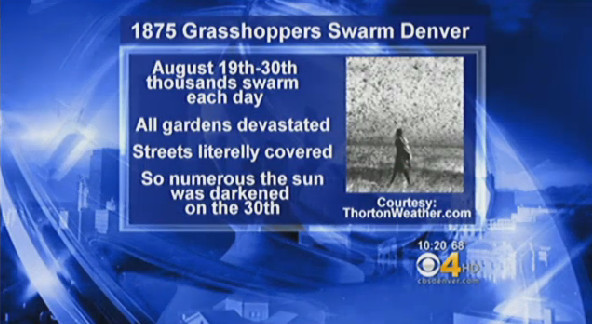
In 1875…grasshoppers appeared in great numbers at 10:00 am on the 19th. Thousands landed on the ground. The streets were literally covered with them. Swarms of grasshoppers were seen on each day. All gardens in the city were devastated…and in the countryside the grasshoppers were very destructive to ripened grain. On the 30th the grasshoppers were so numerous as to almost darken the sun.
24-26
In 1910…the lowest temperature ever recorded in August…40 degrees…occurred on each of these days and on August 22… 1904. The unusually cold weather for so early in the season brought sub-freezing minimum temperatures to much of the Colorado northeastern plains.
26
In 1944…one of the most destructive hailstorms in the city in a decade caused damage estimated at nearly one million dollars. The storm occurred within a period of 10 to 30 minutes…between 2:00 pm and 3:00 pm. The hail varied in size from very small to as large as 1 1/2 inches in diameter. Hail covered the ground to a depth of 5 to 6 inches in some sections of the city. Several people were cut by broken glass. The hail and heavy rain flooded underpasses to a depth of 6 feet…and the occupants of stalled autos had to be rescued. Sewers were unable to handle the sudden amount of water and water backed up and flooded a number of basements. A few first floors of buildings were flooded. The water department had a busy time replacing manhole covers that had been displaced by the water pressure. Trees were stripped…one was severely broken…and telephone lines were downed. Roofs…windows… automobiles…awnings…and gardens were severely damaged. Flowers and gardens in some sections of the city were a total loss. Greenhouses were extensively broken with an estimated 20 carloads of glass shattered. Vegetable and truck crops in and around the city were severely shredded. The next day the American Red Cross was designated by the war agency to grant any and all priorities needed to obtain materials and supplies to replace and repair the damage. In downtown Denver…the thunderstorm produced 0.95 inch of rain and heavy hail along with sustained northwest winds to 25 mph.
In 1961…strong winds blew in the walls of a warehouse under construction in Denver. Two workmen suffered a fractured foot and body bruises.
26-27
In 1980…two heavy thunderstorms hit Arvada and Westminster… Dumping up to 1.50 inches of rain in less than an hour. At least two streets were washed out and a number of homes and cars were damaged when a creek flooded. Three homes in Arvada sustained minor lightning damage.
27
In 1910…a thunderstorm produced south winds sustained to 40 mph.
In 1961…strong thunderstorm winds and heavy rain occurred at 79th and federal blvd. In Westminster. The strong winds blew the roofs off lumber sheds onto parked cars.
In 1967…a young woman was killed by lightning while horseback riding in the suburbs just west of Denver. Her horse died several hours after the incident. A young man and another young woman were also knocked from their horses by the impact of the lightning and required hospitalization.
In 1991…heavy thunderstorm rainfall totaled 0.91 inch at Stapleton International Airport…where 1/4 inch diameter hail was measured.
In 1996…localized street flooding occurred in the Fort Lupton area when 2 to 3 inches of rain fell in 45 minutes. The roof of a community college began leaking…which caused damage to ceiling tiles. The roof was under repair from hail damage which had occurred earlier in the summer. A weak tornado (f0) was sighted near Fort Lupton. No damage was reported.
In 1999…a slow moving thunderstorm dumped 5 inches of rain in 2 hours near Dacono. A severe thunderstorm produced 3/4 inch diameter hail in Castle Rock.
In 2002…severe thunderstorms spread large hail over metro Denver. Hail as large as 2 inches in diameter fell in Jefferson County 5 to 11 miles northwest of Golden. Other large hail reports included: 1 1/2 inches near Golden and in Lakewood; 1 1/4 inches in Nederland; 1 inch hail near Elizabeth…Louviers…Rollinsville…and Blackhawk; 7/8 inch hail near Acequia in Douglas County. A thunderstorm produced a trace of rain and a microburst wind gust to 52 mph at Denver International Airport.
In 2003…lightning struck a house and sparked a fire in Arvada. Damage to the roof and ceiling was extensive.
In 2005…lightning struck an unoccupied home in Parker. The resulting fire damaged the roof…attic…and second floor bedroom. Damage was estimated at 15 thousand dollars.
Colorado’s central mountains experienced an earthquake Tuesday afternoon that rattled towns in the area. According to the US Geological Survey (USGS) the magnitude 3.3 temblor occurred at 3:21pm MDT. The epicenter was in Eagle County 10 miles north of Basalt or 16 miles east of Glenwood Springs. It occurred at a shallow depth of 3.1 miles. Read the rest of this story on Examiner.com including details on Colorado’s ‘shaky’ past.
NASA satellite imagery captured Typhoon Tembin as it approached the Phillipines on August 20, 2012. Click the image to read more about the storm and view more imagery.
The devastating 2012 wildfire season continues to expand and shift west as fires rage out of control in the northwestern United States. In northern California tinder dry conditions have allowed fires to grow quickly and prompted thousands to evacuate in recent days. Read the rest of this story on Examiner.com including photos and satellite imagery.
CBS4 meteorologist Dave Aguilera credited ThorntonWeather.com for information on a particularly noteworthy Denver weather event in our history.
During Sunday night’s 10:00pm newscast CBS4 meteorologist Dave Aguilera talked about one particularly notable historical weather-related event: massive swarms of grasshoppers over the Mile High City this week in Denver weather history. The graphic Aguilera displayed during the broadcast had details on the event with a credit to ThorntonWeather.com as the event was one of many in the This Week in Denver Weather History series that we post every week.
It was pretty neat to see us get credit and we thank Dave for the credit – it is much appreciated. Dave, if you ever want to do a story on personal weather station websites and owners, let us know! 😉
August 19 to August 25 - This Week in Denver Weather History
Funnel clouds, tornadoes, deadly flooding and more highlight our look back at this week in Denver weather history.
From the National Weather Service:
16-19
In 1979…heavy thunderstorm rains on each of 4 consecutive days dumped a total of 2.62 inches of rain on Stapleton International Airport. The heaviest rain…1.05 inches… On the 19th was accompanied by 1/4 inch diameter hail.
18-19
In 1875…nearly 0.75 inch of rainfall in the city overnight… Possibly assisted by heavier rainfall upstream…produced a decided and rapid rise in Cherry Creek…which washed out some bridges. Other small creeks and streams were filled to overflowing.
19
In 1983…heavy rain fell across the northern metro Denver suburbs with 1.50 to 1.80 inches of rain in Broomfield… Arvada…and Thornton.
In 1989…lightning killed a 31-year-old man and injured his 10 year old nephew when it hit a tree they were walking under in the foothills about 5 miles west of Boulder. The boy received mouth to mouth resuscitation on the scene and recovered after being hospitalized overnight. Three other people were knocked to the ground by the bolt…but were uninjured.
In 1990…3/4 inch diameter hail was reported in Wheat Ridge. A thunderstorm over west Denver dumped an inch of rain in 20 minutes…causing minor street flooding. One inch diameter hail was reported over east Denver. Ping pong to golf ball size hail was reported 14 miles northeast of Denver at the intersection of 122nd Ave. and Brighton Blvd. The hail stones knocked out windows and did an unspecified amount of damage to the roof of a house. Close by…heavy thunderstorm rains caused gullies…irrigation ditches…and small streams to overflow their banks near the intersection of 120th Avenue and Riverdale Road. Flood waters 1 to 2 feet deep covered the river bottom land along the South Platte River. However…no structures were threatened by the flood waters.
In 1999…heavy rain…up to 5 inches in two hours…caused east tollgate creek to jump its banks. The bike path adjacent to the creek was underwater at several locations. Several underpasses were also flooded…halting traffic. In addition…an unfinished playground at a local elementary school was completely flooded. Lightning struck a vehicle at east Evans Avenue and Tower Road. The woman inside the vehicle was not injured.
19-30
In 1875…grasshoppers appeared in great numbers at 10:00 am on the 19th. Thousands landed on the ground. The streets were literally covered with them. Swarms of grasshoppers were seen on each day. All gardens in the city were devastated…and in the countryside the grasshoppers were very destructive to ripened grain. On the 30th the grasshoppers were so numerous as to almost darken the sun.
A solicitation on a United States government website seeking hollow point bullets and targets for the National Weather Service caused an online stir today. NOAA was forced to quickly deal with the controversy saying it was a ‘clerical error.’ Read the rest of this story on Examiner.com
While on a routine patrol late last week a New Zealand Defense Force patrol craft spotted a massive area of pumice floating in the South Pacific from an unknown source. Teaming up with NASA, volcanologists today pinpointed the source of a raft of debris covering thousands of square miles. Read the rest of this story on Examiner.com including satellite imagery of the undersea eruption.
A photo of the pumice raft when it was first spotted by a Royal New Zealand Air Force (RNZAF) Orion aircraft. (RNZAF)
Weather, natural disasters & climate news and information.