As Thornton gets hit by a much-needed snowstorm, we are monitoring it very closely and posting regularly to our Facebook page and Twitter feed. You can follow along in real time below. We are also on Google+ here.
The United States begins Daylight Savings Time at 2:00am on Sunday, March 10, 2013.
The biannual ritual of changing our clocks to adjust for Daylight Savings Time occurs this Saturday night providing yet another signal of the changing of seasons. The United States will ‘spring forward’ one hour at 2:00am Sunday morning as we begin Daylight Savings Time.
The ritual of changing our clocks twice a year can be met with some resistance as some people struggle to adjust their body’s internal clock. The start of Daylight Savings Time can be particularly problematic given the one hour less sleep people receive on the night of the change.
However, longer days as we head into the milder months are a very real benefit and for many worth the inconvenience of a lost hour of sleep. The time change definitely has big effects on how much daylight we enjoy during our normal waking hours.
On Saturday, prior to the change, sunset will occur at 6:00pm but on Sunday the sun won’t disappear over the horizon until 7:01pm. This affords folks more time in the evening to get started on those spring-time chores and allows us to get outside and enjoy the warming weather.
The spring equinox is also on the horizon. Spring officially begins at 5:02am on March 20.
This year Daylight Savings Time will come to an end on November 3.
Some of the recent history of Daylight Savings Time (from Wikipedia):
Daylight saving time in the United States was first observed in 1918. Most areas of the United States currently observe daylight saving time, with the exceptions being the states of Arizona and Hawaii along with the territories of Puerto Rico, American Samoa, Guam, and the Northern Mariana Islands.
From 1987 to 2006, daylight saving time in the United States began on the first Sunday of April and ended on the last Sunday of October. The time was adjusted at 2:00 AM (0200) local time (as it still is done now).
Since 2007, daylight saving time starts on the second Sunday of March and ends on the first Sunday of November, with all time changes taking place at 2:00 AM (0200) local time. In 2011, daylight saving time began on March 13 and will end on November 6.
March 3 to March 9: This Week in Denver Weather History
The month of March sometimes brings with it some of our most interesting weather with a wide variety of conditions possible. Our look back at this week in Denver weather history showcases this fact as we see damaging, high wind events, monster snow storms, and even thunderstorms.
From the National Weather Service:
2-3
In 1901…strong northwest winds raked the city for 2 days. On the 2nd…winds were sustained to 55 mph with gusts to 62 mph. The Chinook winds warmed the temperature to a high of 72 degrees…a record maximum for the date. On the 3rd…winds were sustained to 61 mph with gusts as high as 65 mph. The high temperature was 59 degrees.
In 1964…heavy snowfall of 6.3 inches was measured at Stapleton International Airport. East winds gusted to only 20 mph behind a cold front.
In 1978…5.0 inches of snowfall were measured at Stapleton International Airport where northeast winds gusted to 24 mph on the 2nd. The passage of a cold Canadian front kept temperatures only in the teens and 20’s on the 2nd after a high temperature of 33 degrees shortly after midnight. The temperature…after a morning low of 3 degrees below zero…climbed to only 14 degrees on the 3rd…setting a record low maximum for the date.
2-4
In 1963…heavy wet snow was accompanied by strong gusty winds across metro Denver. Snowfall totaled 11.6 inches at Stapleton Airport where north winds gusting to 44 mph caused much blowing and drifting snow. Hazardous driving conditions resulted in many traffic accidents.
In 1976…snowfall totaled 8.0 inches at Stapleton International Airport where…on the 4th…northeast winds gusted to 31 mph reducing the visibility to as low as 1/4 mile. Maximum snow depth on the ground was 7 inches. Nine inches of snow were measured in Boulder.
3
In 1875…six inches of snow fell in Georgetown.
In 1895…northwest bora winds were sustained to 45 mph with gusts to 58 mph in the city.
In 1966…cold northwest wind gusts of 50 to 90 mph occurred across metro Denver. Both cars and trucks were blown off an icy highway just east of Denver where some highways were closed by either blowing dust or blowing snow. A northwest wind gust to 43 mph was recorded at Stapleton International Airport. The strong winds caused limited minor damage.
In 1972…winds gusted to 55 mph in Boulder causing no reported damage. West winds gusted to 49 mph at Stapleton International Airport.
In 1985…snow struck metro Denver. Heaviest hit was Boulder where 6 to 8 inches were measured. Icy roads caused the closure of I-25 north and south of Denver due to traffic accidents. The snow also caused long delays at Stapleton International Airport where snowfall totaled only 2.6 inches.
In 1997…west winds gusted to 52 mph at Denver International Airport.
3-4
In 1932…a dust storm occurred on the 3rd during the late afternoon. North winds gusting as high as 38 mph behind a cold front kicked up much blowing dust. Light snow developed during the evening and continued through the early morning of the 4th. Snowfall totaled 2.7 inches.
In 1934…strong winds raked Boulder. A wind gust to 62 mph was recorded at Valmont just east of Boulder. The strong winds caused hundreds of dollars of damage in Boulder.
In 1981…the most vigorous snow storm of the season struck the state…closing many schools and most highways connecting Denver…Colorado Springs…and Limon. North winds gusting to 43 mph whipped nearly 10 inches of snow in Denver into 3-foot drifts and snarled traffic on the morning of the 4th. Snowfall totaled 9.8 inches at Stapleton International Airport.
In 1989…a storm dumped 2 to 6 inches of snow across metro Denver. The snow caused 2-hour air traffic delays at Stapleton International Airport where 3.0 inches of snow fell and north winds gusted to 23 mph on the 3rd. There were many traffic accidents across metro Denver. I-70 was closed east of Denver for a time on the 3rd.
In 1991…high winds raked the eastern foothills. Wind gusts of 60 to 90 mph were common with 119 mph recorded at Wondervu southwest of Boulder…106 mph on Shanahan Ridge and 92 mph at Table Mesa…both in southwest Boulder. Several trees were uprooted and traffic signs and lights blown over. Flying debris caused damage to homes… Buildings…and cars.
In Boulder…a stop sign was blown onto a car. There were no reports of injuries. Southwest winds gusting as high as 48 mph briefly reduced the prevailing visibility to as low as 1/16th mile in blowing dust at Stapleton International Airport on the 4th.
3-5
In 1961…snowfall totaled 8.3 inches at Stapleton Airport over the 3-day period with most of the snow…4.4 inches… Falling on the 3rd. Winds were generally light gusting to only 23 mph.
Snow covers the streets with Thornton's March 4, 2013 snowstorm. Within a couple of hours the sun was out and the streets were clear. (ThorntonWeather.com)
March is historically the Denver area’s snowiest month and only four days into it Mother Nature delivered a nice, wet shot of the white stuff. The storm moved through quickly Monday afternoon and now we focus on a potentially significant storm this coming weekend.
Today Thornton recorded 2.4 inches of snow and a very welcome 0.15” of liquid precipitation from it. Similar totals, many a bit less, were seen in other locations of the Denver metro area.
This brings Thornton’s seasonal snow total to 28.9 inches. That is still well below normal but given the progress made in recent weeks, we are hoping these storms continue to arrive.
As we discussed in this morning’s forecast, models are pointing toward a far more significant storm arriving as early as late Friday and lasting well into the weekend.
One model, the European ECMWF, has been relatively consistent with its projection of a powerful storm with a hefty shot of snow. Other models have been less optimistic but on later runs today they are starting to come in line with the same thinking.
Severe weather presents a very real danger to property and life and is something which almost all Americans deal with in one form or another. Today NOAA and FEMA launched the second annual National Severe Weather Preparedness Week to…
Northeastern Colorado’s warm, dry winter took a bit of a turn during February as temperatures cooled and we finally received some much needed precipitation.
The month started out with a continuation of the warmer and drier conditions we saw in January. Temperatures for the first days of the month were routinely near or above the 50 degree mark with little precipitation.
That changed on the 9th when low pressure moved through and served to cool things down to below normal. No precipitation was seen however.
The following 10 days were relatively calm and tranquil but with varying temperatures. The month’s high temperature was recorded on the 17th.
As we entered the last part of the month the weather turned much more unsettled and finally delivered a healthy dose of winter. A weak system on the 19th and 20th brought light snow and was followed a few days later by a more significant system on the 24th.
The waning days of the month saw mostly below normal temperatures and one more day of light snow.
The average temperature in Thornton during February 2013 was 30.3 degrees. Out at Denver International Airport, Denver officially had an average of 30.1 degrees. Both were well below the historical February average of 32.5 degrees.
Temperatures in Thornton ranged from a high of 66.2 degrees on the 17th down to the lowest reading of 5.7 degrees on the 25th. Only two days in Thornton failed to climb above freezing.
Denver saw its highest reading of 63 degrees on the 17th and lowest of 5 degrees on the 22nd with six days failing to climb above 32 degrees. All 28 days of the month saw low temperatures below the freezing mark at both locations.
Precipitation was the real weather highlight of February 2013 given how dry the season had been up to then. Thornton recorded 0.71 inches in its bucket while DIA saw 0.77 inches. Average for February is 0.37 so both locations enjoyed above normal measurements.
In terms of snowfall, Thornton measured 11.9 inches of the white stuff. Out at the airport they bested our area with 14.1 inches. Historically February averages a mere 5.9 inches so both were well above normal.
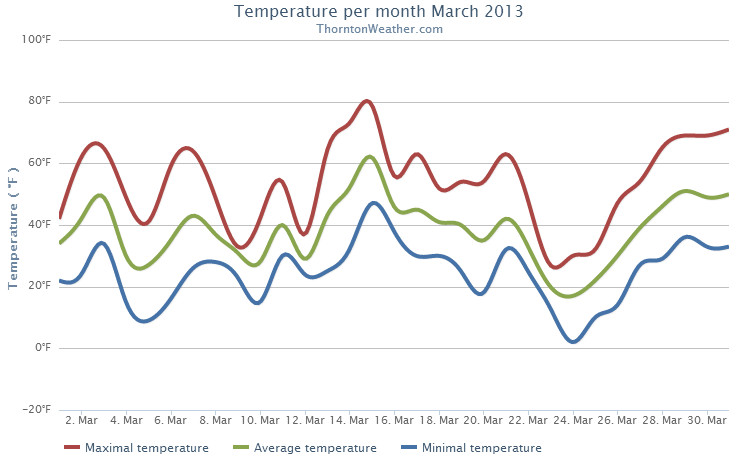
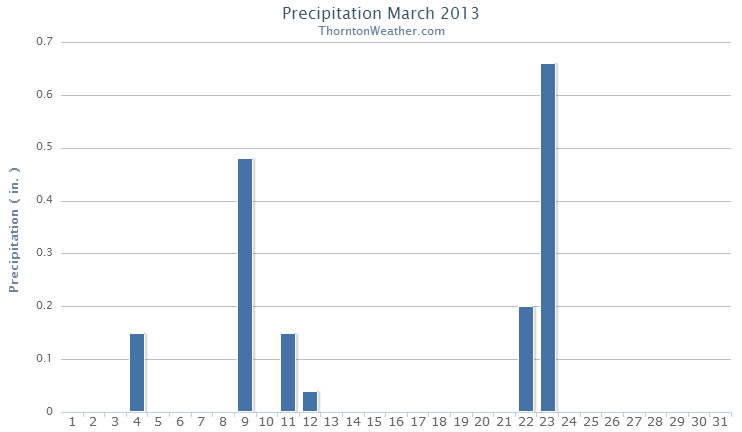
Thornton, Colorado February 2013 TemperaturesThornton, Colorado February 2013 Precipitation
From the National Weather Service:
...THE DENVER CO CLIMATE SUMMARY FOR THE MONTH OF FEBRUARY 2013...
CLIMATE NORMAL PERIOD 1981 TO 2010
CLIMATE RECORD PERIOD 1872 TO 2013
WEATHER OBSERVED NORMAL DEPART LAST YEAR`S
VALUE DATE(S) VALUE FROM VALUE DATE(S)
NORMAL
................................................................
TEMPERATURE (F)
RECORD
HIGH 77 02/28/2006
02/04/1890
LOW -25 02/01/1951
02/08/1936
HIGHEST 63 02/17 70 -7 65 02/25
LOWEST 5 02/22 -14 19 3 02/11
AVG. MAXIMUM 43.3 46.2 -2.9 38.7
AVG. MINIMUM 16.9 18.9 -2.0 18.1
MEAN 30.1 32.5 -2.4 28.4
DAYS MAX >= 90 0 0.0 0.0 0
DAYS MAX = .01 6 5.3 0.7 7
DAYS >= .10 4 0.7 3.3 2
DAYS >= .50 0 0.0 0.0 1
DAYS >= 1.00 0 0.0 0.0 0
GREATEST
24 HR. TOTAL 0.43 02/24 TO 02/24 02/02 TO 02/03
SNOWFALL (INCHES)
RECORDS
TOTAL 22.1 1912
TOTALS 14.1 5.7
DEGREE_DAYS
HEATING TOTAL 972 908 64 1055
SINCE 7/1 4272 4439 -167 4380
COOLING TOTAL 0 0 0 0
SINCE 1/1 0 0 0 0
FREEZE DATES
RECORD
EARLIEST 09/08/1962
LATEST 06/08/2007
EARLIEST 10/07
LATEST 05/05
....................................................
WIND (MPH)
AVERAGE WIND SPEED 10.3
RESULTANT WIND SPEED/DIRECTION 2/229
HIGHEST WIND SPEED/DIRECTION 35/360 DATE 02/15
HIGHEST GUST SPEED/DIRECTION 44/010 DATE 02/15
SKY COVER
POSSIBLE SUNSHINE (PERCENT) MM
AVERAGE SKY COVER 0.60
NUMBER OF DAYS FAIR 5
NUMBER OF DAYS PC 16
NUMBER OF DAYS CLOUDY 7
AVERAGE RH (PERCENT) 51
WEATHER CONDITIONS. NUMBER OF DAYS WITH
THUNDERSTORM 0 MIXED PRECIP 0
HEAVY RAIN 0 RAIN 0
LIGHT RAIN 1 FREEZING RAIN 0
LT FREEZING RAIN 0 HAIL 0
HEAVY SNOW 1 SNOW 4
LIGHT SNOW 10 SLEET 0
FOG 9 FOG W/VIS
February 24 to March 2: This Week in Denver Weather History
As Thornton weathers a winter storm today, we can’t help but wonder if this won’t be one to add to the history books. For Thornton it probably is not. However, our look back at this week in Denver weather history shows many notable events involving high winds and some snow.
From the National Weather Service:
22-29
In 1960…heavy snowfall of 6.1 inches at Stapleton Airport on the 22nd and 23rd marked the beginning of a protracted cold spell which lasted until the end of the month. The cloudy… Cold weather was accompanied by occasional light snow or flurries and fog. New record low temperatures for the dates were set on the 24th thru the 29th with the lowest temperature of 11 degrees below zero on the 28th. The seven consecutive days of low temperatures of zero or below had been exceeded in duration only 4 times previously. New low maximum temperatures for the dates were set on the 23rd… 24th…and the 26th thru the 29th with the lowest maximum temperature of 8 degrees recorded on the 26th.
23-24
In 1935…northwest winds sustained to 37 mph with gusts as high as 47 mph produced considerable blowing dust behind a cold front on the 23rd. The dust was dampened by 7.0 inches of snowfall over downtown Denver from the late evening of the 23rd through the evening of the 24th.
In 1997…heavy snow fell in the foothills. Snowfall totals included 8 inches at sunshine canyon northwest of Boulder… And 6 inches at Morrison. Snowfall totaled only 2.4 inches at the site of the former Stapleton International Airport. East winds gusted to only 22 mph at Denver International Airport on the 23rd.
23-25
In 1912…a severe winter storm dumped 14.2 inches of snowfall over downtown Denver. Snow fell continuously from 9:40 am on the 23rd until 9:15 pm on the 25th with most of the snow… 9.2 inches…on the 24th. Temperatures were mostly in the 20’s. Northeast winds were sustained to 20 mph on the 24th.
24
In 1908…a duststorm occured in the city from mid-morning through mid-day. North winds were sustained from 30 to 35 mph.
In 1927…northwest winds were sustained to 42 mph with an extreme velocity to 46 mph.
In 1924…fog deposited a light coating of glaze…which was very thin and only accumulated on the windward side of cold objects. Streets and sidewalks became slippery.
In 1956…a strong cold front produced north wind gusts to 54 mph…but left only 2.0 inches of snowfall at Stapleton Airport.
In 1959…heavy snowfall totaled 7.5 inches at Stapleton Airport…where north-northeast winds gusted to only 18 mph.
In 1968…west-northwest winds gusted to 49 mph at Stapleton International Airport. The strong Chinook winds warmed the maximum temperature to 61 degrees…the highest temperature of the month that year.
In 1986…wind gusts to 65 mph were reported at Table Mesa in Boulder. West winds gusted to only 28 mph at Stapleton International Airport where the high temperature of 70 degrees equaled the record for the date.
In 1991…the only measurable snowfall for the month totaled only 0.8 inch at Stapleton International Airport where north winds gusted to 28 mph. The light snow fell for most of the day.
In 1994…high winds raked the eastern foothills. Wind speeds of 70 to 80 mph were common. Wind gusts to 110 mph were recorded at the National Center for Atmospheric Research in south Boulder…while in north Boulder winds gusted to 95 mph. The strong winds blew the roof off a building at red rocks community college in Lakewood…causing the evacuation of about 1500 people. A semi-trailer and a delivery truck were overturned. In Lakewood…a home under construction was destroyed by the winds. There were numerous reports of vehicles damaged by flying debris…and many automobile windshields were shattered. West wind gusts to 47 mph were recorded at Stapleton International Airport.
NASA satellite imagery shows the Colorado Front Range covered in snow following a snowstorm on Sunday, February 24, 2012.
Up until the past week satellite imagery of northeastern Colorado was relatively boring – and very brown. In the wake of two storms, one of which was relatively significant, the image from the eyes in the sky changed considerably.
Sunday’s storm brought much-needed precipitation to the drought-stricken area. Snowfall totals ranged from a high of nearly 27” near Pinecliffe west of Denver to 9.1” in the Mile High City and 6.9 inches in Thornton.
As the storm continued east on Monday it caused havoc on parts of Texas and Oklahoma where blizzard conditions brought that region to a standstill.
NASA’s Terra satellite flew over the Centennial State yesterday after skies had cleared and took pictures from 22,000 miles above. The imagery clearly shows the snowy landscape of Colorado as well as parts of Utah, New Mexico, Kansas, Oklahoma, Nebraska and Wyoming.
NASA satellite imagery shows parts of nine states covered in snow following a snowstorm on Sunday, February 24, 2012.
From NASA:
Following on the heels of another storm, heavy snow fell on Colorado and neighboring states on February 24, 2013. On February 25, the Denver/Boulder Forecast Office of the National Weather Service reported preliminary snow totals from the area, including 27.2 inches (69.1 centimeters) west of Denver, and blizzard conditions east of the city. Like the previous storm, this one continued moving eastward.
The Moderate Resolution Imaging Spectroradiometer (MODIS) on NASA’s Terra satellite acquired this image on February 25, 2013. In the wake of the storms, snow extended across Colorado and Wyoming, and covered parts of Utah, New Mexico, and Nebraska. Although clouds had cleared in the west, cloud cover lingered in southeastern Colorado, western Kansas, and the Oklahoma Panhandle. The day after MODIS acquired this image, a new round of snow moved into the region.
References
National Weather Service, Denver/Boulder, Colorado. (2013, February 25) Local storm report. National Oceanic and Atmospheric Administration. February 26, 2013.
The Visible Infrared Imaging Radiometer Suite (VIIRS) on the Suomi NPP satellite captured this nighttime view at 1:55 a.m. Central Standard Time on February 23. (NASA)
From NASA:
In late February 2013, a major snowstorm made its way across the continental United States, dropping snow from Colorado to the Great Lakes region. The National Weather Service reported snow totals of 5 to 8 inches (13 to 20 centimeters) in many parts of the Central Plains and Upper Mississippi River Valley. Some parts of the Central Plains experienced snowfall rates as high as 4 inches (10 centimeters) per hour, along with thundersnow.
The Visible Infrared Imaging Radiometer Suite (VIIRS) on the Suomi NPP satellite captured this nighttime view at 1:55 a.m. Central Standard Time on February 23. This imagery is from the VIIRS “day-night band,” which detects light in a range of wavelengths from green to near-infrared. The day-night band takes advantage of moonlight, airglow, and starlight to brighten the landscape and uses filtering techniques to observe signals such as city lights and snow cover. On the night of this image, the Moon was nearly full.
City lights glow like clusters of stars against a backdrop of grey and black in this image. The snow appears medium gray, and stretches from northern Texas to the Dakotas,and from the Rocky Mountain states eastward past Chicago. When VIIRS acquired this image, snow cover across multiple states had persisted since theprevious night.
References
National Weather Service, La Crosse, Wisconsin. (2013, February 23) Winter Storm February 21–22, 2013. National Oceanic and Atmospheric Administration. February 25, 2013.
NASA Earth Observatory image by Jesse Allen and Robert Simmon, using VIIRS day-night band data from theSuomi National Polar-orbiting Partnership. Suomi NPP is the result of a partnership between NASA, the National Oceanic and Atmospheric Administration, and the Department of Defense. Caption by Michon Scott.
The recent snowstorm didn’t bring all that much snow to Thornton, 6.9 inches, but it was our biggest snowfall in over a year and delivers some much needed precipitation. The light, fluffy snow was easily blown around by winds gusting in excess of 32 mph which limited visibility and made conditions outside harsh.
The video below captures the event from our east facing camera beginning at 6:00pm on Saturday, February 23, 2013 and continuing through 6:00am on Monday, February 25, 2013. Light snow is seen falling soon after 10:00pm on Saturday night and following a lull, really picks up by mid-morning Sunday.
Weather, natural disasters & climate news and information.