Spring forward: Daylight Saving Time begins this weekend

The United States begins Daylight Savings Time at 2:00am on Sunday, March 10, 2013.

The biannual ritual of changing our clocks to adjust for Daylight Savings Time occurs this Saturday night providing yet another signal of the changing of seasons.

The United States will ‘spring forward’ one hour at 2:00am Sunday morning, March 9, as we begin Daylight Savings Time.

The ritual of changing our clocks twice a year can be met with some resistance as some people struggle to adjust their body’s internal clock.  The start of Daylight Savings Time can be particularly problematic given the one hour less sleep people receive on the night of the change.

However, longer days as we head into the milder months are a very real benefit and for many worth the inconvenience of a lost hour of sleep.  The time change definitely has big effects on how much daylight we enjoy during our normal waking hours.

On Saturday, prior to the change, sunset will occur at 6:00pm but on Sunday the sun won’t disappear over the horizon until 7:01pm.  This affords folks more time in the evening to get started on those spring-time chores and allows us to get outside and enjoy the warming weather.

The spring equinox is also on the horizon.  Spring officially begins at 10:57am on March 20.

This year Daylight Savings Time will come to an end on November 2.

Some of the recent history of Daylight Savings Time (from Wikipedia):

Daylight saving time in the United States was first observed in 1918. Most areas of the United States currently observe daylight saving time, with the exceptions being the states of Arizona and Hawaii along with the territories of Puerto Rico, American Samoa, Guam, and the Northern Mariana Islands.

From 1987 to 2006, daylight saving time in the United States began on the first Sunday of April and ended on the last Sunday of October. The time was adjusted at 2:00 AM (0200) local time (as it still is done now).

Since 2007, daylight saving time starts on the second Sunday of March and ends on the first Sunday of November, with all time changes taking place at 2:00 AM (0200) local time. In 2011, daylight saving time began on March 13 and will end on November 6.

Daylight Saving Time Schedule

Year DST Begins 2 a.m.
(Second Sunday in March)
DST Ends 2 a.m.
(First Sunday in November)
2014 9 March 2014 2 November 2014
2015 8 March 2015 1 November 2015
2016 13 March 2016 6 November 2016
2017 12 March 2017 5 November 2017
2018 11 March 2018 4 November 2018
2019 10 March 2019 3 November 2019

Videos: Time lapse of Thornton’s quick, wet snow coming and going

Late winter in Colorado can bring a wide variety of conditions, oftentimes within a very short time span. This was fully evident yesterday and last night as we went from a high of a daytime 62 degrees to receiving a healthy dose of snow before midnight.

Thornton received a total of 2.9 inches of heavy, wet snow from about 9:00 p.m. on March 4 through 1:00 a.m. on March 5.  A healthy 0.45 inches liquid precipitation was recorded from the snow.

The time lapse video below captures the event from its start through sunrise. Below that is a satellite imagery time lapse from 7:00 a.m. to noon to show just how fast that snow disappeared.

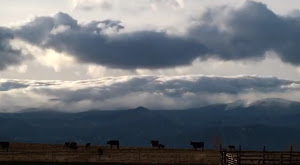
Time lapse video captures mountain wave clouds, sunset

Screenshot of an amazing time lapse video showing mountain wave clouds. (YouTube / BasehuntersChasing)

Watching clouds in real time can be fascinating however it is when they are sped up via time lapse that we can oftentimes truly see the subtle motions that we otherwise miss. A time lapse video released by some local storm chasers provide a stunning visual of wave clouds near Boulder.

Posted to YouTube today by Basehunters Chasing, the video showcases scenes captured over a couple of days along the Front Range.

Rolling mountain wave clouds serve as a backdrop to cows in a field.  Watching closely, snow can be seen falling on the highest mountain peaks.  Zoomed in views of a wave cloud follow showing the amazing motion.

Lastly a sunset is seen with the clouds starting pastel orange, then turning brilliant bright orange before fading away.

The video is set to a very soothing flute-type instrumental.  Check it out below.

Massive 104 car pileup on icy roads in Denver kills one, injures dozens

An accident on icy roads south of Colorado Springs resulted in a vehicle rollover and was one of three significant multi-vehicle accidents on I-25.Icy roads Saturday morning led to a massive 104 car pileup on Interstate 25 through central Denver killing one person and injuring 30.

The chain reaction accident began just before 11:00 a.m. near University and Downing on the northbound side of the interstate. Cars, unable to stop on the ice and snow covered highway, began piling up.

One woman was killed in the accident. Her name is currently being withheld. The woman’s vehicle struck the back of a semitrailer, peeling the roof back as it lodged under the trailer.

Thirty people were injured and transported to area hospitals including Denver Health, St. Anthony’s and Swedish Medical Center. Among the injured were adults and children.

Read more about his incredible accident and check out the photos and video on Examiner.com

February 2014 weather recap: Much colder than normal but drier

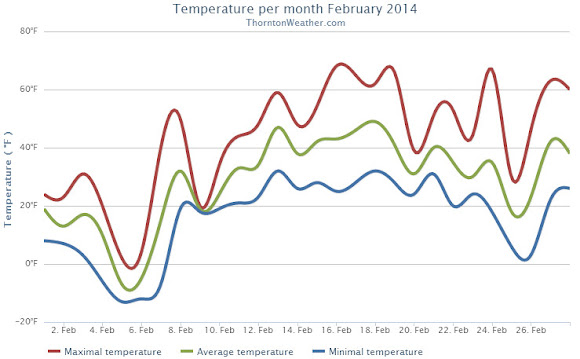
Like all months in Colorado, February 2014 did have some warm periods but those were few and far between as compared to the cold we experienced.  Those cold temperatures did not translate to precipitation however.

The month started out quite cold with 9 out of the first 10 days seeing below normal temperatures.  Two of those days saw ‘high’ temperatures only in the single digits.  Seven of those 10 days stayed below freezing and four saw low temperatures below zero.

Warmer weather courtesy of downslope flow did finally arrive and most of the rest of the month was warmer than average.  Of the last 18 days of the month, only two had below normal temperatures.

Overall Thornton’s monthly average temperature for February 2014 was 28.5 degrees.  This was four degrees below Denver’s February average of 32.5 degrees.  Officially Denver’s average for the month was close to ours at 28.2 degrees.

While clearly a cold month, February 2014 failed to reach ‘top 10 coldest February’ status.  Number 10 on that list is February 1905 with an average temperature of 25.2 degrees.  The coldest February was in 1899 with an average of 17.6 degrees.

Temperatures ranged from a high of 68.3 degrees on the 16th down to a low of -12.6 degrees on the morning of the 5th.  Out at the airport, Denver saw its highest temperature of 68 degrees and its lowest of -19 degrees on the same dates.

Denver record low maximum temperatures on the 5th and 6th.  High temperatures on those days were minus 1 degree and plus 1 degree respectively.

Thornton recorded a mere 0.17 inches of precipitation in the rain bucket during the month.  Denver officially saw 0.19 inches.  Both fall well short of the February average of 0.37 inches.  While dry, it wasn’t dry enough to be one of the top 10 driest Februarys.

In terms of snowfall, Thornton measured 4.7 inches.  Denver lagged with only 3.3 inches.  Again, both were a good ways below the historical Denver average of 5.7 inches.

Click here to view Thornton’s February 2014 climate report.

Thornton, Colorado February 2014 temperature summary. (ThorntonWeather.com)Add a Caption Thornton, Colorado February 2014 temperature summary. (ThorntonWeather.com)
Thornton, Colorado February 2014 precipitation summary. (ThorntonWeather.com)
CLIMATE REPORT
NATIONAL WEATHER SERVICE BOULDER, CO
628 AM MST SAT MAR 1 2014

................................... 

...THE DENVER CO CLIMATE SUMMARY FOR THE MONTH OF FEBRUARY 2014... 

CLIMATE NORMAL PERIOD 1981 TO 2010
CLIMATE RECORD PERIOD 1872 TO 2014

WEATHER         OBSERVED          NORMAL  DEPART  LAST YEAR`S
                 VALUE   DATE(S)  VALUE   FROM    VALUE  DATE(S)
                                          NORMAL
................................................................ 
TEMPERATURE (F)
RECORD
 HIGH              77   02/28/2006
                        02/04/1890
 LOW              -25   02/01/1951
                        02/08/1936
HIGHEST            68   02/16        77      -9       63  02/17
LOWEST            -19   02/05       -25       6        5  02/22
AVG. MAXIMUM     42.3              46.2    -3.9     43.3
AVG. MINIMUM     14.1              18.9    -4.8     16.9
MEAN             28.2              32.5    -4.3     30.1
DAYS MAX >= 90      0               0.0     0.0        0
DAYS MAX <= 32      8               3.9     4.1        6
DAYS MIN <= 32     26              26.9    -0.9       28
DAYS MIN <= 0       5               1.3     3.7        0

PRECIPITATION (INCHES)
RECORD
 MAXIMUM         2.01   1934
 MINIMUM         0.01   1970
TOTALS           0.19              0.37   -0.18     0.77
DAILY AVG.       0.01              0.01    0.00     0.03
DAYS >= .01         4               5.3    -1.3        6
DAYS >= .10         1               0.7     0.3        4
DAYS >= .50         0               0.0     0.0        0
DAYS >= 1.00        0               0.0     0.0        0
GREATEST
 24 HR. TOTAL    0.12   02/04 TO 02/04              0.43
                                                 02/24 TO 02/24
 STORM TOTAL      2.3                                9.1
 (MM/DD(HH))            02/04 TO 02/04           02/24 TO 02/24

 SNOWFALL (INCHES)
RECORDS
 TOTAL           22.1   02-1912
 TOTAL            3.3   02-2014     5.7 1980-2010

DEGREE_DAYS
HEATING TOTAL    1022               908     114      972
 SINCE 7/1       4519              4439      80     4272
COOLING TOTAL       0                 0       0        0
 SINCE 1/1          0                 0       0        0

FREEZE DATES
RECORD
 EARLIEST     09/08/1962
 LATEST       06/08/2007
EARLIEST                        10/07
LATEST                          05/05
..................................................... 

WIND (MPH)
AVERAGE WIND SPEED              10.5
RESULTANT WIND SPEED/DIRECTION   2/270
HIGHEST WIND SPEED/DIRECTION    48/270    DATE  02/16
HIGHEST GUST SPEED/DIRECTION    59/270    DATE  02/16

SKY COVER
POSSIBLE SUNSHINE (PERCENT)   MM
AVERAGE SKY COVER           0.60
NUMBER OF DAYS FAIR            2
NUMBER OF DAYS PC             18
NUMBER OF DAYS CLOUDY          8

AVERAGE RH (PERCENT)     63

WEATHER CONDITIONS. NUMBER OF DAYS WITH
THUNDERSTORM              0     MIXED PRECIP               0
HEAVY RAIN                0     RAIN                       0
LIGHT RAIN                1     FREEZING RAIN              0
LT FREEZING RAIN          0     HAIL                       0
HEAVY SNOW                0     SNOW                       1
LIGHT SNOW               10     SLEET                      0
FOG                      19     FOG W/VIS <= 1/4 MILE      8
HAZE                     12

-  INDICATES NEGATIVE NUMBERS.
R  INDICATES RECORD WAS SET OR TIED.
MM INDICATES DATA IS MISSING.
T  INDICATES TRACE AMOUNT.

March preview: Biggest snow month also brings much milder temperatures

The past two months have brought periods of extreme cold but not a lot of snow to Denver.  March however is our snowiest month and may bring a turnaround in those numbers.  It also typically brings much warmer temperatures.

March is historically Denver’s snowiest month and brings about 20% of our annual snowfall.  Heavy, wet spring snow storms can oftentimes bring the entire month’s snowfall total in one monstrous snow.

We also start the transition to spring and severe weather season and the month typically brings our first thunderstorms of the year.  Temperatures climb throughout the month and by the end our average daytime highs are near 60 degrees.

For a complete look at what lies ahead in March 2014, click here.

February 2014 top shots: Monthly photo slideshow

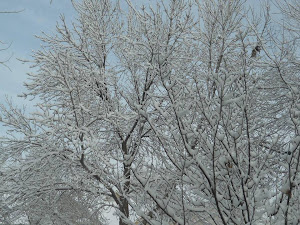
February started with a shot of snow in Thornton. (Jason McNeil)

The month of February is one that begins a transition to warmer temperatures and oftentimes lacks snowfall.  Nevertheless, Mother Nature oftentimes offers stunning scenes to be captured in imagery as we see in our February 2014 slideshow.

  • Slideshow updated February 28, 2014

Showcasing images captured by ThorntonWeather.com readers as well as some of our own, our monthly slideshow covers the entire gamut of weather-related imagery.  Sunsets, sunrises, wildlife and of course snow are vividly depicted.

Throughout the month we will gather the images sent to us via email or shared with us via our various social media outlets and post them in the slideshow below.

To learn more about getting your photos added to our monthly slideshow, click here. 

Click the play button below and sit back and enjoy the images.

Weather, natural disasters & climate news and information.