Category Archives: Thornton Weather

City of Thornton addresses residents’ concerns about tornadoes

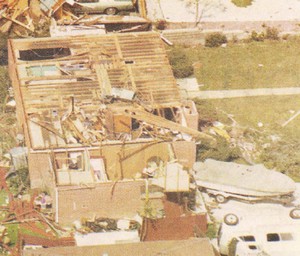
On June 3, 1981 a tornado struck Thornton in what is the worst twister to have struck the Denver metro area. Despite this, Thornton does not have any sort of emergency alert system to warn citizens of tornadoes or other civil disasters.  Image courtesy the City of Thornton archives.
On June 3, 1981 a tornado struck Thornton in what is the worst twister to have struck the Denver metro area. Despite this, Thornton does not have any sort of emergency alert system to warn citizens of tornadoes or other civil disasters. Image courtesy the City of Thornton archives.

As we have discussed before, the City of Thornton is lacking any type of system to alert citizens of severe weather like we have seen recently. In the last week, parts of Thornton have been under Tornado Warnings as funnel clouds circled in the sky and citizens are understandably concerned.

We at ThorntonWeather.com continually remind people that the Denver metro area is at the far western edge of Tornado Alley and funnel clouds, tornadoes, hail and other types of severe weather are not unusual at all. It was 28 years ago last Wednesday in fact that the costliest tornado to ever hit the Denver metro area struck Thornton. Accounts vary but 53 people were injured, at least 25 homes were destroyed and hundreds more damaged.

The danger is real – tornadoes can and do strike in the Thornton area. In some ways it is surprising that the city did not implement some sort of system in the wake of the tornado in 1981. Many municipalities in the metro area do have warning sirens including Denver, Aurora, Englewood, Commerce City and Brighton.

Thornton Mayor Erik Hansen has told ThorntonWeather.com that the city will look at ways to inform citizens when severe weather is imminent. This may take the form of utilizing the reverse 911 system or as we suggested to him, a possible new text alert system that would deliver alerts to citizen’s mobile phones. It is our firm belief that some sort of system to be used not only for severe weather but for other civil disasters is a wise and prudent investment for the city to take.
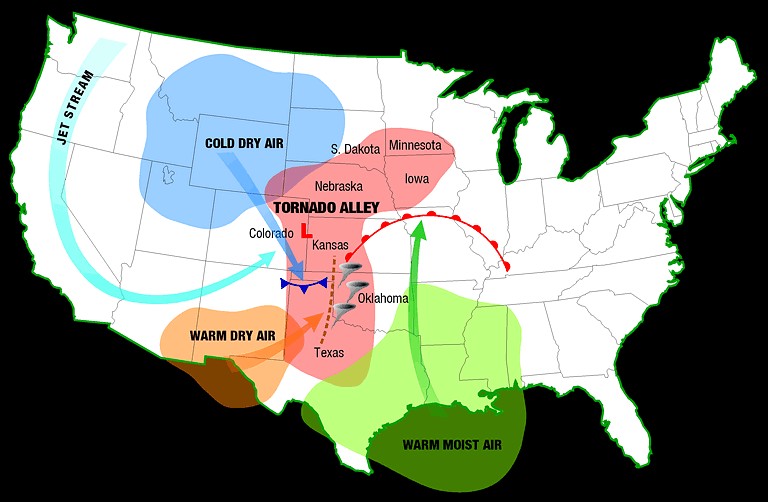
The Denver area is at the western edge of Tornado Alley and as we have seen historically and in recent days, the danger is real.  Click image for larger view.  Image courtesy NOAA.
The Denver area is at the western edge of Tornado Alley and as we have seen historically and in recent days, the danger is real. Click image for larger view. Image courtesy NOAA.

This week the city posted some tornado safety tips on its website that are worth reviewing. You may also wish to review our Severe Weather 101 series which provides more in depth information on the entire array of spring and summer severe weather (links below).

We will continue our conversations with the city about how they can improve communication with Thornton residents about severe weather and keep you updated as appropriate. If you are so inclined, contact your city council representatives and let them know you want to see Thornton implement an emergency alert system.

ThorntonWeather.com Severe Weather 101 Series
Severe weather returns as funnel clouds spotted over Thornton, tornado near Firestone

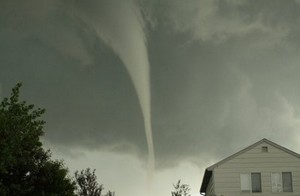
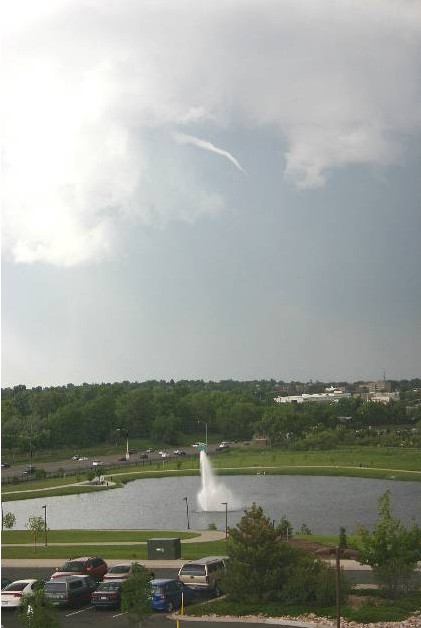
This funnel cloud was seen on Tuesday from the Thornton Civic Center (looking north).  Image courtesy the City of Thornton.
This funnel cloud was seen on Tuesday from the Thornton Civic Center (looking north). Image courtesy the City of Thornton.

Severe weather has returned to the Denver metro area and the Front Range Tuesday afternoon.  At approximately 4:50pm and for nearly one half hour afterwards trained spotters reported numerous funnel clouds over the Northglenn, Thornton, and Broomfield areas.  No tornadoes touched down however.

At 5:11pm local law enforcement reported a tornado four miles northwest of Firestone moving at 20mph.  This area remains under a Tornado Warning until 5:00pm. 

If you are in an area under a Tornado Warning, do not try to outrun the storm or chase it in your vehicle.  Immediately seek shelter in a building.  If no structure is available, seek shelter in a ditch or low spot.  If in your home or other building go to an interior hallway or ideally the basement.

[nggallery id=5]

Tornado in Aurora rated an EF1

The tornado that struck Aurora, Colorado has been rated an EF1 with 100 mph winds by the National Weather Service.  Image courtesy Sean Strachan. Follow the link below to go to Examiner.com for more images.
The tornado that struck Aurora, Colorado has been rated an EF1 with 100 mph winds by the National Weather Service. Image courtesy Sean Strachan. Follow the link below to go to Examiner.com for more images.

The tornado that touched down in the Denver suburb of Aurora and caused damage to a local mall and apartment complex has been rated an EF1 by the National Weather Service.  After two days of evaluations, the service said that the twister most likely had winds of 100 mph, placing it in the middle of that rating.

The four other twisters that struck the area will be rated later this week.  Because they were short lived and struck in open areas, they mostly likely will be rated as EF0 twisters with winds from 65 mph to 85 mph. 

The other tornadoes were reported in the area of 144th and I-25, one was reported five miles south of Bennett, one five miles south of Deer Trail and one three miles north of Byers.

For all the details including photos of the damage and video, check out the complete story on Examiner.com. Examiner.com - Get inside Denver weather

Sunday storm brings funnel cloud and hail to Thornton

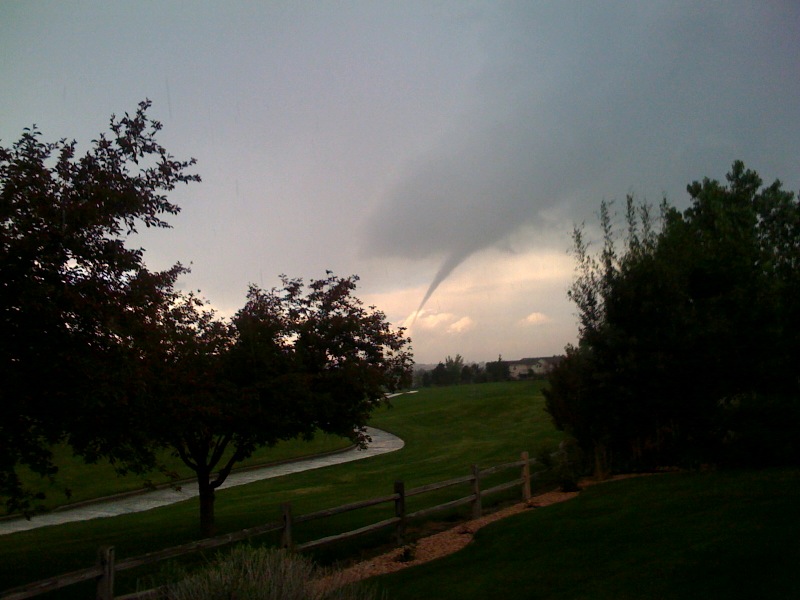
A funnel cloud near Thornton on Sunday, June 7, 2009.  Image courtesy John Wagner, Warrior Legacy Foundation.  Click for larger image.
A funnel cloud near Thornton on Sunday, June 7, 2009. Image courtesy John Wagner, Warrior Legacy Foundation. View our slideshow below for more images.

For a brief period of time this afternoon, Thornton and western Adams County were under a Tornado Warning as a funnel cloud was spotted passing.  Thankfully the storm quickly weakened and the threat diminished.  The image at the right is courtesy John Wagner of the Warrior Legacy Foundation.  This was from approximately 136th & Washington looking northwest. 

Do you have images of the severe weather to share?  Email them to info@thorntonweather.com

View images from ThorntonWeather.com visitors in our slideshow below.  Also check out two videos of the twister below!

Please stay aware of the latest severe weather in Thornton.  As of this writing a Severe Thunderstorm Warning remains in effect and conditions could rapidly deteriorate again. 

[nggallery id=4]

June 7 to June 13 – This week in Denver weather history

June 7 to June 13 - This week in Denver weather history

An extremely eventful week in weather history showing just how varied conditions can be.  We of course see typical spring weather like tornadoes and hail but also a touch of snow and this week also marks the anniversary of the start of the Hayman Fire.

2-7  

In 1921…heavy rainfall for nearly a week…on top of streams already swollen by mountain snowmelt…produced widespread flooding over the South Platte River basin…including the tributaries through the canyons to the west and southwest of Denver.  Heavy rainfall over the 6-day period totaled 3.36 inches in Boulder…4.98 inches in Morrison…4.27 inches in Castle Rock…and 2.94 inches in the city of Denver. Rainfall amounts in the foothills were estimated between 3 and 6 inches.  The narrow-gage tracks of the Colorado and southern railroad were destroyed in the Platte Canyon.  From the mouth of the canyon through the city to near Brighton… The river spread from 1/2 to nearly 1 1/2 miles wide… Flooding farm and pasture land and destroying or damaging many bridges.  In the city…many businesses along with as many as 500 homes were inundated…forcing their evacuation. Bridges were swept away.  The high waters flooded the rail yards and stock yards in lower downtown…closing three adjacent packing houses.  The heavy rains also caused flooding on Boulder creek in Boulder on the 6th.
6-7   in 2004…a brief hot spell produced 3 temperature records. High temperatures of 95 degrees on the 6th and 98 degrees on the 7th were record maximum temperatures for the dates. Low temperature of 68 degrees on the 7th was a record high minimum for the date.
 
In 2007…an unusually strong storm system brought very strong winds to the Front Range foothills and urban corridor. Peak gusts included:  92 mph at Boulder…85 mph…2 miles southwest of Boulder…83 mph…10 miles south of Boulder and 55 mph at Denver International Airport.  High winds forced the closure of Mt. Evans Road and Trail Ridge Road.  Several trees were uprooted across the urban corridor.  In Aurora… The driver of a car was injured when some building material blew off the Fitzsimmons complex.  The debris landed on the car and knocked the driver unconcious.  The wind forced the cancellation of 60 flights at Denver International Airport. Xcel reported outages in Boulder…Denver…Lakewood and Longmont.

7    

In 1904…a thunderstorm produced south winds to 40 mph with gusts to 50 mph…but only a trace of rain.
 
In 1942…heavy thunderstorm rainfall in south Denver caused flooding of shops…stalled motorists…and halted tramway service temporarily.  Lightning damaged houses…but there was no loss of life.  Precipitation totaled 0.53 inch in downtown Denver.
 
Continue reading June 7 to June 13 – This week in Denver weather history

28 years ago today – Thornton is struck by a tornado

Damage along Washington was extensive from the tornado that struck Thornton on June 3, 1981. (City of Thornton archives)

It was 28 years ago today that the worst tornado to ever strike the Denver metro area hit Thornton.  June 3, 1981 is a day that will forever be remembered by longtime residents of the north metro area. 

Last year the Northglenn-Thornton Sentinel did a story about it which you can read by clicking here.  Also, below is the entry from the National Weather Service’s history calendar – it is very interesting and serves as a good reminder that severe weather can strike anywhere.

In 1981…severe thunderstorms produced tornadoes over metro Denver.  The first tornado touched down at the intersection of Alameda Ave. And Sheridan Blvd.  The twister moved north along Sheridan Blvd….damaging businesses…apartment buildings…homes…and vehicles.  Over ten homes were unroofed.  The roof of one landed in the middle of a neighborhood park.  At least 10 mobile homes were wrecked.

The tornado curved to the northeast into northwest Denver… Hopping up and down in several places.  Very strong winds outside the actual funnel caused 20 to 30 thousand dollars in damage in downtown Denver.  The third floor of one old building was demolished.  No major injuries were reported from the tornado…although several people were hurt slightly in traffic accidents on Sheridan Blvd. in the confusion caused by the storm.  Damage in Lakewood alone was estimated at 200 thousand dollars. 

At the same time… The worst tornado to ever hit metro Denver struck Thornton. Coming from the same thunderstorm that spawned the Denver twister…the Thornton tornado tore a swath through the heart of the city.  87 homes were destroyed…110 others damaged at least moderately.  In all…600 homes in a 100 block area sustained some damage.  The twister also hit shopping centers…several restaurants…and other buildings. Seven of the 42 injured were considered serious.  The storm was strong enough to snap lamp posts in half and drive a 6- inch slab of wood 2 feet into the ground.  Damage was estimated at up to 50 million dollars. 

The same storm that struck Thornton produced another damaging tornado that touched down in the northwest section of Fort Lupton.  This twister damaged 16 homes and numerous cars and campers. Two children were slightly injured when the car they were in was knocked about and its windows shattered by the storm.  The twister also damaged two commercial buildings.  Damage was very spotty…and observers said the storm hopped up and down at least 3 times.  Dollar damage was estimated at 500 thousand dollars. 

The thunderstorm complex that produced 3 damaging tornadoes also dropped large hail which damaged many cars over northwest Denver.  One to 2 inches of rain fell in less than an hour…flooding a mobile home park with 3 to 4 feet of water on the northwest edge of Denver.  The high water damaged about half of the 392 homes in the park.  Local flooding was also reported in other areas across metro Denver.  A tornado was also sighted near Franktown…but caused no damage.  A thunderstorm wind gust to 52 mph was recorded at Stapleton International Airport.

A Preview of Thornton’s June Weather – The Severe Weather Month

Denver is historically Thornton's true severe weather month.

June is historically Denver’s severe weather month and severe thunderstorms, tornadoes and hail are notorious visitors to Denver and across eastern Colorado during the month.  In fact, over 40 percent of the tornadoes that occur in Colorado are observed in June and these are typically the most destructive of the year.  Severe thunderstorms have also caused major property damage across the Front Range during the month.

In just the last 25 years or so, there have been some particularly notable storms in June.  Tornadoes have struck the metro area including one that longtime Thornton residents will recall on June 3, 1981.  53 residents were injured, 25 homes were destroyed and 239 other structures were damaged.  Others tornadoes in the metro area include southeast Denver and Aurora on June 8, 1986 and east Denver on June 13, 1984.  Severe thunderstorms occurring on June 13, 1984 dumped large hail making it one of the worst and the second costliest storm in Denver history.  More recently, on June 20, 2001, a major hail storm moved across Denver International Airport dropping hailstones as big as two inches in diameter. Damage was extensive on and near the airport.

For complete details on what we can expect in June, click here to view our June weather preview.

May 31 to June 6 – This week in Denver weather history

May 31 to June 6 - This week in Denver weather history

An extremely eventful week in Denver weather history.  Most notably for longtime Thornton and Northglenn residents is the 28 year anniversary of the infamous Thornton Tornado which struck on June 3, 1981.

26-31

In 1995…a cool period with light morning showers and moderate to heavy afternoon showers and thunderstorms pushed rivers already swollen from mountain snow melt over their banks causing minor flooding.  Streams and rivers such as the South Platte and Boulder creek flooded meadowlands…bike paths…roads near streams…and other low lying areas.  No significant property damage was reported and crop damage was unknown.  Rainfall totaled 1.79 inches at the site of the former Stapleton International Airport and only 1.51 inches at Denver International Airport.

29-1 

In 1894…heavy rain combined with snowmelt runoff caused widespread flooding over the South Platte River basin. Rainfall was heaviest in the foothills where 5 to 8 inches were measured over the 4 days.  Heavy rainfall west of Boulder flooded mining towns and damaged mining properties.  In the canyons above Boulder…railroads and roads were washed out along with many bridges.  The floodwaters spread into central Boulder and covered a wide area from university hill north to near Mapleton Hill to a maximum depth of 8 feet.  Many houses were swept away…and every bridge in Boulder was destroyed. A few people…trapped in their homes by the floodwaters… Had to be rescued.  However…the gradual rise of the flood waters resulted in only one death.  Boulder creek spread to a width of nearly one mile in the pasture land to the east of Boulder.  Extensive flooding on left hand creek north of Boulder washed away railroad and wagon bridges.  The heavy cloudbursts caused flooding on bear creek…which washed away bridges…railroad tracks…and structures and destroyed the canyon roadway.  Morrison sustained the heaviest flood damage on bear creek.  In Denver…rainfall totaled only 1.50 inches on the 30th and 31st…but the heavy rainfall on upstream tributaries of the South Platte River caused the river to rise as much as 10 feet above the low water mark in the city…which caused some flooding of pasture land downstream to a depth of 6 feet near Brighton.

30-31

In 1935…heavy thunderstorm rains overnight caused flash flooding east of the city on both Kiowa and Bijou Creeks… Resulting in a total of 9 deaths.  Most of the damage was on Kiowa Creek where there were more structures.  The water rose rapidly during the storm…ripping houses and stores from their foundations and sweeping them downstream. Precipitation in Denver totaled only 0.01 inch.  Hail fell in the city for a short time.  The hail was very small and caused no damage.
 
In 1983…a late storm of rain and snow hit the Front Range. Over an inch of rain fell at some spots…and above 7 thousand feet…1 to 5 inches of snow whitened the ground. Some snow flakes even fell in the western suburbs of metro Denver on the night of the 30th.
 
In 2002…unseasonably warm weather at the end of the month resulted in 3 temperature records.  High temperature of 91 degrees on the 30th equaled the record maximum for the date.  Low temperature of 61 degrees on the 31st was a record high minimum for the date.  High temperature of 93 degrees on the 31st was a record maximum for the date.
31    in 1917…rainfall totaled 0.55 inch and was mixed briefly with snow around midday.  Only a trace of snow fell. Cold temperatures during the day resulted in a high of 44 degrees and a low of 35 degrees.  The month closed as the coldest May on record with a mean temperature of only 48.7 degrees…about 8 degrees below normal.  The cold temperatures during the month had a marked effect on shade trees and shrubs in the city.  Elms were just starting to leaf.  Leaves on cottonwoods and maples were only half formed.  Lilacs were just blooming…and snowball clusters would not bloom for days.
 
In 1959…the public reported a tornado briefly touching the ground 10 miles south of Stapleton Airport.  No damage was reported.
 
In 1984…a thunderstorm microburst produced a wind gust to 67 mph…7 miles east of Boulder.
 
In 1991…hail to golf ball size pummeled southern and southeastern sections of metro Denver and continued on east to Watkins.  Several houses and cars were damaged.  Later… Thunderstorms dumped heavy rain across the city of Denver… Causing street flooding in an area just south of downtown and just northwest of downtown.  Water was up to 10 inches deep over northwest Denver.  A brief tornado touched down in Castle Rock where 3/4 inch diameter hail also fell.
 
In 1993…thunderstorms dropped dime size hail in Commerce City.
 
In 1994…lightning struck an apartment in Louisville and damaged electronic equipment…including a computer.
 
In 2006…a severe thunderstorm produced 1 inch diameter hail near Boulder.

Continue reading May 31 to June 6 – This week in Denver weather history

Monday weather quieter but a funnel cloud is spotted over Thornton

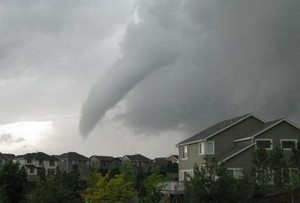
This funnel cloud, one of many across the metro area Sunday, was spotted over Highlands Ranch.  Image courtesy Tracee Hendershott.
This funnel cloud, one of many across the metro area Sunday, was spotted over Highlands Ranch. Image courtesy Tracee Hendershott.

Thus far the weather today has been much quieter than it was yesterday when thunderstorms brought severe weather to most of the metro area.  Southern Thornton has seen a good bit of rain but areas farther north have had very little. 

Earlier today, local law enforcement did report a funnel cloud over 104th and Colorado Blvd from a thunderstorm that was moving through the area.  Reported at 12:47pm, the funnel moved to the east at 15 mph and quickly disappated.  Unlike yesterday when many funnel clouds – and three tornadoes – were reported, this is the only such report thus far today. 

Do you have pictures of this weekend’s severe weather?  Send them to info@thorntonweather.com and we will show them on our site!

Saturday storms bring heavy rain, funnel cloud

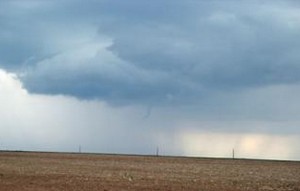
This funnel cloud was over north central Aurora Saturday afternoon.  Photo was taken from the Bennett area.
This funnel cloud was over north central Aurora Saturday afternoon. Photo was taken from the Bennett area.

Saturday afternoon’s thunderstorms brought some pretty interesting weather to Denver and the Front Range.  Our wettest and cloudiest month seems to be intent on finishing out right on par with what we would expect this time of year. 

Thunderstorms and showers moved across the metro area in the late afternoon Saturday producing thunder, lightning and rain across much of the area.  Some stations on the Rocky Mountain Weather Network reported quite heavy rain, particularly those on the west side of town.  Some of the rain totals along the Front Range since yesterday:

In yesterday’s forecast we warned of the possibility of landspouts which are small, short-lived tornadoes.  None were observed however a funnel cloud was reported over north central Aurora about three miles south of DIA at 4:50pm.  The funnel lasted about two minutes and never touched down and did not cause any damage.