Category Archives: Natural Disasters

11th annual Storm Chaser Convention coming to Denver

Get ready for ChaserCon - Coming to Denver in February!

The 11th annual National Storm Chaser Convention is coming to Denver from February 13th to the 15th.  Organized by storm chasers Roger Hill and Tim Samaras, this event brings together amateur and professional storm chasers, meteorologists, climatologists and experts from across a wide spectrum dealing with weather.  It is a great opportunity to learn not just about storm chasing but also about the weather in general.

As usual, a great slate of speakers has been lined up including:

More than lectures though, the convention features screening of some of the most incredible tornado footage from the past year as well as a hands-on look at the latest in weather gadgetry.  On the afternoon of the 15th, the National Weather Service will also be holding an official storm spotter training session that is open to the public. 

You can learn more about this great event and see the complete agenda on the convention website at www.chaserconvention.com.
Top weather story of 2008 – The Windsor tornado

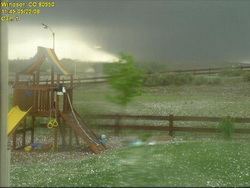
This amazing image of the Windsor tornado was taken from a backyard webcam. Image courtesy MyWindsorWeather.com.

May 22, 2008 started like most other spring days in Colorado.  That Thursday morning had dawned with relatively mild temperatures and a touch of humidity in the air.  That moisture in the air was a warning sign as moist air from the Gulf of Mexico was entering the state and a signal of the potential for severe storms.  No one knew though just what was in store for a small town in northeastern Colorado.

As temperatures rose in the morning, the moist air near the ground mixed with fast moving dry air aloft and created conditions ideal for supercell thunderstorms and tornadoes.  Hail began to fall around 11:20am near Platteville, a harbinger of things to come.  As the weather situation became much more excited and confused, reports of a twister on the ground near Gilcrest at 11:29 rolled in.

A classic wedge tornado had formed and was moving to the north-northwest at a leisurely 30 mph wreaking havoc and destruction all along its path.  Examiner.com soon posted a special report at 11:30 warning of the twister and showing its expected path.  It narrowly missed the town of Milliken, dumping baseball sized hail on it instead.  The twister was now a full mile wide with winds in excess of 136 mph and at 11:57am, the storm struck Windsor, home to 16,000 Coloradoans.  By the time it was done with the town, it had claimed one life, destroyed 80 homes and damaged nearly 770 others.

For a total of nearly 45 minutes the storm carved a 35 mile long path of devastation and all along its path it left the evidence – houses with nothing but a foundation left, power poles snapped like matchsticks, semi-trailers overturned like toy cars, mangled pieces of metal and shards of wood.

Tornadoes in Colorado are not uncommon with an average of 60 per year, although most do occur on the eastern plains in more rural areas.  The storm was only the second deadly tornado in Colorado in the last 10 years (the Holly tornado in 2007 being the other) but it served to highlight that the Front Range is on the western edge of Tornado Alley.  Weld County is in fact Colorado’s own tornado capital having had more twisters than any other county since 1950.

When it was over, Coloradoans showed their sense of community in helping the affected areas.  The Red Cross immediately went into action as did the state government in calling out the National Guard to help.  Donations poured in and other relief agencies provided food and shelter to those left homeless.  While the Windsor Tornado was an example of the worst of Mother Nature, the storm also showed us the best of mankind.  No other weather event comes close to being Colorado’s biggest weather story of 2008.

Below is some amazing raw video from 9News of the tornado as it moved north.

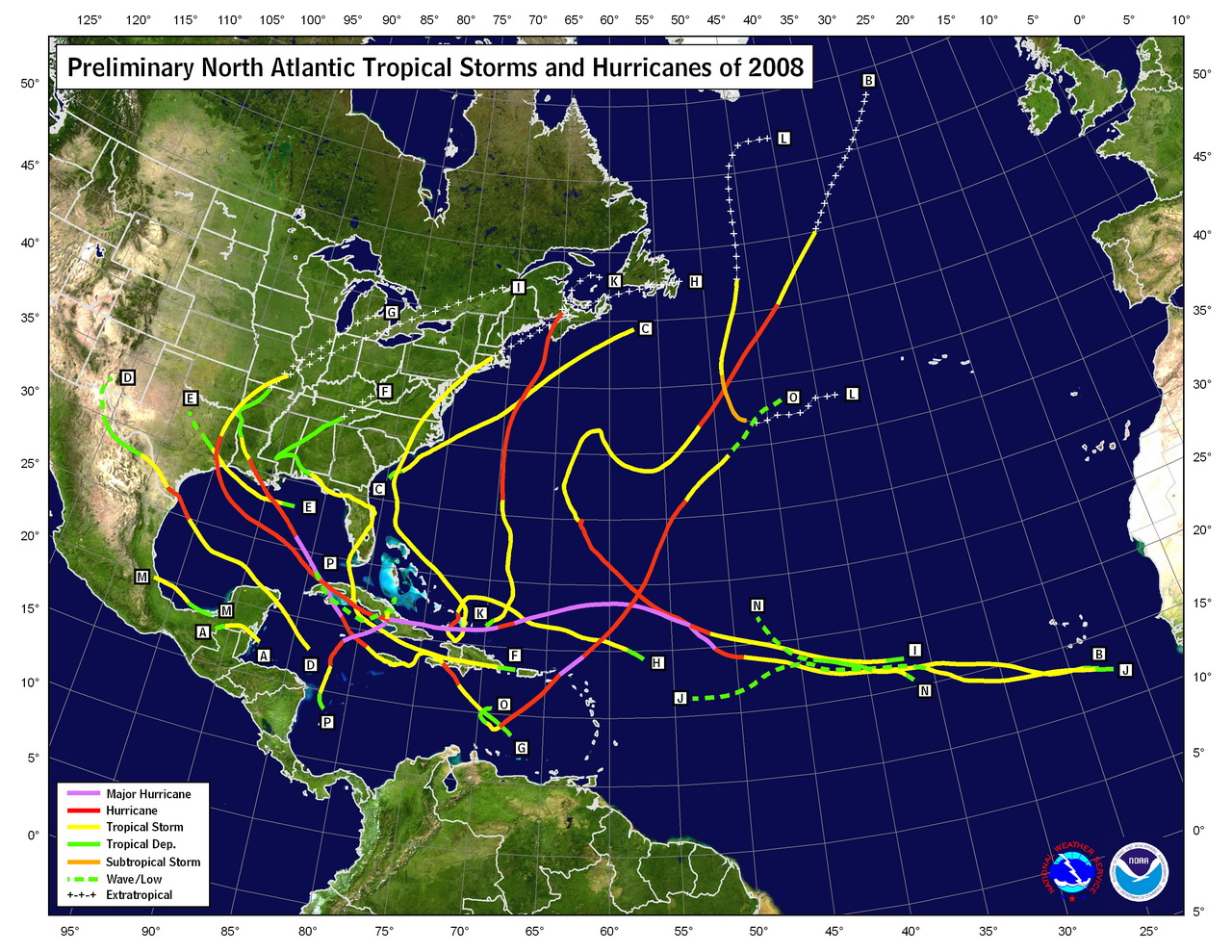
2008 Atlantic hurricane season sets record

This image shows the tracks of hurricanes that occurred during the 2008 season.  Click for larger image.
This image shows the tracks of hurricanes that occurred during the 2008 season. Click for larger image.

Sunday, November 30th marks the close of the hurricane season and the National Oceanic and Atmospheric Administration says it was one for the record books.  The season marks one of the more active in the last 64 years overall and resulted in a record number of consecutive storms striking the United States.

According to Gerry Bell, Ph.D, the lead seasonal forecaster at NOAA, “This year’s hurricane season continues the current active hurricane era and is the tenth season to produce above-normal activity in the past 14 years.”  It is important to note however that comprehensive record keeping of hurricanes has only been occurring for the last 64 years so there is not a great deal of data to draw upon.

In all, a total of 16 named storms formed this season, eight of which were hurricanes.  Five of those were major hurricanes of category 3 strength or higher.  An average hurricane season has 11 named storms, six hurricanes and two major hurricanes.  In May at the start of the 2008 season, NOAA forecasters predicted 12 to 16 named storms and then in August upped their predictions to 14 to 18 named storms.  This represents the first time in recent years forecasters had accurately bracketed the number of storms.  In 2007 NOAA predicted 10 hurricanes and only six formed. The year prior, 2006, nine hurricanes were forecasted by NOAA but only five formed.  In 2005, the year Hurricane Katrina devastated New Orleans in the worst U.S. natural disaster, the forecasts underestimated storm activity.

2008 ties as the fourth most active season in terms of named storms (16) and major hurricanes (5).  It also tied as fifth most active in terms of hurricanes overall (8) since 1944. 

From NOAA, most notably:

For the first time on record, six consecutive tropical cyclones (Dolly, Edouard, Fay, Gustav, Hanna and Ike) made landfall on the U.S. mainland and a record three major hurricanes (Gustav, Ike and Paloma) struck Cuba. This is also the first Atlantic season to have a major hurricane (Category 3) form in five consecutive months (July: Bertha, August: Gustav, September: Ike, October: Omar, November: Paloma).

Bell attributes the active season to ongoing increased activity since 1995, lingering La Nina effects and warmer tropical Atlantic Ocean effects.

Here is a fascinating video from NOAA using satellite imagery of the entire hurricane season:

Remote control hurricane hunters set to deploy

NASA uses unmanned UAVs as hurricane hunters.

Anyone who has followed the wars in Iraq or Afghanistan has heard about the use of Unmanned Aerial Vehicles (UAV).  These are essentially remote control airplanes capable of performing a number of tasks from surveillance to actually carrying weapons. 

NASA and NOAA have over the last year been experimenting with a small UAV from Aerosonde, an Australian manufacturer.  NOAA currently uses manned hurricane hunter aircraft (WP-3D Orion and Gulfstream IVs) to take measurements from inside and immediately surrounding hurricanes.  This data is essential to not only predicting hurricane paths and guaging the storms’ strength but also to learning more about them. 

These new UAVs offer many advantages over the traditional, manned hurricane hunter aircraft.  For one, they can fly at much lower altitudes into the storms without endangering human lives.  Further, they can be called into service on much shorter notice than a manned crew and remain on station around a storm for longer periods of time.  In November of 2007 NOAA sent an Aerosonde UAV into Hurricane Noel and the unit was airborne for over 17 hours and collected more than seven hours worth of data. 

The technology has many applications within NOAA’s mission of monitoring our globe.  In addition to hurricane hunting, UAVs can be used to monitor ice flows, wildfires, severe weather, animal life and much more.  The program is really just getting started and funding is minimal in comparison to the military equivalent but the applications are very promising.  Maybe a tornado hunter is next!

Here’s a video from Aerosonde discussing the potential applications.

Hurricane Ike makes landfall; Fear for what daybreak will bring

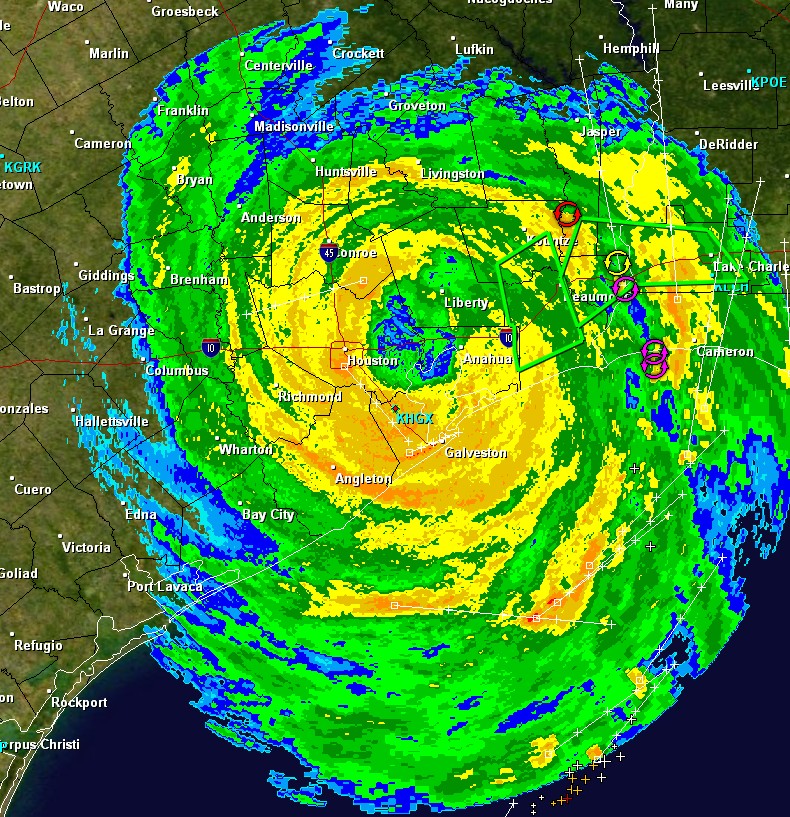
Houston radar image as of 3:45am MDT on Saturday, September 13 as Hurricane Ike moves ashore. The eye of the storm is about 17 miles east of the city.  Click for larger image.
Houston radar image as of 3:45am MDT on Saturday, September 13 as Hurricane Ike moves ashore. The eye of the storm is about 17 miles east of the city. Click for larger image.

The eye of Hurricane Ike made landfall Saturday morning as a category 2 storm with winds of 110 mph at 1:10am MDT.  Long before that though the effects of the storm were being felt as the winds and storm surge began to batter Galveston Island and the Texas coast.  Now the waiting for daybreak begins as no one is sure exactly what will be found once daylight comes.

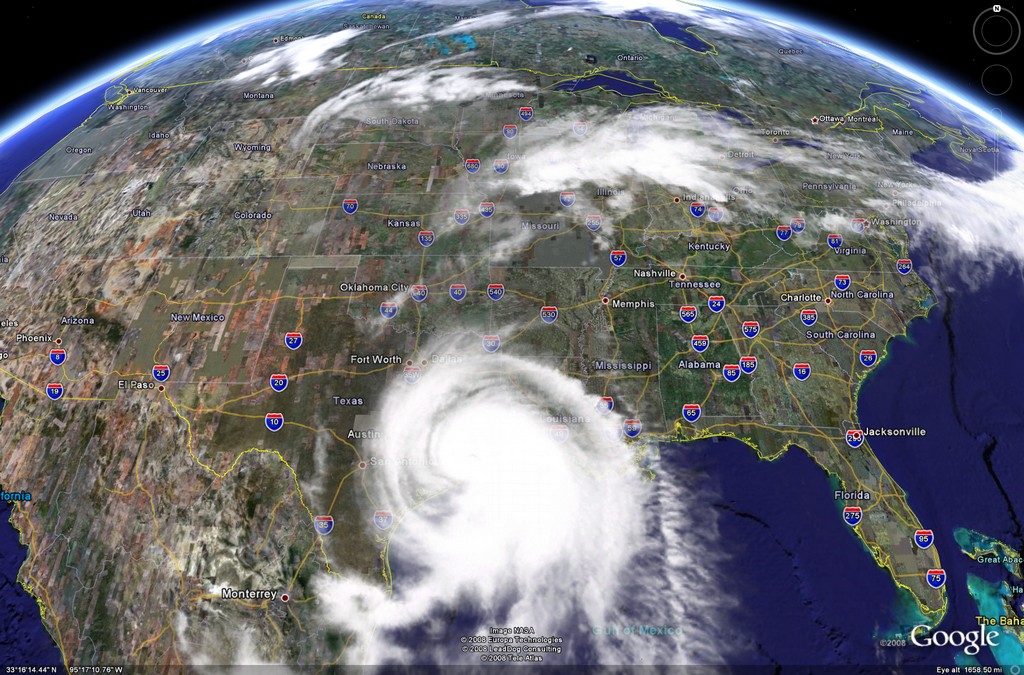
The sheer size of this massive storm has wreaked havoc across much of the Texas and Louisiana coast.  Measuring 900 miles wide, Ike’s tropical storm-force winds extended out to 275 miles – effectively the length of the Texas coastline – from its center.  Evacuation orders were issued for over 1 million people but tens of thousands are expected to have taken the chance and tried to ride the storm out raising fears of potentially massive counts of dead.  Area officials were telling those that stay behind to write their social security numbers on their arms so their bodies could be identified in the worst case scenario. 

Satellite image of the continental United States at 3:45am MDT on Saturday, September 13 as Hurricane Ike moves ashore. You can see the massive size of the storm.  Click for larger image.
Satellite image of the continental United States at 3:45am MDT on Saturday, September 13 as Hurricane Ike moves ashore. You can see the massive size of the storm. Click for larger image.

The Galveston County Office of Emergency Management has said on its website, “Much of the Galveston Island is currently flooded and there are several fires in that area.”  Emergency management officials have reported receiving numerous calls asking for help but rescuers will be unable to aid anyone for hours until the storm subsides.  In perhaps one of the most dramatic moments, early yesterday evening a distress call was received from a 584-foot Cyprus-flagged freighter that was adrift without power 90 miles from the center of the storm.  The Coast Guard sent planes and helicopters to attempt a resuce of the 22 people on board but were forced to turn back due to the conditions.  The ship was told they would simply have to ride it out. 

Now the world waits for daybreak to see what sort of devastation Ike has brought to Texas.

As Gustav winds down, Hanna and Ike spool up

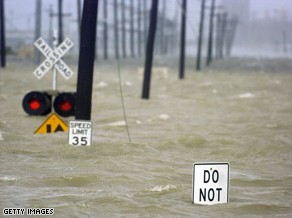
Water from the Industrial Canal floods a road in New Orleans after Hurricane Gustav made landfall Monday. Image courtesy Getty Images.

A weakend Hurricane Gustav came ashore Monday morning shutting down power and swamping much of the Gulf Coast with torrential rain.  Initially making landfall as a category 2 storm, by 3:00pm MDT the storm had lost much of its power and was downgraded to a category 1 system with winds of 80 mph. 

Much of the Louisiana and Mississippi coast lines were subject to extensive rains and high storm surge.  Winds pushed the water over many levees but the Army Corps of Engineers reported no major problems.  The largest provider of electric power in Louisiana, Entergy, said more than 700,000 homes and businesses were without power in the region. 

The Federal Emergency Management Agency (FEMA) reported two Navy boats, each about 350 feet long, that were being scrapped at a facility on the canal broke away from their moorings Monday. They are currently pinned against a wharf in the Industrial Canal but there is concern that should they move they could strike some of the canal walls. 

Much remains to determine the extent of damage from the storm.  The center of the storm is currently north of Lafaette, LA and steadily moving north.  As it does, it will weaken to a tropical storm tonight.

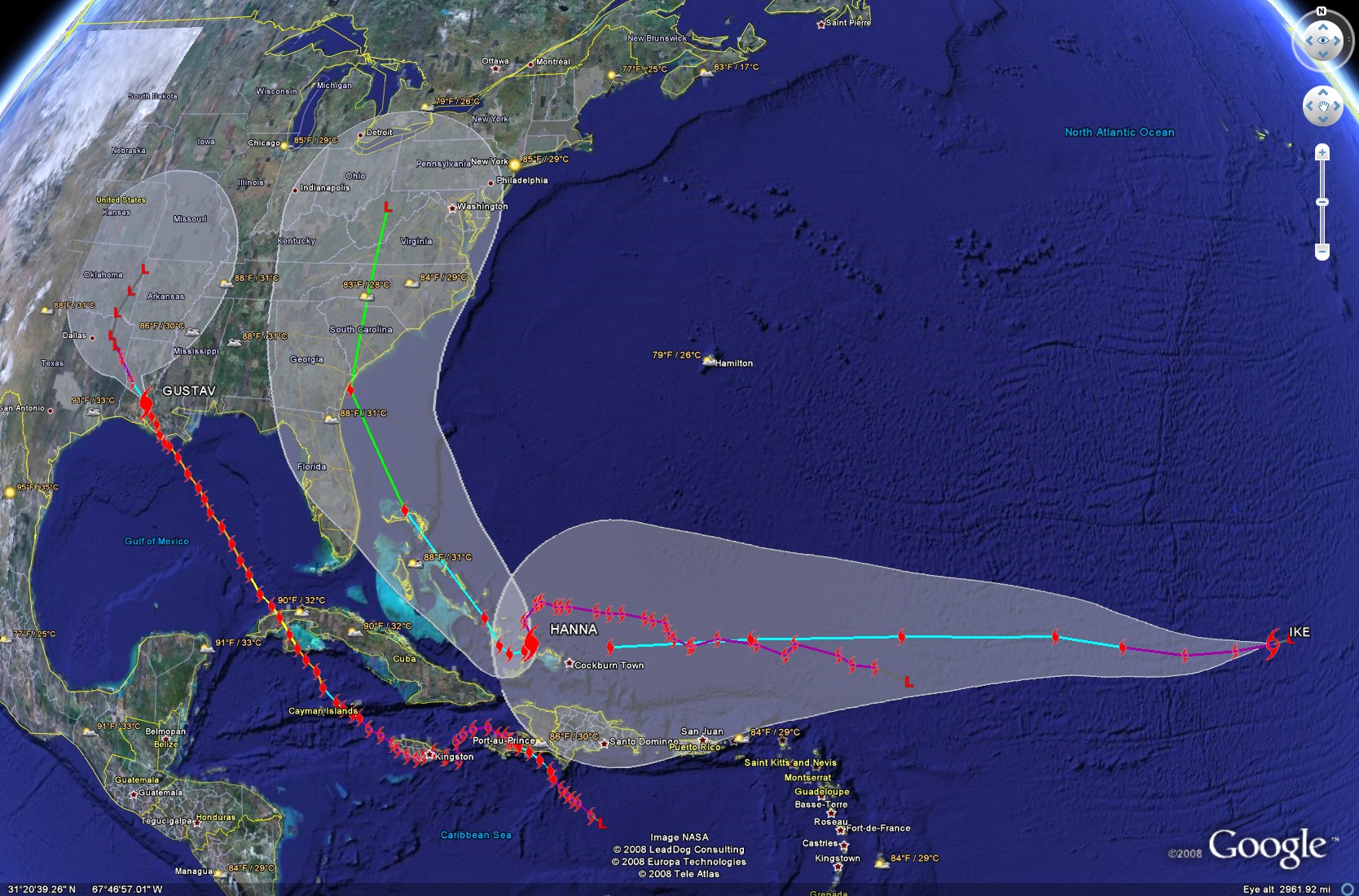
Satellite imagery of the potential tracks of Gustav, Hanna and Ike.  Click for larger version.
Satellite imagery of the potential tracks of Gustav, Hanna and Ike. Click for larger version.

A stark reminder that hurricane season is far from over is the appearance of two additional storms – Hurricane Hanna and Tropical Storm Ike.  Both will bear close watching over the coming days. 

Hanna became a category one hurricane today and as of 3:00pm MDT was  just east of Mayaguana Island in the southeastern Bahamas.  Hanna is expected to meander for a couple of days before making a turn to the northwest with a possible landing anywhere between southern Florida and the Carolinas late this week.   

Ike formed out of a tropical depression today and is currently in the middle of the Atlantic, 1400 miles east of the Leeward Islands moving west at 16 mph.  A warm ocean along Ike’s path is expected to help it reach hurricane strength in the next 36 hours.  It is still very early to tell where Ike will end up but on its current course, it could strike Cuba, the Bahamas and possibly Florida early next week.

Gustav ready to strike Monday AM

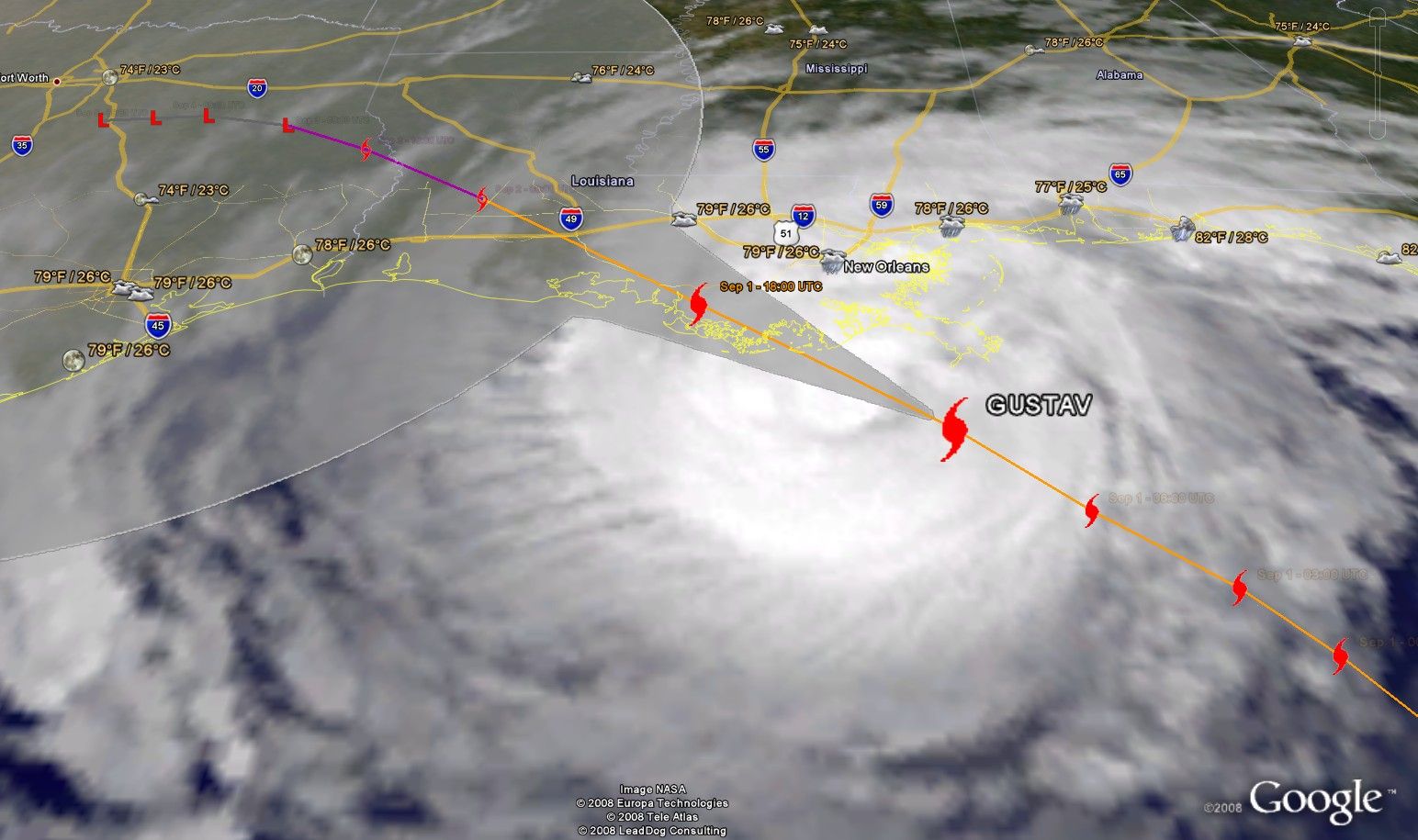
Satellite image of Gustav as of 5:00am MDT showing the storms predicted path.  Click for a larger version.
Satellite image of Gustav as of 5:00am MDT showing the storms predicted path. Click for a larger version.

Hurricane Gustav continues its march to the Louisiana coast Monday morning with landfall expected sometime between 5:00am and 7:00am MDT. At 5:00am MDT the eye of the hurricane was approximately 85 miles south of New Orleans and about 150 miles southeast of Layfayette moving at 16 mph.  Current tracks have it making landfall in the Terrebone / Lafourche areas, just to the east of New Orleans. 

**  Special Coverage:  Click here to view New Orleans radar  **

The good news, if there is any, is that Gustav has not strengthened as was originally expected.  The latest hurricane hunter aircraft report at 3:00am MDT reported sustained winds of 115 mph.  While that is still a category three storm, satellite observations show the storm is not as organized as it could be.  In fact, a station in southwest Pass Louisiana measured only 91mph as Gustav passed over it.  It is important to note that the greatest damage and danger associated with hurricanes is not the winds.  The severe rain, storm surge and the flooding associated with those present the greatest danger.  Rainfall of 6 to 12 inches can be expected and most notably storm surge of 10 to 14 feet. 

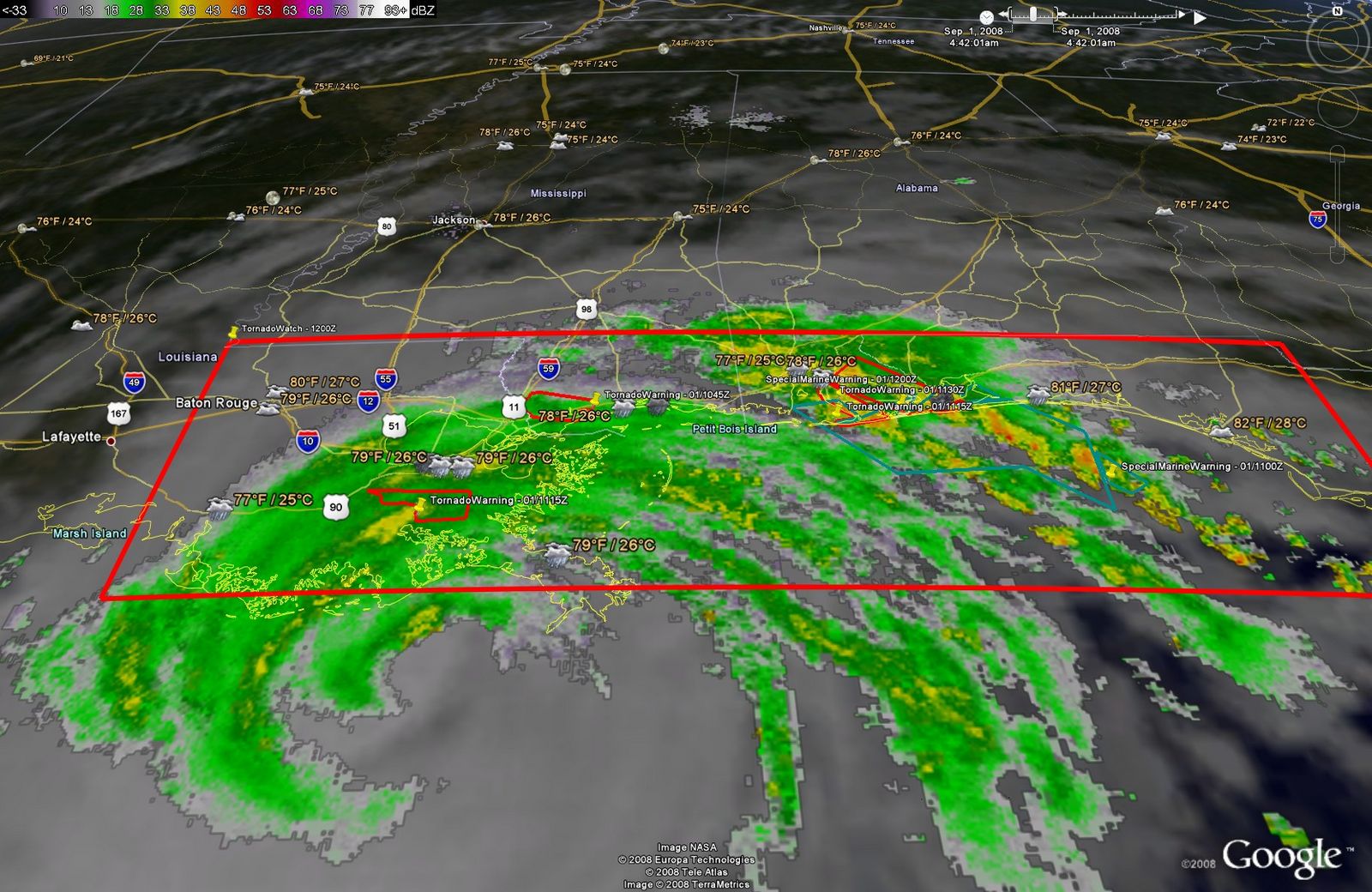
Radar image of Gustav showing current warnings and watches. Click for large version.

Also, one little known additional danger with hurricanes is that of the threat of tornadoes.  In fact, New Orleans and much of the surrounding area is under a Tornado Warning and some twisters have been reported by local law enforcement in Gulfport, MS.  Further, National Weather Service radar indicated the potential for tornadoes right near New Orleans in Jefferson Parish, Southern St. Charles Parish and Plaquemines Parish.

Here are a couple sites with webcams in Louisiana you may wish to check out:

Louisiana DOT

WWLTV.com

Gustav imagery via Google Earth

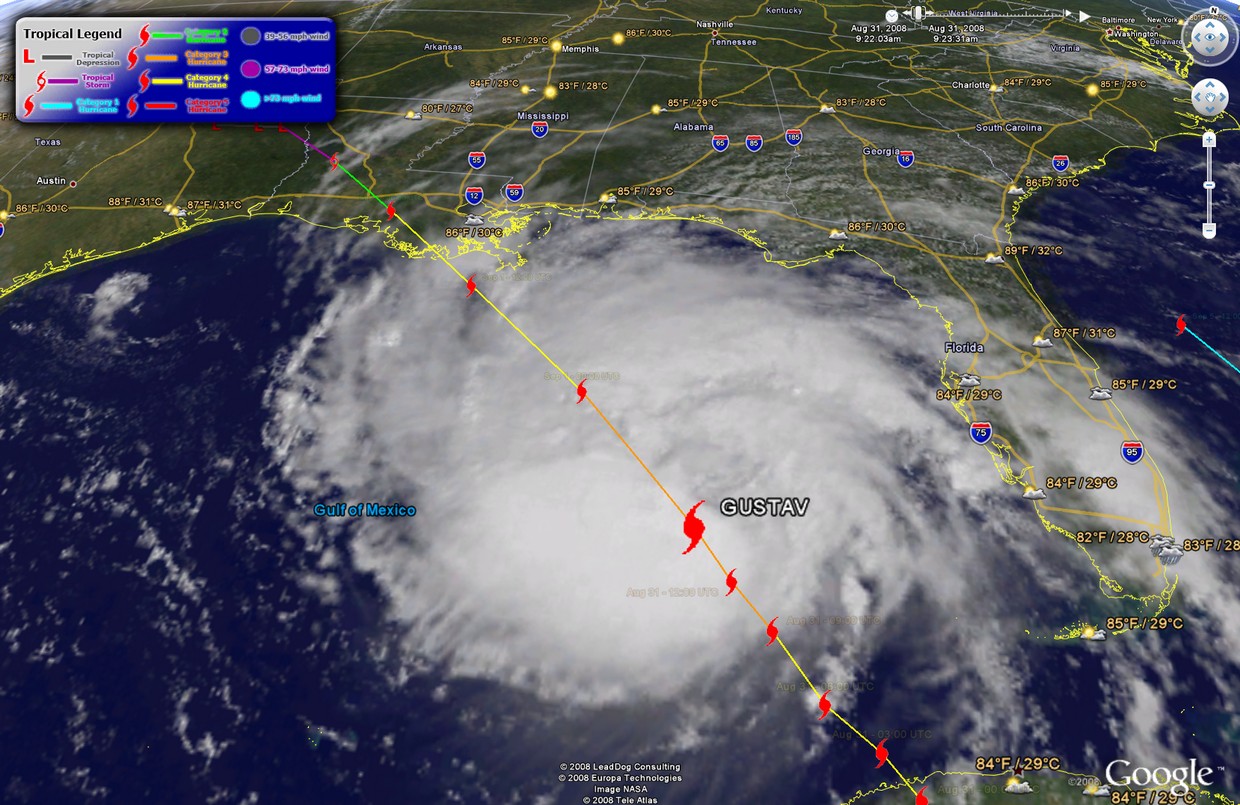
Below you will find the latest satellite imagery (as of 10:00am MDT) with tracking for Gustav generated with Google Earth.  For those that haven’t played with it, Google Earth is a very fun – and useful – program for any number of tasks.  Using it you can download place files with a wide variety of information including weather related items.  Here are a few links to get your started:

Hurricane Gustav image from Google Earth as of 10:00am MDT Sunday.
Hurricane Gustav image from Google Earth as of 10:00am MDT Sunday. Click on image for larger view.

Evacuations as Gulf Coast prepares for Hurricane Gustav

Satellite image of Hurrican Gustav as of 2:00am Sunday.

Residents along the Gulf Coast, particularly in Louisiana, are being ordered to evacuate as Hurricane Gustav bears down on the state.  With Hurricane Katrina still fresh on everyone’s mind, New Orleans is under a mandatory evacuation order and states all along the coast from Texas to Mississippi prepare for a possible hit from Gustav. 

National Hurricane Center forecasters were surprised by how quickly Gustav strengthened in recent days.  Within 24 hours the storm went from a tropical storm to a category 4 hurricane.  Gustav is currently a category 3 storm with sustained winds of 125 mph (gusting to 145 mph) and is expected to intensify in the next 12 hours, possibly reaching category 5 status for a time.  As of 3:00am MT Sunday the storm was 425 miles southeast of the mouth of the Mississippi River and heading northwest at 16 mph. 

By the time it makes landfall, forecasters expect it to be a category 3 storm, possibly a category 4.  The current forecast path for Gustav has it striking the central Louisiana coast with devastating results.  Storm surges of 18 to 25 feet on the eastern side of the hurricane are possible and 6 to 12 inches of rain may fall in Louisiana, southern Mississippi and southern Arkansas. 

John McCain and Sarah Palin await a determination on whether or not the RNC will proceed as scheduled.

In related news, the Republican National Committee was waiting to determine whether or not to proceed with its convention set to begin Monday it St. Paul, MN.  If it proceeds, it is unlikely President Bush would address  the delegates in person Monday as scheduled and would probably do so instead by video link.  John McCain in an interview with Chris Wallace of Fox News said, “It just wouldn’t be appropriate to have a festive occasion while a near-tragedy or a terrible challenge is presented in the form of a natural disaster.  So we’re monitoring it from day to day, and I’m saying a few prayers, too.”

For more information:

National Hurricane Center

2008 Republican National Convention

Hurricane season heats up with Gustav and Hanna

Satellite imagery of Gustav and Hanna.

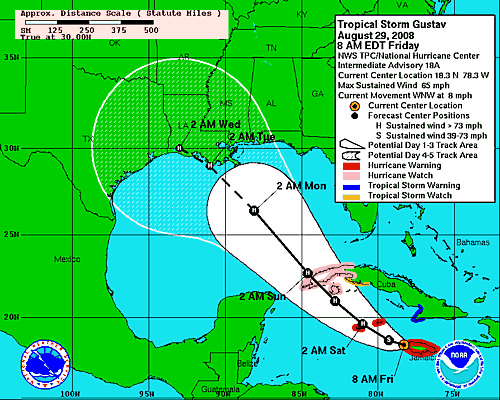
Today, on the three year anniversary of Hurricane Katrina, preparations are underway along the Gulf Coast for the possibility that Tropical Storm Gustav will strike the region next week.  At 3:00am MDT Friday Gustav had tropical storm strength sustained winds of 65mph extending out 140 miles however it is fully expected to become a hurricane today.  It possibly could increase in intensity to a category four storm with 130mph winds by the time it makes landfall toward the beginng of next week. 

Gustav's current predicted track as of Friday morning.

It goes without saying that the storm presents a serious threat to life and property with landfall expected late Monday or early Tuesday.  The greatest danger lies between Houston, TX and Mobile, AL but anywhere along the Gulf Coast remains at risk for a hit from the storm.  State, federal and local officials are preparing for the worst as they should. Disaster declarations have been issued by Louisiana Governor Bobby Jindal and Texas Governor Rick Perry.  Mississippi Governor Haley Barbour has declared a state of emergency.  New Orleans Mayor Ray Nagin is expected to issue an evacuation order for the city, but it likely would not go into effect until Saturday.

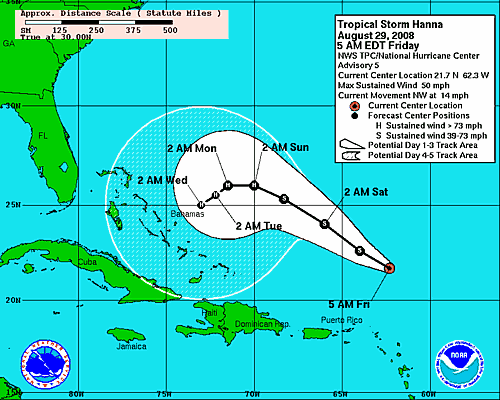
Hanna's current predicted track as of Friday morning.

Tropical Storm Hanna, while less of a threat for the United States, also bears watching.  Hanna currently has winds of 50mph and should remain near those levels today but it is expected to become a hurricane in the coming days.  The storm this morning was located about 245 miles north-northeast of the northern Leeward Islands.  Hanna’s track at this point is uncertain.  A system currently over the Great Lakes could force Hanna to turn to the northeast thus missing any major land features.