
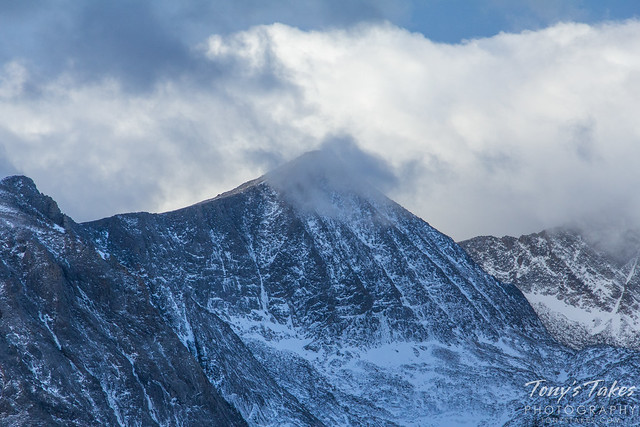
We have all heard the warnings about a warming climate and scientists have claimed to have the data to prove it. However time and time again the very underlying data has been shown to be faulty. Here we again find another case.
A new study from the University of Montana shows extreme warming bias in temperature data from critical networks. The study takes a hard look at climate data gathered across the Rocky Mountain west, including here in Colorado.
“In the context of a warming climate, this artificial amplification of mountain climate trends has likely compromised our ability to accurately attribute climate change impacts across the mountainous western US,” author Jared Oyler writes in his study.
From the University of Montana:
January 12, 2015
MISSOULA – In a recent study, University of Montana and Montana Climate Office researcher Jared Oyler found that while the western U.S. has warmed, recently observed warming in the mountains of the western U.S. likely is not as large as previously supposed.
His results, published Jan. 9 in the journal Geophysical Research Letters, show that sensor changes have significantly biased temperature observations from the Snowpack Telemetry (SNOTEL) station network.
More than 700 SNOTEL sites monitor temperature and snowpack across the mountainous western U.S. SNOTEL provides critical data for water supply forecasts. Researchers often use SNOTEL data to study mountain climate trends and impacts to mountain hydrology and ecology.
Oyler and his co-authors applied statistical techniques to account for biases introduced when equipment was switched at SNOTEL sites in the mid-1990s to mid-2000s. His revised datasets reduced the biases to reveal that high-elevation minimum temperatures were warming only slightly more than minimum temperatures at lower elevations.
“Observations from other station networks clearly show that the western U.S. has experienced regional warming,” Oyler said, “but to assess current and future climate change impacts to snowpack and important mountain ecosystem processes, we need accurate observations from the high elevation areas only covered by the SNOTEL network. The SNOTEL bias has likely compromised our ability to understand the unique drivers and impacts of climate change in western U.S. mountains.”
Co-authors on the paper “Artificial Amplification of Warming Trends Across the Mountains of the Western United States” include UM researchers Solomon Dobrowski, Ashley Ballantyne, Anna Klene and Steve Running. It is available online at http://onlinelibrary.wiley.com/enhanced/doi/10.1002/2014GL062803/.
###
Contact: Jared Oyler, Montana Climate Office, 215-260-4487, jared.oyler@ntsg.umt.edu.
On the net: Study: US Weather Stations Exaggerated Warming In Western Mountains

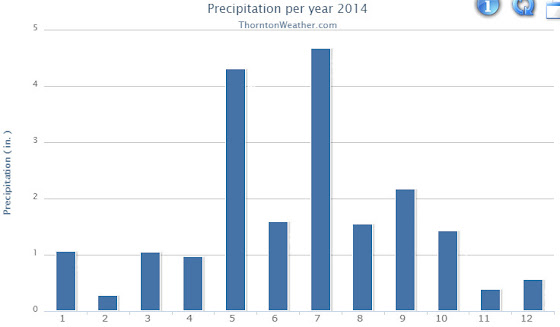
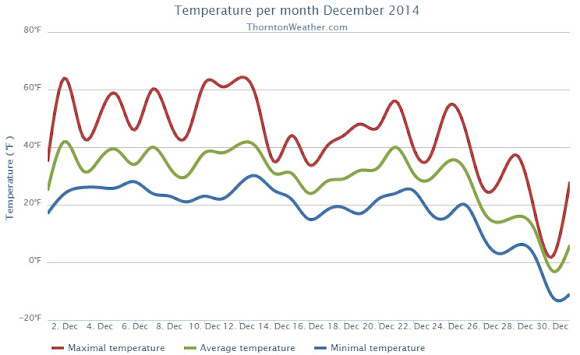


 The month of December brings with it the official start of winter and oftentimes, colder and snowier weather conditions. It however can also offer unseasonably warm temperatures and bone dry conditions.
 The holiday season is about to kick off with Thanksgiving and with many folks traveling in the coming weeks, the focus is oftentimes on the weather. Looking back at Denver’s historical Thanksgiving weather, we see that the day is usually dry with comfortable temperatures.
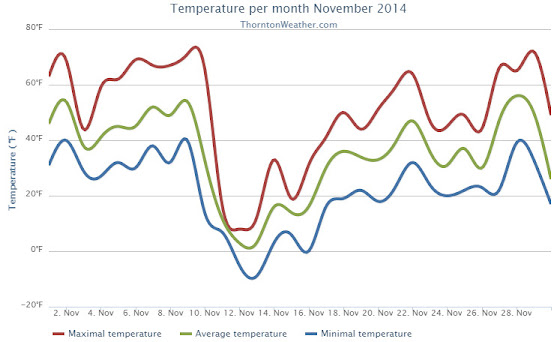
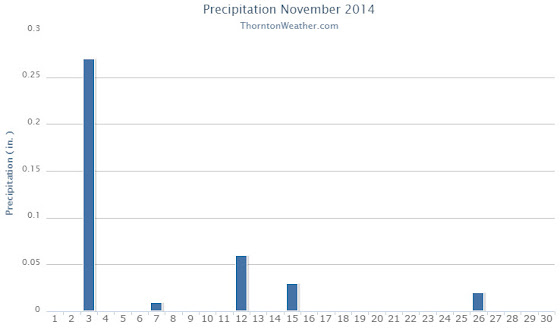
 The weather during the month of November in Denver metro area can offer just about anything. While it is normally a quiet month, it can be prone to extremes.
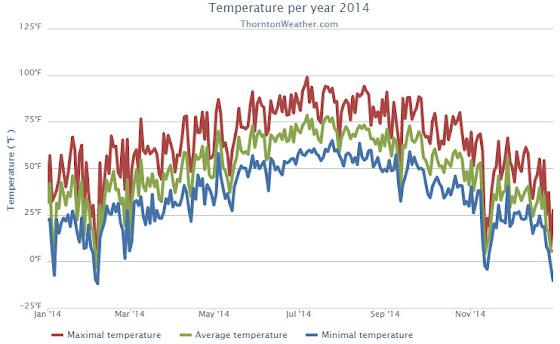
 As expected, temperatures in the Mile High City today were unseasonably warm and climbed to record-setting levels. However, while Denver broke a high temperature record, Thornton fell quite a ways short.