September 6 to September 12 - This week in Denver weather history.
Colorado weather is certainly varied and this week’s look back at weather history proves that. We have seen everything from deadly lightning, hail and severe winds to even snow during the second week of September.
1-7
In 1978…the temperature reached 90 degrees or more on seven consecutive days with the highest temperature…94 degrees… Recorded on both the 4th and 6th.
3-6
In 1909…rainfall for the 4 days accumulated to 3.97 inches in Boulder…while in Denver rainfall totaled 2.45 inches on the 4th…5th…and 6th.
5-9
In 1988…layers of smoke aloft from large forest fires in Yellowstone National Park completely obliterated the sun at times. At Stapleton International Airport…surface visibility was reduced at times to 5 and 6 miles in smoke.
6
In 1940…a thunderstorm pelted the city with small hail. The storm produced some lightning damage. One woman was stunned by a bolt which struck near her. Heavy rain from the storm raised the level of Cherry Creek by more than 3 feet during the height of the storm. Rainfall downtown was only 0.26 inch.
In 1988…strong winds blew down two houses that were under construction in Castle Rock. Northwest winds gusted to 44 mph at Stapleton International Airport.
In 1993…a man was struck and killed by lightning while standing outside his home in unincorporated Arapahoe County 11 miles south of Denver. Lightning also struck a cabin in Marshdale…20 miles southwest of Denver…which started a fire and damaged one room and a portion of the roof.
In 1995…hail as large as 3/4 inch in diameter fell in Coal Creek Canyon in northern Jefferson County.
In 2001…a thunderstorm dropped 3/4 inch diameter hail in Aurora near Cherry Creek.
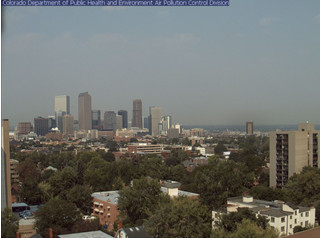
The view of the Rocky Mountains from Denver is obscured by haze caused by smoke from wildfires burning across the western United States.
Update, 5:30pm – The Colorado Department of Public Health and Environment has issued a smoke health advisory for northwest and north-central Colorado. The department warns that residents may wish to limit outside activity, particularly those with heart disease, respiratory illnesses, the very young, and the elderly.
Read the advisory in its entirety at the bottom of this story.
The National Interagency Fire Center (NIFC) reported 17 fires burning in states from Colorado west. Seven fires in California, three in Utah and two in Colorado are the primary ones causing smoke over the Mile High City.
The largest of the blazes, the Station Fire in the foothills near Los Angeles, exploded to more than 120,000 acres in recent days. In Utah, the Mill Flats Fire burning in the Dixie National Forest grew to more than 10,000 acres.
Colorado reports two wildfires, the largest of which has been dubbed the Tabaguache Creek Fire in the Uncompahgre and Gunnison National Forests. That blaze is six miles north of Nucla and has scorched 1,260 acres.
Altogether, the fires that are actively burning have burned more than 150,000 acres of land. For the entire fire season which runs during the calendar year, 65,140 wildfires have been reported and an estimated 5,303,691 acres – more than 8,000 square miles – have been burned.
Tuesday the smoke has eased some over the Front Range and it should dissipate this evening.
From the Colorado Department of Public Health and Environment:
COLORADO SMOKE ADVISORY & OUTLOOK:
Significant smoke from fires in Canada, Utah, Colorado, California and other western states will cause widespread haze in Colorado on Tuesday and from time-to-time this week. Fine Particulate levels are in the Unhealthy-for-Sensitive-Groups category in Garfield County and are probably in the Unhealthy-for-Sensitive-Groups range in other areas across Northwest and North-central Colorado due to the smoke from the forest fires. The highest concentrations are expected to occur in Northwest and North-central Colorado, generally north of I-70, possibly as far east as the Front Range. Much of the rest of Colorado will see concentrations in the Moderate range. IF VISIBILITY IS LESS THAN 5 MILES IN SMOKE IN YOUR NEIGHBORHOOD, SMOKE HAS REACHED LEVELS THAT ARE UNHEALTHY. If smoke is thick or becomes thick in your neighborhood you may want to remain indoors. This is especially true for those with heart disease, respiratory illnesses, the very young, and the elderly. Consider limiting outdoor activity when moderate to heavy smoke is present. Consider relocating temporarily if smoke is present indoors and is making you ill. Smoke should gradually diminish later this evening in most areas.
Moderate to heavy smoke is also possible in the vicinity of a fire 6 miles north of Nucla, especially in areas down-valley of the fire during the nighttime and morning hours.
FRONT RANGE AIR QUALITY FORECAST:
Ozone is expected to be in the Moderate to Unhealthy-for-Sensitive-Groups range Tuesday afternoon and evening (with the highest readings in the Denver metro area) and in the Moderate category on Wednesday. Active children, active adults, and people with respiratory illnesses should limit prolonged outdoor exertion from 2 PM until midnight tonight.
Visibility is expected to remain in the Poor Category on Tuesday and Wednesday.
Carbon monoxide levels are expected to remain in the Good category along the Front Range on Tuesday.
Fine particulate matter levels are expected to be in the Moderate category along the Front Range on Tuesday and Wednesday
Denver & Thornton Climatological Preview - September 2009
As temperatures start to drop, September reminds us that summer is at an end and fall is now here. Sunshine is predominant though as the month actually has the highest percentage of sun out of any month. Sunny days and clear, cool nights are the standard weather pattern for the month.
Normal highs on the first of the month are 82 degrees with a low of 53. By the end of the month we see those high temperatures drop to an average of 73 and the lows get to a chilly 42. Overall the month averages 62.4 degrees.
August 30 to September 5 – This week in Denver weather history.
As always, when looking at weather history we are reminded of the varied and sometimes dangerous weather conditions we have here in Colorado. Our look this week we see high temperatures soaring to 97 degrees but also we see the earliest snowfall on record.
From the National Weather Service:
19-30
In 1875…grasshoppers appeared in great numbers at 10:00 am on the 19th. Thousands landed on the ground. The streets were literally covered with them. Swarms of grasshoppers were seen on each day. All gardens in the city were devastated…and in the countryside the grasshoppers were very destructive to ripened grain. On the 30th the grasshoppers were so numerous as to almost darken the sun.
30
In 1981…60 mph winds were reported in Boulder.
In 2004…a severe thunderstorm produced hail as large as 1 inch in diameter in south Aurora near Cherry Creek.
31
In 1951…hail as large as 1 3/4 inches in diameter caused an estimated 300 thousand dollars damage in metro Denver. Hail as large as 1 1/2 inches in diameter was measured at Stapleton Airport.
In 1978…strong thunderstorm winds tore the roof off an apartment building in Aurora…downed trees…and damaged windows in Denver. A microburst wind gust to 58 mph was recorded at Stapleton International Airport.
In 1985…a thunderstorm wind gust to 60 mph was clocked at Buckley Field in Aurora.
In 1997…hail to 1 1/4 inches in diameter was measured in Aurora.
In 2006…a female postal worker was struck and injured by lightning while delivering mail in Westminster.
In 2008…lightning struck a home in Brighton…damaging the roof and a bedroom. The damaged totaled 20 thousand dollars.
August 23 to August 29 – This week in Denver weather history
Quite the interesting week in Denver weather history. Swarms of grasshoppers are the most unusual item we see but there is plenty of standard severe weather including tornadoes, landspouts, hail, lightning and much more.
From the National Weather Service:
19-30
In 1875…grasshoppers appeared in great numbers at 10:00 am on the 19th. Thousands landed on the ground. The streets were literally covered with them. Swarms of grasshoppers were seen on each day. All gardens in the city were devastated…and in the countryside the grasshoppers were very destructive to ripened grain. On the 30th the grasshoppers were so numerous as to almost darken the sun.
22-24
In 1987…some locations in metro Denver had a total 3-day rainfall of 2 to 4 inches. Rainfall totaled 0.96 inch at Stapleton International Airport.
23
In 1900…northwest winds were sustained to 42 mph with gusts to 49 mph.
In 1921…a thunderstorm cloudburst produced 2.20 inches of rainfall in an hour over downtown Denver. This is the greatest 1 hour rainfall on record at the official observing site in the city. Precipitation totaled 2.93 inches…which is the greatest calendar day precipitation ever recorded in august.
In 1941…one man was killed by lightning about 2 miles from the official weather station in downtown Denver.
In 1962…a home near Boulder was destroyed by a lightning- caused fire.
In 1968…strong winds buffeted Boulder briefly during the early morning hours. At the National Center for Atmospheric Research…winds averaged 55 mph with gusts to 85 mph. Damage was minor. Northwest winds gusted to 31 mph at Stapleton International Airport.
In 1977…lightning damaged at least 6 homes in Aurora.
In 2008…a landspout touched down near Westcreek in Douglas County. One man was seriously injured when he tried to escaped several falling trees in his ATV. One of the trees struck his back and broke two vertebra. Another camper narrowly escaped injury. Seconds after he back up his truck…a tree came down where it had been parked.
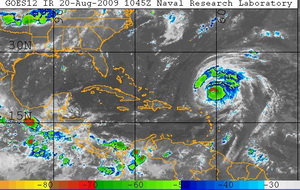
Hurricane Bill on Thursday morning is seen as it nears the United States.
Wind shear helped to slow Hurricane Bill’s wind speeds to Category 3 levels of 125 mph over the last 24 hours. However, the National Hurricane Center cautions that some strengthening is expected in the next 24 hours and Bill may return to Category 4 levels.
The storm now has hurricane force winds extended out 85 miles from its center and tropical storm winds extending out 230 miles. Moving toward the northwest at 18 mph, the effects of the season’s first major Atlantic hurricane will begin to be felt in the next 72 hours.
The Bahamas and Bermuda will begin to experience large swells in the next 24 to 48 hours. Portions of the United States east coast will also feel similar effects Friday into Saturday. The National Hurricane Center is cautioning residents of these areas that ocean waters will be “extremely dangerous” with “life-threatening rip currents.”
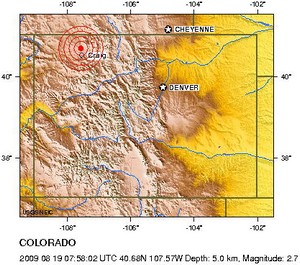
The latest quake was recorded at 1:58am and was centered 3.1 miles below the surface, much like the previous one in the Craig area. While the temblor was small enough that it most likely wasn’t felt, the recent quakes have garnered the attention of seismologists and geologists in the state.
Earthquakes in Colorado are not unusual as the USGS says nine were recorded this year and more than 100 in the last four years. However having this many in such a short time span is not particularly common. The last time the state experienced two quakes of magnitude 3.5 or greater so frequently was in 2001 when an earthquake “swarm” shook the area near Trinidad. During that event, from August 28 and September 21 of that year, 12 earthquakes of magnitude 2.8 to 4.6 struck just west of the southern Colorado city.
In a bit of a rarity for the Centennial State, Colorado experienced a 3.9 magnitude earthquake Sunday evening. According to the U.S. Geological Survey, the quake was centered nine miles east of Eads or 26 miles north of Lamar in the southeastern part of the state.
No damage was reported but the temblor was felt into western Kansas. Mary Breslin of Eads told the Denver Post she felt the shaking. “I really thought it was an explosion,” Breslin said. “It did not occur to me in the beginning that it was an earthquake.”
Originating at a depth of 6.2 miles, the quake occurred at 6:22pm along what state geologist Vince Matthews told the Associated Press might be part of a previously unmapped extension of the Cheraw Fault. See below for complete technical details on the quake.
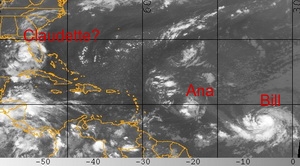
Tropical Storms Ana and Bill formed Saturday. The National Hurricane Center expects a tropical depression off of the coast of Florida to become Tropical Storm Claudette on Sunday.
Following on the first two named storms of the 2009 Atlantic hurricane season forming Saturday, a third may form off the coast of Florida today. Tropical Storm Ana, the first of the season, formed early Saturday. This was followed by Bill later in the day. Today the National Hurricane Center is forecasting that a tropical depression near Florida will reach tropical storm strength by the end of the day and if so, will be assigned the name Claudette.
Tropical Depression Four is currently 90 miles west-southwest of Tampa, Florida and moving to the north-northwest at 16 mph. With maximum sustained winds of 35 mph, the storm is just below the 39 mph threshold to become a tropical storm.
Strengthening is expected and the NHC predicts the system will become a tropical storm before it hits the coast. In anticipation of this, a tropical storm warning has been issued from the Alabama / Florida border east to the Suwannee River in Florida. Rainfall accumulations from 3 to 5 inches are expected with coastal storm surge of 3 to 5 feet.
August 16 to August 22 - This week in Denver weather history
August is usually considered one of the calmer weather months in Denver but as our look back in weather history for this week shows, that isn’t always the case. Thunderstorms and all their associated dangers – lightning, flooding, tornadoes and more – all present a very real danger even this time of year.
From the National Weather Service:
16
In 1902…a thunderstorm produced west winds sustained to 48 mph with gusts to 60 mph…but only a trace of rain.
In 1952…a thunderstorm wind gust to 50 mph was recorded at Stapleton Airport.
In 1960…lightning struck a warehouse in central Denver… Causing 8 thousand dollars in damage to the building and stored electrical equipment.
In 1975…large hail…1 1/2 to 1 3/4 inches in diameter…fell about 4 miles north of Castle Rock. Hail caused some minor damage in Aurora. A funnel cloud was reported 25 miles east of Denver near Bennett.
In 1981…a tornado touched down briefly in open country just to the east of Aurora. No damage was reported.
In 1982…a thunderstorm wind gust to 61 mph was recorded at Buckley Field in Aurora. At the same time almost an inch of rain flooded and closed streets in south Aurora. A women was hit by lightning just north of Denver. A house in the area was also struck.
In 1985…a thunderstorm produced strong wind gusts over southern metro Denver. One strong wind gust hit Cheery Creek Reservoir…capsizing a boat and drowning a man. The wind gusts…clocked as high as 50 mph…also downed a few trees.
In 1989…1 3/4 inch diameter hail fell at Intercanyon in the foothills of Jefferson County.
In 1990…lightning caused minor damage to a south Aurora home. No injuries were reported.
In 1994…strong thunderstorm winds caused damage in southern Weld County near Hudson and Fort Lupton. Two mobile homes were destroyed and a few lost their roofs. Up to 20 downed power poles and the destruction of two 115 thousand-volt towers caused widespread power outages. Thunderstorm gust front winds from the north gusted to 48 mph at Stapleton International Airport.
In 2000…lightning ripped most of the roof from a home in southeast Aurora. The bolt sparked a fire which destroyed the residence. Damage was estimated at 250 thousand dollars.
In 2002…the temperature climbed to a maximum of 100 degrees setting a new record high for the date.
In 2003…a teenager was injured when he was struck by lightning while camping at Herman Lake…13 miles northwest of Georgetown. The boy was knocked unconscious and suffered minor injuries.
16-19
In 1979…heavy thunderstorm rains on each of 4 consecutive days dumped a total of 2.62 inches of rain on Stapleton International Airport. The heaviest rain…1.05 inches… On the 19th was accompanied by 1/4 inch diameter hail.

 We offer in depth coverage of the wildfires and other climate and weather topics on our Denver Weather Examiner pages. Check it out!