All posts by Thornton Weather

ThorntonWeather.com is your local source for live Thornton, Colorado weather conditions and news!

November 8 to November 14 – This week in Denver weather history

November 8 to November 14 - This week in Denver weather history

Wind is always a factor on the plains and the fall usually brings a great deal of it, especially in November.  Our look back at this week in Denver weather history shows that event and snow are quite common this time of year.

From the National Weather Service:

From the 7th to the 8th:

In 1969…wind gusts to 48 mph in downtown Boulder caused minor damage.

On the 8th:    

In 1896…southwest Chinook winds sustained to 42 mph with gusts as high as 46 mph warmed the temperature to a high of 53 degrees.
 
In 1977 near-blizzard conditions in blowing snow caused the closure of I-70 to the west of Denver in clear creek canyon and east of Denver to Limon.  Northeast wind gusts to 46 mph were recorded at Stapleton International Airport where snowfall totaled only 1.1 inches.
 
In 1984…a rare November thunderstorm produced west winds gusting to 31 mph…but only 0.04 inch of rain at Stapleton International Airport.
 
In 1996…high winds gusting from 80 to 100 mph were recorded at Wondervu in the foothills southwest of Boulder.  West northwest winds gusted to 32 mph at Denver International Airport.
 
In 2006…the temperature in Denver climbed to a high of 80 degrees.  This was the first time the temperature had ever exceeded the 70’s in November since records began in 1872. This new all-time record maximum temperature for the month of November was also a new daily record and the highest temperature ever recorded so late in the season.

Continue reading November 8 to November 14 – This week in Denver weather history
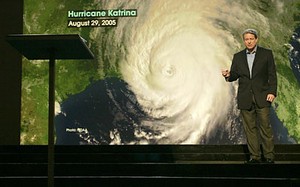
Predictions of climate change induced natural disasters falling flat

Former vice president Al Gore famously used an image of Hurricane Katrina to illustrate his argument that natural disasters will increase in intensity and frequency.  Empirical data howeverhas shown that is not the case. (An Inconvenient Truth)
Former vice president Al Gore famously used an image of Hurricane Katrina to illustrate his argument that natural disasters will increase in intensity and frequency. Empirical data howeverhas shown that is not the case. (An Inconvenient Truth)

Manmade climate change is said to present humankind with some of its greatest challenges in the planet’s history, not the least of which is an alarming increase in frequency and intensity of natural disasters. Massive flooding, super-powered hurricanes, endless tornado seasons and more have all been said to be the direst of consequences of global warming.

In his movie “An Inconvenient Truth”, Al Gore famously proclaimed that, “Temperature changes are taking place all over the world and that is causing stronger storms.” Standing with Hurricane Katrina as a backdrop, the former vice president issued a cautionary tale of disaster in the making, all due to our irresponsible handling of the atmosphere. As recently as February Mr. Gore was giving a presentation showing flooding, drought and wildfires saying, “This is creating weather-related disasters that are completely unprecedented.”

President Barack Obama, in a town hall meeting in April echoed the Nobel laureate’s comments saying, “You’re now looking at huge, cataclysmic hurricanes, complete changes in weather patterns.” He followed that in September when in a speech before the United Nations he claimed, “More powerful storms and floods threaten every continent.”

But what if you predicted global natural disaster catastrophes and they didn’t happen? Does that invalidate your entire message? This is the conundrum faced by climate change alarmists as many of their predictions begin to fall flat.

There's more to this story on the Denver Weather Examiner's site!Learn more about the evidence and find out why even some alarmists say these claims of ‘doom and gloom’ are hurting their case on Examiner.com.

Denver sets new high temperature record for November 5th

Denver broke the record high temperature for the date today.

Everyone in the Mile High City has been enjoying an extraordinarily beautiful November day today. As we mentioned in our morning forecast on Examiner.com, temperatures were expected to reach record-setting highs and that has been the case.

At 1:49pm the official temperature as taken at Denver International Airport reached 77 degrees. This broke the record high for the date last of 76 degrees set in 1945 and before that in 1916.

Here in Thornton we actually were a good bit warmer than the offical high.  ThorntonWeather.com reached a high of 79.9 degrees at 12:12pm.

As always, we have to ask the question: Is this really a record or not? Some say Denver’s climate records have forever been altered and as such any weather record should have an asterisk attached to it. Why? Get the details on that story here.

Where are the tornadoes? 2009 tornado reports well below normal levels

Tornado activity so far in 2009 has been well below normal. This has researchers wondering what has happened to the tornadoes?

Tornado activity in the United States for 2009 is reaching unusually low levels according to statistics from NOAA’s Storm Prediction Center (SPC). By its latest count as of Sunday, November 1st, 1040 tornado reports have been received this year placing it in the 10th percentile since 1954 (see chart below).

Tornadoes occur in every month on the calendar but 2009 started with far below normal numbers for the first three months of the year. As the traditional severe weather season approached during the spring, tornado numbers returned to near average but have since fallen into a decline.

Similarly, tornado deaths in 2009 are far below the average. The three year running average from 2006 to 2008 saw an average of 91 fatalities per year. Over the longer term, the United States experiences 80 per year. Thus far in 2009 only 22 deaths have been reported as a result of twisters. There was nearly a five month period from May 13th to October 9th when there were no deaths at all recorded.

There's more to this story on the Denver Weather Examiner's site!Why so few tornadoes?  For some possible answers and how this ties into global climate change, get the full story on Examiner.com.

Hurricanes MIA – Tropical cyclone activity at 30-year low

Tropical cyclone activity continues to decline despite beliefs that it would increase as a result of global warming.  (NOAA)
Tropical cyclone activity continues to decline despite beliefs that it would increase as a result of global warming. (NOAA)

For the third year in a row, tropical cyclone activity sits near a 30 year low and the 2009 Atlantic hurricane season is showing low levels not seen since 1997. Researchers at Florida State University said that despite what has appeared to be an active season in the Pacific, continual declines in activity are being realized across the globe.

A year ago researcher Ryan Maue documented ‘a remarkable downward trend’ and that trend has continued to flirt with historic lows. Using a measurement called the Accumulated Cyclone Energy index (ACE), Maue said that “2009 as a whole is still well behind normal climatology.”

The ACE index is the standard for measuring tropical cyclone activity. It combines the frequency, duration and intensity of the storms into a numerical index that can be used for historical comparisons.

Through October 2009, the global ACE index for the year sits at 525 – well below the norm of 769. Similarly, if looked at separately both the northern and southern hemisphere activity show well below average numbers. Breaking it down further by basins, the North Atlantic, Western Pacific, Eastern Pacific and North Indian basins are seeing below average ACE as well.

Examiner.com - Get inside Denver weatherGet the rest of this story and find out how this relates to climate change on Examiner.com.

Why do we link to Examiner.com?  Click here to find out.

October 2009 ends as second coldest and fifth snowiest on record

October 2009 in Denver was the second coldest and fifth snowiest October on record.

Most of the month of October was cooler than normal in the Mile High City and now that the month is over we see just how cold it was. Denver finished October 2009 with an average temperature more than 8 degrees below normal and had 9 inches more snow than what is normal for the month.

October 2009’s 42.9 degree average makes it the second coldest since record keeping began in 1873 – 136 years ago! re in Thornton we were actually slightly cooler with an average temperature of 42.0 degrees.  Only October 1969 was colder as that year Denver had an average temperature of a chilly 39 degrees.  He

Across the board temperatures for the month were well below normal. The average daily high temperature of 54.7 degrees was 11.3 degrees below the normal of 66.0 degrees. Low temperatures were similarly well below normal with an average of 31.1 degrees – 4.8 degrees below the normal of 35.9. 

Thornton was warmer for daytime highs than the Denver official temperatures as we averaged 55.6 degrees.  In terms of low temperatures, we were cooler having averaged 30.7 degrees. 

There's more to this story on the Denver Weather Examiner's site!What about the snowfall?  Denver finished with the fifth snowiest October on record.  Click here to get all the details on Examiner.com.

Why do we link to Examiner.com?  Click here to find out.

Join ThorntonWeather.com on Facebook!

ThorntonWeather.com is now on Facebook!  Join us there!
ThorntonWeather.com is now on Facebook! Join us there!

ThorntonWeather.com is pleased to announce the opening of its Facebook fan page.  Now you can stay connected with us and Thornton’s weather on the largest social media site on the Internet!

On our Facebook fan page you will find all the latest weather news and information from your favorite local source for Thornton weather.  And our Facebook page isn’t just another pretty face – it is extremely useful to you. 

Real time weather conditions are updated to the page every three hours.  Forecasts are issued and updated to the site regularly and perhaps most importantly, weather alerts and warnings are posted as they happen in real-time! 

By becoming a fan, you will receive this information right in your regular Facebook news feed.  All of it is there at a glance and ensures that you know what is going on with Thornton’s ever changing weather! 

Click here to visit our fan page on Facebook.  Be sure to click the ‘Become a fan’ button!

And, just a reminder, if you tweet, be sure to follow us on Twitter too.

Thornton’s November weather preview – Our second snowiest month

November is Denvers second snowiest month.  What else can we expect?
November is Denver's second snowiest month. What else can we expect?

Typically November is a quiet weather month with plenty of nice, fall days but it can also turn wet with plenty of snow and moisture.  Just like Forest Gump’s proverbial box of chocolates, you never quite know what you are going to get.

Looking into the weather history books, we see that November is actually Denver’s second snowiest month, second only to March (April is third).  Historically we average 10.7 inches of snow during the month.

In 1994, November was the snowiest month of that year with 16.9 inches – over 12 inches of which fell within a 12 hour period on the 13th and 14th.  In 1991 we saw 29.6 inches of snow (the 2nd snowiest November) and the following year in 1992 we had 20.1 inches of snow (the 8th snowiest November).  Those examples though pale in comparison to the snowiest November on record which was in 1946 when a whopping 42.6 inches of snow fell! 

It isn’t always that snowy though. November 2002 was at the time the 16th month in a row with below normal precipitation and the calendar year of 2002 marked the driest in Denver weather history. This pattern of below normal precipitation continued for 19 months through February 2003. Since 1882, one year (1949) recorded no snow, six more recorded only a trace of snow and four had less than one inch of snow.

For the rest of the November weather preview including complete historical statistics, averages and much more, click here.

November 1 to November 7 – This week in Denver weather history

November 1 to November 7 - This week in Denver weather history

As we enter Denver’s second snowiest month, we of course see plenty of events involving that dominant weather condition.  Sadly we also see two occassions when the winter-like weather turned deadly.

From the 29th to the 1st:

In 1972…heavy snowfall totaled 15.5 inches at Stapleton International Airport.  However…the heaviest snow occurred on Halloween night when 7 inches fell on trick-or-treaters during a short 3-hour period.  I-25 was closed south of Denver.  North winds gusting to 29 mph caused some blowing snow on the 1st.  The snow started late on the 29th and ended during the mid afternoon on the 1st.  The greatest snow depth on the ground at Stapleton International Airport was 13 inches on the 1st.

From the 31st to the 1st:

In 1951…6.4 inches of snowfall were measured at Stapleton Airport.
 
In 1989…a Halloween storm dropped 3 to 6 inches of snow on metro Denver with the adjacent foothills receiving 5 to 10 inches.  Snowfall totaled 4.5 inches at Stapleton International Airport…where north winds gusted to 31 mph on the 31st.  Most of the snow fell on the evening of the 31st…but the storm left icy streets throughout metro Denver on the morning of the 1st…making it a “spooky” commute for many motorists.
 
In 2004…heavy snow fell in and near the foothills of Jefferson and Douglas counties.  Storm total snowfall included:  14.5 inches in Aspen Park…10 inches at Roxborough State Park and near Sedalia…8 inches near Bergen Park…and 7 inches in Highlands Ranch.  Snowfall totaled only 3.2 inches in the Denver Stapleton area.  Post-frontal northeast winds gusted to 41 mph at Denver International Airport.

On the 1st:

In 1896…northwest Chinook winds sustained to 40 mph with gusts to 46 mph warmed the temperature to a high of 60 degrees in the city.
 
In 1973…wind gusts to 92 mph were recorded in Boulder. West winds gusted to 41 mph at Stapleton International Airport where the Chinook winds warmed the temperature to a high of 70 degrees.
 
In 1989…a 39-year-old Lakewood man in a motorized wheelchair was found dead of exposure early in the morning after an overnight snowfall dumped 3 to 6 inches of snow across metro Denver.

From the 1st to the 2nd:

In 1892…snowfall totaled 5.0 inches in downtown Denver. This was the only snow of the month.
 
In 1956…heavy snowfall totaled 7.0 inches at Stapleton Airport.  The storm was accompanied by much blowing and drifting snow.  North winds gusted to 47 mph.
 
In 1991…the storm system which hit the Front Range at the end of October finished the job during the start of November.  Six inches of new snow were recorded at both Rollinsville and Morrison…while 2.9 inches of snow fell at Stapleton International Airport where northeast winds gusted to 17 mph.  The temperature climbed to a high of only 19 degrees on the 2nd…setting a record low maximum for the date.
 
In 1995…a winter storm dropped 5 to 8 inches of snow in the Front Range foothills.  The exception was at Golden gate canyon where a foot of new snow was measured.  Icy roads…fog…and blowing snow along I-70 in the foothills west of Denver caused dozens of accidents.  One man was killed when he lost control of his vehicle and was ejected when his truck hit a median and rolled over.  At least 20 other accidents involved minor injuries.  Only 1.0 inch of snow fell at the site of the former Stapleton International Airport where some freezing rain also fell.

Continue reading November 1 to November 7 – This week in Denver weather history

Thornton begins digging out from early winter storm

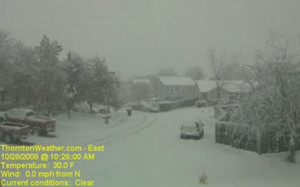
This image from the ThorntonWeather.com webcam was captured at the height of the storm.

A two-day storm that saw areas around Denver measuring snow in terms of feet has moved out of the area and onto the plains. The lingering effects of the storm will be felt Friday in terms of slick roads in Denver and blizzard conditions to the east.

The early winter storm, while not entirely unusual, was the first major snow storm of the season and put Coloradoans to the test. Mercifully, the snow never fell at a particularly heavy rate and while it lingered for a long time, it allowed road crews and residents time to stay on top of the snowfall. Most schoolchildren were pleased to have received at least one snow day from the storm and many were the recipients of two unplanned days off.

At Denver International Airport, initial success at holding the storm’s effects at bay on Wednesday began to whither under the white onslaught on Thursday as winds picked up and the storm shifted east. Hundreds of flights were canceled from the airport’s major carriers including United Airlines, Frontier Airlines and Southwest Airlines.

At the height of the storm’s effects, the airport was reduced to two operating runways from the usual six and delays of up to four hours were occurring. All airlines anticipate being able to operate a normal flight schedule today.

How much snow did the Denver area receive? Here are some of the snowfall totals:

Aurora: 16 inches
Boulder: 18.8 inches
Broomfield: 20 inches
Centennial: 17 inches
Coal Creek Canyon: 46 inches
Denver International Airport: 12 inches (as of 6:00am Thursday)
Evergreen: 30 inches
Highlands Ranch: 24.5 inches
Littleton: 28.5 inches
Longmont: 12.4 inches
Parker: 14.5 inches
Thornton: 14.1 inches
Click here for a complete listing of storm reports.

The storm did push Denver into the record books and the ‘top 10 snowiest Octobers’ list. The National Weather Service will publish the official snow total from DIA for yesterday but even without the snow from yesterday, October 2009 makes the list. As of 6:00am on Thursday, DIA had recorded 14.5 inches for the month (12 inches from this storm). That makes it number 7 on the top 10 list for snowiest Octobers on record since 1882. Once today’s measurement is released, it is possible it will climb further.

There's more to this story on the Denver Weather Examiner's site!For the rest of the storm recap, the latest photos and much more, please visit the story on the Denver Weather Examiner.