The number of natural disasters in 2009 reached the lowest point in the decade. According to preliminary numbers from the United Nations, there were 245 disasters which is far below any of the past 10 years.
Natural disasters, no matter how many there are, due have a toll in human life and economic impact. The UN International Strategy for Disaster Reduction (UNISDR) said that 8,919 people lost their lives from the events and they affected 58 million. The cost of the damage was put at $19 billion.
Weather-related disasters which exclude geological events like earthquakes and volcanoes were responsible for the lion’s share of the losses. Approximately 7,000 lives our of the total of 8,919 were lost due to weather-related events. Similarly, $15 billion of the $19 billion in damages were weather-related.
Margareta Wahlström, the United Nations Special Representative for UNISDR said, “Statistics this year show lower figures compared to previous years, which is good news for people and countries, however extreme weather disasters remain top of the list and will continue to affect more people in the future as more than half of the world’s population highly exposed is living in coastal regions.”
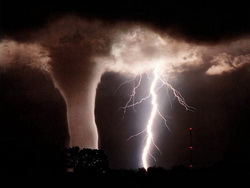
Tornadoes can and do strike at night and during winter months. Are you prepared?
Tornadoes are one of nature’s most violent storms. Able to strike without warning, they bring death and destruction with frightening frequency. Twisters can be scary enough to just think about and when you consider one striking at night when you can’t see it and aren’t expecting it, the odds of survival diminish.
Over the last three years, there has been an average of 1297 tornadoes per year and on average 91 tornado-related deaths per year. While not as common during the winter months, tornadoes can and do occur every month of the year and they do strike at night.
Seeking to draw attention to the dangers nighttime tornadoes present, the National Oceanic and Atmospheric Administration (NOAA) and its National Weather Service announced an effort to increase awareness. In a press release today, the services said that with the El Niño conditions we are experiencing, Florida and the Gulf Coast region stand a greater risk of tornadoes.
NOAA reminded all residents of the United States that a NOAA All Hazards Radio is the first line in defense against not only tornadoes, but all natural disasters. Also announced were new severe weather outlooks that will be issued when conditions are favorable for such storms.
The fallout from the release of thousands of emails from the world’s top climate scientists has been swift. Some of those involved have begun to turn on each other and even the international organization that has driven the manmade climate change debate is turning its back on them.
Dr. Phil Jones, head of the Climate Research Unit at the University of East Anglia, was arguably featured most prominently in the emails. He apparently made requests of his colleagues to delete emails that he didn’t wish to see shared, made concerted efforts to withhold data, and worked with other scientists to stifle others opinions.
Dr. Michael Mann of Penn State University and author of the discredited ‘hockey stick’ graph was the recipient of one of the emails from asking him and other scientists to delete previous correspondence. In interviews since the event, Mann did not support Jones saying, “I can’t put myself in the mind of the person who wrote that email and sent it. I in no way endorse what was in that email.”
Mann disavowed deleting any messages however, when he received the message he did not object and in fact replied that he would forward the request to Dr. Eugene Wahl at the National Climatic Data Center (NCDC).Penn State is currently investigating Mann however that inquiry is being conducted in private just leading to doubts about its impartiality.
December 13 to December 19 - This week in Denver weather history
December can of course be cold and that is why Chinook winds are sometimes welcomed as they bring warm air to the Front Range. However, those winds can also cause a great deal of damage if they blow too hard and we see that in our look back at this week in Denver weather history. Particularly notable were winds on December 14th & 15th which caused accidents, toppled power poles and fences, ripped off roofs and more.
From the National Weather Service:
2-17
In 1939…more than 2 weeks of unseasonably warm weather made the month the 3rd warmest on record. Seven daily temperature records were set…including the all time record high temperature for the month of 79 degrees on the 5th. Daytime highs were balmy with 14 days in the 60’s and 70’s. Low temperatures dipped to freezing or below on only 5 days. The period was dry with only a trace of snow on the 12th.
3-15
In 1972…a protracted cold spell held an icy grip on metro Denver when maximum temperatures never reached above freezing for 10 consecutive days from the 3rd through the 12th and minimum temperatures dipped below zero on eleven consecutive days from the 5th through the 15th. Daily low temperature records were set with 15 degrees below zero on the 5th…17 degrees below zero on the 6th… And 18 degrees below zero on the 10th. Daily record low maximum readings were set with 3 degrees on the 6th and 6 degrees on the 9th. The very cold temperatures were caused by 3 to 5 inches of snow cover and a Canadian air mass.
9-13
In 1961…cold arctic air produced a protracted cold period. The temperature plunged to 16 degrees below zero on the 10th…establishing a new record for the date and the coldest reading since 25 degrees below zero on February 1… 1951. Low temperatures dipped below zero on 5 consecutive days with 9 degrees below zero on the 9th…16 below on the 10th…10 below on the 11th…and 12 below on both the 12th and 13th. High temperatures reached only 3 degrees on the 10th and 6 degrees on the 11th.
11-13
In 1940…5.4 inches of snow fell across downtown Denver. This was the only snowfall of the month. Temperatures were quite cold on the 13th with a high of 6 degrees and a low of 2 degrees below zero.
In 1984…up to 6 inches of new snow fell over metro Denver… Hampering flight operations at Stapleton International Airport where snowfall totaled 3.8 inches and east winds gusted to 25 mph on the 11th.
12-13
In 1916…snowfall totaled 5.7 inches in downtown Denver. Northeast winds were sustained to 27 mph with gusts to 28 mph on the 12th.
In 1992…an upslope snowstorm whitened metro Denver. While snowfall totaled only 4.1 inches at Stapleton International Airport…7 inches of new snow fell in Morrison…with 12 inches measured in Castle Rock. North winds gusted to 23 mph at Stapleton International Airport on the 13th.
In 1995…strong winds gusting to nearly 100 mph whipped across the foothills west of Denver. The strongest wind gusts included 98 mph atop Squaw Mountain and 75 mph at the Eldora Ski Area. West-northwest winds gusted to 41 mph at Denver International Airport on the 13th.
12-15
In 1921…downslope Chinook winds produced warm temperatures in the city…which resulted in 4 temperature records. High temperatures of 72 degrees on the 13th and 68 degrees on the 15th were record maximums for the dates. Low temperatures of 47 degrees on both the 12th and 13th were record high minimums for the dates. West winds were sustained to 38 mph on the 12th and to 25 mph on the 13th.
13
In 1955…strong winds raked the foothills. A wind gust to 72 mph was recorded at rocky flats northwest of Denver. Some damage occurred in Boulder. Northwest winds were sustained to speeds of 23 mph at Stapleton Airport.
In 1988…high winds again occurred in Boulder where winds were clocked to 66 mph. West winds gusted to 43 mph at Stapleton International Airport.
13-14 in 1902…heavy snowfall totaled 6.4 inches in the city overnight. North winds were sustained to 18 mph with gusts to 20 mph on the 13th.
The Climate Change Examiner is the place for the latest on the United Nations Climate Change Conference.
15,000 delegates, 5,000 journalists and dozens of world leaders have decended on Copenhagen, Denmark for the UN Climate Change Conference (COP15). Decisions will be made that could shape the world in the decades to come.
There is a lot going with the various press conferences, proposals, protests and more. Underscoring the importance of the event, President Barack Obama will attend next week. Will an agreement be reached? What form will it take?
The ultimate goal is to establish rules and limits on carbon emissions for all nations but it is not without controversy. The recent Climategate scandal is serving as a backdrop and causing doubt in many people’s minds.
The early forecast for the 2010 hurricane season in the Atlantic basin calls for above normal levels of activity. (NOAA)
The hurricane forecasting team at Colorado State University (CSU) has issued its preliminary forecast for the Atlantic hurricane basin for next year. Generated by Dr. Phil Klotzbach and Dr. Bill Gray, the forecast calls for above normal levels of tropical cyclone activity.
For the 2010 season, Klotzbach and Gray expect an “above-average Atlantic basin tropical cyclone season in 2010 and anticipate an above-average probability of U.S. and Caribbean major hurricane landfall.” In terms of numbers, they forecast 11 – 16 named storms, 6 – 8 hurricanes, and 3 – 5 major hurricanes (Category 3 or stronger).
For the first time, the CSU team is issuing a range for the number of forecast storms instead of a specific number. This is more in line with the forecasts that the National Hurricane Center issues.
In terms of landfall probability for a major hurricane, the team also expects an increased chance. They peg the chance of a Category 3 or greater storm striking the U.S. coastline at 64% which is well above the average of 52%. The U.S. East Coast has a 40% chance of sustaining a hit (versus a 31% average) and the Gulf Coast has a 40% chance as well (versus a 30% average).
NASA’s Terra and Aqua satellites moved over the western half of the nation and captured amazing imagery showing how widespread the winter weather was.
A severe winter storm blustered its way across the United States on December 7 and 8, 2009. The storm dumped heavy snow from California to the Great Plains, and fierce winds added to the hazardous conditions. The storm was predicted to continue eastward in midweek, and blizzard warnings were in effect for Great Lakes states as of December 9.
This image shows the blanket of snow laid down by the storm across the West, along with the thick swirl of storm clouds over the Great Plains from North Dakota to Oklahoma. The image is made from a combination of images captured by the Moderate Resolution Imaging Spectroradiometer (MODIS) sensors on NASA’s Terra (most of the left side of the image) and Aqua (most of the right side) satellites on December 8.
It certainly could have been a lot worse. The Mile High City escaped relatively unscathed with only minor accumulations of snow from the storm that is now moving to the east. Its lingering effects will continue to be felt overnight however.
Some blue skies are starting to be seen which is a welcome sight and the Winter Weather Advisory that was in effect has been cancelled. Temperatures however remain in the single digits across the Front Range and are below zero in the high country according to the Rocky Mountain Weather Network. With the slight breezes wind chills are easily dipping near the zero degree mark.
Overnight tonight, the mercury will continue to drop and likely enter negative numbers. The only consolation we have is that we do gradually begin to warm up tomorrow and may very well start hitting normal temperatures by Saturday.
The winter storm system that impacted Colorado struck Arizona and California before arriving here and as it travels east it will cover a widespread swath of the nation. Check out the story from the Natural Disasters Examiner for more information. Also be sure to look at the slideshow below of the winter weather.
A massive winter storm covering nearly 1,700 miles has brought Arctic cold, record snowfall and blizzard conditions to a large swatch of the nation. From southwestern Utah, across the Rocky Mountains and Great Plains to northeastern Michigan winter weather warnings have been issued as Old Man Winter arrives two weeks early.
Starting in California, parts of the Sierra Nevada saw up to four feet of snow. In Arizona the storm brought high winds to the Phoenix area which downed power lines leaving 250,000 people without power. Flagstaff, Arizona and Reno, Nevada were covered in blankets of snow.
In Colorado, the entire state was feeling the effects of the storm. The southwestern part of the state was experiencing blizzard conditions while the Denver area, spared significant snowfall, suffered through single digit temperatures and wind chills dipping to 10 degrees below zero.
As if often the case, winter storm can turn deadly and this system has not been an exception. Two people were killed in New Mexico due to traffic accidents on dangerously slick roads and the state’s road crews were struggling to keep up with falling snow.
A variety of winter weather advisories had been issued for Colorado. The Winter Weather Advisory for the Front Range has been cancelled. (NWS)
Update, 1:01pm – The Winter Weather Advisory for the Front Range has been cancelled. The snow may be gone but the bitter cold remains. ThorntonWeather.com recorded a wind chill of -11.2°F at 10:59am!
Temperatures will warm slightly this afternoon before plunging overnight to below zero. Stay warm!
Update, 12/8/09, 6:50am: Bitter cold would be an accurate term to describe the weather the Mile High City is waking up to this morning. Temperatures are in the single digits across the Front Range and wind chills are dipping to zero and below.
The snow we were expecting is going to arrive but it will be slower than expected and likely not as much as original forecast. Snow showers are slowly developing to the west and moving into Denver early this morning but with the severe cold and dry atmosphere, snow is going to have a hard time really getting going.

 The number of natural disasters in 2009 reached the lowest point in the decade. According to preliminary numbers from the United Nations, there were 245 disasters which is far below any of the past 10 years.
.jpg "Climategate")