January brings the NFL playoffs and in Denver that oftentimes means difficult weather conditions for players and fans. Today’s divisional playoff game between the Denver Broncos and the Baltimore Ravens will be less notable for snow than for the bitter cold. Get the complete forecast for the game on Examiner.com
A dropping thermometer and a chance for snow could impact today's game. Click the image for details.
Senate Majority Leader Harry Reid’s comment last week that those who suffered the effects of Hurricane Katrina had it easy as compared to the aftermath of Hurricane Sandy has sparked a quick and vicious response. Sen. David Vitter called the Democrat leader ‘an idiot’ Monday and Reid was forced to issue an apology. Read the rest of this story and see video of Reid’s comments on Examiner.com
Senate Majority Leader Harry Reid (D-NV) rubs his eyes during the counting of the Electorial College votes. Reid's comments minimizing the victims of Hurricane Katrina have sparked outrage. (Getty Images)
This bald eagle was spotted Saturday along the South Platte River Greenway Trail near the Spratt Platte Lakes. See more images in the slideshow below. (ThorntonWeather.com)
One of the great joys of winter in Colorado is an increase in appearances of bald eagles. The national bird of the United States is majestic to see and here in Thornton the birds routinely roost during the cold months.
Bald eagles can be found virtually anywhere in the United States and while Benjamin Franklin would have preferred the turkey, eagles won the right to become one of our nation’s most important symbols.
Here in Colorado there are some year-round nesting pairs, most notably for those in the north Denver metro area are some at Barr Lake. More common are eagles that come to Colorado seasonally and then return north when we start to warm up in the spring.
In recent years we have admired a number of these great birds on the South Platte River Greenway Trail between Colorado Blvd and McKay Road.
This year as many as four have been spotted in the area. While they don’t appear to have nested in the area, they do roost daily along the river.
Yesterday we went for a bike ride and were able to spot one of the eagles as well as a hawk, ducks and the ever-present geese. The slideshow below shows you some of the images we captured.
January 6 to January 12: This Week in Denver Weather History
Extreme cold would be the first thing to come to your mind when you think of January. While there have been many such notable events of that nature, our look back at this week in Denver weather history actually is more remarkable for the damaging wind that has raked the area in the past.
From the National Weather Service:
31-6
In 1973…the 31st marked the start of a protracted cold spell that extended into January of 1974 when temperatures dipped below zero on 7 consecutive days. Record daily minimum readings occurred on the 3rd and 5th when the temperature plunged to 17 degrees below zero on both days. A record low daily maximum temperature of only 4 degrees occurred on the 5th.
31-7
In 1941…a protracted cold spell through January 7…1942… Produced below zero low temperatures on 7 of the 8 days. A low temperature of 2 degrees on the 3rd prevented a string of 8 days below zero. The coldest days during the period were the 1st with a high of 2 degrees and a low of 9 degrees below zero…the 4th with a high of 2 degrees and a low of 11 degrees below zero…and the 5th with a high of 26 degrees and a low of 12 degrees below zero.
5-6
In 1940…snowfall totaled 5.9 inches in downtown Denver.
In 1975…high winds gusting to over 75 mph caused considerable damage in the Boulder area and minor damage in Jefferson County.
In Boulder…one home was unroofed… Several power lines were blown down…and a number of homes and commercial buildings were damaged. Northwest winds gusted to 36 mph on the 5th and 38 mph on the 6th at Stapleton International Airport.
In 1980…high winds in and near the foothills shattered windows…tore roofs from buildings…and caused many power outages. Much of the damage was in Boulder…where winds gusted to at least 82 mph. Wind gusts of 80 to 100 mph were common in the foothills. West winds gusted to only 37 mph at Stapleton International Airport on the 6th.
In 1982…2 to 6 inches of snow fell across metro Denver. Only 1.1 inches of snow were measured at Stapleton International Airport.
In 1983…high winds buffeted the foothills with gusts of 60 to 75 mph recorded in the Boulder area. West winds gusted to only 38 mph at Stapleton International Airport on the 6th.
In 1998…heavy snow blanketed the Front Range foothills. Snowfall totals included: 15 inches 8 miles north of Blackhawk; 13 inches at Evergreen and 5 miles east of Nederland; 12 inches in Coal Creek Canyon; 11 inches 8 miles west of Conifer; 10 inches in sunshine canyon northwest of Boulder; 10 inches 11 miles southwest of Morrison; 9 inches in south turkey canyon; and 8 inches at Eldora Ski Area. Snowfall totaled only 1.8 inches at the site of the former Stapleton International Airport.
6
In 1903…northwest winds were sustained to 45 mph with an extreme velocity of 48 mph. The Chinook winds warmed the temperature to a high of 66 degrees…which was a record maximum for the date. The low temperature dipped to only 35 degrees.
In 1962…strong winds caused nearly 14 hundred dollars in damage 2 miles north of Boulder. West-northwest Chinook winds gusted to 33 mph at Stapleton Airport in advance of a cold front that produced northeast wind gusts to 43 mph along with some blowing dust and 0.1 inch of snow.
In 1972…a wind gust to 69 mph was recorded at the National Bureau of Standards in Boulder. Only minor damage occurred. Northwest winds gusted to 33 mph at Stapleton International Airport.
In 2007…a large avalanche swept two vehicles off U.S. Highway 40…near Berthoud Pass…and partially buried them. The slide covered all three lanes of the highway. Eight people were in the vehicles…but only one person was seriously injured. He suffered several broken ribs. The slide was approximately 200 feet wide and 15 feet deep.
A record-setting heat wave and tinder dry conditions have sparked dozens of blazes across Australia. Hardest hit Tasmania has seen dozens of homes destroyed and with nearly 100 people missing, officials fear the possible loss of life. Read the rest of this story on Examiner.com.
Clouds from a nearby bushfire are seen over Mount Wellington during day one of the Hobart International at Domain Tennis Centre on January 4, 2013 in Hobart, Australia. (Getty Images)
The Lower North Fork Wildfire Commission released yesterday its recommendations for changes in the wake of the deadly spring blaze. Improving coordination among first responders, raising limits on government liability and improved emergency notification are part of the recommended overhaul. Read the rest of this story on Examiner.com.
Much like in the United States, spring and summer bring severe weather to New Zealand and that does sometimes mean tornadoes. Following on a deadly twister in Hobsonville last month, another twister near Ashburton tore through a golf course yesterday. Read the rest of this story and check out the amazing video on Examiner.com.
A tornado on Thursday, January 3, 2012 caused damage to a golf course in Ashburton, New Zealand. (YouTube / Stephan Burrows)
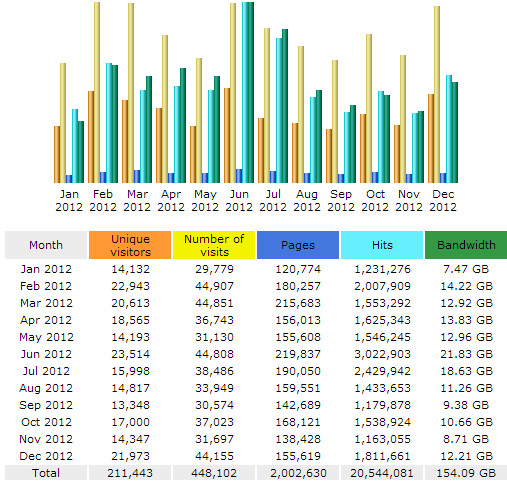
ThorntonWeather.com's 2012 website statistics. Traffic to our site grew by more than 20% as we served up over 2,000,000 pages.
We knew people across northern Colorado loved us but now we know just how much! ThorntonWeather.com experienced record-setting traffic in 2012 with over 2 million pages served.
As arguably the most popular, independent weather source in the Denver area, ThorntonWeather.com has seen tremendous growth since it was first started in October 2006. Back then the site looked much different and didn’t have near as much information as it does now.
Since our founding we have strived to provide the most accurate, timely weather information for Thornton and its surrounding communities. ThorntonWeather.com has become the go to source for residents and even local governments and organizations.
The sheer breadth of information on our website surpasses any local broadcast or print media outlet – period. And while we may not be as flashy as some of the bigger sites on the Internet, we will put up the quality of our weather and climate information against any of them.
You, our visitors and our neighbors, paid us back with a banner year. Nearly one quarter of a million unique visitors came to our site as we served up over 2 million individual pages. This was about a 20 percent increase over 2011.
What’s ahead for 2013? You can be certain we won’t be standing still.
We continue to raise funds for high-definition webcams to help give you a better look at what is going on outside. Remember, we make no money off of ThorntonWeather.com as it is simply run by a resident that is passionate about the weather. Any help you can provide is greatly appreciated. Click here to learn more about how to help.
Additionally, while we are in the depths of winter right now, severe weather season will be here before you know it and we have a number of enhancements in mind to help you monitor the changing conditions and keep you and your family safe.
We truly are humbled and appreciate that so many of you have make ThorntonWeather.com your source for weather. Thank you very much and we wish each of you a very prosperous and happy new year!
For all the latest with Thornton’s weather, be sure to ‘like’ us on Facebook, follow us on Twitter and add us to your Google+ circles.
In the immediate days following the end of the month most of us are likely to remember the bitter cold that closed it out. However an unseasonably mild start to December 2012 made the month not only finish warmer than average but also drier than normal.
December started out very mild with the first eight days seeing overall average temperatures 12.7 degrees above normal. Colder air moved in after that for a few days before above normal temperatures returned again and continued through the 18th.
Another three day cold spell arrived but mild temperatures returned on the 21st. Christmas Eve ushered in a big chill that lingered through the end of the month.
Overall December’s average temperature in Denver as measured at Denver International Airport was 31.2 degrees. This was 1.2 degrees above the 1981 to 2000 average of 31.0 degrees. Here in Thornton we were closer to average with a monthly average temperature of 30.5 degrees.
Denver temperatures ranged from a high of 69 degrees on the 5th down to a bitter cold low of -2 on the 26th. Eight days failed to reach high temperatures above the freezing mark in the Mile High City and it recorded two days with low temperatures at or below zero.
Thornton saw its warmest temperature on the 1st of the month with a high of 67.6 degrees and its coldest temperature of 00.4 degrees on the 26th. Like Denver, Thornton recorded eight days with high temperatures failing to reach 32 degrees.
Precipitation as recorded at DIA was slightly below normal during December. 0.27 inch was recorded as compared to the average of 0.35 inch. Thornton was unfortunately drier as we only recorded 0.19 inch of precipitation.
Snowfall fell short of average as well during the month. Denver recorded 5.2 inches and Thornton 3.7 inches. On average the Mile High City records 8.4 inches during the month.
With the end of the month, Denver’s 2012 – 2013 seasonal snowfall total falls further behind average. To date it is 8.8 inches below normal. While the snowpack has rebounded considerably thanks to the storms in the latter half of the month, it is currently at 72% of normal.
Thornton, Colorado December 2012 Temperature Summary. (ThorntonWeather.com)Thornton, Colorado December 2012 Precipitation Summary. (ThorntonWeather.com)
From the National Weather Service:
...THE DENVER CO CLIMATE SUMMARY FOR THE MONTH OF DECEMBER 2012...

CLIMATE NORMAL PERIOD 1981 TO 2010
CLIMATE RECORD PERIOD 1872 TO 2012

WEATHER         OBSERVED          NORMAL  DEPART  LAST YEAR`S
                 VALUE   DATE(S)  VALUE   FROM    VALUE  DATE(S)
                                          NORMAL
................................................................
TEMPERATURE (F)
RECORD
 HIGH              79   12/05/1939
 LOW              -25   12/22/1990
                        12/24/1876
HIGHEST            69   12/05        65      -4       58  12/18
LOWEST             -2   12/26       -10       8       -5  12/06
AVG. MAXIMUM     44.2              42.8     1.4     38.5
AVG. MINIMUM     18.3              17.1     1.2     14.8
MEAN             31.2              30.0     1.2     26.6
DAYS MAX >= 90      0               0.0     0.0        0
DAYS MAX = .01         5               4.1     0.9        6
DAYS >= .10         1               1.1    -0.1        3
DAYS >= .50         0               0.1    -0.1        0
DAYS >= 1.00        0               0.0     0.0        0
GREATEST
 24 HR. TOTAL    0.20   12/24 TO 12/25

SNOWFALL (INCHES)
RECORDS
 TOTAL           57.4   1913
TOTALS            5.2               8.4

DEGREE_DAYS
HEATING TOTAL    1038              1086     -48     1182
 SINCE 7/1       2233              2468    -235     2434
COOLING TOTAL       0                 0       0        0
 SINCE 1/1       1236               769     467      964

FREEZE DATES
RECORD
 EARLIEST     09/08/1962
 LATEST       06/08/2007
EARLIEST                        10/07
LATEST                          05/05
...................................................

WIND (MPH)
AVERAGE WIND SPEED              9.9
RESULTANT WIND SPEED/DIRECTION   3/215
HIGHEST WIND SPEED/DIRECTION    38/270    DATE  12/03
HIGHEST GUST SPEED/DIRECTION    48/290    DATE  12/03

SKY COVER
POSSIBLE SUNSHINE (PERCENT)   MM
AVERAGE SKY COVER           0.60
NUMBER OF DAYS FAIR            1
NUMBER OF DAYS PC             22
NUMBER OF DAYS CLOUDY          8

AVERAGE RH (PERCENT)     49

WEATHER CONDITIONS. NUMBER OF DAYS WITH
THUNDERSTORM              0     MIXED PRECIP               0
HEAVY RAIN                0     RAIN                       0
LIGHT RAIN                0     FREEZING RAIN              0
LT FREEZING RAIN          0     HAIL                       0
HEAVY SNOW                0     SNOW                       2
LIGHT SNOW                8     SLEET                      0
FOG                      10     FOG W/VIS
ThorntonWeather.com is provided as a free service to the community simply because we love the weather! However the site and the associated hardware are quite expensive to operate and occasionally we seek our vistors’ help in funding improvements.
In the past donations have helped us to replace a faulty temperature sensor. Today we are seeking help in upgrading one of our most popular features – the webcams.
Our webcams are now 5+ years old and quite frankly not very good quality by today’s standards. Heading into the winter months we are wanting to upgrade them to allow you to get a better view at the weather outside.
To that end we are asking for donations to fund the purchase of two new high-definition webcams. We have identified the cameras we would like to purchase and they provide remarkably high quality imagery far exceeding our current cameras.
If you are able, please consider making a contribution to the ‘webcam fund’ – any amount, no matter how big or small is greatly appreciated and will go directly to the purchase of the cameras. Thank you!
Update, 10/31/12 – We have received $135.00 in donations toward new HD webcams so far. The cameras will cost $300 so if you are able, please consider contributing.
Weather, natural disasters & climate news and information.







 ThorntonWeather.com is provided as a free service to the community simply because we love the weather! However the site and the associated hardware are quite expensive to operate and occasionally we seek our vistors’ help in funding improvements.