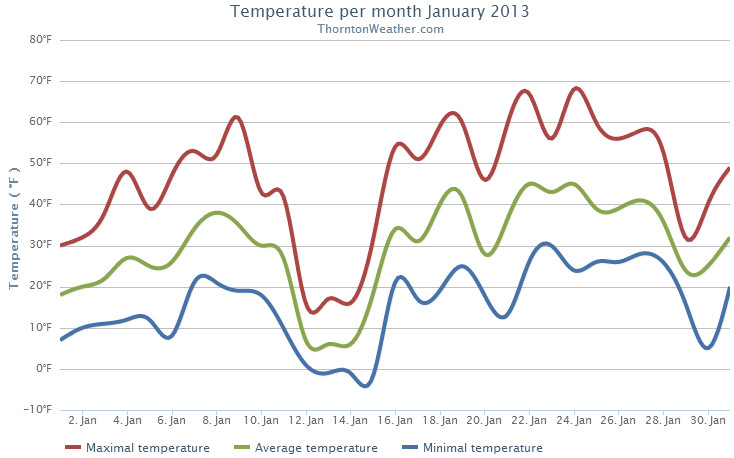
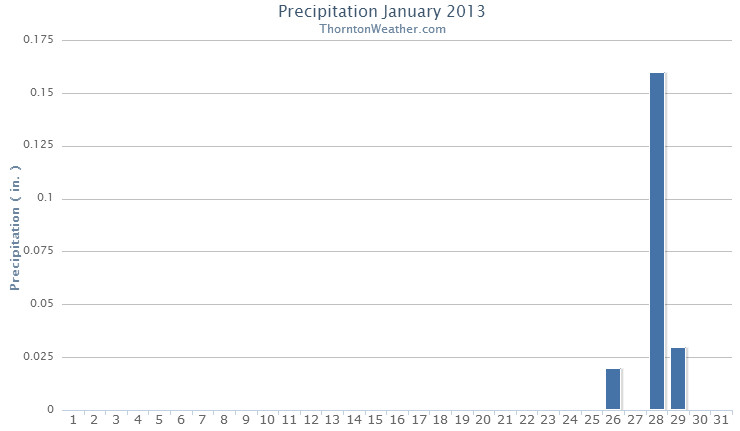
As we begin the new year the winter chill begins to set in. While January can see its share of extremes, the month historically sees stable temperatures and is usually relatively dry.
January ranks as the second coldest month in Denver next to December with average temperatures remaining virtually the same from the start to the end of the month. In terms of snowfall, the month only ranks as the fourth snowiest and it is not uncommon for it to be quite dry.
What does January 2013 hold for us? Indications are that we may very well continue the recent pattern of below normal temperatures and relatively dry conditions.
As the sun sets on 2012 and the new year dawns, we look back on the past 12 months and can see it for what it was: unusually dry and warm. While we were spared monster blizzards or much severe weather, there were still noteworthy weather events.
In terms of temperatures, Denver recorded an overall average of 53.8 degrees as recorded at Denver International Airport. This was 3.4 degrees above average and put 2012 in the history books as the third warmest year in Denver history. Here in Thornton we were, as usual, a bit cooler with an annual average temperature of 52.9 degrees.
The National Weather Service reported 73 days with temperatures at or above 90 degrees which far exceeds the average of 40 such days we normally see annually. Here in Thornton we too saw more than average with 62 days of 90 degree or hotter temperatures.
The late spring and early summer proved to be record setting in terms of heat. The month of June set a record high temperature average and July was the hottest month in Denver history. Two days, June 25th and 26th broke daily high temperature records and tied Denver’s all-time high temperature of 105 degrees.
On the opposite end of the thermometer, Denver officially recorded 132 days with temperatures at or below freezing. Here in Thornton we recorded two more with 134 days. On average the Mile High City records 157 days of freezing temperatures.
While the year was unusually warm, it was also extraordinarily dry. A mere 10.11 inches of precipitation was recorded in Denver’s rain bucket at DIA, 4.19 inches below normal. Here in Thornton we were even drier as we recorded 9.61 inches of precipitation in 2012. While extremely dry, neither measurement was low enough to make the list of top 15 driest years.
Total snowfall for the calendar year ended up at 38.5 inches at DIA and 35.1 inches in Thornton. Both locations fell well short of the Denver annual average snowfall of 53.5 inches. Denver’s snowfall was enough to keep it off the list of top 15 least snowiest years. However Thornton’s measurement would have made it the 13th least snowiest on Denver’s list.
Snowfall started out reasonably strong thanks to a healthy snowfall total in February. However while March is on average our snowiest month, that did not hold true in 2012. A mere 0.03 inch of precipitation was recorded setting the stage for the balance of a dry year.
Combined, June, July and August recorded only 1.81 inches of precipitation at DIA. This was an astonishing 4.02 inches below average for that period. Thornton fared only slightly better over the period with 2.34 inches.
While September brought above normal precipitation, the final three months of 2012 returned us to drier than normal conditions.
Extreme weather events were not particularly common in 2012. There was a distinct lack of heavy snow events and even spring’s severe weather season was relatively tame.
However, the hot summer temperatures and tinder dry conditions did lead to a deadly and destructive wildfire season.
The High Park Fire in June quickly became the second largest wildfire in Colorado history. That blaze was soon followed by the Waldo Canyon Fire west of Colorado Springs which went into the history books as the most destructive blaze in state history.
Thornton, Colorado 2012 Temperature Summary (ThorntonWeather.com)Thornton, Colorado 2012 Precipitation Summary (ThorntonWeather.com)Denver, Colorado 2012 Temperature and Precipitation Summary (National Weather Service)
From the National Weather Service:
CLIMATE REPORT
NATIONAL WEATHER SERVICE BOULDER, CO
130 AM MST TUE JAN 1 2013
...THE DENVER CO CLIMATE SUMMARY FOR THE YEAR OF 2012...
CLIMATE NORMAL PERIOD 1981 TO 2010
CLIMATE RECORD PERIOD 1872 TO 2012
WEATHER OBSERVED NORMAL DEPART LAST YEAR`S
VALUE DATE(S) VALUE FROM VALUE DATE(S)
NORMAL
................................................................
TEMPERATURE (F)
RECORD
HIGH 105 06/26/2012
06/25/2012
07/20/2005
LOW -29 01/09/1875
HIGHEST 105R 06/26 64 41 99 08/25
06/25 07/31
07/04
LOWEST -6 01/11 36 -42 -17 02/02
AVG. MAXIMUM 68.4 64.7 3.7 64.8
AVG. MINIMUM 39.3 36.3 3.0 36.4
MEAN 53.9 50.5 3.4 50.6
DAYS MAX >= 90 73 39.6 33.4 50
DAYS MAX <= 32 19 20.0 -1.0 23
DAYS MIN <= 32 132 156.9 -24.9 158
DAYS MIN <= 0 4 5.8 -1.8 12
PRECIPITATION (INCHES)
RECORD
MAXIMUM 23.31 1196
MINIMUM 7.29 2008
TOTALS 10.11 14.30 -4.19 17.31
DAILY AVG. 0.03 0.04 -0.01 0.05
DAYS >= .01 52 79.7 -27.7 80
DAYS >= .10 23 34.9 -11.9 37
DAYS >= .50 9 7.6 1.4 10
DAYS >= 1.00 1 2.3 -1.3 6
GREATEST
24 HR. TOTAL 1.63 MM 05/11 TO 05/12
10/26 TO 10/26
10/26 TO 10/26
STORM TOTAL MM 2.52
(MM/DD(HH)) MM 05/12(00) TO 05/12(00)
10/26(00) TO 10/26(00)6
SNOWFALL (INCHES)
RECORDS
TOTAL MM 5
24 HR TOTAL MM
SNOW DEPTH MM MM
TOTALS 38.5 53.8 -15.3 46.8
LIQUID EQUIV 3.85 5.40 -1.55 4.68
SINCE 7/1 12.4 22.5 -10.1 29.5
LIQUID 7/1 1.24 2.20 -0.96 2.95
SNOWDEPTH AVG. 0 MM MM 0
DAYS >= TRACE 36 33.3 2.7 41
DAYS >= 1.0 13 16.3 -3.3 16
GREATEST
SNOW DEPTH 11 02/04 7 01/10
01/11
24 HR TOTAL 12.5 MM 10/26 TO 10/26
10/26 TO 10/26
10/26 TO 10/26
STORM TOTAL MM 8.5
(MM/DD(HH)) MM 10/26(00) TO 10/26(00)
10/26(00) TO 10/26(00)6
DEGREE_DAYS
HEATING TOTAL 5198 6059 -861 6069
SINCE 7/1 MM 2468 MM MM
COOLING TOTAL 1236 0 1236 964
SINCE 1/1 1236 769 467 964
FREEZE DATES
RECORD
EARLIEST 09/08/1962
LATEST 06/08/2007
EARLIEST 10/07
LATEST 05/05
.......................................................
WIND (MPH)
AVERAGE WIND SPEED 10.3
RESULTANT WIND SPEED/DIRECTION 3/205
HIGHEST WIND SPEED/DIRECTION 52/240 DATE 06/02
HIGHEST GUST SPEED/DIRECTION 67/250 DATE 06/02
SKY COVER
POSSIBLE SUNSHINE (PERCENT) MM
AVERAGE SKY COVER 0.50
NUMBER OF DAYS FAIR 86
NUMBER OF DAYS PC 235
NUMBER OF DAYS CLOUDY 45
AVERAGE RH (PERCENT) 44
WEATHER CONDITIONS. NUMBER OF DAYS WITH
THUNDERSTORM 0 MIXED PRECIP 0
HEAVY RAIN 4 RAIN 12
LIGHT RAIN 45 FREEZING RAIN 0
LT FREEZING RAIN 1 HAIL 3
HEAVY SNOW 4 SNOW 15
LIGHT SNOW 37 SLEET 0
FOG 73 FOG W/VIS <= 1/4 MILE 21
HAZE 51
- INDICATES NEGATIVE NUMBERS.
R INDICATES RECORD WAS SET OR TIED.
MM INDICATES DATA IS MISSING.
T INDICATES TRACE AMOUNT.
For many the holiday season isn’t complete without a chill in the air and snow on the ground. Here in Denver we historically enjoy a better chance of experiencing the proverbial white Christmas than many places in the nation.
How the Mile High City fares in experiencing a white Christmas does depend on your definition of one. If it means having actual snowfall on Christmas Day the chances aren’t that good. However if simply having snow on the ground suffices, the chances improve considerably.
With the first full month of fall here, October usually brings one of the quietest weather months in the Denver area with plenty of mild, sunny days and clear, cool nights.
October is historically the second sunniest month and conditions are generally calm. However we also will usually see our first taste of winter during the month with the first freeze and first snowfall of the season. Temperatures as well will start to drop and by the end of the month the average nighttime lows are below freezing.
The World Meteorological Organization (WMO) announced today that the record holder for the hottest temperature ever recorded on the planet had been changed. A record dating back to 1922 in El Azizia, Libya was deemed invalid and thus the honor now falls on a temperature recorded in Death Valley, California in 1913. Read the rest of this story on Examiner.com and find out why the ‘honor’ was taken away from Libya.
The World Meteorological Organization (WMO) has given the world's highest temperature record to a reading taken in 1913 in Death Valley, California. Click the image to find out why.
Denver's August 2012 will go into the books as the 5th hottest and 4th driest August since 1872.
There would be no break from the hot and dry summer of 2012 in August as records continued to tumble and the ground remained parched. While a few cold fronts provided some relief, they were short-lived and high pressure dominated during the month.
Denver recorded an average temperature of 75.0 degrees which was 2.5 degrees above normal. This ties August 1994 as the 5th warmest August since record keeping began in 1872.
In all, 20 days recorded high temperatures at or above 90 degrees at Denver International Airport. By the end of the month 2012 moved into the record books as having the most seasonal 90 degree days of any year (66 as of 8/31). Highs ranged from 98 degrees on the 3rd, 6th, 9th, and 27th to a low of 47 degrees on the 17th.
Here in Thornton our average temperature was quite a bit cooler, although still above average in comparison to recent years. Thornton’s average for the month came in at 72.7 degrees.
Thornton recorded 17 days of 90 degree or hotter high temperatures. Our hottest temperature was 96 degrees which occurred on the 27th and 29th. The coldest temperature recorded was 48 degrees on the 17th and 19th.
Precipitation continued to elude the Mile High City as a mere 0.11 inch fell into the rain bucket during the month, and that all came in a single day. This was far below the normal of 1.68 inches for August and put 2012 into the books as the 4th driest August on record.
Thornton fared only slightly better on the precipitation front as we recorded 0.31 inch of rain. As with Denver, that total came all in a single day, the 1st of the month.
...THE DENVER CO CLIMATE SUMMARY FOR THE MONTH OF AUGUST 2012...
CLIMATE NORMAL PERIOD 1981 TO 2010
CLIMATE RECORD PERIOD 1872 TO 2012
WEATHER OBSERVED NORMAL DEPART LAST YEAR`S
VALUE DATE(S) VALUE FROM VALUE DATE(S)
NORMAL
................................................................
TEMPERATURE (F)
RECORD
HIGH 105 08/08/1878
LOW 40 08/26/1910
08/25/1910
08/24/1910
HIGHEST 98 08/27 87 11 99 08/25
08/03
08/06
08/09
LOWEST 47 08/17 40 7 55 08/20
AVG. MAXIMUM 91.0 87.2 3.8 92.7
AVG. MINIMUM 58.9 57.9 1.0 61.3
MEAN 75.0 72.5 2.5 77.0
DAYS MAX >= 90 20 11.5 8.5 22
DAYS MAX = .01 1 8.6 -7.6 3
DAYS >= .10 1 4.3 -3.3 1
DAYS >= .50 0 1.2 -1.2 0
DAYS >= 1.00 0 0.3 -0.3 0
GREATEST
24 HR. TOTAL 0.11 08/11 TO 08/11 08/03 TO 08/03
SNOWFALL (INCHES)
RECORDS
TOTAL 0.0 NO SNOW EVER RECORDED IN AUGUST
TOTALS 0.0 NO SNOW EVER RECORDED IN AUGUST
DEGREE_DAYS
HEATING TOTAL 0 10 -10 0
SINCE 7/1 0 16 -16 0
COOLING TOTAL 319 244 75 382
SINCE 1/1 1122 688 434 863
FREEZE DATES
RECORD
EARLIEST 09/08/1962
LATEST 06/08/2007
EARLIEST 10/07
LATEST 05/05
..................................................
WIND (MPH)
AVERAGE WIND SPEED 9.9
RESULTANT WIND SPEED/DIRECTION 3/217
HIGHEST WIND SPEED/DIRECTION 38/330 DATE 08/30
HIGHEST GUST SPEED/DIRECTION 45/330 DATE 08/30
SKY COVER
POSSIBLE SUNSHINE (PERCENT) MM
AVERAGE SKY COVER 0.50
NUMBER OF DAYS FAIR 8
NUMBER OF DAYS PC 22
NUMBER OF DAYS CLOUDY 1
AVERAGE RH (PERCENT) 34
WEATHER CONDITIONS. NUMBER OF DAYS WITH
THUNDERSTORM 4 MIXED PRECIP 0
HEAVY RAIN 0 RAIN 0
LIGHT RAIN 9 FREEZING RAIN 0
LT FREEZING RAIN 0 HAIL 0
HEAVY SNOW 0 SNOW 0
LIGHT SNOW 0 SLEET 0
FOG 0 FOG W/VIS
Sweltering, unseasonably warm temperatures gripped much of the contiguous United States last month breaking many records. In the final analysis of the month, NOAA announced that July was the hottest month ever recorded in the U.S. How hot was it? Read the rest of this story on Examiner.com
Much of the Lower 48 states saw above average temperatures during July 2012. Click the image to view the story and slideshow. (NOAA)
The National Oceanic and Atmospheric Administration (NOAA) released its climate summary for June 2012 showing the United States experienced an unusually warm month. Most notably the U.S. has recorded its warmest first half of the year on record and the warmest 12 month period on record. Climate change? Learn more about the warm weather across the nation on Examiner.com.
Denver set a high temperature record of 94° on Tuesday, June 4.
As officially measured at Denver International Airport, the Mile High City hit a high temperature of 94° at 2:25pm. This broke the old record high temperature for the date of 93° set in 2010, 1990 and 1977.
The problem? No other reliable station in the metro area came anywhere near that high of a temperature reading.
For comparison, Rocky Mountain Regional Airport saw 91°, Centennial 88°, Boulder 91°, Denver City Park 90°, Stapleton 90° and here in Thornton we recorded 91°.
December ranks as Denver's coldest and third snowiest month.
As with any month in the Denver area, December can bring a variety of conditions. Certainly we have seen bitter cold and heavy snow but in other years dry and mild conditions prevailed.
Based on the updated 1981 to 2010 averages from the National Weather Service, the month is actually our coldest of the year. It also is our third snowiest behind March and November.
Winter weather is typically what we think of when we think about December and it is indeed prone to winter extremes.
In fact, our coldest month in Denver history was in December 1983. In terms of snow, our snowiest month ever occurred in December 1913. More recently the Christmas Eve Blizzard of 1982 and the storms on December 2006 invoke snow-filled memories.
Remember, when the snow starts flying, stay up to date with ThorntonWeather.com: ‘Like’ us on Facebook, follow us on Twitter and add us to your Google+ circles
Weather, natural disasters & climate news and information.