While they are viewed by the public these days as routine, there can hardly be a more dangerous – or thrilling – task for an astronaut to perform than a spacewalk. The imagery captured by these modern day explorers is nothing short of amazing as seen in a photo of NASA astronaut Sunita Williams seemingly touching the sun during a spacewalk last week.
During an extravehicular activity (EVA) aboard the International Space Station, Williams and Japan Aerospace Exploration Agency astronaut Aki Hoshide performed much-needed maintenance and repairs to the orbiting platform. During the six-hour, 28-minute spacewalk Hoshide captured an image of Williams appearing to reach for the sun at one point during the EVA.
NASA astronaut Sunita Williams, Expedition 32 flight engineer, appears to touch the bright sun during the mission’s third session of extravehicular activity (EVA) on Sept. 5, 2012. (NASA) Click the image for a larger view.
NASA's Curiosity rover and its parachute were spotted by NASA's Mars Reconnaissance Orbiter as Curiosity descended to the surface on Aug. 5 PDT (Aug. 6 EDT). Image Credit: NASA/JPL-Caltech/Univ. of Arizona
Landing on Mars has proven over the years to be an extremely difficult task with few space probes seeing success. NASA’s Curiosity rover beat the odds completing its 352 million mile journey with a perfect landing early Monday morning.
The probe was launched on November 26 and as it neared its touchdown on the Red Planet, NASA had been discussing the “7 minutes of terror” involved in inserting the probe into the Martian atmosphere and successfully landing. The craft used an amazing array of equipment to land including a sky crane and a supersonic parachute.
The image above was taken by the Mars Reconnaissance Orbiter in a perfectly choreographed event designed to capture just an image. The photo shows Curiosity dangling under its massive parachute as it descends to the surface.
NASA’s Curiosity rover and its parachute were spotted by NASA’s Mars Reconnaissance Orbiter as Curiosity descended to the surface on Aug. 5 PDT (Aug. 6 EDT). The High-Resolution Imaging Science Experiment (HiRISE) camera captured this image of Curiosity while the orbiter was listening to transmissions from the rover. Curiosity and its parachute are in the center of the white box; the inset image is a cutout of the rover stretched to avoid saturation. The rover is descending toward the etched plains just north of the sand dunes that fringe “Mt. Sharp.” From the perspective of the orbiter, the parachute and Curiosity are flying at an angle relative to the surface, so the landing site does not appear directly below the rover.
The parachute appears fully inflated and performing perfectly. Details in the parachute, such as the band gap at the edges and the central hole, are clearly seen. The cords connecting the parachute to the back shell cannot be seen, although they were seen in the image of NASA’s Phoenix lander descending, perhaps due to the difference in lighting angles. The bright spot on the back shell containing Curiosity might be a specular reflection off of a shiny area. Curiosity was released from the back shell sometime after this image was acquired.
This view is one product from an observation made by HiRISE targeted to the expected location of Curiosity about one minute prior to landing. It was captured in HiRISE CCD RED1, near the eastern edge of the swath width (there is a RED0 at the very edge). This means that the rover was a bit further east or downrange than predicted.
The image scale is 13.2 inches (33.6 centimeters) per pixel .
HiRISE is one of six instruments on NASA’s Mars Reconnaissance Orbiter. The University of Arizona, Tucson, operates the orbiter’s HiRISE camera, which was built by Ball Aerospace & Technologies Corp., Boulder, Colo. NASA’s Jet Propulsion Laboratory, a division of the California Institute of Technology in Pasadena, manages the Mars Reconnaissance Orbiter Project for NASA’s Science Mission Directorate, Washington. Lockheed Martin Space Systems, Denver, built the spacecraft.
A large solar flare on Thursday was expected to lead to heightened aurora activity this weekend but not as far south as Colorado. One Thornton resident however appears to have captured images of the northern lights Sunday morning.
The images by Justin Whitesel show a purple sky over the city as the geomagnetic storm hits the Earth. You can view an animation Whitesel put together here.
An X1.4 flare was observed on the sun by NASA's SDO on Thursday, July 12, 2012.
The coronal mass ejection (CME) that resulted from the solar flare on Thursday has begun hitting the Earth. Satellite and terrestrial stations began picking up the increase in geomagnetic activity at around 1:00pm MDT Saturday.
The solar flare was a significant one as is the CME however it is not expected to be powerful enough to have any ill effects on earth. More significant events can affect satellites and even bring down power grids.
Here on Earth the most notable effect will be an increase in aurora activity. Unfortunately it doesn’t appear the CME is strong enough to push the aurora down to Colorado but areas across the northern latitudes of the contiguous United States may be treated to a show.
NASA depiction of a solar flare and the resultant coronal mass ejection (CME) hitting the Earth. (NASA)
A very large solar flare erupted on the Sun yesterday and the Coronal Mass Ejection (CME) is speeding toward the Earth right now. It is expected to arrive early Saturday morning (4:30am MDT + / – 7 hours) and if you can get away from the city lights, even northern Colorado has a chance to see the heightened aurorae. Here is some good background info on solar flares and CMEs from NASA.
Space weather starts at the Sun. It begins with an eruption such as a huge burst of light and radiation called a solar flare or a gigantic cloud of solar material called a coronal mass ejection (CME). But the effects of those eruptions happen at Earth, or at least near-Earth space. Scientists monitor several kinds of space “weather” events — geomagnetic storms, solar radiation storms, and radio blackouts – all caused by these immense explosions on the Sun.
One of the most common forms of space weather, a geomagnetic storm refers to any time Earth’s magnetic environment, the magnetosphere, undergoes sudden and repeated change. This is a time when magnetic fields continually re-align and energy dances quickly from one area to another.
Geomagnetic storms occur when certain types of CMEs connect up with the outside of the magnetosphere for an extended period of time. The solar material in a CME travels with its own set of magnetic fields. If the fields point northward, they align with the magnetosphere’s own fields and the energy and particles simply slide around Earth, causing little change. But if the magnetic fields point southward, in the opposite direction of Earth’s fields, the effects can be dramatic. The sun’s magnetic fields peel back the outermost layers of Earth’s fields changing the whole shape of the magnetosphere. This is the initial phase of a geomagnetic storm.
The next phase, the main phase, can last hours to days, as charged particles sweeping into the magnetosphere accumulate more energy and more speed. These particles penetrate closer and closer to the planet. During this phase viewers on Earth may see bright aurora at lower latitudes than usual. The increase – and lower altitude – of radiation can also damage satellites traveling around Earth.
The final stage of a geomagnetic storm lasts a few days as the magnetosphere returns to its original state.
Geomagnetic storms do not always require a CME. Mild storms can also be caused by something called a corotating interaction region (CIR). These intense magnetic regions form when high-speed solar winds overtake slower ones, thus creating complicated patterns of fluctuating magnetic fields. These, too, can interact with the edges of Earth’s magnetosphere and create weak to moderate geomagnetic storms.
Geomagnetic storms are measured by ground-based instruments that observe how much the horizontal component of Earth’s magnetic field varies. Based on this measurement, the storms are categorized from G1 (minor) to G5 (extreme). In the most extreme cases transformers in power grids may be damaged, spacecraft operation and satellite tracking can be hindered, high frequency radio propagation and satellite navigation systems can be blocked, and auroras may appear much further south than normal.
Solar Radiation Storms
A solar radiation storm, which is also sometimes called a solar energetic particle (SEP) event, is much what it sounds like: an intense inflow of radiation from the sun. Both CME’s and solar flares can carry such radiation, made up of protons and other charged particles. The radiation is blocked by the magnetosphere and atmosphere, so cannot reach humans on Earth. Such a storm could, however, harm humans traveling from Earth to the moon or Mars, though it has little to no effect on airplane passengers or astronauts within Earth’s magnetosphere. Solar radiation storms can also disturb the regions through which high frequency radio communications travel. Therefore, during a solar radiation storm, airplanes traveling routes near the poles – which cannot use GPS, but rely exclusively on radio communications – may be re-routed.
Solar radiation storms are rated on a scale from S1 (minor) to S5 (extreme), determined by how many very energetic, fast solar particles move through a given space in the atmosphere. At their most extreme, solar radiation storms can cause complete high frequency radio blackouts, damage to electronics, memory and imaging systems on satellites, and radiation poisoning to astronauts outside of Earth’s magnetosphere.
Radio Blackouts
Radio blackouts occur when the strong, sudden burst of x-rays from a solar flare hits Earth’s atmosphere, jamming both high and low frequency radio signals. The X-rays disturb a layer of Earth’s atmosphere known as the ionosphere, through which radio waves travel. The constant changes in the ionosphere change the paths of the radio waves as they move, thus degrading the information they carry. This affects both high and low frequency radio waves alike. The loss of low frequency radio communication causes GPS measurements to be off by feet to miles, and can also affect the applications that govern satellite positioning.
Radio blackouts are rated on a scale from R1 (minor) to R5 (extreme). The strongest radio blackouts can result in no radio communication and faulty GPS for hours at a time.
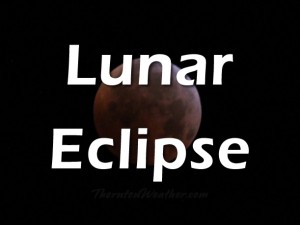
The lunar eclipse gets started in Colorado as the Earth's shadow starts to cover the moon. View more images in the slideshow below. (ThorntonWeather.com)
It was a very cold morning in Thornton as the temperature dropped to 15° but the fog that was forecast never materialized and we had a great view of the lunar eclipse. Just before dawn the Earth’s shadow began to encroach on the moon and just as the eclipse was peaking, the moon set behind the Rocky Mountains.
View images of the lunar eclipse as seen from Barr Lake State Park below
Fog in Denver was feared to be a threat for viewing this morning’s total lunar eclipse but Mother Nature cooperated and provided clear Colorado skies. Not long before dawn the celestial show began and those who were able to witness it saw something that we won’t have an opportunity to see again until 2014.
NASA had called the lunar eclipse a ‘super-sized’ event due to its low placement on the horizon which tricks the mind and eye to thinking the moon is larger than it normally is. With our only natural satellite setting in the west, Coloradoans were able to view the eclipse just as the moon set behind the Rocky Mountains.
The total lunar eclipse was visible across a large swath of the Earth. From east of the Rocky Mountains to Australia and to Asia, nearly half of the globe had a view of the event.
Heightening interest in the eclipse was the fact that it will be the last total lunar eclipse for nearly three years. The next one won’t occur until April 14, 2014. There will be a second one that year on October 8th. In 2015 there will also be two; one on April 4th and another on September 27th.
Stay up to date with ThorntonWeather.com: ‘Like’ us on Facebook, follow us on Twitter and add us to your Google+ circles
The last lunar eclipse until 2014 will be visible along the Colorado Front Range early Saturday morning. (ThorntonWeather.com)
If you can get yourself out of bed early in the morning on Saturday, December 10, 2011 you will be treated to the last total lunar eclipse for nearly three years. For viewers in Thornton and along the Colorado Front Range, the event will be relatively quick but punctuated by a setting moon with the Rocky Mountains in the foreground.
Saturday morning the moon will be passing through the lower half of the Earth’s shadow just before it sets in the west at 7:12am MST Saturday. The low hanging moon will appear much larger than normal bringing what NASA calls a ‘super-sized’ eclipse.
Because the moon will be low on the western horizon, finding a good spot to watch it will be critical. In Thornton, visitors to our Facebook page have suggested near the Thornton Civic Center, Brittany Hill or near the water towers at 112th Ave and I-25. Some higher locations along Colorado Blvd north of 136th Ave might be good places as well.
The December 10th eclipse will begin around 5:46am MST as the first part of Earth’s shadow encroaches on the moon. Totality will be achieved at 7:06am MST.
For watchers along the Colorado Front Range, the low moon with the Rocky Mountains to the west will render some extraordinary images. There is however a catch.
The tall mountains on our western horizon are going to limit the time we are able to see the moon and the eclipse. In the Denver area, we won’t actually be able to see the total eclipse as the moon will have disappeared behind the mountains by then.
It is estimated metro area residents will be able to watch the show until about 6:50am at which point the moon will be below the horizon. Clear skies are in the forecast so clouds should not be a concern.
Stay up to date with ThorntonWeather.com: ‘Like’ us on Facebook, follow us on Twitter and add us to your Google+ circles
NASA says that astronomers and psychologists don’t know why the human brain sees the moon as larger when it is low on the horizon. “In fact, a low Moon is no wider than any other Moon (cameras prove it) but the human brain insists otherwise. To observers in the western USA, therefore, the eclipse will appear super-sized,” NASA said.
The celestial show should be worth getting out of bed a bit early to see, even if residents of Colorado won’t get to see the entire show.
Atmospheric scientist Richard Keen of the University of Colorado told NASA, “I expect this eclipse to be bright orange, or even copper-colored, with a possible hint of turquoise at the edge.”
Keen explains that the Earth’s stratosphere is currently relatively free of volcanic dust and other particulates. This should allow for a very bright event.
Tomorrow’s eclipse will be the last total lunar eclipse until April 14, 2014. A second will occur that year on October 8th. In 2015 there will also be two; one on April 4th and another on September 27th.
Screen capture from a time lapse video of images from the International Space Station. Watch the video below. (NASA)
Speeding above the Earth at 17,000 miles per hour and an altitude of 250 miles, astronauts aboard the International Space Station have arguably one of the best views of our planet. A German videographer has compiled many images taken by the orbiting outpost into an extraordinary video.
Scroll down to watch this amazing video
Among the highlights of the video are views of the aurora borealis over the United States, the aurora australis on the other side of the globe near Australia, as well as various nighttime and daytime views of other continents. One pass covers the United States from southern California to the Hudson Bay and overflies Colorado and the Mile High City in the blink of an eye.
Shooting locations in order of appearance:
1. Aurora Borealis Pass over the United States at Night
2. Aurora Borealis and eastern United States at Night
3. Aurora Australis from Madagascar to southwest of Australia
4. Aurora Australis south of Australia
5. Northwest coast of United States to Central South America at Night
6. Aurora Australis from the Southern to the Northern Pacific Ocean
7. Halfway around the World
8. Night Pass over Central Africa and the Middle East
9. Evening Pass over the Sahara Desert and the Middle East
10. Pass over Canada and Central United States at Night
11. Pass over Southern California to Hudson Bay
12. Islands in the Philippine Sea at Night
13. Pass over Eastern Asia to Philippine Sea and Guam
14. Views of the Mideast at Night
15. Night Pass over Mediterranean Sea
16. Aurora Borealis and the United States at Night
17. Aurora Australis over Indian Ocean
18. Eastern Europe to Southeastern Asia at Night
From their perch 250 miles above the Earth, astronauts aboard the International Space Station (ISS) capture some amazing imagery. The latest from them is of a Progress supply craft as it burns up in the atmosphere upon reentry.
NASA explains:
Have you ever wondered how the astronauts and cosmonauts onboard the International Space Station (ISS) take out the trash? Several times a year, robotic spacecraft carrying a variety of items—including food, water, fuel, oxygen, medical supplies, replacement parts, and research materials—are launched from Earth to dock with the ISS. These spacecraft are built and launched by ISS international partners in Russia,Japan, and the Europe. After the cargo has been transferred to the ISS, the spacecraft is refilled with refuse, and then undocked and de-orbited—essentially using the Earth’s atmosphere as an incinerator for both the spent spacecraft and the refuse.
This astronaut photograph highlights the reentry plasma trail of one such spacecraft, the ISS Progress 42P supply vehicle (Russian designation M-10M). The Progress is based on the Soyuz design, and can fly autonomously or under remote control from the space station. Progress 42P docked at the ISS on April 29, 2011, and was undocked and de-orbited on October 29, 2011. Astronauts on the ISS took a time-lapse sequence of the event; the image above is part of that sequence.
The ISS was located over the southern Pacific Ocean when this image was taken. Light from the rising sun illuminates the curvature of the Earth limb (horizon line) at image top, but does not completely overwhelm the airglow visible at image top left. Airglow is the emission of light by atoms and molecules in the upper atmosphere when they are excited by ultraviolet radiation.
Image of the Progress 42P as it burns up in the atmosphere on October 29, 2011. (NASA)
City lights and thunderstorms are seen in this screen capture taken from an video - watch it below. (YouTube / yesterday2221)
There is no doubt the views from space are awe-inspiring as we have seen many times. A new video pieced together from imagery taken aboard the International Space Station shows amazing imagery of the planet as the station passes above.
The description doesn’t do the video justice but provides highlights of what can be seen:
A time-lapse taken from the front of the International Space Station as it orbits our planet at night. This movie begins over the Pacific Ocean and continues over North and South America before entering daylight near Antarctica. Visible cities, countries and landmarks include (in order) Vancouver Island, Victoria, Vancouver, Seattle, Portland, San Francisco, Los Angeles. Phoenix. Multiple cities in Texas, New Mexico and Mexico. Mexico City, the Gulf of Mexico, the Yucatan Peninsula, El Salvador, Lightning in the Pacific Ocean, Guatemala, Panama, Columbia, Ecuador, Peru, Chile, Lake Titicaca, and the Amazon. Also visible is the earths ionosphere (thin yellow line), a satellite (55sec) and the stars of our galaxy.
Watch the video:
Weather, natural disasters & climate news and information.