All posts by Thornton Weather

ThorntonWeather.com is your local source for live Thornton, Colorado weather conditions and news!

September 27 to October 3 – This week in Denver weather history

September 27 to October 3 - This week in Denver weather history

With the end of summer and the arrival of fall, looking back at Denver weather history we start to see more mentions of snow.  It is of course not the only notable weather event this time of year.  We still have received severe thunderstorms, damaging winds, and 90 degree plus heat.

From the National Weather Service:

From the 25th to the 27th:

in 1996…an early season snowstorm brought heavy snow to the Front Range eastern foothills.  Snowfall totals included:  8 to 12 inches around Conifer…7 inches on Floyd Hill…and 6 inches at both bailey and Chief Hosa. Snowfall totaled only 4.7 inches at the site of the former Stapleton International Airport.  This was the first measurable snow of the season.  After the passage of a strong cold front…north winds gusted to 38 mph at Denver International Airport on the 25th.

From the 26th to the 28th: 

In 1936…the heaviest snowfall ever recorded in September and the heaviest snowfall ever recorded so early in the season dumped a total of 16.5 inches of snow on downtown Denver and 21.3 inches at Denver municipal airport.  The 15.0 inches of snow measured from 6:00 pm on the 27th to 6:00 pm on the 28th is the greatest 24 hour snowfall ever recorded in September.  This was the first snow of the season.  The snow was intermittent through the 26th…but continuous from early afternoon on the 27th to around midnight on the 28th…except for a period of rain during the afternoon of the 28th which contributed to a loss of depth on the ground.  The greatest snow depth on the ground downtown was 13 inches with 8 inches at Denver municipal airport.  There were no high winds with the storm and traffic was interrupted for only a short period.  The storm produced property damage estimated at 7 million dollars.  With trees and shrubs in full foliage…the leaves caught and held the heavy water-laden snow…until the branches snapped from the weight.  More than 3000 workmen were called to remove the debris and snow from the city.  The city firemen who were off duty…as well as all the reserves… Were asked to report to their stations.  All schools in the city remained open…but attendance was only 50 percent of normal.  Grade school students were sent home at noon on the 28th.  The early storm caught stockmen with many cattle still in higher ranges.  Warm weather followed the snow…which had all melted by the end of the month…except for a few inches in sheltered places.

On the 27th:

In 1877…smoke from heavy forest fires in the mountains spread over the city on upper wind currents.
 
In 1935…the first snow of the season was 2.8 inches in downtown Denver.  The low temperature dipped to 31 degrees for the first freeze of the season.

Continue reading September 27 to October 3 – This week in Denver weather history
Summer 2009 in review – The summer of storms

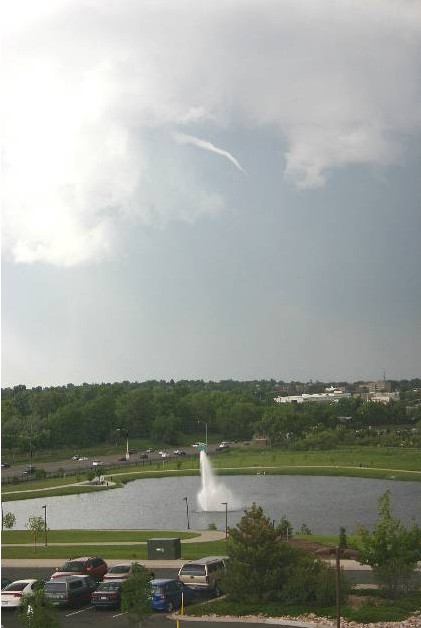
This funnel cloud was seen from the Thornton Civic Center (looking north) on June 10th.  Image courtesy Lisa Wilson, the City of Thornton.
This funnel cloud was seen from the Thornton Civic Center (looking north) on June 10th. Image courtesy Lisa Wilson, the City of Thornton.

As summer 2009 comes to a close, it is perhaps most fitting that fall arrives with nearly winter-like weather. We ushered in the summer a month early with a record setting high temperature and soon followed that up with a near constant stream of severe weather for weeks. In fact, most of the events during what was a very active summer season actually occurred in the weeks leading up to the official start of summer.

Even though the official start of summer was a month away, May 19th seemed to be an unofficial start as the mercury climbed to 90 degrees that day setting a new record for the date. The very next day in perhaps what was a sign of things to come, a tornado touched down in Mesa County – only the ninth to strike in that county since 1950.

On May 24th, the first of many severe weather days arrived bringing rain totals of more than an inch to some areas of the Front Range and a funnel cloud over Aurora. As the afternoon progressed the severe weather continued and three tornadoes had been reported in the metro area.

After a couple weeks of relative calm, the severe weather once again appeared and on June 7th funnel clouds and tornadoes seemed to be appearing everywhere. From the north metro area in Broomfield to Aurora, most of the Front Range had some sort of direct severe weather threat. Most notably,the Southlands Shopping Center was struck by an EF1 tornado where extensive damage to the mall occurred.

There's more to this story on the Denver Weather Examiner's site!All of that was only a start to what was a very eventful summer for Thornton and Denver!  Read the rest of this story on Examiner.com!

Flooding in southeastern U.S. claims eight lives

A washed out bridge is shown Monday, Sept. 21, 2009 in Douglasville, Ga. Heavy rain caused flooding in and around the Atlanta area. (AP Photo/John Bazemore)

The governor of Georgia issued a state of emergency on Tuesday morning as the death toll from flooding in the area continued to climb. Some areas near Atlanta reported up to 20 inches of rain in recent days as creeks and rivers ran over their banks flooding entire communities and even sending the Six Flags Over Georgia amusement park under water (see slideshow on Examiner.com).

Adding to the tally of lives lost was a 15-year-old boy whose body was found in the Chattooga River Tuesday morning. In a heart wrenching story, in Carroll County, Georgia a 2-year-old boy perished when he was ripped from his father’s arms as the father struggled against floodwaters.

There is much more to this story on Examiner.com.  Get all the details on the tremendous flooding and view photos and video.
There's more to this story on the Denver Weather Examiner's site!

September 20 to September 26 – This week in Denver weather history

September 20 to September 26 - This week in Denver weather history

Looking back at this week in Denver history we start to see more of the signs that summer is coming to an end and fall and winter are right around the corner.  Summer-like severe weather can still occur but we also start to see more cold temperatures and occasions with snow become more prevelant.

From the National Weather Service:

20   

In 1921…an apparent Bora produced northwest winds sustained to 44 mph with gusts to 64 mph.
 
In 1955…hail stones 1/2 to 3/4 inch in diameter were reported across parts of the city of Denver.
 
In 1992…weather observers at Buckley Air National Guard base sighted two tornados southeast of the base.  The tornados were short-lived and caused no injuries or damage.

20-21

In 1963…heavy rain and hail caused local flooding in southeast Denver.  Thunderstorm rainfall was only 0.60 inch at Stapleton Airport on the 20th.
 
In 1983…the cold front on the 19th brought an unusually cold air mass into metro Denver for so early in the season.  The temperature dipped to a daily record minimum of 28 degrees on both days.
 
In 1995…a vigorous late summer storm brought the season’s first heavy snow to portions of metro Denver.  Millions of trees were damaged and power lines downed as 4 to 8 inches of heavy wet snow settled on fully leafed trees in the Boulder and Denver areas.  Branches snapped and trees split under the weight of heavy snow…downing power lines. Firefighters responded to numerous transformer fires. Around 100 thousand people were left without electricity in Boulder and Denver areas alone.  It took over a week to fully restore power to some areas.  Insurance claims were estimated to be around 6 million dollars to homes in metro Denver and about 500 thousand dollars in damage to automobiles.  It was estimated that about 80 percent of 125 million dollars worth of city owned trees in Denver were damaged.  Snowfall totaled 7.4 inches at the site of the former Stapleton International Airport where the greatest depth of snow on the ground was only 4 inches due to melting.  Temperature records were set on the 21st when the thermometer dipped to a record low reading of 27 degrees and climbed to a high of only 36 degrees… Setting a record low maximum for the date.  North winds gusted to 29 mph at Denver International Airport on the 20th.

Continue reading September 20 to September 26 – This week in Denver weather history

National Weather Service weather balloon zaps Thornton boy

Hundreds of weather balloons like this are released daily by the National Weather Service. (NOAA)

A 12-year-old boy reportedly received a bit of a shock when he touched a National Weather Service balloon that had landed near Niver Creek Middle School in Thornton. The balloons which are launched twice daily from the old Stapleton International Airport facility and other locations across the nation are essential instruments for forecasters.

The boy complained of numbness in his hands after touching it and school officials called the fire department as they were unsure what the device was. Upon closer inspection they read the labels that said the unit belonged to the National Weather Service and was a weather instrument. The boy was transported to a hospital as a precaution and his father told Channel 7 Wednesday morning that he was fine.

Weather balloons are launched daily from 102 locations across the United States, Caribbean and Pacific and are essential forecasting instruments (see below for a map of sites in the contiguous United States). The six foot diameter balloons are launched twice daily and simultaneously at all the sites at midnight UTC and noon UTC (5:00am MDT and 5:00pm MDT). Once launched, the units can attain an altitude of 115,000 feet and travel up to 200 miles before they burst and fall harmlessly to the ground.

Called a radiosonde, the balloon’s payload measures air pressure, temperature, humidity, wind direction and wind speed. The data is transmitted in real time to receivers on the ground which is then fed into National Weather Service computers and monitored by forecasters. Information obtained by the units is essential for forecasters to evaluate and predict atmospheric conditions for forecasting, severe weather alerting and more.

For more details on what these instruments are used for, read the full story on Examiner.com.

There's more to this story on the Denver Weather Examiner's site!

1,900 mile wide thunderstorm strikes Saturn

A massive thunderstorm 1,900 miles wide lasting more than 9 months is occuring on Saturn.

A thunderstorm that would encompass an area from San Francisco to the Mississippi River was recorded on Saturn. The storm, recorded by NASA’s Cassini spacecraft, has lasted an amazing 9 months so far and became a record setter for the longest lightning storm recorded in the solar system. The previous longest storm duration was 7 ½ months, also set on Saturn, between November 2007 and July 2008.

Scientists speaking at the European Planetary Science Congress (EPSC) said instruments onboard Cassini recorded the storms that are 10,000 times more powerful than lightning storms on Earth. This record breaking storm is the ninth that the spacecraft has recorded on Saturn since it arrived at the planet in July 2004.

Saturn is well known for its severe thunderstorms that usually occur in an area scientists have dubbed ‘Storm Alley’ – something akin to Tornado Alley in the central United States although much bigger in area and the storms are much more powerful. The area on Saturn lies 35 degrees south of Saturn’s equator and scientists aren’t entirely sure why this area is a hot bed for activity.

There's more to this story on the Denver Weather Examiner's site!For more details on this amazing storm and other interesting weather on Saturn, read the full storm on Examiner.com.

Updated weather links is your directory for everything weather

A funnel cloud near Thornton on Sunday, June 7, 2009. Knowing where to get information on developing weather could save your life. Image courtesy John Wagner, Warrior Legacy Foundation.

We recently updated our weather links page (available from the menu at the left) with dozens more links to a wide array of weather related website.  From sites that provide statistical information and historical data to ones where you can become your own weather forecaster, we have it all.

Certainly weather is one of the things that every single person on the globe has in common. It can impact almost every aspect of our daily lives in a myriad of ways. It can make or break that outdoor event, determine whether or not the kids have school today and most notably it can change lives in an instant when it turns severe.

Knowing where to find information about weather can help to educate, inform and possibly save lives – possibly even your own. We have accumulated this extensive list of Internet resources devoted to weather topics on everything from climatology to tropical weather and winter weather.

When you have a chance, check it out here.

NOAA: Summer 2009 was 34th coolest on record; thousands of low temp records set

Highlighting the cooler summer, thousands of record low temperatures were experienced in July 2009. (NCDC)

The National Oceanic and Atmospheric Administration (NOAA) announced this week that the summer of 2009 was the 34th coolest since 1895. Covering the months from June to August for the contiguous United States, the average temperature was 0.4 degrees below the 20th century average.

Emphasizing the lower temperatures experienced in the United States over the summer, a closer look at the statistics provides some telling information.

Over the three month period, stations reporting to the National Climatic Data Center (NCDC) showed 2,254 daily record low temperatures and 1,296 low temperature records were tied according to preliminary data. Similarly, 4,051 daily record low maximums were recorded and 1,501 records were tied across the nation during the summer.

July in particular was notably cooler than normal and the single month by itself counted for roughly half of the records set across the three month summer. For the month, 2,212 record low maximum temperatures were recorded and 737 were tied. 1,225 new record low temperatures were recorded and 657 records were tied.

There's more to this story on the Denver Weather Examiner's site!For all the details on the United States’ summer weather including NOAA’s summary and a look back at the country’s August weather, go to Examiner.com.

September 13 to September 19 – This week in Denver weather history

September 3 to September 19 - This week in Denver weather history
September 13 to September 19 - This week in Denver weather history
Weather conditions in Colorado can of course vary greatly and we always see that in our weekly look back in the history books.  For this week, we see a dizzying array of weather events from record setting temperatures in the 90’s and summer-like thunderstorms with tornadoes to an early arrival of winter that brought a foot of snow!

From the National Weather Service:

13   

In 1899…west winds were sustained to 43 mph with gusts to 46 mph.
 
In 1928…northwest winds were sustained to 41 mph with gusts to 45 mph.
 
In 1937…an apparent dry microburst produced brief north winds sustained to 31 mph with gusts to 41 mph.  There was a trace of rain.
 
In 1982…torrential rains drenched both the foothills and plains from Denver north.  While the heaviest rain occurred north of Denver…just east of Denver 2 1/3 inches of rain fell in 5 hours along with hail that caused minor damage to a few airplanes.  Thunderstorm rainfall totaled 0.83 inch at Stapleton International Airport.
 
In 1993…an upper level system combined with a cold and moist upslope flow to bring the heaviest snowfall to metro Denver for so early in the season.  Snowfall from the storm totaled 5.4 inches at Stapleton International Airport; however…most of the snow melted as it fell leaving a maximum of one inch on the ground at any one time.  North winds gusted to 21 mph at Stapleton International Airport where a record low temperature of 33 degrees for the date was observed.
 
In 2002…Friday the 13th proved to be bad luck for several motorists when heavy thunderstorm rainfall caused flooding on I-25 in central Denver.  Water rose several feet under the Logan Street overpass…inundating several vehicles. Some motorists were rescued…while others simply waited atop their cars for the flood water to recede.  The highway had to be closed in both directions for about 3 hours.  The flooding was exacerbated by poor drainage due to the construction along the highway.  A 12-foot drainage pipe had not yet been installed beneath the underpass.  The deluge also flooded several businesses along Broadway.

Continue reading September 13 to September 19 – This week in Denver weather history

Popular meteorologists express doubts about global warming

Global warming or global cooling?  There doesn't seem to be a consensus anymore.
Global warming or global cooling? There doesn't seem to be a consensus anymore.

While the United States debates whether or not to push climate change legislation this year, the debate on the climate and man’s effect on it continues in the public forum. In recent days two high profile meteorologists have come forth and added their voices to the growing movement of those who reject the ‘consensus’ of the manmade climate change theory.

Many who advocate the manmade climate change theory like Al Gore and James Hansen have said that the ‘science is settled’ and there is no debate to be made on the issue. Despite this, more and more evidence is being released calling into question the very basis of the arguments climate change alarmists make.

The Capital Weather Gang section of the Washington Post is a must read for many weather enthusiasts. Today, meteorologist and Capital Weather Gang writer Matt Rogers outlined his case for questioning the ‘consensus’ of manmade global warming in a ‘top 10’ list.

AccuWeather.com is one of the most popular weather websites on the Internet and a major provider of weather related news and information to media of all types. Joe Bastardi is an Expert Senior Forecaster at AccuWeather and is considered one of the premier meteorologists in the country. Bastardi recently said that those that advocate the manmade climate change theory have a “house of cards that goes up in smoke.”

There's more to this story on the Denver Weather Examiner's site!For all the details on what these two esteemed meteorologists had to say, read the full storm on Examiner.com.