All posts by Thornton Weather

ThorntonWeather.com is your local source for live Thornton, Colorado weather conditions and news!

February 24 to March 2: This Week in Denver Weather History

This Week In Denver Weather History
February 24 to March 2: This Week in Denver Weather History

As Thornton weathers a winter storm today, we can’t help but wonder if this won’t be one to add to the history books. For Thornton it probably is not. However, our look back at this week in Denver weather history shows many notable events involving high winds and some snow.

From the National Weather Service:

22-29

In 1960…heavy snowfall of 6.1 inches at Stapleton Airport on the 22nd and 23rd marked the beginning of a protracted cold spell which lasted until the end of the month. The cloudy… Cold weather was accompanied by occasional light snow or flurries and fog. New record low temperatures for the dates were set on the 24th thru the 29th with the lowest temperature of 11 degrees below zero on the 28th. The seven consecutive days of low temperatures of zero or below had been exceeded in duration only 4 times previously. New low maximum temperatures for the dates were set on the 23rd… 24th…and the 26th thru the 29th with the lowest maximum temperature of 8 degrees recorded on the 26th.

23-24

In 1935…northwest winds sustained to 37 mph with gusts as high as 47 mph produced considerable blowing dust behind a cold front on the 23rd. The dust was dampened by 7.0 inches of snowfall over downtown Denver from the late evening of the 23rd through the evening of the 24th.

In 1997…heavy snow fell in the foothills. Snowfall totals included 8 inches at sunshine canyon northwest of Boulder… And 6 inches at Morrison. Snowfall totaled only 2.4 inches at the site of the former Stapleton International Airport. East winds gusted to only 22 mph at Denver International Airport on the 23rd.

23-25

In 1912…a severe winter storm dumped 14.2 inches of snowfall over downtown Denver. Snow fell continuously from 9:40 am on the 23rd until 9:15 pm on the 25th with most of the snow… 9.2 inches…on the 24th. Temperatures were mostly in the 20’s. Northeast winds were sustained to 20 mph on the 24th.

24

In 1908…a duststorm occured in the city from mid-morning through mid-day. North winds were sustained from 30 to 35 mph.

In 1927…northwest winds were sustained to 42 mph with an extreme velocity to 46 mph.

In 1924…fog deposited a light coating of glaze…which was very thin and only accumulated on the windward side of cold objects. Streets and sidewalks became slippery.

In 1956…a strong cold front produced north wind gusts to 54 mph…but left only 2.0 inches of snowfall at Stapleton Airport.

In 1959…heavy snowfall totaled 7.5 inches at Stapleton Airport…where north-northeast winds gusted to only 18 mph.

In 1968…west-northwest winds gusted to 49 mph at Stapleton International Airport. The strong Chinook winds warmed the maximum temperature to 61 degrees…the highest temperature of the month that year.

In 1986…wind gusts to 65 mph were reported at Table Mesa in Boulder. West winds gusted to only 28 mph at Stapleton International Airport where the high temperature of 70 degrees equaled the record for the date.

In 1991…the only measurable snowfall for the month totaled only 0.8 inch at Stapleton International Airport where north winds gusted to 28 mph. The light snow fell for most of the day.

In 1994…high winds raked the eastern foothills. Wind speeds of 70 to 80 mph were common. Wind gusts to 110 mph were recorded at the National Center for Atmospheric Research in south Boulder…while in north Boulder winds gusted to 95 mph. The strong winds blew the roof off a building at red rocks community college in Lakewood…causing the evacuation of about 1500 people. A semi-trailer and a delivery truck were overturned. In Lakewood…a home under construction was destroyed by the winds. There were numerous reports of vehicles damaged by flying debris…and many automobile windshields were shattered. West wind gusts to 47 mph were recorded at Stapleton International Airport.

Continue reading February 24 to March 2: This Week in Denver Weather History

NASA satellite captures stunning imagery of a white landscape in aftermath of Colorado snowstorm

2013-02-26_130316.jpg
NASA satellite imagery shows the Colorado Front Range covered in snow following a snowstorm on Sunday, February 24, 2012.

Up until the past week satellite imagery of northeastern Colorado was relatively boring – and very brown.  In the wake of two storms, one of which was relatively significant, the image from the eyes in the sky changed considerably.

Sunday’s storm brought much-needed precipitation to the drought-stricken area.  Snowfall totals ranged from a high of nearly 27” near Pinecliffe west of Denver to 9.1” in the Mile High City and 6.9 inches in Thornton.

As the storm continued east on Monday it caused havoc on parts of Texas and Oklahoma where blizzard conditions brought that region to a standstill.

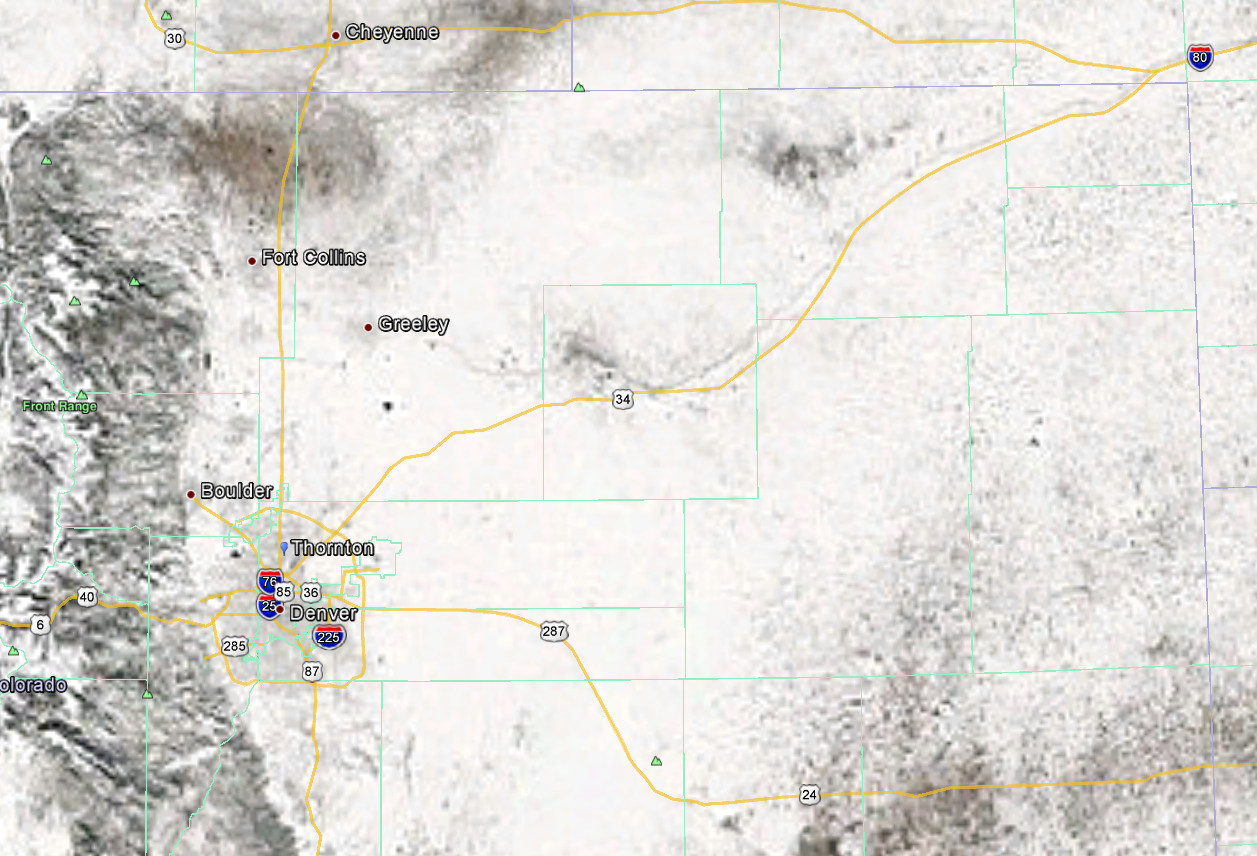
NASA’s Terra satellite flew over the Centennial State yesterday after skies had cleared and took pictures from 22,000 miles above.  The imagery clearly shows the snowy landscape of Colorado as well as parts of Utah, New Mexico, Kansas, Oklahoma, Nebraska and Wyoming.

2013-02-26_130344.jpg
NASA satellite imagery shows parts of nine states covered in snow following a snowstorm on Sunday, February 24, 2012.

From NASA:

Following on the heels of another storm, heavy snow fell on Colorado and neighboring states on February 24, 2013. On February 25, the Denver/Boulder Forecast Office of the National Weather Service reported preliminary snow totals from the area, including 27.2 inches (69.1 centimeters) west of Denver, and blizzard conditions east of the city. Like the previous storm, this one continued moving eastward.

The Moderate Resolution Imaging Spectroradiometer (MODIS) on NASA’s Terra satellite acquired this image on February 25, 2013. In the wake of the storms, snow extended across Colorado and Wyoming, and covered parts of Utah, New Mexico, and Nebraska. Although clouds had cleared in the west, cloud cover lingered in southeastern Colorado, western Kansas, and the Oklahoma Panhandle. The day after MODIS acquired this image, a new round of snow moved into the region.

References

  1. National Weather Service, Denver/Boulder, Colorado. (2013, February 25) Local storm report. National Oceanic and Atmospheric Administration. February 26, 2013.
  2. Sagliani, A. (2013, February 26) Snowstorm clogs Missouri, Illinois highways. AccuWeather.com. Accessed February 26, 2013.

NASA image courtesy LANCE MODIS Rapid Response. Caption by Michon Scott.

Instrument:

  • Terra – MODIS
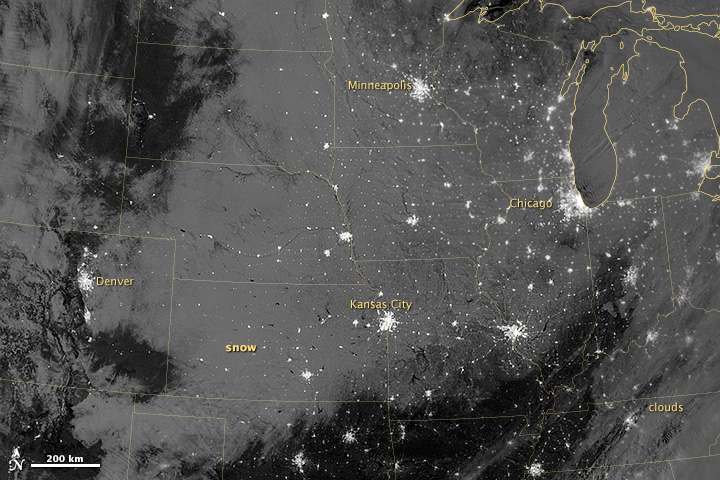
midwestnight_vir_2013054.jpg
The Visible Infrared Imaging Radiometer Suite (VIIRS) on the Suomi NPP satellite captured this nighttime view at 1:55 a.m. Central Standard Time on February 23. (NASA)

 From NASA:

In late February 2013, a major snowstorm made its way across the continental United States, dropping snow from Colorado to the Great Lakes region. The National Weather Service reported snow totals of 5 to 8 inches (13 to 20 centimeters) in many parts of the Central Plains and Upper Mississippi River Valley. Some parts of the Central Plains experienced snowfall rates as high as 4 inches (10 centimeters) per hour, along with thundersnow.

The Visible Infrared Imaging Radiometer Suite (VIIRS) on the Suomi NPP satellite captured this nighttime view at 1:55 a.m. Central Standard Time on February 23. This imagery is from the VIIRS “day-night band,” which detects light in a range of wavelengths from green to near-infrared. The day-night band takes advantage of moonlight, airglow, and starlight to brighten the landscape and uses filtering techniques to observe signals such as city lights and snow cover. On the night of this image, the Moon was nearly full.

City lights glow like clusters of stars against a backdrop of grey and black in this image. The snow appears medium gray, and stretches from northern Texas to the Dakotas,and from the Rocky Mountain states eastward past Chicago. When VIIRS acquired this image, snow cover across multiple states had persisted since theprevious night.

References

  1. National Weather Service, La Crosse, Wisconsin. (2013, February 23) Winter Storm February 21–22, 2013. National Oceanic and Atmospheric Administration. February 25, 2013.

NASA Earth Observatory image by Jesse Allen and Robert Simmon, using VIIRS day-night band data from theSuomi National Polar-orbiting Partnership. Suomi NPP is the result of a partnership between NASA, the National Oceanic and Atmospheric Administration, and the Department of Defense. Caption by Michon Scott.

Instrument: 
Suomi NPP – VIIRS

36 hours in 72 seconds: Time lapse video of Thornton’s February snowstorm

The recent snowstorm didn’t bring all that much snow to Thornton, 6.9 inches, but it was our biggest snowfall in over a year and delivers some much needed precipitation.  The light, fluffy snow was easily blown around by winds gusting in excess of 32 mph which limited visibility and made conditions outside harsh.

The video below captures the event from our east facing camera beginning at 6:00pm on Saturday, February 23, 2013 and continuing through 6:00am on Monday, February 25, 2013.  Light snow is seen falling soon after 10:00pm on Saturday night and following a lull, really picks up by mid-morning Sunday.

Interactive map: Snowfall reports from Colorado’s February 24, 2013 snowstorm

ThorntonWeather.com Snow ReportNortheastern Colorado received a much needed wallop of snow and the accompanying precipitation.
The heaviest snowfall was in the southern and western suburbs and foothills. In Thornton the storm was less generous but nevertheless welcome.

Pinecliffe west of Golden was the prize winner with nearly 22 inches of snow. Further to the south Conifer received 15 inches. In the metro area most snowfall totals were in the 6 to 10 inch range with the higher amounts to the south.

The interactive map below shows snowfall reports from National Weather Service storm spotters.  You can double-click to zoom in or use the + / – buttons.  Click and hold and then drag to pan the map around.  Click on any ‘dot’ to see the report for that location.


View Larger Map

February 17 to February 23: This Week in Denver Weather History

This Week In Denver Weather History
February 17 to February 23: This Week in Denver Weather History

Staying true to its reputation as a relatively dry month, our look back at this week in Denver weather history doesn’t contain much in the way of snow. What it does have an abundance of however are powerful, damaging wind events.

From the National Weather Service:

15-17

In 1938…a cold air mass brought a light snowfall of 6.2 inches over 3 days to downtown Denver where northeast winds were sustained to 18 mph on the 15th.
16-17 in 1929…strong west winds gusting to 84 mph raked Boulder and Lafayette. Limited minor damage and a few injuries occurred.

In 1986…strong Chinook winds continued to howl in the foothills. A wind gust to 89 mph was recorded at Table Mesa in Boulder on the 16th. Winds of 60 to 75 mph were clocked at other locations in Boulder on both days. A west wind gust to 51 mph was recorded at Stapleton International Airport on the 16th.

16-18

In 1970…a wind gust to 90 mph was recorded in Boulder at the National Center for Atmospheric Research. In downtown Boulder…sustained winds of 30 to 40 mph with gusts to 53 mph were measured. Damage was minor. West winds gusted to 45 mph at Stapleton International Airport on the 17th. The strong Chinook winds warmed the temperature to 70 degrees on the 16th and to 72 degrees on the 17th…both records for the date. The low temperature dipped to only 32 degrees on the 16th equaling the record high minimum for the date.

17

In 1887…west winds were sustained to 64 mph. Strong winds occurred all day long in the city. Rainfall was 0.02 inch.

In 1894…northwest winds were sustained to 40 mph with gusts to 46 mph.

In 1937…northwest winds sustained to 36 mph with gusts to 44 mph started a few minor fires and broke a number of plate-glass windows in downtown Denver office buildings.

In 1962…heavy snowfall totaled 7.5 inches at Stapleton Airport where the visibility was reduced to as low as 1/4 mile at times. Winds gusted from the northeast at only 15 mph.

In 2009…strong prefrontal wind gusts knocked down some trees and power lines in Boulder. More than 3400 Xcel customers in the University Hill area were without power for about one hour. Peak wind gusts included 68 mph at the NCAR Mesa Lab and 60 mph in Boulder.

17-18

In 1976…a strong cold front produced wind gusts 30 to 60 mph with much blowing snow and severe dust storms. In the Boulder area…high winds collapsed a garage and broke some windows. Northwest winds gusted to 43 mph on the 17th and to 44 mph on the 18th at Stapleton International Airport.

In 1984…the third blizzard in a week struck eastern Colorado. Heavy snow hit some parts of metro Denver with 8 to 10 inches measured in Aurora…but only 2.9 inches of snow fell at Stapleton International Airport where northwest winds gusted to 31 mph.

In 1999…damaging downslope bora winds developed in the foothills behind a strong cold front. Peak wind reports included: 90 mph at the Gamow Tower on the University of Colorado campus in Boulder; 79 mph at the National Center for Atmospheric Research mesa lab near Boulder and at the national wind technology center south of Boulder; and 72 mph atop Blue Mountain and at Jefferson County Airport. Downed power lines caused major outages for at least 10 thousand residents in Evergreen…Idaho Springs…Golden… And Lakewood. In Golden…the wind toppled a lightning static protection line atop a 70-foot…230 thousand-volt distribution tower. The downed line…sparked a small grass fire just east of the Lookout Mountain youth services center. The fire burned a path approximately 100 yards wide and 1/3 mile long before it was contained.

In 2000…snow…heavy in the mountains and foothills…spread over metro Denver. Snowfall totaled 24 inches at the Eldora Ski Resort with 8 inches measured near Blackhawk. Snowfall was only 1.8 inches at the site of the former Stapleton International Airport…which was the only measurable snow of the month.

Continue reading February 17 to February 23: This Week in Denver Weather History

Storm may not have been impressive in reality but time lapse video looks cool

The recent storm was certainly far less than impressive in reality.  Thornton recorded a mere 3.6″ of snow and our seasonal snowfall totals continue to lag well below average.

However, when you take 24 hours of pictures taken at one minute intervals and combine them all into a single video you end up with a pretty neat 48 second time lapse.  Below are videos from each of our webcams covering the period from noon on Wednesday, February 20 to noon on Wednesday, February 21.

Meteor explodes over Russia with more energy than an atomic bomb, hundreds injured

2013-02-15_153151.jpg
Flames from the explosion of the meteor were captured by Russians. (YouTube)

The Friday morning calm in Chelyabinsk, Russia was shattered by a meteor slamming into Earth’s atmosphere and exploding over the city in the Ural Mountains.  The energy released was greater than that of the first atomic bombs and caused widespread destruction and injuries.

  • Photo slideshow and video below

NASA says the 50 foot, 7,000 ton meteor entered the atmosphere at a speed of 40,000 mph and impacted at 9:20 a.m. local time (8:20 p.m. MST).

The energy released by the explosion has been estimated at 300 kilotons – far more than the 16 kiloton explosion of the bomb dropped on Hiroshima and 21 kilotons of the one dropped on Nagasaki.

The meteor lasted in the atmosphere for over 30 seconds before exploding approximately 15 miles above the planet.

Most of the fragments burnt up before reaching the ground however photos from the area did show a large, 20 foot wide hole in the ice on a nearby lake suspected to have been caused by a chunk of the rock.

The loud sonic boom and the resultant shockwave blew out windows in buildings across the area and is believed to have caused the collapse of a wall of an industrial building.

Russia media reports nearly 1,000 people reported injuries including 82 children, two of which are in intensive care.  No fatalities have been reported and no one is believed to have been hit by any fragments.

NASA said the meteor was not related to asteroid 2012 DA14 which passed extremely close to the earth today.  That asteroid is 150 feet across and came within 17,200 miles of the Earth.

More coverage:

Russian meteor photo slideshow

Video: Meteor explodes over Russia

February 10 to February 16: This Week in Denver Weather History

This Week In Denver Weather History
February 10 to February 16: This Week in Denver Weather History

As we continue an incredibly dry winter, we look to history to provide some sort of hope. While there have been some significant snow events this week in Denver weather history, more common is bitter cold and damaging winds.

From the National Weather Service:

15-23

In 1962…a protracted cold spell kept metro Denver in the deep freeze for more than a week. From the 15th thru the 23rd…low temperatures were zero or below for 9 consecutive days…but a daily record low was set only on the 22nd when the temperature dipped to 14 degrees below zero. A record low maximum for the date was also set on the 22nd when the temperature climbed to only 11 degrees. The coldest high temperature was 3 degrees above zero on the 21st…which did not break the record. The protracted cold was broken for only a few hours on the afternoon of the 20th when Chinook winds warmed the temperature to a high of 38 degrees before another surge of cold arctic air plunged temperatures back into the deep freeze that evening. The severe cold caused much damage to water systems. A woman was frozen to death at Morrison. There were other deaths attributable to the weather…including traffic deaths and heart attacks from overexertion.

16

In 1911…a trace of rain fell…a rare event in January.

In 1935…rainfall was 0.01 inch during the afternoon…a rare event in January.

In 1989…wind gusts to 80 mph were reported in southwest Boulder. Winds reached 100 mph at Rollinsville in the foothills southwest of Boulder.

In Golden…the wind blew a 25-foot trailer through a fence and flipped it over. West winds gusted to 37 mph at Stapleton International Airport where the Chinook winds warmed the temperature to a high of 49 degrees.

16-17

In 1886…a brief cold spell resulted in two temperature records. High temperatures of zero degrees on the 16th and 2 degrees below zero on the 17th were both record low maximums for the dates. Low temperatures of 8 degrees below zero on the 16th and 16 degrees below zero on the 17th were not records.

In 1930…temperatures plunging well below zero resulted in two records. Low temperatures of 19 degrees below zero on the 16th and 20 degrees below zero on the 17th were record low temperatures for the dates. High temperatures were 4 degrees on the 16th and 15 degrees on the 17th. Light snowfall totaled 4.0 inches. North winds were sustained to 18 mph on the 16th.

In 1964…high winds struck the eastern foothills. Gale velocity winds were recorded in Boulder with gusts to 83 mph measured at Rocky Flats. Several airplanes were damaged at the Jefferson County Airport in Broomfield. Roofs…walls…and parts of buildings were blown away at various locations. Power poles and trees were blown over.

16-18

In 1943…light snowfall totaled 3.2 inches over the 3 days. This was the only measurable snow of the month. North winds were sustained to 20 mph on the 16th.

In 2011…very strong winds associated with an upper level jetstream over Colorado produced blizzard conditions in the mountains above timberline. Peak wind gusts included: 99 mph atop Loveland pass…94 mph…2 miles southwest of Mary Jane…80 mph atop Berthoud Pass and 79 mph atop Niwot Ridge. Storm totals in the ski areas west of Denver ranged from 8 to 14 inches.

5-11

In 1978…the 5th marked the start of a record 7 consecutive days of dense fog at Stapleton International Airport. The heavy fog reduced the visibility to 1/4 mile or less for a period of time on each of these days. Light snow and/or freezing drizzle occurred on most days. Fog reducing visibility to less than 7 miles was recorded at Stapleton International Airport on 11 consecutive days through the 15th. During the period 5-14…the cold thick fog deposited heavy rime ice up to 5 inches thick on power lines and poles over a wide area of eastern Colorado…causing a major electrical power outage disaster.

Continue reading February 10 to February 16: This Week in Denver Weather History

Close call: Asteroid to pass between Earth and moon, manmade satellites

2013-02-10_164421.jpg
NASA depiction of asteroid 2012 DA14 as it passes by the Earth. (NASA)

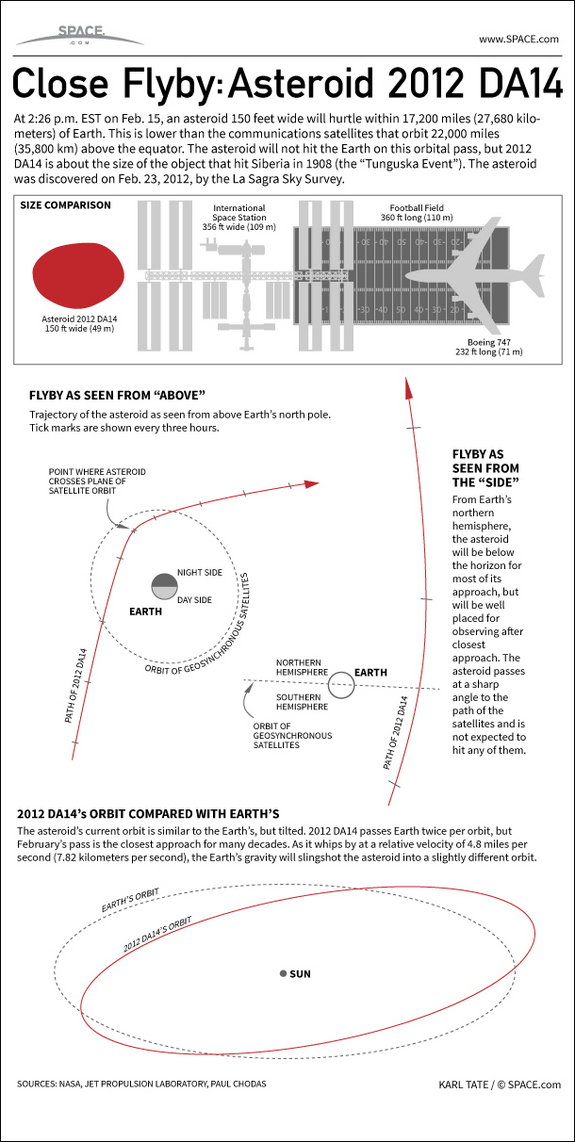
Known formally as ‘Asteroid 2012 DA14’, a massive piece of rock will pass perilously close to Earth on Friday.  The 150 foot wide asteroid is similar in size to one that devastated Siberia in the early 20th century.

At its closest to the Earth, asteroid 2012 DA14 will be within 17,200 miles of Earth.  That is much closer than the orbit of the moon (239,000 miles) and in fact will pass between Earth and many of our crucial communication satellites.

More than 100 geostationary satellites are perched in orbit at 22,000 miles.  While there is no danger of 2012 DA14 hitting the Earth, there is a very remote chance it could collide with one of these manmade satellites.

NASA says that the rock is will be speeding by at 17,400 miles per hour.  2012 DA14 will be at its closest point to earth on Friday, February 15 at approximately 12:24 p.m. MST.

The daytime pass for those in North America will preclude viewing here.  However those in Indonesia, Eastern Europe, Australia and Asia should be able to view it with a small telescope.

At 150 feet across, 2012 DA14 is similar in size to an asteroid that exploded over Siberia in 1908 – the “Tunguska Event.”  That object created a blast estimated at 1,000 times more powerful that the atomic bomb dropped on Hiroshima and flatted trees across an 800 square mile area.

Asteroids this size can cause extensive regional damage but are nowhere near the scale of the 5-mile-wide one that is thought responsible for wiping out the dinosaurs.

  • Watch: NASA video explaining asteroid 2012 DA14 below the inforgraphic

See how close asteroid 2012 DA14 will come to hitting the Earth, in this SPACE.com Infographic.
Source SPACE.com: All about our solar system, outer space and exploration

NASA Image of the Day captures powerful Nor’easter set to slam northeastern U.S.

Two powerful winter storms are set to collide over the northeastern United States today in what could be a record-breaking weather event.  Many locations including Boston and New York City will see blizzard conditions in what some are calling a potentially historic event.

Parts of New England will be measuring snow in feet when this storm is finished and it is possible many locations will see their biggest snows on record.  NASA satellites captured an amazing image this morning of the region as the storms begin to arrive – see below.

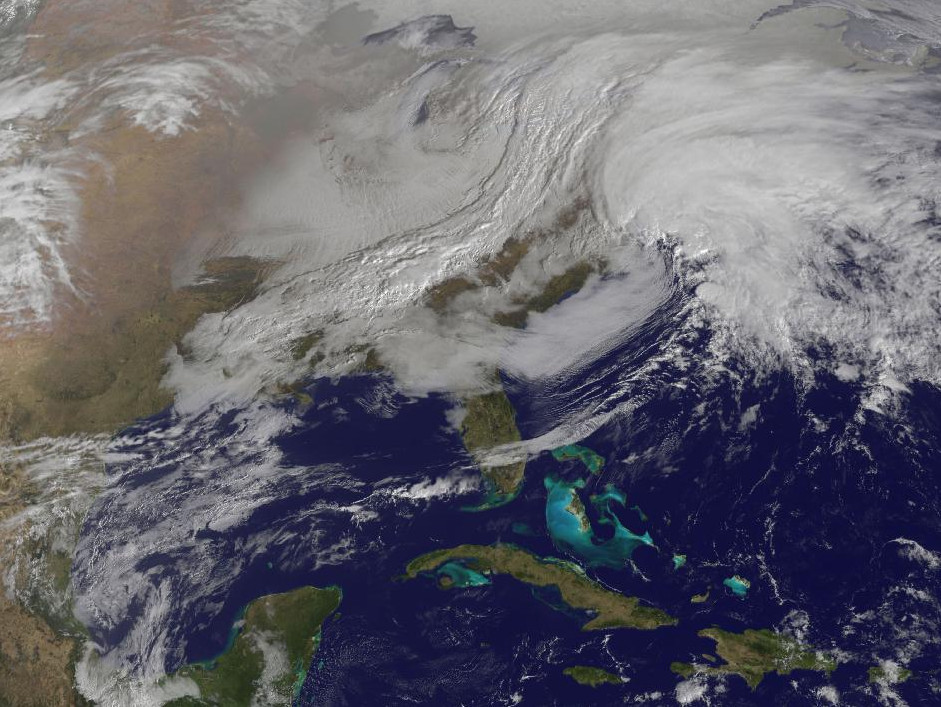
NASA says, “The satellite image, captured at 9:01 a.m. EST, shows clouds associated with the western frontal system stretching from Canada through the Ohio and Tennessee valleys, into the Gulf of Mexico. The comma-shaped low pressure system located over the Atlantic, east of Virginia, is forecast to merge with the front and create a powerful nor’easter. The National Weather Service expects the merged storm to move northeast and drop between two to three feet of snow in parts of New England.”

Related:

2013-02-08_095942.jpg
A massive winter storm is coming together as two low pressure systems are merging over the U.S. East Coast. A satellite image from NOAA's GOES-13 satellite on Feb. 8 shows a western frontal system approaching the coastal low pressure area. (NASA) Click the image for a larger view.