All posts by Thornton Weather

ThorntonWeather.com is your local source for live Thornton, Colorado weather conditions and news!

Weather Geek Stuff offers wide array of gear for the weather enthusiast on your shopping list

Weather Geek Stuff is a great place to shop for gifts for weather enthusiasts, weather geeks and weather lovers.

Not everyone gets excited about blizzards, tornadoes, hurricanes and other types of extreme weather but many folks out there are passionate about Mother Nature.  Weather Geek Stuff is an online shop just for those whose hearts race with the thrill of severe weather and they are offering special deals through the holiday season.

Weather Geek Stuff is an online store that provides a host of clothing items and novelties just for weather buffs.  From the store’s custom ‘Weather Geek’ and ‘Weather Diva’ logoed merchandise to items imprinted with amusing weather warnings signs as well as Skywarn storm spotter logos, there is something there sure to please any weather lover.

Weather Geek Stuff’s merchandise was shown on the Weather Channel as a recommended gift so you know the quality is good.  Stu Ostro, Weather Channel’s Senior Director of Weather Communications even sports a ‘Weather Geek’ t-shirt on his Facebook page and Twitter profile.

Kids and dogs aren’t left out of the weather fun either.  There is a wide variety of clothing items sized just right for the little ones from babies to bigger kids.  Canine companions as well can get shirts and bowls emblazoned with a weather-related logo.

The selection goes far beyond clothing too.  Water bottles, clocks, mugs, bags and other novelties are part of the store’s offerings.  For the tech types, cases for iPhones and iPads are available.  New products this season include laptop skins, clipboards and throw blankets.

Be sure to head over to WeatherGeekStuff.com and get that holiday gift today for your favorite weather geek. 

Support ThorntonWeather .com

Weather Geek Stuff is owned and operated by the same folks that run ThorntonWeather.com.  We provide ThorntonWeather.com as a no-cost service to the community and use the minimal amount of money made from Weather Geek Stuff to support the costs of running this website and the associated equipment.  So remember, if you have a weather buff on your shopping list, by buying from Weather Geek Stuff you are supporting ThorntonWeather.com!  You can also donate directly to fund the site here.

Second record low temperature in as many days set in Denver

Record Cold TemperaturesClear skies and snow cover helped push the mercury down early this morning.  The result was a second record low temperature set in the past 24 hours.

As measured at Denver International Airport, the Mile High City’s official low temperature this morning was -15 degrees.  This ties the record low for December 5 last set in 1972.

Thornton managed to be slightly warmer as our temperature bottomed out at -9.2 degrees right before sunrise.

Yesterday, just before midnight, Denver set a record low temperature for December 4 as well.

The bitter cold looks to remain with us for quite some time.  Some warming in the coming days is expected however it may be the middle of next week before temperatures climb above freezing.

Denver sets new record low temperature for December 4

Record Cold TemperaturesWith snow on the ground, clear skies above and a very cold air mass in place, Denver set a new record low temperature for December 4.

Late in the evening the mercury at Denver International Airport dropped to -13 degrees.  These shattered the old record low temperature for the date of -5 degrees last set in 2008.

Here in Thornton we weren’t quite as cold as our low temperature dropped to  -4.4 degrees right before midnight.

The storm system that pushed through deposited a light, fluffy 2.2 inches of snowfall on Thornton which equated to 0.13 inch of liquid precipitation.

Seasonal snowfall totals continue to run well below  normal.  On average, by the end of November we have received 13.0 inches and by the end of December 21.2 inches.

To date Thornton’s seasonal snowfall total is at 7.3 inches and Denver’s 4.2 inches.

November 2013 weather recap: Month featured warmer, drier than normal conditions

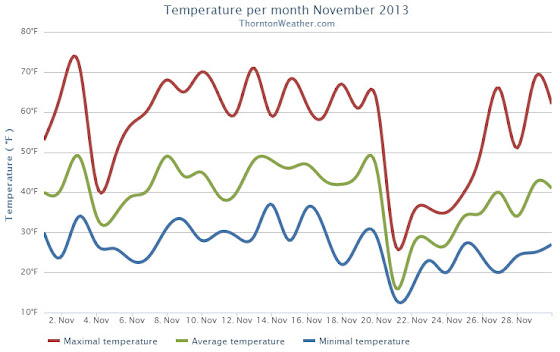
The month of November 2013 goes into the books as a quiet one without much notable in terms of the weather in the Denver area.  We enjoyed unusually warm and dry conditions but neither were record-setting.

The month started with average temperatures followed by a couple of days of above normal readings.  Colder temperatures and light snow followed on the 4th of the month and lasted until the 6th.

A week of warmer than normal conditions then settled in and lasted through the 20th.  On the 21st, a period of five days with colder than normal temperatures arrived as did some light snow on two days during the span.

Temperatures then warmed up from there and above normal temperatures and dry conditions continued through November 30th.

Overall temperatures for the month averaged 39.6 degrees in Thornton.  Officially, Denver’s average temperature was 40.9 degrees.  Both were a good bit above the historical November average temperature of 43.5 degrees.

Temperatures in Thornton ranged from a high of 71.8 degrees on the 3rd down to a low of 13.7 degrees on the 21st.  Denver’s maximum and minimum were 71 degrees on the 13th and 12 degrees on the 21st.

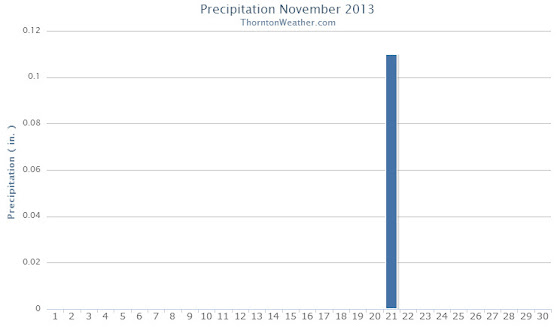
In terms of precipitation, Thornton recorded a scant 0.11 inch of liquid.  Denver fared better with 0.27 inches.  Both however were below the average November monthly precipitation mark of 0.61 inches.

Thornton saw total of only 1.8 inches snow during the month, most of which (1.6 inches) fell on the 21st.  Officially the Mile High City recorded 2.0 inches of snow, all on the 21st.  The average November snowfall is 8.7 inches so the 2013 – 2014 snow season is off to a poor start.

No temperature, precipitation or snowfall records were set during the month.

Click here to view the November 2013 climate summary for Thornton.

Thornton's November 2013 Temperature Summary.
Thornton’s November 2013 Temperature Summary.
Thornton's November 2013 Precipitation Summary.
Thornton’s November 2013 Precipitation Summary.

From the National Weather Service:

...THE DENVER CO CLIMATE SUMMARY FOR THE MONTH OF NOVEMBER 2013...

CLIMATE NORMAL PERIOD 1981 TO 2010
CLIMATE RECORD PERIOD 1872 TO 2013

WEATHER         OBSERVED          NORMAL  DEPART  LAST YEAR`S
                 VALUE   DATE(S)  VALUE   FROM    VALUE  DATE(S)
                                          NORMAL
................................................................
TEMPERATURE (F)
RECORD
 HIGH              80   11/08/2006
 LOW              -18   11/29/1877
HIGHEST            71   11/13        79      -8       77  11/07
LOWEST             12   11/21       -18      30       13  11/11
AVG. MAXIMUM     55.1              52.1     3.0     58.4
AVG. MINIMUM     26.7              24.5     2.2     28.5
MEAN             40.9              38.3     2.6     43.5
DAYS MAX >= 90      0               0.0     0.0        0
DAYS MAX <= 32      2               2.3    -0.3        0
DAYS MIN <= 32     25              23.4     1.6       19
DAYS MIN <= 0       0               0.6    -0.6        0

PRECIPITATION (INCHES)
RECORD
 MAXIMUM         3.21   1946
 MINIMUM            T   1899
                        1901
                        1949
TOTALS           0.27              0.61   -0.34     0.27
DAILY AVG.       0.01              0.02   -0.01     0.01
DAYS >= .01         3               4.7    -1.7        1
DAYS >= .10         1               1.6    -0.6        1
DAYS >= .50         0               0.0     0.0        0
DAYS >= 1.00        0               0.0     0.0        0
GREATEST
 24 HR. TOTAL    0.23   11/21 TO 11/21           11/10 TO 11/10
                        11/20 TO 11/21                    11/09 TO 11/10
                        11/21 TO 11/21                    11/10 TO 11/10
 STORM TOTAL       MM                                 MM
 (MM/DD(HH))            MM                    11/10(00) TO 11/10(00)
                                                 11/10(00) TO 11/10(00)0
                                                 11/10(00) TO 11/10(00)0

SNOWFALL (INCHES)
RECORDS
 TOTAL             MM   MM
TOTALS            2.0               8.7

DEGREE_DAYS
HEATING TOTAL     715               801     -86      638
 SINCE 7/1       1323              1382     -59     1195
COOLING TOTAL       0                 0       0        0
 SINCE 1/1        999               769     230     1236

FREEZE DATES
RECORD
 EARLIEST     09/08/1962
 LATEST       06/08/2007
EARLIEST                        10/07
LATEST                          05/05
.................................................

WIND (MPH)
AVERAGE WIND SPEED              9.0
RESULTANT WIND SPEED/DIRECTION   3/203
HIGHEST WIND SPEED/DIRECTION    31/040    DATE  11/20
HIGHEST GUST SPEED/DIRECTION    45/150    DATE  11/02

SKY COVER
POSSIBLE SUNSHINE (PERCENT)   MM
AVERAGE SKY COVER           0.50
NUMBER OF DAYS FAIR            8
NUMBER OF DAYS PC             18
NUMBER OF DAYS CLOUDY          4

AVERAGE RH (PERCENT)     50

WEATHER CONDITIONS. NUMBER OF DAYS WITH
THUNDERSTORM              0     MIXED PRECIP               0
HEAVY RAIN                0     RAIN                       0
LIGHT RAIN                1     FREEZING RAIN              0
LT FREEZING RAIN          1     HAIL                       0
HEAVY SNOW                1     SNOW                       1
LIGHT SNOW                7     SLEET                      0
FOG                       8     FOG W/VIS <= 1/4 MILE      1
HAZE                      4

-  INDICATES NEGATIVE NUMBERS.
R  INDICATES RECORD WAS SET OR TIED.
MM INDICATES DATA IS MISSING.
T  INDICATES TRACE AMOUNT.

Thornton’s December preview: A very chilly month quite possible

November was an unseasonably warm and unusually dry month. As we look into December, that trend looks to change, particularly when it comes to temperatures.

The month brings with it the official start to winter and the month usually brings with it our first real taste of Arctic temperatures. Precipitation can be hit or miss with monster snowstorms possible but we have also seen starkly dry years.

Current long range forecasts indicate that for at least the first half of the month we will see unusually cold temperatures and have the potential for better than average levels of precipitation.

Get all the details on Thornton’s December weather including a look back at historical events and a look at the long range forecast in our December weather preview here.

NOAA imagery shows population centers and road transportation network

The Suomi NPP satellite acquired two nighttime images early on October 1, 2013, for this natural-light, mosaic view (top) of the continental United States. (NOAA)

Millions of Americans will be taking to the highways of byways of the nation in the coming weeks for various holiday travels.  Imagery released by NOAA this week shows how the nation’s major roadways intersect with the major population centers.

A nighttime satellite image of the nation was taken by the Suomi NPP satellite taken last month near the new moon when light from space was relatively low.  This allowed NOAA to generate an image showing population centers from coast to coast.

When overlaid with a graphic of major interstate highways, railroads, and rivers, the images provide insight into how the nation evolved.

Early in the nation’s history, rivers were the major means of transportation and population centers developed around them.  As we expanded and the national highway system took shape, major roads connected the cities.

Below we have added an interactive slider to allow you to compare the surface travel networks with the satellite image.  Simply move it side to side to compare.

[wpw_ba_viewer width=”600″ disable_intro=”false” alternate_skin=”true”]
[wpw_ba_img src=”http://lh3.googleusercontent.com/-sz3WguZ6u70/UpT_qACKk2I/AAAAAAAAA6E/F8lNPrVHqBs/s600/us_vir_2013274_720.jpg” data_alt=”http://lh3.googleusercontent.com/-ccGCWfWTc1A/UpT_qGByopI/AAAAAAAAA54/N_VcvIEcg6w/s600/us_vir_2013274_720_maps.jpg” title=””]
[/wpw_ba_viewer]

NASA’s Cassini beams back stunning image of Saturn and Earth

The ringed planet of Saturn have been a source of fascination for earthlings for hundreds of years.  NASA’s Cassini probe, launched in 1997, has provided amazing views of the planet but none more so than the image released yesterday.

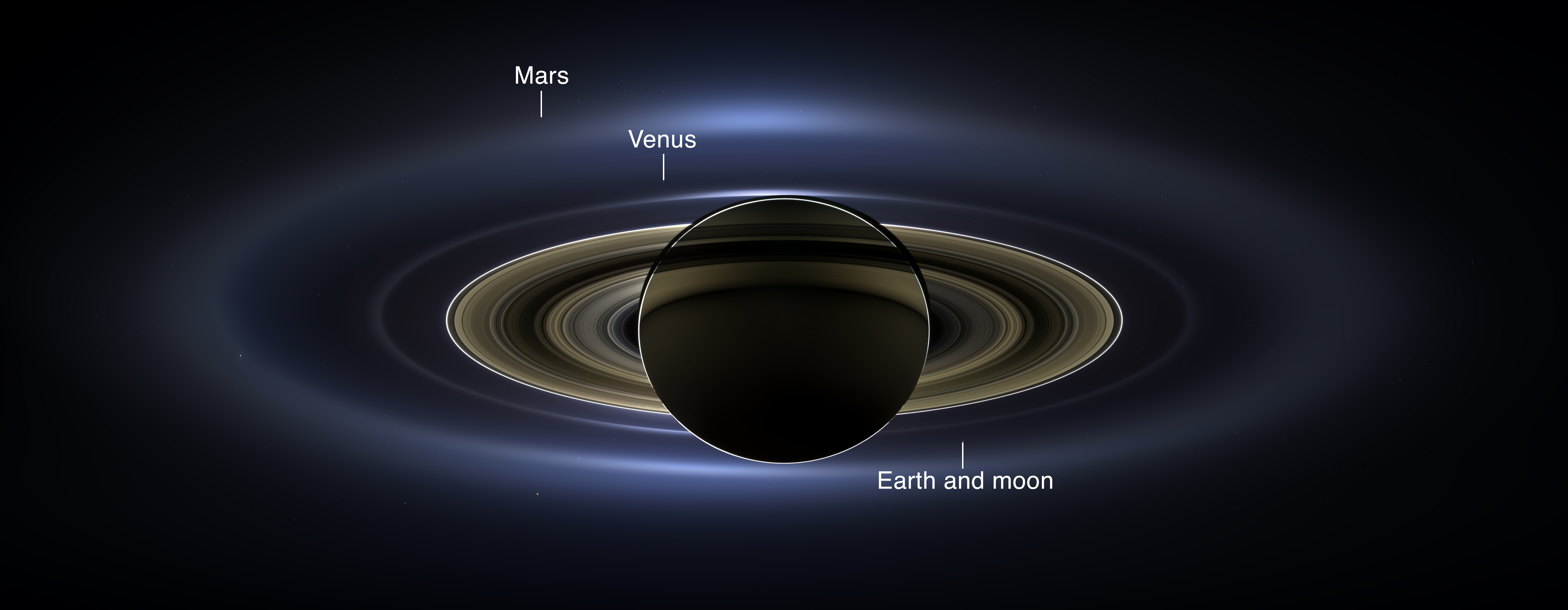
With the sun being blocked by Saturn, Cassini was able to capture the view of the planet and the inner solar system.  Actually a compilation of 141 images, the panoramic image shows a backlit Saturn as well as Mars, Venus and a pale blue Earth and our moon.

See the image below, click it for a larger view.  More on the image and Cassini’s mission below the photo.

On July 19, 2013, in an event celebrated the world over, NASA's Cassini spacecraft slipped into Saturn's shadow and turned to image the planet, seven of its moons, its inner rings -- and, in the background, our home planet, Earth.  Click the image for a larger view.  (NASA/JPL-Caltech/SSI)
On July 19, 2013, in an event celebrated the world over, NASA’s Cassini spacecraft slipped into Saturn’s shadow and turned to image the planet, seven of its moons, its inner rings — and, in the background, our home planet, Earth. Click the image for a larger view. (NASA/JPL-Caltech/SSI)

From NASA:

NASA has released a natural-color image of Saturn from space, the first in which Saturn, its moons and rings, and Earth, Venus and Mars, all are visible.

The new panoramic mosaic of the majestic Saturn system taken by NASA’s Cassini spacecraft, which shows the view as it would be seen by human eyes, was unveiled at the Newseum in Washington on Tuesday.

Cassini’s imaging team processed 141 wide-angle images to create the panorama. The image sweeps 404,880 miles (651,591 kilometers) across Saturn and its inner ring system, including all of Saturn’s rings out to the E ring, which is Saturn’s second outermost ring. For perspective, the distance between Earth and our moon would fit comfortably inside the span of the E ring.

“In this one magnificent view, Cassini has delivered to us a universe of marvels,” said Carolyn Porco, Cassini’s imaging team lead at the Space Science Institute in Boulder, Colo. “And it did so on a day people all over the world, in unison, smiled in celebration at the sheer joy of being alive on a pale blue dot.”

The mosaic is part of Cassini’s “Wave at Saturn” campaign, where on July 19, people for the first time had advance notice a spacecraft was taking their picture from planetary distances. NASA invited the public to celebrate by finding Saturn in their part of the sky, waving at the ringed planet and sharing pictures over the Internet.

An annotated version of the Saturn system mosaic labels points of interest. Earth is a bright blue dot to the lower right of Saturn. Venus is a bright dot to Saturn’s upper left. Mars also appears, as a faint red dot, above and to the left of Venus. Seven Saturnian moons are visible, including Enceladus on the left side of the image. Zooming into the image reveals the moon and the icy plume emanating from its south pole, supplying fine, powder-sized icy particles that make up the E ring.

The E ring shines like a halo around Saturn and the inner rings. Because it is so tenuous, it is best seen with light shining from behind it, when the tiny particles are outlined with light because of the phenomenon of diffraction. Scientists who focus on Saturn’s rings look for patterns in optical bonanzas like these. They use computers to increase dramatically the contrast of the images and change the color balance, for example, to see evidence for material tracing out the full orbits of the tiny moons Anthe and Methone for the first time.

“This mosaic provides a remarkable amount of high-quality data on Saturn’s diffuse rings, revealing all sorts of intriguing structures we are currently trying to understand,” said Matt Hedman, a Cassini participating scientist at the University of Idaho in Moscow. “The E ring in particular shows patterns that likely reflect disturbances from such diverse sources as sunlight and Enceladus’ gravity.”

Cassini does not attempt many images of Earth because the sun is so close to our planet that an unobstructed view would damage the spacecraft’s sensitive detectors. Cassini team members looked for an opportunity when the sun would slip behind Saturn from Cassini’s point of view. A good opportunity came on July 19, when Cassini was able to capture a picture of Earth and its moon, and this multi-image, backlit panorama of the Saturn system.

“With a long, intricate dance around the Saturn system, Cassini aims to study the Saturn system from as many angles as possible,” said Linda Spilker, Cassini project scientist based at NASA’s Jet Propulsion Laboratory in Pasadena, Calif. “Beyond showing us the beauty of the Ringed Planet, data like these also improve our understanding of the history of the faint rings around Saturn and the way disks around planets form — clues to how our own solar system formed around the sun.”

Launched in 1997, Cassini has explored the Saturn system for more than nine years. NASA plans to continue the mission through 2017, with the anticipation of many more images of Saturn, its rings and moons, as well as other scientific data.

The Cassini-Huygens mission is a cooperative project of NASA, the European Space Agency and the Italian Space Agency. JPL, a division of the California Institute of Technology, Pasadena, manages the mission for NASA’s Science Mission Directorate in Washington. JPL designed, developed and assembled the Cassini orbiter and its two onboard cameras. The imaging team is based at the Space Science Institute, Boulder, Colo.


October 2013 weather recap: Cooler than normal temperatures, first snow recorded

Thornton and Denver’s October 2013 was overall a relatively un-noteworthy month in terms of weather.  Temperatures were below normal and we did receive our first measurable snowfall of the season.

We started the first two days of the month with temperatures in the 70s.  That was followed by a cold front moving through and delivering 0.8” of snow in Thornton on the 4th while Denver recorded only a trace at DIA.

We then saw five days of dry conditions with temperatures warming back up into the 70s.  On the 10th the next system arrived and rain was recorded on four of the next five days in Thornton.  Cooler than normal temperatures were notable during the period and lasted for the next eight days.

On the 18th another shot winter-like weather arrived and Thornton saw its biggest snowfall yet of the season: 2.4 inches.  Out at the airport, Denver recorded 1.4 inches.

The next nine days from the 19th to the 27th were largely pleasant days but with light rain on two days during that time.  On the 28th another cold front and storm system moved in and chilly temperatures returned.  Thornton recorded a dusting of snow on the 30th.

Overall temperatures for the month averaged 47.7 degrees as measured officially at DIA.  Here in Thornton our average temperature was slightly cooler at 45.9 degrees.  Both marks were considerably cooler than the historical October average temperature of 50.9 degrees.

Temperatures in Thornton ranged from a high of 79.5 degrees on the 8th down to a low of 25.5 degrees on the 16th.  Denver’s high and low were similar with 79 degrees also on the 8th and 27 degrees on the 5th and 16th.

One temperature record was set in Denver during the month.  On October 5 the low temperature reading of 28 degrees tied the record low for the date last set in 1877.

In terms of precipitation, Thornton recorded 1.21 inches between rainfall and snowmelt.  Denver was drier recording only 0.72 inches.  The Mile High City historically averages 1.02 inches so Thornton was above average, Denver below.

With only small snowfalls recorded, it wasn’t a particularly white month.  Thornton measured a total of 3.3 inches while Denver recorded only 1.4 inches.  Both were below the October average of 4.0 inches.

Click here to view Thornton’s October 2013 climate summary report.

[pe2-image src=”http://lh4.ggpht.com/-D-mSqpy-pQc/UnQi63nQ0FI/AAAAAAAAA3Q/_8y6TRKhmuE/s144-c-o/October2013Temps.jpg” href=”https://picasaweb.google.com/108306177534978229224/Misc?authkey=Gv1sRgCNPjmpm5l5PSOA#5941412203164913746″ caption=”Thornton’s October 2013 Temperatures.” type=”image” alt=”October2013Temps.jpg” pe2_single_image_size=”w560″ pe2_img_align=”left” ]

[pe2-image src=”http://lh5.ggpht.com/-d6PD6Dq3lto/UnQi_K0Q-dI/AAAAAAAAA3Y/L7pCMZAzn7E/s144-c-o/October2013Precip.jpg” href=”https://picasaweb.google.com/108306177534978229224/Misc?authkey=Gv1sRgCNPjmpm5l5PSOA#5941412277039200722″ caption=”Thornton’s October 2013 Precipitation.” type=”image” alt=”October2013Precip.jpg” pe2_single_image_size=”w560″ pe2_img_align=”left” ]

CLIMATE REPORT
NATIONAL WEATHER SERVICE BOULDER, CO
240 AM MDT FRI NOV 1 2013

...................................

...THE DENVER CO CLIMATE SUMMARY FOR THE MONTH OF OCTOBER 2013...

CLIMATE NORMAL PERIOD 1981 TO 2010
CLIMATE RECORD PERIOD 1872 TO 2013

WEATHER         OBSERVED          NORMAL  DEPART  LAST YEAR`S
                 VALUE   DATE(S)  VALUE   FROM    VALUE  DATE(S)
                                          NORMAL
................................................................
TEMPERATURE (F)
RECORD
 HIGH              90   10/01/1892
 LOW               -2   10/29/1917
HIGHEST            79   10/08        90     -11       83  10/03
LOWEST             27   10/16        -2      29       24  10/27
                        10/05
AVG. MAXIMUM     60.0              65.3    -5.3     62.2
AVG. MINIMUM     35.5              36.6    -1.1     35.9
MEAN             47.7              50.9    -3.2     49.0
DAYS MAX >= 90      0               0.0     0.0        0
DAYS MAX <= 32      0               0.4    -0.4        1
DAYS MIN <= 32     12               8.5     3.5       11
DAYS MIN <= 0       0               0.0     0.0        0

PRECIPITATION (INCHES)
RECORD
 MAXIMUM         4.17   1969
 MINIMUM            T   1934
TOTALS           0.72              1.02   -0.30     1.22
DAILY AVG.       0.02              0.03   -0.01     0.04
DAYS >= .01         8               5.3     2.7        5
DAYS >= .10         3               2.4     0.6        3
DAYS >= .50         0               0.5    -0.5        2
DAYS >= 1.00        0               0.1    -0.1        0
GREATEST
 24 HR. TOTAL    0.25   10/18 TO 10/18           10/24 TO 10/25
                        10/03 TO 10/04                    10/25 TO 10/25
                                                          10/25 TO 10/25
 STORM TOTAL       MM                                 MM
 (MM/DD(HH))            MM                    10/25(00) TO 10/25(00)
                                                 10/25(00) TO 10/25(00)5
                                                 10/25(00) TO 10/25(00)5

SNOWFALL (INCHES)
RECORDS
 TOTAL             MM   MM
TOTALS            1.4               4.0

DEGREE_DAYS
HEATING TOTAL     525               440      85      488
 SINCE 7/1        608               581      27      557
COOLING TOTAL       0                 5      -5        1
 SINCE 1/1        999               769     230     1236

FREEZE DATES
RECORD
 EARLIEST     09/08/1962
 LATEST       06/08/2007
EARLIEST      10/04             10/07
LATEST                          05/05
......................................................

WIND (MPH)
AVERAGE WIND SPEED              8.8
RESULTANT WIND SPEED/DIRECTION   1/180
HIGHEST WIND SPEED/DIRECTION    40/270    DATE  10/10
HIGHEST GUST SPEED/DIRECTION    48/270    DATE  10/10

SKY COVER
POSSIBLE SUNSHINE (PERCENT)   MM
AVERAGE SKY COVER           0.50
NUMBER OF DAYS FAIR           12
NUMBER OF DAYS PC             14
NUMBER OF DAYS CLOUDY          5

AVERAGE RH (PERCENT)     61

WEATHER CONDITIONS. NUMBER OF DAYS WITH
THUNDERSTORM              0     MIXED PRECIP               0
HEAVY RAIN                0     RAIN                       3
LIGHT RAIN                9     FREEZING RAIN              0
LT FREEZING RAIN          1     HAIL                       0
HEAVY SNOW                1     SNOW                       2
LIGHT SNOW                4     SLEET                      0
FOG                      13     FOG W/VIS <= 1/4 MILE      9
HAZE                      4

-  INDICATES NEGATIVE NUMBERS.
R  INDICATES RECORD WAS SET OR TIED.
MM INDICATES DATA IS MISSING.
T  INDICATES TRACE AMOUNT.

Thornton’s November preview: Expect just about anything

Thornton's November weather previewThe weather during the month of November in Denver metro area can offer just about anything.  While it is normally a quiet month, it can be prone to extremes.
November is Denver’s second snowiest month and major snowstorms are not entirely uncommon.  However conditions can also be quite dry.

Temperatures during the month continue to cool as we get closer to winter and by the end of the month the low temperatures routinely dip to 20 degrees or below.  At times it can in fact bring conditions more like what we see in January.

Get all the details on November’s weather and what we can expect in our complete preview here.

Time to ‘fall back’ as Daylight Saving Time comes to an end

The United States returns to Standard Time at 2:00am Sunday as Daylight Saving Time comes to an end.

The biannual ritual of changing our clocks to adjust for Daylight Saving Time occurs tonight providing yet another signal of the changing of seasons.  The United States will ‘fall back’ one hour at 2:00am Sunday morning as we return to Standard Time.

The ritual of changing our clocks twice a year can be met with some resistance as some people struggle to adjust their body’s internal clock.  Others actually like the return to standard time as they get to enjoy an extra hour of sleep.

The time change definitely has big effects on the dawning of daylight and how early it gets dark in the evening.

Sunrise on Saturday occurs at 7:30am but on Sunday it will be at 6:29am. Similarly, sunset will occur at 5:55pm on Saturday but on Sunday the sun will disappear over the horizon at 4:54pm.

For many this means that when they get home from work it will now be dark and outdoor activities will be significantly curtailed as a result.

Arizona and Hawaii are the only states that do not observe Daylight Saving Time and remain on Standard Time year round.    The U.S. territories of Puerto Rico, American Samoa, Guam, Northern Mariana Islands, and the United States Virgin Islands also do not observe the event.

It won’t be all that long though before Daylight Saving Time returns.  On March 9, 2014 we will ‘spring forward.’

Daylight Saving Time Schedule

The mandated beginning and end of Daylight Saving Time has changed in the United States over the years.

The most recent schedule was set by the Energy Policy Act of 2005 and took effect in 2007.  We now ‘spring forward’ to begin Daylight Saving Time on the second Sunday in March and ‘fall back’ with the return to Standard Time on the first Sunday in November.

Year DST Begins 2 a.m.
(Second Sunday in March)
DST Ends 2 a.m.
(First Sunday in November)
2013 10 March 2013 3 November 2013
2014 9 March 2014 2 November 2014
2015 8 March 2015 1 November 2015
2016 13 March 2016 6 November 2016
2017 12 March 2017 5 November 2017
2018 11 March 2018 4 November 2018
2019 10 March 2019 3 November 2019