Tag Archives: February weather

February 14 to February 20: This week in Denver weather history

This Week in Denver Weather History

Many notable weather events have occurred in Denver this week in the past, some recently.  It was just last year that a windstorm knocked down trees and powerlines in Boulder.  Nine years ago, we saw an end to 61 days straight with snow cover – the second longest streak in Denver history.

From the National Weather Service:

13-14

In 1895…a cold air mass settled over the city.  High temperatures of only 4 degrees on the 13th and 8 degrees on the 14th were record low maximum temperatures for each day.  Low temperatures were 6 degrees below zero on the 13th and 5 degrees below zero on the 14th…but were not records.  Light snow totaled only 0.4 inch.  Winds were light.

In 1960…snowfall totaled 6.1 inches and north-northwest winds gusted to 39 mph at Stapleton Airport.

In 1967…high winds were widespread along the foothills where wind gusts of 60 to 90 mph were common.  A wind gust to 108 mph was measured at the National Center for Atmospheric Research in Boulder.  Sustained winds of 50 to 55 mph with gusts as high as 70 mph were recorded in downtown Boulder. An estimated 3 thousand dollars in damage occurred to mobile homes in Boulder.  Power lines were downed over a wide area.  At Stapleton International Airport…west winds gusted to 32 mph on the 13th and southwest winds gusted to 48 mph on the 14th.

In 1972…winds gusted to 67 mph at the National Bureau of Standards in Boulder.  Wind gusts to 49 mph were measured in downtown Boulder.  West winds gusted to 26 mph at Stapleton International Airport.

In 2001…heavy snow fell across metro Denver and in the foothills.  Snowfall totals included:  8 inches at Evergreen; 7 inches atop Crow Hill and in Lakewood; 6 inches in Denver…Doubleheader…Eldorado Springs… Morrison…and Pine Junction.  Snowfall totaled 4.8 inches at the site of the former Stapleton International Airport. Northeast winds gusted to 33 mph at Denver International Airport on the 13th.

14

In 1918…southwest winds were sustained to 41 mph with a measured extreme velocity to 46 mph.

In 1987…metro Denver received only 3 to 4 inches of snow… But the foothills west of Boulder received up to 11 inches of snow.  Snowfall totaled 4.2 inches at Stapleton International Airport where north winds gusted to 31 mph.

In 1988…winds gusted to 81 mph at Echo Lake.

In 2002…high winds developed in the Front Range foothills during the early morning hours.  Winds gusted to 84 mph… 11 miles north of central city.  West winds gusted to 43 mph at Denver International Airport.
14-15 in 1960…heavy snowfall totaled 6.1 inches at Stapleton Airport.

In 1965…5.4 inches of snow fell at Stapleton International Airport behind a cold front.  North-northeast winds gusted to 32 mph.  Winds were strong and gusty all day and caused considerable blowing snow…contributing to hazardous driving conditions mainly to the east of Denver.

In 1984…a snow and wind storm howled across eastern Colorado closing I-70 east of Denver.  This was the second blizzard in less than 4 days.  Only 0.5 inch of new snow fell at Stapleton International Airport…but north winds gusted to 51 mph.

15

In 1881…the temperature plunged to a low of 20 degrees below zero in the city.  In outer areas of the city…the temperature dipped to 26.5 degrees below zero.

In 1910…west winds were sustained to 42 mph.

In 1986…high winds battered the Front Range foothills. A wind gust to 95 mph was recorded in Boulder…but winds of 60 to 80 mph were common in and near the foothills.  In Aurora…an automobile dealership lost a large plate glass window.  Southwest wind gusts to 44 mph were recorded at Stapleton International Airport.  The strong winds warmed temperatures.  A record maximum temperature of 66 degrees and a record high minimum temperature of 37 degrees were recorded at Stapleton International Airport.

In 1988…winds to 75 mph were clocked in Boulder…while a west wind gust to only 41 mph was recorded at Stapleton International Airport.

In 1997…winds gusted to 75 mph at Golden Gate Canyon during the early morning hours.  West winds gusted to 31 mph at Denver International Airport.

In 2000…high winds spread from the foothills onto the plains. While the strongest winds were north and northeast of metro Denver…west winds gusted to 58 mph in Thornton and to 54 mph at Denver International Airport.

In 2005…light precipitation of only 0.02 inch at Denver International Airport was the only measurable precipitation of the month.  This ranked the month as the 2nd driest February of record.

15-16

In 1889…heavy snowfall totaled 6.7 inches in downtown Denver.  Most of the snow…5.5 inches…fell on the 15th when northeast winds were sustained to 18 mph.

In 1921…strong Bora winds cooled maximum temperatures from the 60’s on the previous 3 days to 54 degrees on the 15th and to 43 degrees on the 16th.  West winds were sustained to 39 mph with gusts to 54 mph on the 15th and to 46 mph with gusts to 56 mph on the 16th.

In 1953…strong…cold northwest winds were widespread from the foothills across the plains.  Near gale force winds were observed in Boulder.  A wind gust to 54 mph was recorded at Stapleton Airport where blowing dust briefly reduced the visibility to 1 1/2 miles.  Damage was minor.

In 1993…an arctic cold front pushed south over the eastern Colorado plains with upslope snow developing behind the front.  Snowfall amounts of 3 to 6 inches were common over metro Denver.  At Stapleton International Airport…snowfall totaled 4.5 inches and north winds gusted to 25 mph. Temperatures hovered only in the single digits for most of the day.  The storm produced up to a foot of snow over southeast Colorado.

In 2005…light snowfall of 0.5 inch at Denver Stapleton was the only measurable snowfall of the month…which ranked the month the 2nd least snowiest February of record.

In 2006…overnight snowfall in the mountains and eastern foothills contained a lot of red dust and dirt apparently from Arizona.  Strong southwest winds with gusts to 100 mph in the San Juan Mountains on the 15th created widespread blowing dust.  This red dust became entrained in snowfall across the area.  The reddish colored snow was reported in Ward…Nederland…Blackhawk…and Boulder.  The storm produced only 0.9 inch of snowfall in the Stapleton area of Denver with 4 to 5 inches measured in the foothills.

15-17

In 1938…a cold air mass brought a light snowfall of 6.2 inches over 3 days to downtown Denver where northeast winds were sustained to 18 mph on the 15th.

16

In 1879…a sudden burst of 3 inches of snow in less than 90 minutes stopped the street cars in downtown Denver during the late afternoon.  Melted snow resulted in 0.16 inch of precipitation.  Small soft hail also fell when the snow began.  A gentleman caught on the prairie between Denver and Morrison described the event as the most severe storm of the winter while it lasted.

In 1885…a windstorm caused severe damage in the city.  The strong winds blew all afternoon and most of the evening. West winds were sustained to 62 mph.  The strong winds blew down signs and broke windows.  Buggies and vehicles of all kinds were blown over.  Smokestacks and chimneys were toppled.  Roofs were blown off.  The Denver and Rio Grande Railroad car shop was partially unroofed and had a wall blown down.  Three railroad cars were blown off the track.  Many fences were damaged.

In 1897…west winds were sustained to 46 mph with gusts to 56 mph.

In 1912…northwest winds were sustained to 44 mph with a measured extreme velocity to 45 mph.

In 1921…west winds were sustained to 46 mph.

In 1972…wind gusts to 58 mph were recorded at the National Bureau of Standards in Boulder.  In downtown Boulder…a wind gust to 51 mph was measured.  Northwest winds gusted to 41 mph at Stapleton International Airport.

In 1988…snowfall totaled 3 to 6 inches across metro Denver… But 9 inches were measured in both Wheat Ridge and Evergreen.  At Stapleton International Airport…3.4 inches of snow fell and northeast winds gusted to 26 mph.  The strong winds blew a scaffold against a hotel in downtown Denver…breaking three windows.

In 1995…high winds occurred in the foothills behind a departing winter storm.  A wind gust to 91 mph was recorded at Rollinsville with a gust to 82 mph atop Squaw Mountain west of Denver.  West winds gusted to only 20 mph at Stapleton International Airport.

In 2014…a peak wind gust to 59 mph…from the west… Was recorded at Denver International Airport.

Continue reading February 14 to February 20: This week in Denver weather history
February 7 to February 13: This week in Denver weather history

This Week in Denver Weather History

You can tell how eventful a week in Denver weather history is by the length of these articles and this one is a long one for sure.  In history we have seen Arctic cold, spring-like warmth, major snowstorms and blizzards and hurricane force winds.  There is even a rare thunderstorm that dropped a bit of hail.

From the National Weather Service:

30-7

In 1985…a cold front on the 29th produced a protracted cold spell as arctic air remained entrenched across metro Denver. While the only daily temperature record set was a low maximum reading of 2 degrees on February 3rd…minimum temperatures plunged well below zero on 9 consecutive days. The coldest readings were 15 degrees below zero on January 31st and 14 degrees below zero on February 5th.

31-8

In 1963…warm weather that began with the strong Chinook winds on the 31st and 1st continued through the 8th. Maximum temperatures through the period ranged from 52 degrees on the 2nd to 76 degrees on the 5th…which was a new record high for that date.

31-12

In 1899…a protracted cold spell lasted almost two weeks. Low temperatures plunged below zero on all days but February 9th with a reading of 6 degrees.  The coldest low temperature of 22 degrees below zero on February 6th was a record low for the date.  Low temperatures of 20 degrees below zero occurred on both February 11th and 12th… But only the 11th remains as the record minimum for the date.  High temperature of only 5 degrees below zero on February 11th was a record low maximum for the date.  High temperatures climbed to only zero degrees on both February 2nd and 3rd…but were not records.  Intermittent light snow or flurries fell during the period.  The most snowfall…2.0 inches…occurred on February 2nd.

1-9

In 1883…a protracted cold period occurred when low temperatures dipped below zero for 9 consecutive days. Low temperatures ranged from 22 degrees below zero on the 4th to 2 degrees below zero on the 1st and 6th.  High temperatures ranged from 10 below zero on the 3rd to 23 on the 9th.  Several temperature records were set that still stand today.  Record lows of 18 below and 22 below zero occurred on the 3rd and 4th.  Record low maximum readings of 2 below and 10 below zero occurred on the 2nd and 3rd.  The high of only 10 below zero on the 3rd is the coldest maximum temperature ever recorded in Denver.

5-11

In 1978…the 5th marked the start of a record 7 consecutive days of dense fog at Stapleton International Airport.  The heavy fog reduced the visibility to 1/4 mile or less for a period of time on each of these days.  Light snow and/or freezing drizzle occurred on most days.  Fog reducing visibility to less than 7 miles was recorded at Stapleton International Airport on 11 consecutive days through the 15th.  During the period 5-14…the cold thick fog deposited heavy rime ice up to 5 inches thick on power lines and poles over a wide area of eastern Colorado…causing a major electrical power outage disaster.

6-7

In 1929…5.0 inches of snow fell in downtown Denver behind a Canadian cold front.  Temperatures plunged…but no records were set.  Low readings dipped to 3 degrees below zero on the 6th and 9 degrees below zero on the 7th.  Highs climbed to 5 degrees on the 6th and to only 1 degree below zero on the 7th.

In 1933…post-frontal light snowfall totaled 3.0 inches over downtown Denver.  Northeast winds were sustained to 28 mph with gusts to 32 mph on the 6th.  The very cold air mass plunged temperatures from a high of 60 degrees on the 5th to lows of 10 degrees below zero on the 6th and 16 degrees below on the 7th.  High temperature of only 4 degrees below zero on the 7th was a record low maximum for the date.

6-10

In 1933…3:00 pm on the 6th marked the start of a protracted cold period through 8:00 am on the 10th when the temperature was below zero for 86 out of 88 hours.  The cold period was interrupted on the 8th at 9:00 am when the temperature was 1 degree above zero and at 10:00 am when the temperature was 8 degrees above zero.  Four temperature records were set. High temperatures of 4 degrees below zero on the 7th…8 degrees on the 8th…and 5 degrees below zero on the 9th were record low maximums for those dates.  The only record low temperature record was 14 degrees below zero on the 10th. The lowest temperature reached during the period was 16 degrees below zero on both the 7th and 8th…which were not records.

7

In 1940…a distant thunderstorm was recorded.  This was only the second ever recorded in the city during February since 1900.

In 1976…strong Chinook winds were reported along the foothills with sustained winds at 46 mph and gusts to 69 mph at the National Center for Atmospheric Research in Boulder.  Wind gusts of 70 to 90 mph were recorded at other locations in Boulder.  Northwest winds gusted to 44 mph at Stapleton International Airport.

In 1979…strong west winds gusted as high as 99 mph near Boulder.  The winds caused ground blizzards that closed several highways around Boulder.  Some cars were forced off the road…and a truck was overturned.  Wind gusts of 50 to 80 mph were common in and near the foothills.  Northwest winds gusted to 33 mph at Stapleton International Airport.

In 1988…a wind gust to 82 mph was clocked at Rollinsville in the foothills southwest of Boulder.

In 1999…strong Chinook winds developed in the foothills. Peak wind reports included:  90 mph at the National Center for Atmospheric Research Mesa Lab near Boulder and 88 mph at Wondervu in the foothills southwest of Boulder. West to southwest winds gusted to only 48 mph at Denver International Airport.

Continue reading February 7 to February 13: This week in Denver weather history

Thornton’s February 2021 weather preview: Temps begin to warm, snow can be elusive

February in Colorado typically brings to an end an extended period when average temperatures are at their lowest. Winter begins to loosen its grip and temperatures get warmer but precipitation is not a particularly common event during the month.
Thus far, our snow season has been a bit of a disappointment. Things looked hopeful at the start but the last couple of months have seen things really lag .  February is only our sixth snowiest month so we may not see much improvement in the seasonal totals this month.

Temperatures however do usually see a nice rebound during the month. Average high temperatures climb from an average of 44 degrees at the start to 50 degrees by the end of February.

For the complete February preview including a look at historical averages and extremes as well as a look at what long range forecasts are predicting, click here. 

January 31 to February 6: This week in Denver weather history

This Week in Denver Weather History

Winds can be a blessing and a curse this time of year.  Chinook winds can help warm what is otherwise a normally chilly season.  They can also cause a great deal of damage as they pick up speed as they come roaring across the Front Range.  While we have been lucky thus far this year and not had damaging wind events, looking back at this week in Denver weather history one can’t help but think that maybe it is just a matter of time before they strike.

26-1

In 1888…a protracted warm spell lasted a week.  Maximum temperatures ranged from 62 degrees on the 29th to an all time record high for the month of 76 degrees on the 27th.  Daily record high temperatures of 76…69…and 71 occurred on the 27th…28th…and 30th respectively. Record high minimum temperatures of 47 and 34 occurred on the 26th and 27th.

27-31

In 1951…a major storm dumped 10.1 inches of snowfall at Stapleton Airport.  Most of the snow…8.3 inches…fell on the 29th.  Cold arctic air accompanied the snow.  Several temperature records were set…including record low maximum temperatures of 4 on the 28th and 4 below zero on the 29th and record low temperatures of 12 below zero on the 29th and 24 below zero on the 31st.  Temperatures were below zero for 45 consecutive hours.

29-31

In 1883…a major winter storm dumped 19.3 inches of snow on downtown Denver.  Most of the snow…12.2 inches…fell on the 31st.  This was the heaviest snowfall to hit the city in years.  Temperatures plunged from a high of 52 degrees on the 29th to a low of 13 degrees on the 31st. Precipitation from the storm totaled 2.23 inches.  The 1.22 inches of precipitation on the 31st was the greatest calendar day and 24 hour precipitation ever recorded in the city during the month of January.

30-31

In 1908…an apparent strong cold front plunged temperatures 45 degrees in 24 hours from 47 degrees at noon on the 30th to only 2 degrees at noon on the 31st.  North winds were sustained to 30 mph on the 30th.  Snowfall was only 0.8 inch on the 31st.

In 1965…a major storm dumped 10.4 inches of snow over metro Denver.  After 5 inches of snow fell in Boulder… Strong Chinook winds developed…warming the temperature 25 degrees in 90 minutes.  Wind gusts to 97 mph were recorded on Table Mountain in Boulder.  Winds gusts to 53 mph were measured in downtown Boulder where some damage occurred.  Minor wind damage also occurred in western suburbs of Denver.  West winds gusted to 51 mph at Stapleton International Airport on the 31st.

In 2005…a winter storm brought heavy snow to the Front Range foothills.  Storm totals included:  17 inches at Aspen Springs…13 inches 7 miles southwest of Boulder and at Lake Eldora…12.5 inches near Blackhawk…11.5 inches at Rollinsville and near Nederland…11 inches near Evergreen and Golden and at Gross Reservoir…and 10 inches at Cabin Creek.  Lesser amounts of snow fell over the city.  Only 1.9 inches of snow were measured overnight at Denver Stapleton.  North winds gusted to 30 mph at Denver International Airport…where freezing fog during the early morning of the 30th reduced the surface visibility to as low as 1/8 mile.  Light rainfall… Rare in January…totaled 0.06 inch at Denver Stapleton on the early morning of the 30th.

30-7

In 1985…a cold front on the 29th produced a protracted cold spell as arctic air remained entrenched across metro Denver. While the only daily temperature record set was a low maximum reading of 2 degrees on February 3rd…minimum temperatures plunged well below zero on 9 consecutive days. The coldest readings were 15 degrees below zero on January 31st and 14 degrees below zero on February 5th.

31

In 1876…hurricane force winds caused some damage in Boulder.

In 1951…the low temperature plunged to 24 degrees below zero.

In 1933…snowfall was 0.2 inch in downtown Denver.  This was the only measurable snowfall of the month and resulted in 0.01 inch of melted snow…the only measurable precipitation of the month.

In 1964…high winds blew down a sidewalk cover where a building was under construction…injuring a young woman. Three men were injured when a brick wall at a construction site toppled on them.  All were treated for face…leg…and neck injuries.  A west-northwest wind gust to 47 mph was recorded at Stapleton International Airport.

In 1969…high winds struck Boulder with gusts to 115 mph recorded at the National Center for Atmospheric Research and 83 mph in downtown Boulder.  Schools were closed because of danger from flying debris.  Some damage and minor injuries occurred.  Northwest winds gusted to 35 mph at Stapleton International Airport.

In 1985…bitterly cold weather froze pipes and cars and forced some schools to close across metro Denver.  Minimum temperatures dipped to as low as 15 below to 20 below zero across metro Denver.  The low temperature was 15 below zero at Stapleton International Airport.

31-1

In 1963…high winds struck metro Denver.  The strong Chinook winds reached 101 mph in Littleton…80 mph in Denver…and 90 mph at Rocky Flats.  Among the hardest hit areas were Boulder where buildings under construction were blown down…porches and roofs blown off buildings…and power lines damaged.  Damage totaled 100 thousand dollars in Boulder alone.

In other areas…utility lines were damaged and many signs…antennas…and road markers were blown down.  At Stapleton Airport…west winds gusted to 44 mph on the 31st and 66 mph on the 1st.  The Chinook winds warmed maximum temperatures to 65 degrees on the 31st and to 70 degrees on the 1st.

31-8

In 1963…warm weather that began with the strong Chinook winds on the 31st and 1st continued through the 8th. Maximum temperatures through the period ranged from 52 degrees on the 2nd to 76 degrees on the 5th…which was a new record high for that date.

31-12

In 1899…a protracted cold spell lasted almost two weeks. Low temperatures plunged below zero on all days but February 9th with a reading of 6 degrees.  The coldest low temperature of 22 degrees below zero on February 6th was a record low for the date.  Low temperatures of 20 degrees below zero occurred on both February 11th and 12th… But only the 11th remains as the record minimum for the date.  High temperature of only 5 degrees below zero on February 11th was a record low maximum for the date.  High temperatures climbed to only zero degrees on both February 2nd and 3rd…but were not records.

Intermittent light snow or flurries fell during the period.  The most snowfall…2.0 inches…occurred on February 2nd.

1

In 1904…northwest winds were sustained to 51 mph with gusts to 60 mph.  The Chinook winds warmed the temperature to a high of 55 degrees.

In 1907…west winds sustained to 42 mph warmed the temperature to a high of 59 degrees.

In 1932…the temperature rose from a low of 8 degrees at 7:00 am to the high of 58 degrees at 2:30 pm.  The biggest jump occurred from 16 degrees at 8:00 am to 42 degrees at 9:10 am.

In 1951…the lowest recorded temperature in February…25 degrees below zero…occurred.  The same temperature was also reached on February 8…1936.

In 1963…west-southwest winds gusted to 66 mph at Stapleton Airport where the strong Chinook winds warmed the temperature to a maximum of 70 degrees.

In 1970…snowfall of 0.3 inch contained only 0.01 inch of melted snow.  This was the only measurable snow and precipitation for the month…making it the driest and least snowiest February on record.  Snowfall also was only 0.3 inch on February 22-23…1992…equaling the least snowiest February.

In 1980…high winds occurred in the foothills.  Wind gusts to 75 mph were reported at Wondervu.  Northwest winds gusted to 32 mph at Stapleton International Airport.

In 1995…a short blast of early morning winds near the foothills produced a gust to 64 mph at Rocky Flats in northern Jefferson County.  Winds gusting to 59 mph in Lakewood downed a few tree branches in residential areas. West winds gusted to 37 mph at Stapleton International Airport where the warm winds kept the temperature from falling below 43 degrees…setting a new record high minimum for the date.  The temperature climbed to a non-record high of 63 degrees.

1-2

In 1934…light Chinook winds warmed temperatures to record levels on both days.  Record maximum temperatures reached 73 degrees on the 1st and 74 degrees on the 2nd. West winds were sustained to 18 mph on the 1st.

In 2016…a slow moving storm system produced a deep east to northeasterly upslope flow late in the afternoon of the 1st.  Moderate to heavy snowfall continued through the evening across the rest of Front Range Mountains…Foothills and adjacent plains. Extensive blowing and drifting snow occurred along the Palmer Divide and adjacent plains. Snowdrifts 3 to 6 ft deep were observed. Numerous roads and highways were closed east of the I-25 overnight…including I-70 and I-76…as the roadways became impassable. The road closures continued through the morning of the 2nd as bands of light to moderate snow…with gusty winds to 35 mph persisted. The roads were reopened the afternoon of the 2nd. At Denver International Airport…480 flights were cancelled on the 1st and an additional 125 flights on the 2nd. The official snowfall measurement at Denver International Airport was 11.6 inches…which set a new record for greatest snowfall for the first two days of February.  In the mountains and foothills…storm totals included: 25 inches near Eldorado Springs…24 inches at Genesee and 12.5 miles northwest of Golden…22.5 inches near Nederland…21 inches near Pinecliffe…16.5 inches near Brookvale…14 inches at Intercanyon…13 inches near Berthoud…Echo Mountain and Tiny Town; 12 inches near Conifer and Eldora Ski Area…11 inches at Roxborough State Park…9.5 inches near Golden…9 inches near Bergen Park and Strontia Springs Dam…and 8 inches near Black Hawk.  Across the I-25 Corridor…storm totals included: 19.5 inches near Parker…15 inches near Loveland…14.5 inches near Louisville…14 inches in Arvada and Ken Caryl…13 inches near Federal Heights…Northglenn and Ralston Reservoir; 12 inches in Broomfield…near Buckley AFB…Castle Rock…Erie and Highlands Ranch; 11.5 inches near Westminster…11 inches in southeast Denver…north Longmont…Lafayette and Mead; 10 inches near Aurora… Franktown and Wheat Ridge; 9.5 inches in Thornton…and 9 inches at Frederick.

In 2017…widespread freezing drizzle contributed to numerous road closures and accidents across the Denver area and adjacent plains. Several crashes were reported on Interstate 25…and several cities and counties went on accident alert. Up to 32 delays at Denver International Airport. Numerous school delay openings and some school and business closures were reported over northeast Colorado.

1-3

In 1996…cold arctic air plunged temperatures below zero for more than 35 consecutive hours from late on the 1st until sunrise on the 3rd.  The temperature warmed to only 1 degree below zero on the 2nd after a record low of 16 degrees below zero.

1-4

In 2011…a frigid arctic airmass settled into Front Range urban corridor. At Denver International Airport… Overnight low temperatures…from the 1st to the 3rd… Were 13 below zero…17 below zero and zero respectively. The icy temperatures caused pipes to crack and burst following the freeze. In Loveland…firefighters responded to more than a dozen water pipe breaks…most in fire sprinkler systems at businesses…apartments and assisted care facilities. At CU Earth Science Library in Boulder…more than 1000 books and several costumes for an upcoming production were damaged. At the county courts administration building in Jefferson County…a steady stream of water from a crack on the 5th floor… Went unnoticed on the 3rd and flooded all the floors of the administration wing overnight. As a result…much of the office equipment…furniture and carpet sustained water damage. A burst sprinkler line caused minor damage at the Platte Valley Medical Center in Brighton. The icy temperatures forced to closure of several school districts as well.

1-5

In 1985…the most bitter cold spell of the winter season brought sub-zero temperatures to metro Denver.  Daily low temperature records were broken at Denver.  The usual cold weather problems struck including stalled vehicles…jammed traffic lights…and frozen water and sewer lines.  At Stapleton International Airport…the high temperature was only 2 degrees above zero on the 1st…setting a record low maximum for the date.  Low temperatures reached 13 below zero on the 1st…12 below on the third…and 14 below on the 5th.

1-6

In 1989…one of the century’s worst doses of winter weather ravaged the entire state.  Bitterly frigid weather moved into metro Denver on the 1st as snow buried many sections of the state.

In metro Denver where 3 to 6 inches of snow fell…blowing snow and resultant poor visibilities caused a 46-car pile-up on I-25 in the middle of the city on the 4th.  During the period…2 to 3 hour delays were common at Stapleton International Airport where snowfall from the storm totaled 4.3 inches and northeast winds gusted to 30 mph on the 1st.

Intense cold accompanied the storm. Temperatures in Denver stayed below zero continuously for the best part of 3 days (3rd…4th…5th)…for a total of 69 hours.  This is the fourth longest sub-zero period on record.  Wind chill temperatures reached 50 degrees below zero.  The mercury dipped to 24 degrees below zero on the 5th…setting a record for the date.  This was the city’s coldest temperature in over 26 years.  Low temperatures dipped below zero on 8 consecutive days (2nd-9th).  High temperature of 9 degrees below zero on the 4th was a record low maximum for the date…as was the high of 5 degrees on the 5th.  Extensive damage occurred when pipes and water lines froze and broke.  Thousands of cars failed to start. On the 3rd…a 57-year-old woman died of hypothermia in an Arvada park.  Eighteen high school students were treated for hypothermia after a 2-hour ride through Jefferson County in an unheated bus.  At least 2 cases of frostbite were reported; there were undoubtedly many more.

1-9

In 1883…a protracted cold period occurred when low temperatures dipped below zero for 9 consecutive days. Low temperatures ranged from 22 degrees below zero on the 4th to 2 degrees below zero on the 1st and 6th.  High temperatures ranged from 10 below zero on the 3rd to 23 on the 9th.  Several temperature records were set that still stand today.  Record lows of 18 below and 22 below zero occurred on the 3rd and 4th.  Record low maximum readings of 2 below and 10 below zero occurred on the 2nd and 3rd.  The high of only 10 below zero on the 3rd is the coldest maximum temperature ever recorded in Denver.

Continue reading January 31 to February 6: This week in Denver weather history

February 2020 weather recap: Colder than normal temps, above normal snowfall

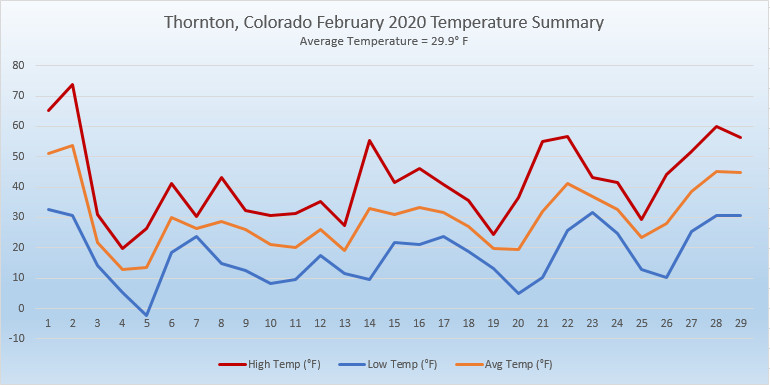
Certainly when you look back on February 2020, you probably will remember it as being cold and snowy. That indeed is true, as the numbers show, however that really only pertained to the first half of the month. The latter part was far more on par with what we expect to see.

The month did start out quite warm as we saw temperature readings well above normal on the first and second. The third, however, brought about significant changes and an end to the warmth that had carried over from January.

Several storm systems moved through over the next 10 days, bringing significantly colder temperatures and regular doses of snow. Indeed, 8 of the first 12 days of the month brought measurable snowfall. Into the third week of the month it appeared we were on pace for one of the coldest Februarys on record.

Things changed again on the 21st and five of the last nine days of the month brought warmer than normal temperatures. This was enough to drive up our average temperature which, while it did come in well below normal, was not in record-setting territory.

Thornton’s average temperature for the month came in at 29.9 degrees. This was a good ways below Denver’s long term average for February of 32.5 degrees. Out at Denver International Airport where the Mile High City’s official measurements are taken, it actually was colder with an average of 28.1 degrees.

Our temperatures ranged from a high of 73.7 degrees on the 2nd down to a low of -2.2 degrees on the morning of the 5th. Out at DIA, they saw their warmest and coldest temperatures of 74 degrees and -5 degrees on the same dates.

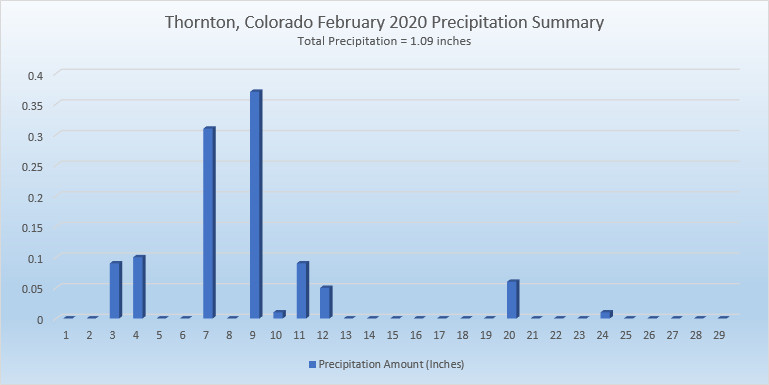
Precipitation came in well above the Denver average for the month of 0.37 inches. Thornton recorded 1.09 inches while Denver measured 0.88 inches.

Snow was of course notable for the first half of the month and drove the monthly totals. On average, Denver receives 5.7 inches in February.  Thornton far surpassed that with 22.1 inches and Denver did as well with 16.5 inches of the white stuff.

Click here to view Thornton’s February 2020 climate report.

Thornton, Colorado's February 2020 Temperature Summary. (ThorntonWeather.com)
Thornton, Colorado’s February 2020 Temperature Summary. (ThorntonWeather.com)
Thornton, Colorado's February 2020 Precipitation Summary. (ThorntonWeather.com)
Thornton, Colorado’s February 2020 Precipitation Summary. (ThorntonWeather.com)
CLIMATE REPORT
NATIONAL WEATHER SERVICE DENVER/BOULDER CO
717 AM MST SUN MAR 1 2020

...................................

...THE DENVER CO CLIMATE SUMMARY FOR THE MONTH OF FEBRUARY 2020...

CLIMATE NORMAL PERIOD 1981 TO 2010
CLIMATE RECORD PERIOD 1872 TO 2020

WEATHER         OBSERVED          NORMAL  DEPART  LAST YEAR`S
                 VALUE   DATE(S)  VALUE   FROM    VALUE  DATE(S)
                                          NORMAL
................................................................
TEMPERATURE (F)
RECORD
 HIGH              80   02/10/2017
 LOW              -25   02/01/1951
                        02/08/1936
HIGHEST            74   02/02        66       8       65  02/03
LOWEST             -5   02/05                -4      -11  02/07
                        02/04
AVG. MAXIMUM     39.9              46.2    -6.3     40.8
AVG. MINIMUM     16.3              18.9    -2.6     15.3
MEAN             28.1              32.5    -4.4     28.0
DAYS MAX >= 90      0               0.0     0.0        0
DAYS MAX <= 32     10               3.9     6.1        8
DAYS MIN <= 32     28              26.9     1.1       26
DAYS MIN <= 0 2 1.3 0.7 3 PRECIPITATION (INCHES) RECORD MAXIMUM 2.01 1934 MINIMUM 0.01 1970 TOTALS 0.88 0.37 0.51 0.72 DAILY AVG. 0.03 0.01 0.02 0.03 DAYS >= .01         9               5.3     3.7        6
DAYS >= .10         4               0.7     3.3        3
DAYS >= .50         0               0.0     0.0        0
DAYS >= 1.00        0               0.0     0.0        0

GREATEST
 24 HR. TOTAL    0.19     02/12

SNOWFALL (INCHES)
TOTALS           16.5               5.7             13.4  2019
RECORD           22.4      2015

DEGREE_DAYS
HEATING TOTAL    1063               908     155     1029
 SINCE 7/1       4499              4468      31     4417
COOLING TOTAL       0                 0       0        0
 SINCE 1/1          0                 0       0        0

FREEZE DATES
RECORD
 EARLIEST     09/08/1962
 LATEST       06/08/2007
EARLIEST                        10/07
LATEST                          05/05
.................................................................

WIND (MPH)
AVERAGE WIND SPEED              10.3
RESULTANT WIND SPEED/DIRECTION   2/212
HIGHEST WIND SPEED/DIRECTION    40/350    DATE  02/25
HIGHEST GUST SPEED/DIRECTION    54/350    DATE  02/25

SKY COVER
POSSIBLE SUNSHINE (PERCENT)   MM
AVERAGE SKY COVER           0.60
NUMBER OF DAYS FAIR            8
NUMBER OF DAYS PC             13
NUMBER OF DAYS CLOUDY          8

AVERAGE RH (PERCENT)     64

-  INDICATES NEGATIVE NUMBERS.
R  INDICATES RECORD WAS SET OR TIED.
MM INDICATES DATA IS MISSING.
T  INDICATES TRACE AMOUNT.

February 2020 top shots: Monthly photo slideshow

An amazing sunset starts off February in style. (Renee Franz)

February signifies the start of the climb toward warmer temperatures for the year.  Cold and snow though do intrude but, coupled with milder conditions, there are lots of photo opportunities as can be seen in our monthly slideshow.

The month is one of our least snowiest of the year but it isn’t unusual to see the landscape blanketed in white.  Warming temperatures through the month can bring the onset of spring fever and gives residents the opportunity to enjoy some prolonged time outdoors on the mild days.

Cold or mild, snowy or dry, our scenery is almost always gorgeous – and photo worthy.

  • Slideshow updated February 28, 2020
  • To learn more about how to send your photo to us for inclusion in the slideshow, see below the slideshow.

Showcasing images captured by ThorntonWeather.com readers as well as some of our own, our monthly slideshow covers the entire gamut of weather-related imagery.

Sunsets, sunrises, wildlife and of course every type of weather condition are vividly depicted in images captured from yours and our cameras.

[flickr_set id=”72157712939478292″]

What is missing in the slideshow above?  Your photo!

Our monthly photo slideshow is going to feature images that we have taken but more importantly images that you have captured.  The photos can be of anything even remotely weather-related.

Landscapes, current conditions, wildlife, pets, kids.  Whimsical, newsy, artsy.  Taken at the zoo, some other area attraction, a local park, a national park or your backyard.  You name it, we want to see and share it!

Images can be taken in Thornton, Denver or anywhere across the extraordinary Centennial State.  We’ll even take some from out of state if we can tie it to Colorado somehow.

We’ll keep the criteria very open to interpretation with just about any image eligible to be shown in our slideshows.

What do you win for having your image in our slideshow?  We are just a ‘mom and pop’ outfit and make no money from our site so we really don’t have the means to provide prizes.  However you will have our undying gratitude and the satisfaction that your images are shared on the most popular website in Thornton.

To share you images with us and get them included in the slideshow just email them to us or share them with ThorntonWeather.com on any of the various social media outlets.  Links are provided below.

So come on, get those camera’s rolling!

Thornton’s February 2020 weather preview: Temps warm and not much snow

4February in Colorado typically brings to an end an extended period when average temperatures are at their lowest. Winter begins to loosen its grip and temperatures get warmer but precipitation is not a particularly common event during the month.
Thus far, our snow season has been a mixed bag. We started fast in October and November but December and January added very little to the totals.  February is only our sixth snowiest month so we may not see much snowfall for the balance of the month.

Temperatures however do usually see a nice rebound during the month. Average high temperatures climb from an average of 44 degrees at the start to 50 degrees by the end of February.

For the complete February preview including a look at historical averages and extremes as well as a look at what long range forecasts are predicting, click here. 

February 2019 weather recap: Thornton experiences a very cold, somewhat snowy month

Cold and snow. Those were certainly the operative words for the month of February 19. Thornton recorded its coldest February in the past 12 years and its snowiest month overall since March 2016.

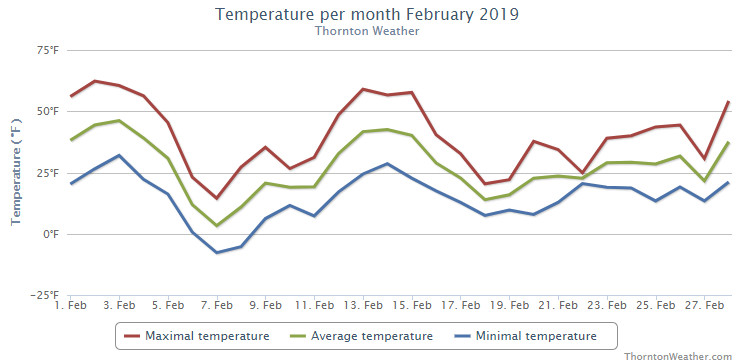
Mild temperatures started things off for the first four days of the month and fooled us into thinking of an early spring. Those dreams were soon crushed though as the first extended period of below normal temperatures arrived on the 6th. Six straight days of below normal temperatures then arrived as did our first shot of snow for the month.

We rebounded briefly for a four day period from the 12th to the 15th with mild temperatures. Once again though, the mercury plunged delivering 13 straight days of below normal temperatures and five days of measurable snowfall.

Thornton recorded an average temperature for the month of 26.3 degrees. This was our coldest February since ThorntonWeather.com came online in 2007 – by more than two degrees. Out at Denver International Airport where the Mile High City’s official readings are taken it was slightly warmer with an average of 28.0 degrees.  Both were well below Denver’s long term February average of 32.5 degrees for February.

While certainly cold, neither average reading for the month could crack Denver’s list of top 10 coldest Februarys.

Thornton saw its warmest mercury reading for the month of 62.3 degrees on the second. Its coldest reading of -7.7 degrees came on the 7th of the month. Denver saw a maximum of 65 degrees on the 3rd and its low of -11 degrees on the 7th.

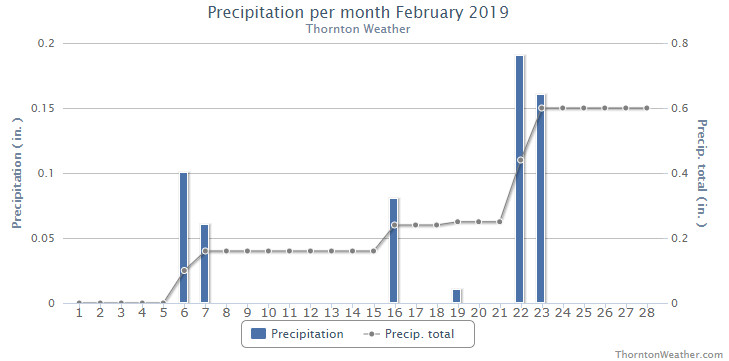
February is usually a dry month with Denver averaging 0.37 inches of liquid precipitation. Thornton recorded 0.60 inches this year while Denver saw 0.72 inches.

Similarly, snow was a good bit above normal for February as well. Thornton saw 11.2 inches of the white stuff while out at the airport 13.4 inches was recorded.

Click here to view Thornton’s January 2019 climate report.

Thornton, Colorado's temperature summary for February 2019. (ThorntonWeather.com)
Thornton, Colorado’s temperature summary for February 2019. (ThorntonWeather.com)
Thornton, Colorado's precipitation summary for February 2019. (ThorntonWeather.com)
Thornton, Colorado’s precipitation summary for February 2019. (ThorntonWeather.com)
CLIMATE REPORT
NATIONAL WEATHER SERVICE DENVER/BOULDER CO
555 AM MST FRI MAR 1 2019

...................................

...THE DENVER CO CLIMATE SUMMARY FOR THE MONTH OF FEBRUARY 2019...

CLIMATE NORMAL PERIOD 1981 TO 2010
CLIMATE RECORD PERIOD 1872 TO 2019

WEATHER         OBSERVED          NORMAL  DEPART  LAST YEAR`S
                 VALUE   DATE(S)  VALUE   FROM    VALUE  DATE(S)
                                          NORMAL
................................................................
TEMPERATURE (F)
RECORD
 HIGH              80   02/10/2017
 LOW              -25   02/01/1951
                        02/08/1936
HIGHEST            65   02/03
LOWEST            -11   02/07
AVG. MAXIMUM     40.8              46.2    -5.4     44.4
AVG. MINIMUM     15.3              18.9    -3.6     15.4
MEAN             28.0              32.5    -4.5     29.9
DAYS MAX >= 90      0               0.0     0.0        0
DAYS MAX <= 32      8               3.9     4.1        6
DAYS MIN <= 32     26              26.9    -0.9       26
DAYS MIN <= 0       3               1.3     1.7        3

PRECIPITATION (INCHES)
RECORD
 MAXIMUM         2.01   1934
 MINIMUM         0.01   1970
TOTALS           0.72              0.37    0.35     0.31
DAILY AVG.       0.03              0.01    0.02     0.01
DAYS >= .01         6               5.3     0.7        5
DAYS >= .10         3               0.7     2.3        2
DAYS >= .50         0               0.0     0.0        0
DAYS >= 1.00        0               0.0     0.0        0
GREATEST
 24 HR. TOTAL    0.41   02/22

             OBSERVED            NORMAL   DEPART   LAST YEAR`S
SNOWFALL (INCHES)
TOTAL            13.4               5.7      7.7     6.2
RECORD FEB       22.4   2015
SEASON TOTAL     27.8              35.2

DEGREE_DAYS
HEATING TOTAL    1029               908     121      975
 SINCE 7/1       4417              4439     -22     4057
COOLING TOTAL       0                 0       0        0
 SINCE 1/1          0                 0       0        0

FREEZE DATES
RECORD
 EARLIEST     09/08/1962
 LATEST       06/08/2007
EARLIEST                        10/07
LATEST                          05/05
.................................................................

WIND (MPH)
AVERAGE WIND SPEED              9.5
RESULTANT WIND SPEED/DIRECTION   1/176
HIGHEST WIND SPEED/DIRECTION    35/060    DATE  02/14
HIGHEST GUST SPEED/DIRECTION    42/070    DATE  02/14

SKY COVER
POSSIBLE SUNSHINE (PERCENT)   MM
AVERAGE SKY COVER           0.60
NUMBER OF DAYS FAIR            3
NUMBER OF DAYS PC             20
NUMBER OF DAYS CLOUDY          5

AVERAGE RH (PERCENT)     66

WEATHER CONDITIONS. NUMBER OF DAYS WITH
THUNDER        0   FREEZING RAIN    0      LIGHT SNOW    14
MIXED PRECIP   0   LGT FR RAIN      0      ICE PELLETS    0
HEAVY RAIN     0   HAIL             0      FOG           17
RAIN           0   HEAVY SNOW       2      HEAVY FOG     11
LIGHT RAIN     0   MODERATE SNOW    3      HAZE           8

-  INDICATES NEGATIVE NUMBERS.
R  INDICATES RECORD WAS SET OR TIED.
MM INDICATES DATA IS MISSING.
T  INDICATES TRACE AMOUNT.

February 2019 top shots: Monthly photo slideshow

February 4, 2019 - A bison and bird boop noses on a mild winter day. (Jessica Fey)
February 4, 2019 – A bison and bird boop noses on a mild winter day. (Jessica Fey)

February signifies the start of the climb toward warmer temperatures for the year.  Cold and snow though do intrude but, coupled with milder conditions, there are lots of photo opportunities as can be seen in our monthly slideshow.

The month is one of our least snowiest of the year but it isn’t unusual to see the landscape blanketed in white.  Warming temperatures through the month can bring the onset of spring fever and gives residents the opportunity to enjoy some prolonged time outdoors on the mild days.

Cold or mild, snowy or dry, our scenery is almost always gorgeous – and photo worthy.

  • Slideshow updated February 27, 2019
  • To learn more about how to send your photo to us for inclusion in the slideshow, see below the slideshow.

Showcasing images captured by ThorntonWeather.com readers as well as some of our own, our monthly slideshow covers the entire gamut of weather-related imagery.

Sunsets, sunrises, wildlife and of course every type of weather condition are vividly depicted in images captured from yours and our cameras.

[flickr_set id=”72157676280611747″]

What is missing in the slideshow above?  Your photo!

Our monthly photo slideshow is going to feature images that we have taken but more importantly images that you have captured.  The photos can be of anything even remotely weather-related.

Landscapes, current conditions, wildlife, pets, kids.  Whimsical, newsy, artsy.  Taken at the zoo, some other area attraction, a local park, a national park or your backyard.  You name it, we want to see and share it!

Images can be taken in Thornton, Denver or anywhere across the extraordinary Centennial State.  We’ll even take some from out of state if we can tie it to Colorado somehow.

We’ll keep the criteria very open to interpretation with just about any image eligible to be shown in our slideshows.

What do you win for having your image in our slideshow?  We are just a ‘mom and pop’ outfit and make no money from our site so we really don’t have the means to provide prizes.  However you will have our undying gratitude and the satisfaction that your images are shared on the most popular website in Thornton.

To share you images with us and get them included in the slideshow just email them to us or share them with ThorntonWeather.com on any of the various social media outlets.  Links are provided below.

So come on, get those camera’s rolling!

February 24 to March 2: This Week in Denver Weather History

This week in Denver weather history
February 24 to March 2: This Week in Denver Weather History

As February comes to a close, one of our snowiest months, March, is ahead.  Our look back at this week in Denver weather history shows there have indeed been some significant snowfalls as well as high wind events.

From the National Weather Service:

22-29

In 1960…heavy snowfall of 6.1 inches at Stapleton Airport on the 22nd and 23rd marked the beginning of a protracted cold spell which lasted until the end of the month. The cloudy… Cold weather was accompanied by occasional light snow or flurries and fog. New record low temperatures for the dates were set on the 24th thru the 29th with the lowest temperature of 11 degrees below zero on the 28th. The seven consecutive days of low temperatures of zero or below had been exceeded in duration only 4 times previously. New low maximum temperatures for the dates were set on the 23rd… 24th…and the 26th thru the 29th with the lowest maximum temperature of 8 degrees recorded on the 26th.

23-24

In 1935…northwest winds sustained to 37 mph with gusts as high as 47 mph produced considerable blowing dust behind a cold front on the 23rd. The dust was dampened by 7.0 inches of snowfall over downtown Denver from the late evening of the 23rd through the evening of the 24th.

In 1997…heavy snow fell in the foothills. Snowfall totals included 8 inches at sunshine canyon northwest of Boulder… And 6 inches at Morrison. Snowfall totaled only 2.4 inches at the site of the former Stapleton International Airport. East winds gusted to only 22 mph at Denver International Airport on the 23rd.

23-25

In 1912…a severe winter storm dumped 14.2 inches of snowfall over downtown Denver. Snow fell continuously from 9:40 am on the 23rd until 9:15 pm on the 25th with most of the snow… 9.2 inches…on the 24th. Temperatures were mostly in the 20’s. Northeast winds were sustained to 20 mph on the 24th.

24

In 1908…a duststorm occured in the city from mid-morning through mid-day. North winds were sustained from 30 to 35 mph.

In 1927…northwest winds were sustained to 42 mph with an extreme velocity to 46 mph.

In 1924…fog deposited a light coating of glaze…which was very thin and only accumulated on the windward side of cold objects. Streets and sidewalks became slippery.

In 1956…a strong cold front produced north wind gusts to 54 mph…but left only 2.0 inches of snowfall at Stapleton Airport.

In 1959…heavy snowfall totaled 7.5 inches at Stapleton Airport…where north-northeast winds gusted to only 18 mph.

In 1968…west-northwest winds gusted to 49 mph at Stapleton International Airport. The strong Chinook winds warmed the maximum temperature to 61 degrees…the highest temperature of the month that year.

In 1986…wind gusts to 65 mph were reported at Table Mesa in Boulder. West winds gusted to only 28 mph at Stapleton International Airport where the high temperature of 70 degrees equaled the record for the date.

In 1991…the only measurable snowfall for the month totaled only 0.8 inch at Stapleton International Airport where north winds gusted to 28 mph. The light snow fell for most of the day.

In 1994…high winds raked the eastern foothills. Wind speeds of 70 to 80 mph were common. Wind gusts to 110 mph were recorded at the National Center for Atmospheric Research in south Boulder…while in north Boulder winds gusted to 95 mph. The strong winds blew the roof off a building at red rocks community college in Lakewood…causing the evacuation of about 1500 people. A semi-trailer and a delivery truck were overturned. In Lakewood…a home under construction was destroyed by the winds. There were numerous reports of vehicles damaged by flying debris…and many automobile windshields were shattered. West wind gusts to 47 mph were recorded at Stapleton International Airport.

In 2013…A storm system near the Four Corners region produced heavy upslope snowfall in and near the Front Range with blizzard conditions further east as it made its way across southern Colorado. In the Front Range Mountains and Foothills storm totals included: 27 inches near Pinecliffe; 24 inches…13 miles northwest of Golden; 20 inches near Genesee; 17 inches near Conifer; 15 inches near Jamestown; 14 inches…just southwest of Eldorado Springs; 12.5 inches near Aspen Springs; 12 inches near Evergreen and Ward; 10 inches at Eldora Ski Area; with 8 inches near Gross Reservoir…Idaho Springs and Nederland. Across the Urban Corridor storm totals included: 12 inches in Aurora; 11.5 inches near Highlands Ranch; 11 inches in Lakewood; 10.5 inches just north of Longmont and Westminster; 10 inches in Lone Tree and Thornton; 8.5 inches in Aurora…6 miles southwest of Denver and near Loveland; 8 inches at Boulder… Broomfield…and Ralston Reservoir; 7.5 inches near Frederick…with 7 inches at Commerce City. The storm prompted the cancellation of 200 flights in and out of Denver International Airport. Officially…the storm system produced 9.1 inches of snow at DIA which established a new daily snowfall record in Denver for the date. Along and south of the I-70 corridor and east of Denver…the combination of heavy snow and strong wind produced blizzard conditions. Storm totals included: 14 inches…10 miles south-southeast of Buckley AFB…10.5 inches…8 miles southeast of Watkins; with 6 inches near Byers. Northerly winds of 25 to 30 mph were common with gusts to 40 mph. At DIA…a peak wind gust of 32 mph was observed.

25

In 1887…northwest winds were sustained to 47 mph.

In 1904…the low temperature cooled to only 49 degrees…the all-time record high minimum temperature for February.

In 1957…north winds gusted to 49 mph at Stapleton Airport.

In 1998…a bora wind storm developed in the Front Range foothills and adjacent plains as winds gusted between 60 and 75 mph. Peak wind gusts during the storm included: 75 mph atop Blue Mountain near Wondervu…60 mph in south Boulder and at Jefferson County Airport near Broomfield. West winds gusted to 32 mph at Denver International Airport.

In 2000…high winds occurred in and near the foothills. Winds gusted to 84 mph at the Rocky Flats Environmental Test Facility south of Boulder and to 71 mph atop Niwot Ridge in the mountains west of Boulder. West winds gusted to only 36 mph at Denver International Airport.

25-26

In 1971…a wind gust to 100 mph was recorded in Boulder at the National Center for Atmospheric Research. The cold west winds gusted to 53 mph in downtown Boulder. No damage was reported. Northwest winds gusted to 31 mph on the 25th and to 38 mph on the 26th at Stapleton International Airport.

In 1984…a heavy snow storm left 1 to 2 feet of new snow in the foothills west of Denver. I-70 was closed…stranding skiers returning from the mountains. Most had to spend several hours in Idaho Springs. The snow spread over metro Denver with 9 inches at Littleton…Castle Rock…and Boulder and up to 5 inches in Aurora and Denver. Snowfall totaled only 3.6 inches at Stapleton International Airport where north winds gusted to 31 mph.

26

In 1884…heavy snowfall totaled 6.0 inches in downtown Denver.

In 1908…a duststorm occurred in the city during the afternoon. Northwest winds were sustained from 14 to 24 mph.

In 1918…pre-frontal Chinook winds from the southwest… Sustained to 43 mph with a maximum velocity to 52 mph… Warmed temperatures to a high of 62 degrees.

In 1954…strong Chinook winds gusting to 52 mph during the morning warmed the temperature in Denver to a balmy 65 degrees by early afternoon. A vigorous Canadian cold front during the late afternoon produced north winds at sustained speeds of 52 mph with gusts as high as 65 mph and billows of blowing dust…which reduced the visibility to as low as 1 mile at Stapleton Airport. Showers left half an inch of snow on the ground as the temperature dipped to a low of 27 degrees before midnight.

In 1989…a brief rain shower produced a microburst wind gust to 51 mph at Stapleton International Airport.

In 1997…snowfall totaled 4 to 6 inches in and near the foothills. Only 0.8 inch of snow fell at the site of the former Stapleton International Airport. Northeast winds gusted to 29 mph at Denver International Airport.

In 2013…a storm system produced heavy snow in the Front Range Foothills. Storm totals included: 12 inches near Black Mountain and Pine Junction…10 inches near Conifer and Nederland; 9 inches…12 miles northwest of Golden; 8 inches near Evergreen…with 6 inches near Eldorado Springs. Snow and blowing snow produced blizzard conditions along and south of the Interstate 70 corridor…just east of Denver. Storm totals generally ranged from 3 to 7 inches. North winds of 25 to 30 mph were reported with gusts around 40 mph. Roads became impassable as snow and blowing snow produced 3 to 4 ft snow drifts. Interstate 70 was closed from Aurora to the Kansas state line. At Denver International Airport…a peak wind gust to 31 mph was reported along with 1.0 inch of snow.

Continue reading February 24 to March 2: This Week in Denver Weather History