September 13 to September 19: This week in Denver weather history

This Week in Denver Weather History

Weather conditions in Colorado can of course vary greatly and we always see that in our weekly look back in the history books.  For this week, we see a dizzying array of weather events from record setting temperatures in the 90’s and summer-like thunderstorms with tornadoes to an early arrival of winter that brought a foot of snow!

From the National Weather Service:

5-13

In 2010…the Fourmile Canyon wildfire…northwest of Boulder… Broke out on the morning of the 5th. It originated from an unattended fire pit at a local residence. The wildfire quickly consumed 5 1/2 square miles or 3500 acres the first day…and forced the evacuation of over three thousand residents. Erratic 45-mph gusts sent the fire in two directions at times. Very dry weather conditions preceded the fire. The combination of strong winds…low relative humidities and dry fuels allowed the wildfire spread rapidly through the steep…heavily forested terrain. The flames were reportedly 20 to 50 feet in length. Towns within the burn area included Salina…Wallstreet and Gold Hill. The dry conditions coupled with gusty winds ranging from 45 to 64 mph persisted for several more days. Fire managers used as many as 700 firefighters and support personnel from 35 agencies and seven air tankers to battle the wildfire. A total of 6181 square acres or approximately 10 square miles were burned. The Fourmile Canyon wildfire was the most destructive fire in Colorado history in terms of the damage to personal property. It destroyed 171 homes with an estimated cost of 217 million dollars.

11-16 in 2013…a deep southerly flow over Colorado… Ahead of a nearly stationary low pressure system over the great basin… Pumped copious amounts of monsoonal moisture into the area. In addition…a weak stationary front stretched along the Front Range foothills and Palmer Divide.  This resulted in a prolonged period of moderate to heavy rain across the Front Range foothills…Palmer Divide…urban corridor. By the 14th…storm totals ranged from 6 to 18 inches… Highest in the foothills of Boulder County. The headwaters then moved down the South Platte River and caused widespread flooding with record flood stages at several locations as it made its way downstream.  The record high flood stages resulted in widespread flooding along the South Platte River basin. The flood damage encompassed 4500 square miles of the Front Range…left 7 dead… Forced thousands to evacuate…and destroyed thousands of homes and farms. Record amounts of rainfall generated flash floods that tore up roads and lines of communication… Leaving many stranded. Nearly 19000 homes were damaged… And over 1500 destroyed. Colorado department of transportation estimated at least 30 state highway bridges were destroyed and an additional 20 seriously damaged. Preliminary assessments of the state`s infrastructure showed damage of $40 million to roads and $112 million to bridges. Repair costs for state and county roads ran into the hundreds of millions of dollars. Miles of freight and passenger rail lines were washed out or submerged… Including a section servicing Amtrak`s iconic California Zephyr. The town of Lyons was isolated by the flooding of St. Vrain creek…and several earth dams along the Front Range burst or were over-topped. Floodwaters swept through Estes Park; damaged hundreds of buildings and destroyed large sections of U.S. 34 from Loveland and U.S. 36 from Lyons to Boulder. U.S. 34 suffered the most damage… With 85 percent of its roadway and bridges destroyed. In Weld County…about nearly two thousand gas wells were damaged and had to be closed off as the floodwaters inundated entire communities. Sewage treatment plants and other utilities were knocked out in a number of towns. Governor Hickenlooper declared a disaster emergency on September 13th…in 11 counties across northeast Colorado including:  Adams…Arapahoe…Broomfield…Boulder…Denver…  Jefferson…Larimer…Logan…Morgan… Washington and Weld. By the 15th…federal emergency declarations covered those counties as well as Clear Creek County. Projected losses from the flooding statewide was nearly two billion dollars in property damage…according to Eqecat… A catastrophe modeling firm.  The damage was most severe in and around Lyons and Boulder.  More than 11 thousand people were evacuated…reportedly the largest since Hurricane Katrina. President Obama declared a state of emergency for Boulder and Larimer counties.  An additional 10 counties were added on the 16th and included: Adams… Arapahoe…Broomfield…Clear Creek…Denver…Jefferson…  Morgan…Logan… Washington and Weld counties. The president also declared a major disaster specifically for Boulder County.  There were six fatalities directly attributed to flash flooding. Two 19-yr old teenagers died on the 11th…after they were swept away by floodwaters after abandoning their car on Lindon Drive in Boulder. In Jamestown…a 72-yr old man was killed when the building he was in collapsed. An 80-yr old Lyons resident died in the early morning hours of the 12th…when his truck was swept into the St. Vrain River near his home. Later on the 12th…a 79-yr old Larimer County resident was killed when she was swept away while trying to climb to safety from her home in Cedar Point. A 61-yr old cedar point resident died when her home was swept down the Big Thompson River by the floodwaters. An 80-yr old Idaho Springs resident drowned in Clear Creek when the embankment he was standing on collapsed. In Boulder…some of the monthly records broken included: one-day all-time record: 9.08 inches which shattered the previous wettest day of 4.8 inches set on July 31… 1919; one-month record of 18.16 inches…which broke the previous all-time monthly record of 9.59 inches set in May of 1995; wettest September on record which broke the previous record of 5.5 inches set in September of 1940; one-year record of 34.15 inches broke the previous wettest year of 29.93 inches set in 1995. At Denver International Airport…the total precipitation for the month of September was 5.61 inches…which was 4.65 inches above the normal of 0.96 inches. This is the most precipitation ever recorded in Denver for the month of September. Daily precipitation records included 1.11 inches on the 12th and 2.01 inches on the 14th.

13

In 1899…west winds were sustained to 43 mph with gusts to 46 mph.

In 1928…northwest winds were sustained to 41 mph with gusts to 45 mph.

In 1937…an apparent dry microburst produced brief north winds sustained to 31 mph with gusts to 41 mph.  There was a trace of rain.

In 1982…torrential rains drenched both the foothills and plains from Denver north.  While the heaviest rain occurred north of Denver…just east of Denver 2 1/3 inches of rain fell in 5 hours along with hail that caused minor damage to a few airplanes.  Thunderstorm rainfall totaled 0.83 inch at Stapleton International Airport.

In 1993…an upper level system combined with a cold and moist upslope flow to bring the heaviest snowfall to metro Denver for so early in the season.  Snowfall from the storm totaled 5.4 inches at Stapleton International Airport; however…most of the snow melted as it fell leaving a maximum of one inch on the ground at any one time.  North winds gusted to 21 mph at Stapleton International Airport where a record low temperature of 33 degrees for the date was observed.

In 2002…Friday the 13th proved to be bad luck for several motorists when heavy thunderstorm rainfall caused flooding on I-25 in central Denver.  Water rose several feet under the Logan Street overpass…inundating several vehicles. Some motorists were rescued…while others simply waited atop their cars for the flood water to recede.  The highway had to be closed in both directions for about 3 hours.  The flooding was exacerbated by poor drainage due to the construction along the highway.  A 12-foot drainage pipe had not yet been installed beneath the underpass.  The deluge also flooded several businesses along Broadway.

In 2009…a severe thunderstorm produced large hail… Up to half dollar size in the foothills of Jefferson County…west of Denver.

14

In 1912…snow fell for most of the day…but melted as it fell. Precipitation from melted snow was 0.46 inch.  Some sleet was also observed.  Total precipitation was 0.61 inch.  North winds were sustained to 15 mph with gusts to 17 mph.

In 1934…a moderate dust storm blew into the city at 4:15 pm. North winds were sustained to 35 mph with gusts to 44 mph. By 5:25 pm the winds had decreased and the storm had ended. A trace of rain fell during the evening.

In 1976…a tornado touched down just west of I-25 between Arapahoe Road and Dry Creek Road…tearing the roof from a house.  Nearby…a high tension wire fell on a house causing damage…and lightning ripped a hole in the side of a house. Three tornadoes were observed just east of Stapleton International Airport and northeast of Buckley Field.  No damage was reported.  Dime to quarter size hail fell in northeast Denver with only 1/4 inch hail at Stapleton International Airport.  The Colorado State Patrol reported golf ball size hail 4 miles west of Franktown.  A funnel cloud was sighted 4 miles north of Franktown.

In 1983…a thunderstorm produced winds gusts as high as 56 mph across metro Denver along with thick blowing dust. Power was knocked out in many locations.  Thunderstorm winds gusting to 49 mph briefly reduced the visibility to 2 miles in blowing dust at Stapleton International Airport.

In 1996…a 54-year-old woman was struck by lightning near Franktown…as she was preparing an outdoor barbeque.  The woman was knocked unconscious…but received only minor injuries.  Thunderstorms over southern Jefferson County dumped heavy rain in the buffalo creek area.  Some minor roads were washed out by flash flooding…but no other damage was reported.  Hail ranging in size from 1/2 to 3/4 inch in diameter fell at the site of the former Stapleton International Airport.

In 2006…a microburst from a thunderstorm produced sustained winds to 40 mph with gusts to 53 mph at Denver International Airport.

Continue reading September 13 to September 19: This week in Denver weather history

Denver ties one cold weather temperature record for September 9, breaks another

As our first taste of wintry weather for the season comes to an end, we close it out with two more weather records in the books.

This morning, as measured at Denver International Airport, the temperature dropped to 31 degrees. This ties the Mile High City’s record low for September 9 set in 1962.

The daytime didn’t bring much relief as the high at the airport only reached 42 degrees. This shatters the old record low maximum for the date of 53 degrees set in 1989.

Here in Thornton, we matched both of those marks with a low of 31 degrees and a high of 42 degrees.

The past few days have seen an extraordinary bout of weather as we went from record heat to record cold. The graphic below shows just some of what has occurred.

Some of the weather records tied or broken in the first part of September 2020. Click for a larger view. (National Weather Service)

Denver ties two cold weather records for September 8, sees second earliest snow on record

Record Cold Temperatures

From record heat to record cold. You must live in Colorado. 😉  Today, Denver tied two cold weather records and saw its second earliest snow on record.

As measured at Denver International Airport, the low temperature in the Mile High City dropped to 31 degrees at 7:33pm. This ties the record low temperature for September 8 last set in 1962. Going hand-in-hand with that record, it tied the record for the earliest freeze in Denver history last set on the same date.

Here in Thornton, we managed to stay just a hair warmer with a low of 32 degrees.

Notable as well is that the Mile High City’s official 1.0 inch of snow is the second earliest snowfall on record. The snow was also the first September snowfall seen in 20 years. The number one spot for earliest snow on record, September 3, 1962, remains secure.

September 6 to September 12: This week in Denver weather history

This Week in Denver Weather History

Colorado weather is certainly varied and this week’s look back at weather history proves that.  We have seen everything from deadly lightning, hail and severe winds to even snow during the second week of September.  Most notably however were the devastating – and deadly – floods of 2013.

1-7

In 1978…the temperature reached 90 degrees or more on seven consecutive days with the highest temperature…94 degrees… Recorded on both the 4th and 6th.

3-6

In 1909…rainfall for the 4 days accumulated to 3.97 inches in Boulder…while in Denver rainfall totaled 2.45 inches on the 4th…5th…and 6th.

5-9

In 1988…layers of smoke aloft from large forest fires in Yellowstone National Park completely obliterated the sun at times.  At Stapleton International Airport…surface visibility was reduced at times to 5 and 6 miles in smoke.

5-13

In 2010…the Fourmile Canyon wildfire…northwest of Boulder… Broke out on the morning of the 5th. It originated from an unattended fire pit at a local residence. The wildfire quickly consumed 5 1/2 square miles or 3500 acres the first day…and forced the evacuation of over three thousand residents. Erratic 45-mph gusts sent the fire in two directions at times. Very dry weather conditions preceded the fire. The combination of strong winds…low relative humidities and dry fuels allowed the wildfire spread rapidly through the steep…heavily forested terrain. The flames were reportedly 20 to 50 feet in length. Towns within the burn area included Salina…Wallstreet and Gold Hill. The dry conditions coupled with gusty winds ranging from 45 to 64 mph persisted for several more days. Fire managers used as many as 700 firefighters and support personnel from 35 agencies and seven air tankers to battle the wildfire. A total of 6181 square acres or approximately 10 square miles were burned. The Fourmile Canyon wildfire was the most destructive fire in Colorado history in terms of the damage to personal property. It destroyed 171 homes with an estimated cost of 217 million dollars.

6

In 1940…a thunderstorm pelted the city with small hail. The storm produced some lightning damage.  One woman was stunned by a bolt which struck near her.  Heavy rain from the storm raised the level of Cherry Creek by more than 3 feet during the height of the storm.  Rainfall downtown was only 0.26 inch.

In 1988…strong winds blew down two houses that were under construction in Castle Rock.  Northwest winds gusted to 44 mph at Stapleton International Airport.

In 1993…a man was struck and killed by lightning while standing outside his home in unincorporated Arapahoe County 11 miles south of Denver.  Lightning also struck a cabin in Marshdale…20 miles southwest of Denver…which started a fire and damaged one room and a portion of the roof.

In 1995…hail as large as 3/4 inch in diameter fell in Coal Creek Canyon in northern Jefferson County.

In 2001…a thunderstorm dropped 3/4 inch diameter hail in Aurora near Cherry Creek.

7

In 1875…the creeks were running dangerously high during the night from heavy rains in the mountains.

In 1885…a thunderstorm produced very white hail of irregular shape and about the size of beans.  Precipitation was only 0.10 inch.

In 1971…a vigorous cold front accompanied by a thunderstorm produced wind gusts to 48 mph at Stapleton International Airport and much upslope cloudiness and light rain across metro Denver.

In 1989…widespread thunderstorms produced lightning strikes that knocked out power to about 13 thousand homes in Boulder County.  In a rugged area stripped of vegetation by a forest fire earlier in July…heavy rain triggered mud slides that destroyed one home and severely damaged another in Boulder canyon 10 miles west of Boulder.  In one home…the mud caved in an exterior wall and poured into the residence only seconds after 2 people had evacuated the premises. Rainfall totaled 1 to 3 inches.  Hail 1 3/4 inches in diameter fell in Nederland…Idaho Springs…and Golden Gate Canyon.  Hail 1 inch in diameter was measured 10 miles north of Golden.

In 1993…thunderstorm winds toppled an overhead sign onto the intersection of I-70 and I-25 in Denver…causing considerable damage to 4 vehicles.  The winds also caused a police car to be blown off the road northeast of Denver. Thunderstorm winds gusting to 66 mph damaged the siding of a residence southeast of Brighton.  A thunderstorm wind gust to 53 mph was recorded at Stapleton International Airport.  Hail to 7/8 inch in diameter fell at Kittredge in the foothills of Jefferson County.

In 1994…lightning severely damaged a public television transmitter atop squaw mountain west of Denver.

7-8

In 1884…a windstorm from mid-afternoon until the early morning hours of the 8th produced south winds sustained to 48 mph.  The strong winds toppled several trees in the city.

In 1892…there was a trace of rainfall each day.  This together with a trace of rain on both the 2nd and 3rd was the only rainfall of the month…making the month the driest on record.  The record was equaled in 1944.

8

In 1886…the last thunderstorm of the season pelted the city with hail the size of beans and dropped 0.81 inch of precipitation.

In 1962…the earliest first freeze of the season occurred. The temperature dipped to a low of 31 degrees.

In 1973…hail up to 1 1/2 inches in diameter fell northeast of Boulder.  A tornado was reported by a pilot east of Parker.  No damage was reported.

9

In 1933…heavy rain in the foothills over the clear creek and Golden gate canyon watersheds caused flooding in Golden and damaged the roadway in Golden gate canyon… Which resulted in its closure.

In 1969…a funnel cloud was sighted in southeast Denver. There was also considerable thunderstorm activity and local heavy rain across metro Denver.  Rainfall totaled 1.30 inches at Stapleton International Airport where small hail also fell.

In 1973…hail from 3/4 inch to 1 3/4 inches in diameter fell in Westminster and south of Broomfield.

In 2009…a man was critically injured when he was struck by lightning while riding his bicycle.  He was nearing a paramedic van when he was hit.  His heart stopped but paramedics quickly responded and were able to resuscitate him.

In 2011…a man was struck by lightning at the Adams County Fairgrounds.  He was leaning against a tree while watching a cross country meet when the tree was hit.  The lightning traveled down the tree and up through the ground…using him as a conductor.  The victim received second and third degree burns.

Continue reading September 6 to September 12: This week in Denver weather history
Denver sets record high minimum and ties record high for September 6

Record High Temperature

Our recent warm weather not only impacts daily high temperatures, it also impacts overnight lows as seen by the record set tonight.

As measured at Denver International Airport, the Mile High City saw a low of 67 degrees. This set a record high minimum for the date, beating the old mark of 66 degrees set in 1933.

Here in Thornton, we were quite a bit cooler seeing a low of 56 degrees.

Additionally, Denver’s official high temperature came in at 97 degrees. This tied the record high for September 6, last set in 2013. Thornton was actually hotter with a high of 99 degrees.

Multiple high temperature records broken on September 5

Record High Temperature

While snow and cold are on the horizon, that will wait and until then, we continue to experience extraordinarily warm weather. Today, September 5, Denver actually broke three records.

As measured at Denver International Airport, the high temperature topped out at 101 degrees. This easily bested the record high temperature for the date of 98 degrees set just last year.

Additionally, the 101 degree reading is the warmest temperature ever recorded in Denver during the month of September. Only one other time has it been 100 degrees or warmer in the month, that coming on September 2, 2019 with a 100 degree reading.

Lastly, this is the latest in the year a 100 degree or higher reading has been recorded.

Here in Thornton, we managed to stay just a bit cooler with a high of 99 degrees.

September snow in Denver is not entirely uncommon

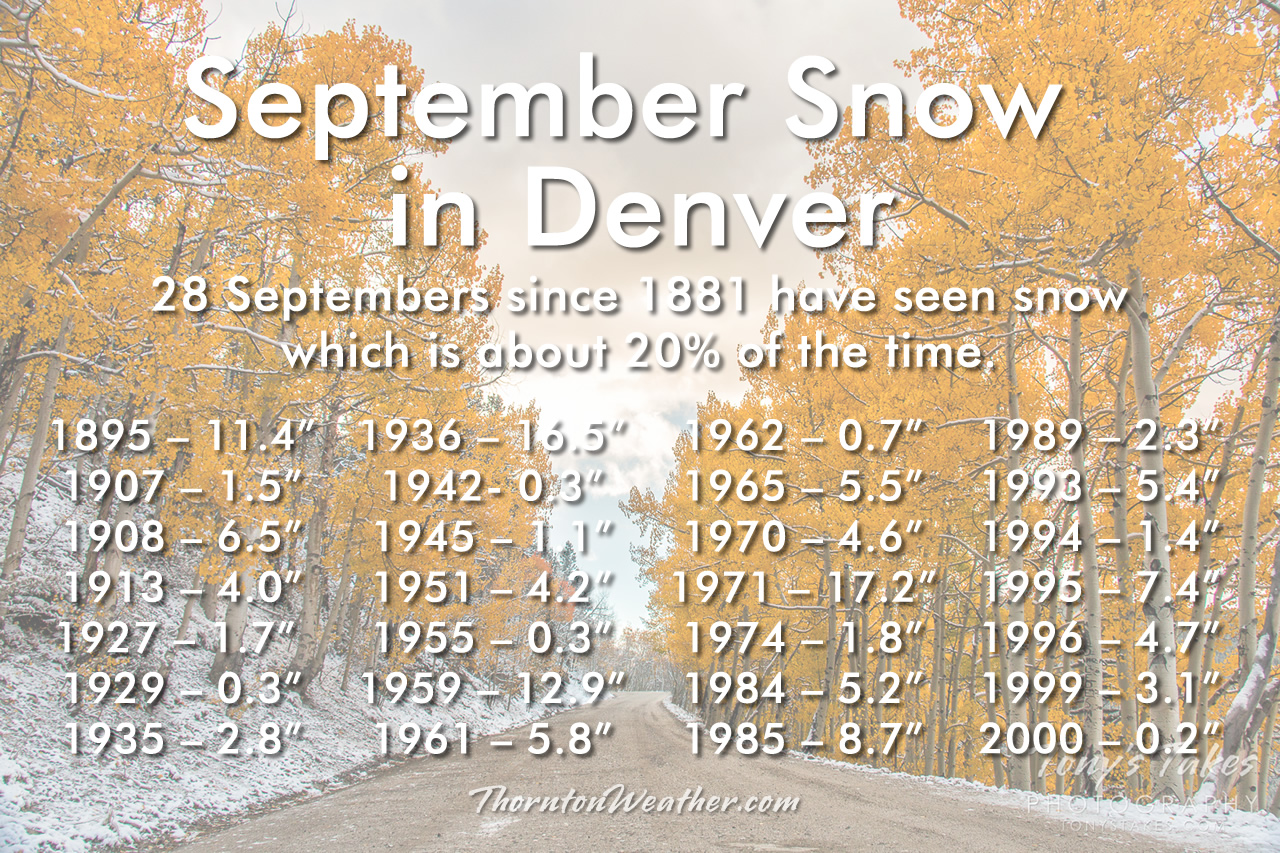
Denver September Snow History. (ThorntonWeather.com)
Denver September Snow History. Click for larger view. (ThorntonWeather.com)

There is lots of talk (and hype!) about next week’s storm and the potential for our first snowfall of the season. While it is somewhat unusual to get snow so early in the season, it is far from unprecedented and not near as rare as you might think.

Whipping out the weather history books, we see that snow has fallen in 28 Septembers in the 139 years since the National Weather Service began recording snow in the Mile High City. That equates to about 20% of the years.

It has, however, been quite a while since we have seen one, the most recent occurring in 2000. That was the last in a stretch in which six out of eight years saw September snow.

Our earliest snowfall on record came on September 3, 1961 when 4.2 inches of the white stuff fell. The average date of Denver’s first snow is October 18th.

Most concerning about these early season snows is the potential for tree damage and power outages. Like spring storms, early season snows are usually quite wet and heavy and have the potential to wreak havoc, even if there isn’t much to them.

August 30 to September 5: This week in Denver weather history

This Week in Denver Weather History

As always, when looking at weather history we are reminded of the varied and sometimes dangerous weather conditions we have here in Colorado.  Our look this week we see high temperatures soaring to 97 degrees but also we see the earliest snowfall on record.

From the National Weather Service:

19-30

In 1875…grasshoppers appeared in great numbers at 10:00 am on the 19th.  Thousands landed on the ground.  The streets were literally covered with them.  Swarms of grasshoppers were seen on each day.  All gardens in the city were devastated…and in the countryside the grasshoppers were very destructive to ripened grain.  On the 30th the grasshoppers were so numerous as to almost darken the sun.

30

In 1981…60 mph winds were reported in Boulder.

In 2004…a severe thunderstorm produced hail as large as 1 inch in diameter in south Aurora near Cherry Creek.

31

In 1951…hail as large as 1 3/4 inches in diameter caused an estimated 300 thousand dollars damage in metro Denver. Hail as large as 1 1/2 inches in diameter was measured at Stapleton Airport.

In 1978…strong thunderstorm winds tore the roof off an apartment building in Aurora…downed trees…and damaged windows in Denver.  A microburst wind gust to 58 mph was recorded at Stapleton International Airport.

In 1985…a thunderstorm wind gust to 60 mph was clocked at Buckley Field in Aurora.

In 1997…hail to 1 1/4 inches in diameter was measured in Aurora.

In 2006…a female postal worker was struck and injured by lightning while delivering mail in Westminster.

In 2008…lightning struck a home in Brighton…damaging the roof and a bedroom.  The damaged totaled 20 thousand dollars.

1

In 1951…large hail pounded Boulder…causing thousands of dollars in damage to roofs and automobiles.  Heavy thunderstorm rainfall flooded basements and produced widespread street flooding.

In 1966…severe thunderstorms caused local flooding in areas from Denver to the north and east.  There was scattered damage from hail and lightning.  Streets were flooded in Boulder…and streets and basements were flooded in several areas of metro Denver.  The public reported 1 inch diameter hail in Aurora and near Cheery Creek Reservoir. Thunderstorm rainfall totaled only 0.39 inch at Stapleton International Airport.

In 1985…severe thunderstorms dumped heavy rain and hail at many locations along the Front Range from Denver south. The southern and eastern suburbs of metro Denver were especially hard hit.  Rainfall from 1 1/2 to 3 inches caused extensive street flooding in Aurora where two creeks rose out of their banks.  Two homes in the city suffered minor lightning damage.  Almost 4 inches of rain fell in the Parker area.  Hail up to ping-pong ball size piled up to a foot deep and closed a road in Evergreen. Hail as large as 1 3/4 inches in diameter was reported 8 miles northeast of Deckers.  Wind gusts to 65 mph were estimated in southeast Aurora.

In 1990…marble size hail piled up to 2 inches deep in the foothills community of Kittredge…18 miles southwest of Denver.  As much as half an inch of rain fell in just 15 minutes and caused minor road and small stream flooding. A thunderstorm dropped pea to marble size hail and brief heavy rain near ward road and 64th avenue in Arvada. Minor street and small stream flooding was reported in the area.

In 1995…a strong thunderstorm microburst with only a few drops of rain produced a recorded wind gust to 85 mph at the site of the former Stapleton International Airport. The wind gust occurred at 8:30 pm MDT.  The all-time highest recorded temperature in September…97 degrees… Occurred.  The same temperature also occurred on September 5…1899…September 4…1960…and September 4… 1995.

1-5

In 1995…record breaking heat occurred on the first 5 days of the month when the temperature climbed into the 90’s on each day.  Record high temperatures of 97 degrees on both the 1st and 4th equaled the all-time record maximum for the month.  High temperature of 95 degrees on the 3rd was a record for the date.  High temperatures of 94 degrees on both the 2nd and the 5th were not records.  The low temperature of 64 degrees on the 4th equaled the record high minimum for the date.

1-7

In 1978…the temperature reached 90 degrees or more on seven consecutive days with the highest temperature…94 degrees… Recorded on both the 4th and 6th.

2

In 1938…heavy cloudbursts in the foothills near the top of Genesee Mountain caused flash flooding on Bear Creek at Morrison.  Nearly 8 inches of rain fell just north of Morrison in 6 hours and drowned 6 people in a car between Morrison and Kittredge.  Damage was estimated at nearly a half million dollars.  Flash flooding also occurred on south Boulder creek in Eldorado Springs. Rainfall totaled 4.42 inches in Eldorado Springs…and rainfall was estimated to more than 6 inches in the foothills west of the town.  Many buildings and residences were damaged in Eldorado Springs…and bridges were swept away.  The high waters forced residents from their homes as far downstream as Erie.  This was the flood of record on south Boulder Creek.

In 1973…hail to 3/4 inch diameter was reported in Boulder.

In 1987…lightning struck two men who were standing under a tree in downtown Denver.  Both were seriously injured and hospitalized.

In 1996…lightning sparked a brush fire in the south buffer zone of the rocky flats environmental test facility.  No structures were damaged…but the fire burned about 100 acres of grassland before being contained.

2-3

In 1892…there was a trace of rainfall each day.  This… Together with a trace of rain on both the 7th and 8th…was the only rainfall of the month…making the month the driest on record.  The monthly record was equaled in 1944.

Continue reading August 30 to September 5: This week in Denver weather history

Thornton’s September weather preview: Usually a calm, pleasant month

Following an August that was unseasonably warm and dry, we find ourselves heading into September hoping for relief.  The month can bring plenty of rain and even our first snow of the season but more often than not, it is one of the most pleasant along the Colorado Front Range.

As temperatures start to drop, September usually reminds us that summer is at an end and fall is now here. Sunshine is predominant though as the month actually has the highest percentage of sun out of any month. Sunny days and clear, cool nights are the standard weather pattern for the month.

The month can bring extremes however.  We will of course forever remember 2013’s devastating floods brought on by record-setting rain.  Longtime residents might remember September 1971 which brought over 17 inches of snowfall.

Get a complete look at September’s weather and more details as to what we can expect this year here.

August 2020 top shots: Monthly photo slideshow

Sunflowers at sunset near DIA. (Jessica Fey)

As the calendar turns to August, the summertime heat begins to fade and that makes it easier to get out and enjoy all of the outdoor activities Colorado has to offer.  From a walk in a park to afternoon thunderstorms to an abundance of wildlife, photo opportunities abound as is seen in our slideshow.

Our monsoon season typically arrives about now and that means better chances for moisture.  However with limited instability, the intensity of storms are more sedate.  That doesn’t mean however that the weather is any less photographic.

  • Slideshow updated August 27, 2020

By the end of the month some of our seasonal feathered friends will be looking to leave the state giving our last chance to see them till spring.  Larger mammals are gearing up for the rut (mating season) and that can make for some intense scenes.

Showcasing images captured by ThorntonWeather.com readers as well as some of our own, our monthly slideshow covers the entire gamut of weather and nature related imagery. Sunsets, sunrises, wildlife and of course every type of weather condition are vividly depicted.

To learn more about how to send your photo to us for inclusion in the slideshow, see below the slideshow.

[flickr_set id=”72157715425013148″]

What is missing in the slideshow above?  Your photo!

Our monthly photo slideshow is going to feature images that we have taken but more importantly images that you have captured.  The photos can be of anything even remotely weather-related.

Landscapes, current conditions, wildlife, pets, kids.  Whimsical, newsy, artsy.  Taken at the zoo, some other area attraction, a local park, a national park or your backyard.  You name it, we want to see and share it!

Images can be taken in Thornton, Denver or anywhere across the extraordinary Centennial State.  We’ll even take some from out of state if we can tie it to Colorado somehow.

We’ll keep the criteria very open to interpretation with just about any image eligible to be shown in our slideshows.

What do you win for having your image in our slideshow?  We are just a ‘mom and pop’ outfit and make no money from our site so we really don’t have the means to provide prizes.  However you will have our undying gratitude and the satisfaction that your images are shared on the most popular website in Thornton.

To share you images with us and get them included in the slideshow just email them to us or share them with ThorntonWeather.com on any of the various social media outlets.  Links are provided below.

So come on, get those camera’s rolling!

Weather, natural disasters & climate news and information.