ThorntonWeather.com set to chase tornadoes on the Great Plains

ThorntonWeather.com's chief amateur meteorologist will be on the hunt for tornadoes starting next week.  Be sure to follow along!
ThorntonWeather.com's chief amateur meteorologist will be on the hunt for tornadoes starting next week. Be sure to follow along!

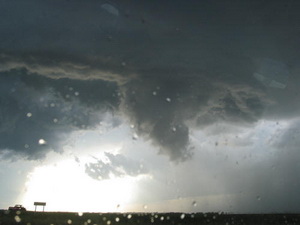
Severe weather season brings danger and destruction to the Great Plains of the United States. No other place on earth sees as many tornadoes as this region and now ThorntonWeather.com is going to go on the hunt in an attempt to witness Mother Nature’s fury up close and personal.

As we have pointed out before, the owner and operator of ThorntonWeather.com writes weather, disaster and climate news for Examiner.com.  This allows Tony to share his passion for the topics and also helps to pay for all the great features ThorntonWeather.com visitors enjoy.

Starting Sunday, May 30th and for the six days following, one Examiner will seek out and attempt to witness and document these events. World famous storm chaser Roger Hill will serve as tour guide and teacher for the Examiner and a group of weather enthusiasts as they hunt the ultimate prize – tornadoes.

An average of over 1,300 tornadoes have struck the United States in each of the last three years claiming more than 200 lives total. These devastating events can strike with little warning and with a fury unseen with any other natural phenomena.

After a slow start to the season in 2010, recent weeks have seen activity ramp up to much more normal levels. Tornadoes ripped through Oklahoma on May 11th killing five and just this past weekend a monstrous EF4 twister carved a path through rural South Dakota.

We will be bringing along Examiner and ThorntonWeather.com readers on this great chase. There are no guarantees because as we all know, Mother Nature is far from reliable – six days on the plains could yield little more than rain. However, confidence is high that you will be taken on a virtual ride unlike any other with videos, photos and more from the road.

To keep things simple, ThorntonWeather.com’s chief amateur meteorologist will be primarily posting things to the Storm Chase 2010 Examiner’s home page.  To be sure you don’t miss a thing, check the Storm Chase 2010 Examiner’s home page regularly. Be sure to click the “Subscribe” link at the top of the page and you will be emailed whenever a new story is posted.

Also, we will be posting regular updates from the road on Twitter via the Natural Disasters Examiner – click here to follow. On Facebook, be sure to ‘become a fan’ / ‘like’ the Natural Disasters Examiner as well to receive the latest right on there too.

On the net:

2010 hurricane season names from Alex to Walter

Hurricane names 2010From Hurricane Andrew to Hurricane Katrina, the names given one of the earth’s most devastating disasters become part of our history and are forever associated with the death and destruction they bring. For the 2010 hurricane season, the names chosen run through 21 letters of the alphabet from Alex to Walter.

During World War II, the practice of naming storms only for women became common practice but in 1951 the United States changed that and began naming them using the phonetic alphabet. By 1953 however the practice of naming them for women returned. In 1979 the current system which includes male and female names was adopted.

Storms get their name when they reach 39 mph (34 knots) and are then officially a tropical storm. In the North Atlantic, the World Meteorological Organization determines what names will be used for a given season on a six year rotating basis with one of 21 letters of the alphabet used in order. The letters Q, U, X, Y, and Z are not used due to the lack of names available using those and the names that are chosen alternate male and female.

Should the situation arise where all 21 names are used during a season, any additional storms are named after the letters of the Greek alphabet (Alpha, Beta, Gamma, etc). Only one time have there been enough storms to exceed the usual 21 names – In 2005 there were 27 named storms.

When a storm has caused extensive damage or death, the World Meteorological Organization can vote to retire a name. There are currently 74 retired names including 2005’s Hurricane Katrina and 1992’s Hurricane Andrew.

More hurricane news from the Natural Disasters Examiner:

National Hurricane Preparedness Week looks to get coastal residents ready

Hurricanes are a deadly and devastating annual ritual for much of the Gulf Coast and East Coast of the United States. With June 1st being the unofficial start of hurricane season, President Barack Obama proclaimed this week National Hurricane Preparedness Week.

Hurricane Isabel is seen on September 15, 2003 from the International Space Station. (NASA)

Throughout the week the National Hurricane Center (NHC) will be releasing information designed to inform and educate residents of areas that are at risk for hurricanes. This annual event is crucial to ensuring that residents are adequately prepared for hurricane season and the hazards these monstrous storms can present.

In the proclamation, Obama wrote, “I urge individuals, families, communities, and businesses to take time to plan for the storm season before it begins. While hurricane forecasting has improved, storms may still develop with little warning. For Americans in hurricane threatened areas, knowledge and preparation are pivotal to ensure emergency readiness and responsiveness.”

  • Read the complete text of the proclamation below

All indications are that the 2010 hurricane season will be one of the biggest in recent years. Colorado State University’s forecast team has said that there is a 69% chance a major hurricane will make landfall in the United States this year. The National Hurricane Center is already tracking an area of interest that it says has a medium chance to become the first named storm of the season.

For all the latest on hurricanes and all other types of natural disasters, be sure to visit the Natural Disasters Examiner.

Monster EF3 tornado rips through South Dakota

A powerful half-mile wide tornado ripped through South Dakota on Saturday, May 22, 2010. (NWS)  Watch video of the twister and see a slideshow of the damage below.
A powerful half-mile wide tornado ripped through South Dakota on Saturday, May 22, 2010. (NWS) Watch video of the twister and see a slideshow of the damage below.

A massive tornado reminiscent of a famous tornado in the state’s history ripped through central South Dakota on Saturday. The powerful twister appears to have been an EF3 tornado packing winds of over 160 mph and while damage to homes was recorded, miraculously no one was injured.

Supercell thunderstorms began forming on the South Dakota plains yesterday afternoon and began spawning tornadoes. The twisters were reported near the towns of Bowdle, Hosmer, Ipswich and Wetonka.

The National Weather Service’s Aberdeen, SD office reported that the largest of these appears to have done at least EF3 level damage, a level classified as “severe.” The twister tore through parts of Brown and McPherson Counties coming closes to the town of Bowdle.

The storm damage evaluation is ongoing but National Weather Service personnel said the tornado was at least one-half mile wide at its largest. No injuries were reported however three farms were damaged and numerous power lines were downed.

Images of the storm drew parallels to a tornado on June 24, 2003 that struck the town of Manchester, South Dakota. That twister, rated an F4, destroyed the town and to this day it has not been rebuilt. The photos of both events looked eerily similar.

Slideshow - Tornado damage from Bowdle, SD, May 22, 2010.

Announcing our new advanced mobile ThorntonWeather.com site

ThorntonWeather.com now brings local, Thornton weather to your advanced mobile phone.

With the advent of new advanced mobile phones like the Droid and iPhone, users of these devices are able to view more complete content than ever before.  No longer are they limited to totally stripped down versions of web pages.  Recognizing the proliferation of these new devices, ThorntonWeather.com has completely revamped our mobile website to provide users of advanced mobile devices a more interactive, graphical experience.

On ThorntonWeather.com Mobile (http://m.thorntonweather.com) you will find a familiar looking ‘dashboard’ much like on our full site.  It provides real-time Thornton weather conditions as well as an almanac with sunrise and sunset times, moon rise and moon set times, as well as the moon phases.

The forecast page has your complete local, Thornton forecast – not a forecast for DIA or downtown.  Radar is of course available including a local, regional and national view.  You can also view our weather webcams on the webcams page and graphs of today’s weather as well as days past.

Looking for some reading material?  Our news and blog section now has a mobile version as well which you can access from the mobile pages.  All of our recent news stories are available for viewing by mobile users.

You can access the mobile site by clicking the “Mobile” button on the top right of our main site or direct your phone’s mobile browser to http://m.thorntonweather.com.  Be sure to bookmark it so you can come back to it easily.

If you have any questions, comments or suggestions, please feel free to contact us.

May 23 to May 29 – This week in Denver weather history

May 23 to May 29 - This week in Denver weather history

We are getting closer to Colorado’s severe weather season and see how dangerous it can be when we look back in Denver weather history.  Many occurrences of dangerous lightning, large hail, flooding and tornadoes have been the hallmark of this week in Denver weather history.

20-27

In 2002…lightning sparked a wildfire near Deckers.  Extremely dry conditions and very strong winds the following day allowed the fire…known as the schoonover…to consume 3850 acres before it could be contained.  Thirteen structures were destroyed…including 4 homes…resulting in 2.2 million dollars in damage.

21-23

In 1876…snow changed to heavy rain over the city…resulting in widespread flooding along Cherry Creek and the South Platte River…nearly as great as the flash flood of May 19-20…1864.  However…damage was greater because the city had grown much larger and there were more bridges for the flood waters to destroy.  Precipitation in the city totaled 6.70 inches from 10:00 pm on the 21st through 3:00 am on the 23rd.  The greatest precipitation ever recorded in Denver in 24 hours…6.53 inches…occurred on the 21st and 22nd.  Small buildings and bridges along Cherry Creek were washed away by the flood waters.  Bridges over the South Platte River were damaged.  The city irrigation ditch was damaged and rendered unfit for service.  Strong winds at speeds of 30 to 40 mph drove the heavy rain through brick walls 12 to 16 inches thick.  Many sheep and cattle were either killed by lightning or drowned…including some 100 head of cattle in Jefferson County alone.  There was immense damage to railroad tracks…especially the Kansas Pacific line to the east of the city.  The Colorado Central suffered estimated damage of 10 to 15 thousand dollars.  In addition…the heavy rain caused extensive flooding on soda and bear creeks in the foothills.  Flooding along Boulder creek inundated farm and pasture land in the Boulder valley and damaged a few bridges.  Rail travel had to be suspended in the area for several days.

22-23

In 1933…high winds and gales overnight caused considerable damage in and near the city.  Much greenhouse glass was broken…which caused damage to sheltered plants.  Great numbers of plants growing in the open were damaged or killed by wind-driven sand and soil.  Fields were eroded by the wind and a few trees were uprooted.  West winds were sustained to 38 mph with gusts as high as 65 mph in downtown Denver on the 22nd.

23

In 1916…southeast winds were sustained to 43 mph with gusts as high as 52 mph.  The winds were strong for several hours during the afternoon.
 
In 1965…thunderstorm outflow wind gusts to 59 mph were recorded at Stapleton International Airport.
 
In 1987…slow moving thunderstorms bombarded metro Denver. One inch diameter hail was reported in south central Denver.  Torrential rain caused widespread street flooding… Stalling traffic throughout the area.  Rainfall totaled 2.10 inches in just 25 minutes in extreme southeast Aurora. Many other locations in Aurora and east Denver reported 1 to 1 1/2 inches of rain in about 30 minutes.  Thunderstorm rainfall totaled 1.33 inches at Stapleton International Airport where 1/4 inch diameter hail was measured and north winds gusted to 40 mph.  A man was slightly injured by lightning near Stapleton International Airport.  Lightning also started a fire that severely damaged a house in Aurora.
 
In 1990…a microburst wind gust to 52 mph at Stapleton International Airport produced some blowing dust.
 
In 1991…thunderstorms moving from southwestern sections of metro Denver to the east of Denver produced large hail up to golf ball size.  An estimated 5 thousand homes and 8 thousand cars received considerable damage.  Early estimates placed damage costs around 60 million dollars. Three funnel clouds were also reported…two by personnel at Buckley Field and the other by a storm spotter.  Heavy rain produced street flooding in Aurora where hail accumulated to a depth of 6 inches.  As the storms moved to the east…golf ball size hail was reported at Strasburg.
 
In 1997…hail to 3/4 inch diameter fell in Broomfield.
 
In 2002…a very strong microburst near Strasburg swept a woman into a swirl of dirt and carried her about 150 feet. The woman was in an open field…corralling a yearling horse… When the incident occurred.  Fortunately…she received only minor injuries.

Continue reading May 23 to May 29 – This week in Denver weather history

Storm chasing’s popularity leads to conflicts on the road

Dangerous driving and irresponsible behavior by some storm chasers has led to worries that someone will get killed while chasing storms soon. In this image from a video, the infamous Tornado Intercept Vehicle (TIV) is seen passing other vehicles in an unsafe manner. Watch the video at the link below. (YouTube / Steve Miller)

Professional and amateur storm chasers, television and movie crews, researchers and news media all converge on Tornado Alley during storm season. Severe weather is fascinating and it has been brought more and more into the public eye thanks to the Internet and popular television shows. That popularity has given rise to increased danger to everyone and many say it is only a matter of time before someone chasing a storm gets killed.

Over recent weeks, tornado outbreaks in Oklahoma have seen hundreds of chasers of all types converge on tornado producing storms. Some are there for fun, others to study the phenomena for science, a few to get their two minutes of fame by capturing video to be shown on the Weather Channel and some to capture ‘the perfect shot’ for a movie.

With so many people in a relatively small area chasing the same target, conflicts are sure to arise and they have. Traffic jams of chasers around the storms have created a safety hazard as vehicles are unable to move. People are exiting their vehicles, standing in the middle of roads, all to get a glimpse of a twister.

Many have put the blame for the problem on inexperienced chasers, lured to the chase by what they see on television and the Internet. To be sure these novices can cause problems however they are not the only ones by far.

Vortex 2, the largest tornado research project in history, has brought a veritable armada of vehicles to bear chasing storms. The group’s mission of trying to learn more about tornadoes is important and Dr. Josh Wurman, one of the scientists involved with the project, laments that chasers are getting in the way of science.

There's more to this story on Examiner.com!Read more on the Natural Disasters Examiner about how many big name chasers, including those from Discovery Channel’s “Storm Chasers” are thought to be part of the problem.

Waterworld hero Kevin Costner to try invention to clean up Gulf oil spill

Waterworld hero? A device funded by Academy Award winning director and actor Kevin Costner will be deployed to help with the Gulf oil spill. (Universal Pictures)

As the Deepwater Horizons oil spill continues to grow virtually unabated, officials have turned to an unlikely source for help. Actor Kevin Costner offered the use of his “Oceans Therapy” device to help with the cleanup of the expanding environmental disaster and BP willingly accepted.

In the wake of the Exxon Valdez accident in Alaska, Costner believed there had to be a way to speed the cleanup and recovery. Since then, he has invested $24 million of own money to fund the Oceans Therapy Solutions, the firm that has worked to develop the machine. Costner’s brother is a lead researcher on the project.

Using centrifugal force, the manufacturer claims the machines can remove 97 percent of the oil from the water. A single machine is reportedly capable of cleaning up to 210,000 gallons of water per day and the company is prepared to donate their use to help with the Gulf of Mexico cleanup.

In a demonstration in Louisiana (video at the link blow), the devices appeared to work as claimed, sucking in dirty water and dispensing virtually clear water.

Learn more about how the device will be deployed and watch video of Kevin Costner discusisng it on the Natural Disasters Examiner.

Weather radios – Your first line of defense against extreme weather

What is the best way to get information about severe weather?  A weather radio. (File photo)
What is the best way to get information about severe weather? A weather radio. (File photo)

No matter whether it is a blizzard in the winter or tornadoes and hail in the summer, it is important that everyone knows where to turn for information about developing weather conditions.  Keeping an eye on the sky is fine but oftentimes there is dangerous weather brewing that you may not see.

How dangerous is the weather?  Consider this:  In 2008, 566 people across the United States were killed by weather-related causes and 2,899 were injured – and that was a below average year.  Of those, 12 were Coloradoans that were killed with 100 Coloradoans injured.  Over $29 billion was paid out in property and crop losses across the nation, $166 million in Colorado alone.

The danger is real and with the severe weather we have seen recently, residents are wondering how best to keep themselves and their families safe.  Tuning in the TV or radio or checking your favorite weather website is one way but what if you aren’t near your computer or don’t have your TV on?  What if severe weather strikes in the middle of the night?

NOAA All Hazards Weather RadioIt is important to note that there is only one official source for weather related alerts and warnings – the National Weather Service (NWS).  All watches, warnings and alerts you see and hear about originate with the NWS and by far the best way to be proactively warned of severe weather is what is commonly referred to as a “weather radio.”

NOAA Weather Radio All Hazards (NWR) is a nationwide network of radio stations broadcasting continuous weather information directly from the nearest National Weather Service office. NWR broadcasts official Weather Service warnings, watches, forecasts and other hazard information 24 hours a day, 7 days a week.  When a weather watch or warning is issued, it is immediately broadcast on NWR.  The system is also used to broadcast information about other civil and weather hazard information like earthquakes, avalanches, chemical spills, terrorist attacks and even AMBER alerts.

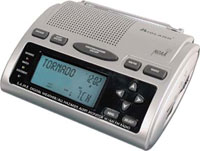
This weather radio from Midland (model WR-300) includes SAME area encoding and an AM / FM radio.

It is highly recommended that any weather radio purchased include the SAME feature – Specific Area Message Encoding.  Using the SAME feature, users can program a code into the radio for the area in which they live and the radio can then be set to automatically turn on and sound an alert when a weather watch or warning is issued for their area.  Users of weather radios with SAME coding can be assured they will be immediately notified in an emergency.

Price and features of weather radios can vary but a good one with the SAME feature can be found for about $30.00.  More expensive models may add clock, AM/FM radio and even weather forecasts retrieved from the Internet.  There are portable handheld models as well that you can take with you wherever you go.

Finding a weather radio locally may be difficult as there aren’t many stores that carry them.  Some Denver area King Soopers and Radio Shack stores have had them so you may call your local store to check.  Alternatively, there are many good, trustworthy sites online where they can be purchased including Amazon.com, New Egg and Ambient Weather.

Weather radios provide essential information when severe weather is ready to strike.  With a small investment, these units are an essential tool to protecting you and your family.

Do you have questions about weather radios?  Post them in the comments section below and ThorntonWeather.com will answer them.

April 2010 goes down in books as the hottest globally

Combined global temperature anomalies for April 2010. (NOAA)According to data released by the National Oceanic and Atmospheric Administration (NOAA), the combined land and sea temperatures for last month were the warmest April temperatures on record. Individually, sea surface temperatures were the warmest for any April and surface temperatures were the third warmest.

Utilizing data from the National Climatic Data Center (NCDC), the agency reported that the combined temperature of 58.1°F (14.5°C) was 1.37°F (0.76°C) above the 20th century average of 56.7°F (13.7°C).
For the period from January to April, temperatures also were the warmest first quarter on record. NOAA said the combined temperature over the period was 56.0°F (13.3°C). That is 1.24°F (0.69°C) above the 20th century average.

Arctic sea ice, long considered a harbinger of global warming, was reported at 2.1 percent below average. NOAA conceded however that sea ice was at its highest April extent since 2001. As reported previously, Arctic sea ice has seen three consecutive years of increasing measurements.

In the United States, NOAA said that April featured above normal temperatures and below normal precipitation. Much of the eastern half of the nation experienced warmer than normal temperatures resulting in measurements 2.3°F above average and going down in the books as the 14th warmest April on record.

For more on the climate, global warming and manmade climate change be sure to visit the Climate Change Examiner. 

Weather, natural disasters & climate news and information.