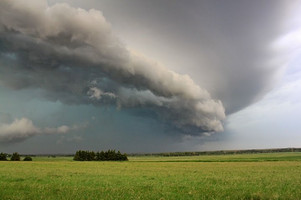
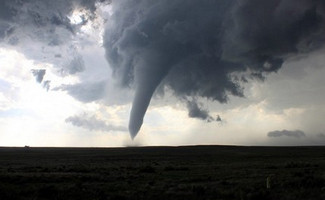
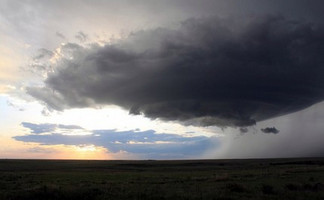
A 'cold air funnel' was spotted over Leadville, Colorado on Sunday morning. (NWS Pueblo)
At an altitude nearly two miles high, one would not expect a funnel cloud to appear in the sky over a town like Leadville, Colorado. On Sunday however, Mother Nature treated visitors and residents to a rare ‘cold air funnel’ over the town high in Colorado’s Rocky Mountains.
At approximately 10:30 a.m. on Sunday, the funnel was spotted over Leadville where it continued to rotate for nearly 20 minutes, according to observers. The funnel never touched down, thus never becoming a tornado, but it serves as a reminder that twisters can occur just about anywhere on earth.
Funnel clouds and tornadoes typically need four conditions to form – Shear, Lift, Instability and Moisture (SLIM as famed storm chaser Roger Hill calls it). With a cold air funnel, those conditions also exist, although they aren’t associated with a supercell thunderstorm like is seen on the plains.
According to the National Weather Service’s Pueblo office, a cold low pressure system over northwestern Colorado provided the instability part of the equation. Strong upper level winds over the southwestern part of the state and slower winds over the northwest provided shear. The difference in lower and upper level temperatures and a passing thunderstorm provided the lift and moisture for the funnel.
One Denver-area television station is incorrectly reporting on its website that “Leadville was never in any danger because he says cold-air funnels do not turn into tornadoes.”
This is wholly inaccurate. While cold air funnels do not typically touch down, they can reach the ground and as the National Weather Service states, they “can bring damage in a small area.”
June 13 to June 19 - This week in Denver weather history
June typically is a very eventful weather month and looking back at this week in Denver weather history that is clearly seen. Among the more noteworthy items are the 2002 Hayman Fire, a 1965 flood that damaged dozens of bridges in the Denver area and the infamous tornadoes in 1988 that struck near downtown Denver.
11-14
In 1999…damage from several hailstorms in and near metro Denver totaled 35 million dollars. About 17.5 million dollars was from automobile claims with another 17.5 million in homeowner claims. The areas hardest hit by the storms included Castle Rock…Commerce City…Evergreen… And Golden.
12-17
In 2000…two large wildfires developed in the Front Range foothills as careless campers and very dry conditions proved to be a dangerous combination. Strong winds gusting in excess of 60 mph on the 13th fanned the flames… Spreading both wildfires out of control. Winds gusted to 78 mph atop Niwot Ridge near the Continental Divide west of Boulder. The hi meadows wildfire…about 35 miles southwest of Denver…consumed nearly 11 thousand acres and 80 structures…mostly high priced homes. The bobcat wildfire…located about 12 miles southwest of Fort Collins… Consumed nearly 11 thousand acres and 22 structures. Late on the 16th…a strong cold front moved south over the great plains into northeastern Colorado. Low level upslope conditions developed in the wake of the front…producing 2 to 4 inches of snowfall overnight at elevations above 8 thousand feet. Firefighters were able to contain both fires shortly thereafter.
13
In 1956…a microburst caused a brief wind gust to 59 mph at Stapleton Airport.
In 1957…an unconfirmed tornado appeared to touch the ground in the vicinity of Franktown. No damage was reported from the twister.
In 1968…a violent gust of wind…possibly associated with a thunderstorm…caused 75 hundred dollars damage in Boulder.
In 1973…hail…1/2 to 3/4 inch in diameter…fell over Lakewood. Flash flooding occurred in west Denver from the same storm.
In 1974…a thunderstorm wind gust to 64 mph was recorded at Stapleton International Airport.
In 1977…hail the size of table tennis balls…1 1/2 inches in diameter…was reported in Boulder.
In 1981…large hail to golf ball size fell in Denver… Northglenn…and Brighton. Hail as large as baseballs was reported in Federal Heights.
In 1984…one of the worst hailstorms ever experienced in metro Denver struck the northwestern suburbs of Arvada…Wheat Ridge…and Lakewood…but large hail also fell in Golden… Southeast Denver…and Aurora. Homes and other buildings sustained around 200 million dollars in damage. Thousands of cars were battered by giant hailstones…and total damage to vehicles was estimated at 150 million dollars. In some areas…golf ball size hail fell continuously for 30 to 40 minutes. Some places were pelted with a few stones as large as grapefruits! Roofs on thousands of structures were severely damaged. Uncounted car windshields were broken; two-thirds of Arvada’s police cars were rendered inoperable. Torrential rains…with as much as 4.75 inches in Lakewood clogged drains and caused widespread damage from flooding. In some places hail was washed into drifts several feet deep. About 20 people were injured by the giant hailstones. One couple was hospitalized. A woman drowned when she was trapped under a trailer by high water. Only pea size hail fell at Stapleton International Airport.
In 1988…2 inch hail fell in Parker. Soft hail 1 inch in diameter fell at the mouth of turkey creek canyon 5 miles southeast of Morrison. Hail between 1 inch and 1 3/4 inches fell at both Bennett and Strasburg. A tornado touched down briefly at Strasburg. A brief funnel cloud was sighted by national weather service observers 15 miles southwest of Stapleton International Airport.
In 1991…a Boulder man was injured when struck by lightning while in a tent. He received only minor burns.
In 1997…lightning struck a home in Denver. The extent of the damage was unknown. A home in Littleton was also struck. The house caught fire…but the extent of the damage was not known.
In 1998…a strong mountain wave produced a brief period of high winds along the Front Range. A small building atop squaw pass west of Denver was blown down. Tree limbs were downed across metro Denver. Peak wind gusts included: 80 mph on squaw pass…69 mph at Jefferson County Airport near Broomfield…and 60 mph in Westminster and at the National Center for Atmospheric Research in Boulder. West-northwest winds gusted to 51 mph at Denver International Airport.
In 2001…high winds developed briefly in Boulder County. A peak wind gust to 76 mph was recorded at the National Center for Atmospheric Research atop the mesa in Boulder. A wind gust to 72 mph was recorded at southern hills middle school in Boulder. Lightning started a small fire…which damaged the roof of a house in Greenwood Village.
In 2009…severe thunderstorms produced hail up to one inch in diameter near Arvada and byers…as well as 7 miles north-northwest of Front Range airport near watkins.
It is Colorado’s severe weather season and Thornton received a reminder of that Thursday night. The late afternoon brought various watches and warnings and soon hail as large as ping-pong balls was falling.
What started as a light rain with ominous clouds overhead soon turned to hail that pounded central Thornton near 120th Avenue and Colorado Boulevard. Mercifully, the hail never got any bigger than ping-pong ball sized however that is plenty big enough to have caused damage. Residents should check their vehicles and other property closely for damage.
Following the hail, in a short 20 minute span, the area was inundated with 1/4 inch of rain coming down in sheets. A rainbow soon appeared to the east signifying this round of severe weather was over.
Check out the slideshow below for some of the images from the short-lived but potentially damaging storm.
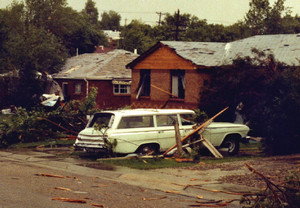
On June 3, 1981, Thornton was the site of the most destructive tornado in the history of the Denver metro area. The City of Thornton is now evaluating options to warn residents of severe weather threats. (City of Thornton archives)
Visitors to ThorntonWeather.com have often asked us if the city was taking any steps to protect its citizens and warn them about severe weather. The city – and Adams County – are lacking any type of alert system. Following last year’s ‘Summer of Storms,’ we were told the city would look into it.
Current options for citizens range from the Emergency Alert System used by television and radio broadcasters, free and pay Internet services as well as NOAA Weather Radio All Hazards (weather radio). As we have discussed previously, these systems have their limitations.
At this week’s city council update session, the Thornton City Council heard a presentation from city staff on the alternatives available. Utilizing Reverse 911 and contracting with a third party provider were two of the items discussed.
Read the presentation city staff gave to the Thornton City Council below
In trying to identify ways to keep citizens aware of deteriorating weather conditions, city staff told council, “Technology is changing so quickly that supporting a single system would not be efficient.”
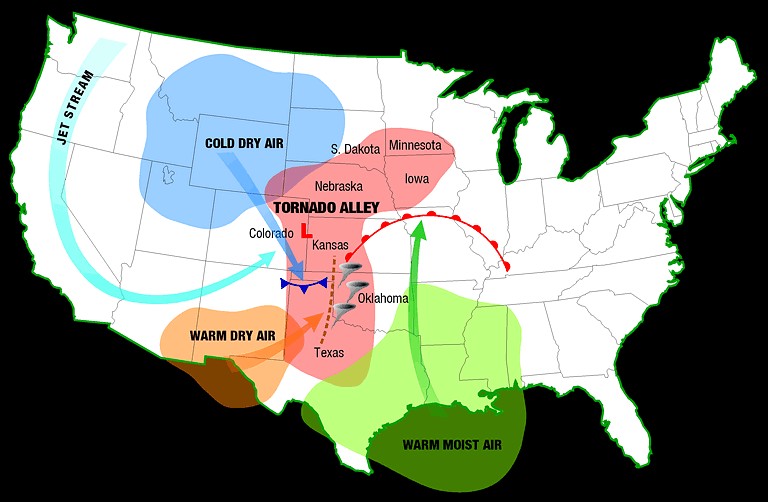
The Denver area is at the western edge of Tornado Alley and as we have seen historically and in recent days, the danger is real. Click image for larger view. Image courtesy NOAA.
Rather than implement their own system, staff recommended the city rely upon the federal government and the Federal Emergency Management Agency’s (FEMA) forthcoming Integrated Public Alert and Warning System (IPAWS).
Slated for widespread deployment in 2010, IPAWS will take the old Emergency Alert System and move it into the modern age by leveraging new communication technologies such as email and cellular phones.
Mayor Erik Hansen told ThorntonWeather.com, “The City of Thornton recognizes the dangers of severe weather and we are actively working to identify solutions to protect its citizens.”
While the city waits for IPAWS, staff said they recommend the “development of a Weather Awareness Public Education Program that would be implemented in the spring of each year.” They further would work to encourage residents to purchase weather radios.
ThorntonWeather.com’s Take
We are pleased that the city is finally taking some steps in the right direction – albeit 29 years late.
NOAA Weather Radio All Hazards is essential to protecting you and your family.
The implementation of a severe weather education program is also a step in the right direction, assuming it takes the form of something more substantial than the simple brochure the city developed this year.
Each spring the National Weather Service (NWS) offers storm spotter training seminars. These would likely be overkill for average citizens however we think it would be ideal for the City of Thornton to partner with the Denver / Boulder NWS office to offer education sessions for citizens. These could be taped and then shown on Channel 8 and on the city’s website.
We do have our reservations about waiting for and relying on the forthcoming IPAWS system when commercial systems are available, proven and ready now for the city to implement. Big government projects rarely are completed on time and often do not perform as expected. Hopes are high for IPAWS but we are cautious on giving it any sort of endorsement.
Granted, severe weather on par with the 1981 tornado is rare however last year’s severe weather and the Windsor tornado of two years ago show the danger is present. If a warning system saves one life, the cost incurred is well worth it and we hope the city continues to stay on top of this issue – we will certainly be watching.
A shelf cloud moves across Nebraska farmland. (Tony Hake / ThorntonWeather.com)
Certainly the highlight of storm chasing is tornadoes and ThorntonWeather.com’s Storm Chase 2010 had plenty of those – five in one day in fact. However, as great of satisfaction can be derived from simpler, less violent storms. The images from a week of chasing on the Great Plains show the fury and the beauty of Mother Nature.
Storm chasing is as much an art as a science – there are no guarantees that tornadoes will appear as forecast. Other types of severe weather and the amazing structure they display can bu just as impressive.
Scud clouds hovering over a coal train in Nebraska, egg sized hail pummeling storm chaser vehicles, the sun setting on the Oklahoma plains and the now infamous Baca County, Colorado tornado ripping through ranchland all were highlights of Storm Chase 2010.
The images in the slideshow below represent some of the most stunning and beautiful images captured during the week.
The Memorial Day tornado in Baca County, Colorado near Campo was the highlight of a week of storm chasing but it wasn’t the only exciting thing to happen. (Tony Hake / ThorntonWeather.com)
We have said before that storm chasing is as much an art as a science and it can very much be feast or famine. Both extremes were seen over the course of a week of storm chasing on the Great Plains by ThorntonWeather.com.
We hope our site visitors were checking out the Storm Chase 2010 Examiner where we were documenting our chase across America’s heartland. With stories, photos and video, the entire incredible week has been described in detail.
The first tornado of that day near Pritchett, Colorado allowed chasers to witness the complete tornado genesis. As massive amounts of air were sucked into a storm cell and the clouds swirled menacingly above, a small funnel cloud soon grew into a powerful tornado.
Two other tornadoes and an incredible hail storm on the virtually barren ranchland followed. The main event was yet to come however.
About eight miles south of Campo, Colorado, a massive supercell seemed poised to generate a tornado. Chasers waited anxiously as the sky grew darker on the plains. A funnel cloud formed and was cheered on as it grew closer to the ground.
Before long the tornado was on the ground moving at a leisurely 10 mph – its slow pace allowing for plenty of time to capture amazing photos and video of the event. The Baca County tornado would draw national media attention and will possibly go down as the most picturesque of all twisters during the 2010 tornado season.
While the Memorial Day tornadoes would be the last seen during the week, they were not the last extraordinary weather event witnessed by the storm chasers.
Storm Chase 2010 intercepted a flying saucer over western Kansas at the end of a very long chase day. (Tony Hake / ThorntonWeather.com)
Central Nebraska proved to be the backdrop for another day of weather beauty. Waiting patiently at a small town gas station, multiple super cells moved across the area and chasers were on the move. From highways to dirt roads, the chasers saw the storms generate amazing shelf clouds and funnel clouds.
In the end, the group of storm chasers covered over 2,500 miles across five states. They witnessed many funnel clouds and amazing storm structures and of course five tornadoes, two of which were at close range. For many it was truly a once in a lifetime experience that allowed them to see Mother Nature’s fury up close and personal.
Complete stories, photos and video from Storm Chase 2010:
The growing environmental disaster in the Gulf of Mexico from the Deepwater Horizon oil rig explosion and leak will likely take years to recover from. A new image released by NASA shows the extent of the oil slick as it continues to encroach on shoreline around the Gulf.
From NASA:
Oil on water has many appearances. In this photo-image, acquired by the Moderate Resolution Imaging Spectroradiometer (MODIS) on NASA’s Terra satellite on June 7, 2010, at least part of the oil slick is pale gray. A large area of oil is southeast of the Mississippi Delta, at the site of the leaking British Petroleum well. Traces of thick oil are also visible farther north.
Not all of the oil that is in the Gulf is visible here. The image shows regions of heavy oil where the oil smoothes the surface and reflects more light than the surrounding water. Lighter concentrations and streamers are not visible. The Deepwater Horizon Unified Response reported oil washing ashore and immediately offshore in eastern Alabama and northwestern Florida on June 7, and this oil is not visible in the image.
Several other features may mask the oil in the image. Pale white haze (possibly smoke from fires in Central America) hangs over the Gulf, partially obscuring the view of the oil slick. The oil slick also blends with sediment washing into the Gulf from the Mississippi River. The sediment plume is tan and green. Because the sediment also reflects more light than clear water, it may be masking the presence of oil in the water. West of the mouth of the Mississippi River, sunlight reflecting off the surface of the water (sunglint) turns the water silvery white. In this region, it is difficult to see sediment and oil, but NOAA maps of the extent of the oil spill on June 7 report oil throughout sunglint region.
The large image provided above is the highest-resolution version of the image available. The MODIS Rapid Response System provides twice-daily images of the Gulf of Mexico.
June typically brings severe weather to Thornton and the Denver area.
June is historically Denver’s severe weather month and severe thunderstorms, tornadoes and hail are notorious visitors to Denver and across eastern Colorado during the month. In fact, over 40 percent of the tornadoes that occur in Colorado are observed in June and these are typically the most destructive of the year. Severe thunderstorms have also caused major property damage across the Front Range during the month.
In just the last 25 years or so, there have been some particularly notable storms in June. Tornadoes have struck the metro area including one that longtime Thornton residents will recall on June 3, 1981. 53 residents were injured, 25 homes were destroyed and 239 other structures were damaged. Others tornadoes in the metro area include southeast Denver and Aurora on June 8, 1986 and east Denver on June 13, 1984. Severe thunderstorms occurring on June 13, 1984 dumped large hail making it one of the worst and the second costliest storm in Denver history. More recently, on June 20, 2001, a major hail storm moved across Denver International Airport dropping hailstones as big as two inches in diameter. Damage was extensive on and near the airport.
ThorntonWeather.com is ready to begin the hunt for tornadoes!
Storm Chase 2010 is making final preparations to take to the Great Plains on Saturday. With severe weather forecast for the northern plains, the opportunity is too good to resist so the hunt begins a day early.
The Storm Prediction Center has placed a slight risk for severe weather on an area from northeastern Colorado into Nebraska and then north from there. The risk for tornadoes is relatively small but even if we don’t see a twister, there is a good chance to witness some great storm structure as well as strong winds and hail.
The tour we are a part of isn’t officially supposed to start until tomorrow and we must be in Denver this evening to meet with the rest of the group. As such, today’s chase will be relatively short and won’t cover too much of a distance.
Roger Hill, famed storm chaser and tour leader, will outline the plans for the chase later today but we are anticipating we will hunt northeastern Colorado and western Nebraska. If all goes according to plan, we should be on the road by noon (MDT) and on our way to the target area.
We will be bringing along Examiner and ThorntonWeather.com readers on this great chase. There are no guarantees because as we all know, Mother Nature is far from reliable – six days on the plains could yield little more than rain. However, confidence is high that you will be taken on a virtual ride unlike any other with videos, photos and more from the road.
To keep things simple, ThorntonWeather.com’s chief amateur meteorologist will be primarily posting things to the Storm Chase 2010 Examiner’s home page. To be sure you don’t miss a thing, check the Storm Chase 2010 Examiner’s home page regularly. Be sure to click the “Subscribe” link at the top of the page and you will be emailed whenever a new story is posted.
Hail covers the road at 104th Avenue and Chambers Road on Wednesday afternoon. (Chelsea Kovach)
Colorado’s severe weather season is upon us and it paid a visit to the north Denver metro area in spades on Wednesday. Brief, heavy rain, large hail and a few tornadoes were reported with the fast moving storms.
Isolated thunderstorms began popping up along the Front Range after lunchtime, quickly turning severe in nature.
Hail nearly three inches in diameter pounded vehicles and homes in north Denver, Commerce City, Thornton and unincorporated Adams County. Enough hail fell in the Reunion development area of Commerce City to cover the ground like snow. Residents used snow blowers and state highway crews used snowplows to clear the frozen water.
An untold number of vehicles sustained heavy damage in the area northeast of downtown Denver. Reports of broken windows, roofs with damage and trees stripped of leaves were commonplace. In the central part of Thornton there were reports of hail up to 1.75 inches in diameter.
Operations at Denver International Airport were affected as flights were delayed while the severe weather passed. Delays of 30 to 60 minutes were experienced and those inside the airport were instructed to go to designated tornado shelters for a time.
Brief, weak tornadoes were reported in some areas and strong winds caused damage further northeast of the area. In Larimer County, multiple structures were reportedly destroyed and a 15 foot silo was knocked down.
The severe weather was enough to draw the attention of the VORTEX 2 tornado study. The research study is the largest field study of tornadoes with hundreds of scientists and dozens of vehicles roaming the plains to learn more about the severe weather. The teams tracked the storms as they moved from near DIA to the plains further to the northeast.
Are you ready for severe weather? Do you know what to do to keep you and your family safe? Review our Severe Weather 101 series to learn more: