Snow starts to pour into the Metrodome as the roof collapses. Watch the amazing video below. (FOX Sports)
The upper Midwest has been pounded my a major winter storm in the past 36 hours that has brought bone chilling cold and heavy snow to the region. One casualty of the snow was the roof of the home of the NFL’s Minnesota Vikings as the roof collapsed early this morning under the weight of 17 inches of snow.
Some areas in the region have seen more than 20 inches of snow and blizzard conditions have persisted as strong winds make things treacherous for travel. Winter weather warnings and advisories of one sort or another stretch across more than a dozen states from Wisconsin and Michigan down to Alabama and Georgia.
The Minnesota Vikings were originally scheduled to take on the New York Giants today in Minneapolis. The game was first pushed back to Monday after Minneapolis – St. Paul International Airport was closed yesterday stranding the Giants in Kansas City.
This morning the inflated roof of the Metrodome collapsed for the third time in its history. The fabric of the dome shredded and snow came pouring onto the field. Amazing new video released by FOX Sports (see below) shows the sights and sound of the collapse as it happened.
As for the game between the Giants and Vikings, it will be played tomorrow night at 5:20pm MST at Ford Field in Detroit.
The Denver Broncos don’t have this problem – of course we don’t have a roof on our stadium and for that matter we don’t have any snow either.
A brilliant sunrise over south Thornton. View more images in the slideshow below. (ThorntonWeather.com)
A very chilly morning yielded a beautiful sunrise over south Thornton this morning. ThorntonWeather.com was out for a walk and captured images of the brilliant red sky near the Spratt Lake facility.
With mostly clear skies temperatures Sunday morning dipped clear down to 14.7 degrees – the coldest day we have seen this season. Thankfully we will be warming up to above normal temperatures today as the forecast calls for a high of 54 degrees.
The images this morning not only include the spectacular sunrise but also lenticular and wave clouds.
Lenticular clouds are one of the least common types and typically only occur at high altitudes near mountains with strong winds – both of which Colorado has in abundance. These virtually stationary lens-shaped formations have been mistaken for UFO’s due to their rare appearance and unique saucer shapes.
Also known by their scientific name of altocumulus standing lenticularis, these clouds are not entirely unusual in Colorado on the Front Range during the winter. Strong jet winds force moist air to be pushed up by the rugged terrain of the adjacent Rocky Mountains. This creates a wave-like pattern of air flow that condenses at high altitudes (usually around 20,000 feet).
Below is a slideshow of some of the images we took this morning.
Track map of the 2010 Atlantic hurricane season shows how lucky the U.S. was. Click image for larger version. (NOAA)
Virtually every forecaster predicted an extremely active 2010 hurricane season and they were proven right. Mercifully however the United States was spared the worst as not one storm made landfall in the U.S.
In all, there were 19 named storms in 2010 which ties 1887 and 1995 for the third most on record. Of those 19, 12 became hurricanes tying 1968 for the second highest on record. Five became major hurricanes of Category 3 or greater. On average the Atlantic sees 11 named storms, six hurricanes and two major hurricanes.
Watch: Scroll down to see video of the 2010 hurricane season as captured by NOAA satellites
Other notable statistics from the season include three periods when there were three named storms occurring at the same time. On August 30, Hurricane Earl, Hurricane Danielle and Tropical Storm Fiona were all churning. Two days later it was Tropical Storm Gaston, Tropical Storm Fiona and Hurricane Earl. Finally on September 14 we saw Hurricane Karl, Hurricane Igor and Hurricane Julia all at once.
For a 36 day period from August 21 to September 26 there was at least one tropical cyclone active in the Atlantic. A total of 11 storms were active during that period. September alone saw eight named storms tying the 2002 and 2007 hurricane seasons.
On average 25% of Atlantic hurricanes make landfall in the United States. Given how active the season was, it is that much more remarkable that the U.S. was spared.
Other places along the Atlantic were not so lucky. In all, 259 deaths were directly attributed to the hurricane season and more than $11 billion in damage was realized. Tropical Storm Matthew was the deadliest 2010 storm accounting for 126 fatalities in Nicaragua, Belize and Cuba.
While the Atlantic was active, the eastern Pacific saw the fewest number of named storms and hurricanes since the satellite era began in the mid-1960s. Only seven named storms developed of which three became hurricanes. Two of those three became major hurricanes. For comparison, the North Pacific averages 15 named storms, nine hurricanes and four major hurricanes.
NOAA Time Lapse Video of the 2010 Atlantic Hurricane Season
December 12 to December 18 - This week in Denver weather history.
We all know weather can be dangerous but usually we don’t associate that with winter weather conditions. However, our look in Denver weather history for this week shows that the common winter conditions of wind and cold can not only cause injure, it can lead to death.
2-17
In 1939…more than 2 weeks of unseasonably warm weather made the month the 3rd warmest on record. Seven daily temperature records were set…including the all time record high temperature for the month of 79 degrees on the 5th. Daytime highs were balmy with 14 days in the 60’s and 70’s. Low temperatures dipped to freezing or below on only 5 days. The period was dry with only a trace of snow on the 12th.
3-15
In 1972…a protracted cold spell held an icy grip on metro Denver when maximum temperatures never reached above freezing for 10 consecutive days from the 3rd through the 12th and minimum temperatures dipped below zero on eleven consecutive days from the 5th through the 15th. Daily low temperature records were set with 15 degrees below zero on the 5th…17 degrees below zero on the 6th… And 18 degrees below zero on the 10th. Daily record low maximum readings were set with 3 degrees on the 6th and 6 degrees on the 9th. The very cold temperatures were caused by 3 to 5 inches of snow cover and a Canadian air mass.
8-12
In 1932…the second longest sub-zero period on record in Denver occurred. The temperature fell below zero shortly after 1:00 pm on the 8th and remained below zero for 92 hours until 9:00 am on the 12th. The lowest temperature recorded during this period was 13 degrees below zero on both the 9th and 11th. That temperature on the 11th was a record low for the date. High temperatures of 4 on the 8th…5 below zero on the 9th…1 below zero on the 10th… And 6 below zero on the 11th were record low maximum temperatures for those dates. Light north winds at 5 to 10 mph were accompanied by occasional light snow…which totaled only 2.2 inches.
9-13
In 1961…cold arctic air produced a protracted cold period. The temperature plunged to 16 degrees below zero on the 10th…establishing a new record for the date and the coldest reading since 25 degrees below zero on February 1… 1951. Low temperatures dipped below zero on 5 consecutive days with 9 degrees below zero on the 9th…16 below on the 10th…10 below on the 11th…and 12 below on both the 12th and 13th. High temperatures reached only 3 degrees on the 10th and 6 degrees on the 11th.
11-12
In 1903…a sharp cold front on the 11th plunged temperatures from a high of 59 degrees to a low of 15 degrees…produced northeast winds sustained to 42 mph along with gusts as high as 60 mph…and produced 1.3 inches of snow overnight. The high temperature on the 12th was only 25 degrees.
In 1968…strong winds buffeted the eastern foothills and plains and caused light…but widespread property damage. Wind gusts of 50 to 75 mph were reported. West winds gusted to 52 mph at Stapleton International Airport.
A full day of events highlights Thornton’s annual WinterFest on Saturday and the weather should cooperate for the most part. It will be a bit cool and windy but there is nothing weather-wise to keep everyone from coming out to this great event.
The outdoor activities start at 9:00 with a community walk around the multipurpose fields (108th & Colorado Blvd). Temperatures will be right around the freezing mark at the start with northwest winds at 5 mph creating a wind chill of 28 degrees. It will be chilly but certainly tolerable.
WinterFest gets started in earnest at 10:00 with a full slate of events. By then the mercury will have climbed to 35 degrees with light winds of 7 mph. Skies overhead will be partly cloudy today but there should at least be intermittent sun to help warm things up.
As the day progresses the thermometer will rise but the winds will also be picking up. The high today will hit 41 degrees by about 1:00pm and hold steady there through 4:00pm when the sun starts to go down. Winds will gradually increase through the morning peaking by 2:00pm at 15 to 20 mph, gusting to 25 mph. After that they should start to die down and by 7:00pm they will be mostly calm.
Fireworks will close out today’s events at 8:30pm and the weather will be chilly but otherwise it should be a great display. Temperatures by then will be down to 30 degrees but the winds will be calm.
The City of Thornton has plenty of activities for the whole family today. From the community walk to Santa’s village, ice skating, food and a concert from the Thornton Community Band. Be sure to come out and join your Thornton neighbors!
Cool and slightly breezy for Santa's arrival in Thornton tonight. (ThorntonWeather.com)
Thornton’s annual WinterFest kicks off this evening at 6:30pm with the arrival of Santa and Mrs. Claus. The weather will certainly not be a factor and Santa should be able to arrive without any problem and enjoy their time in our city.
Look for temperatures at the recreation center fields to be around 43 degrees when Santa arrives. Temps will drop to around 39 degrees by the time tonight’s festivities end at 9:00pm.
Winds are a bit gusty right now from 10 to 20 mph as a cold front moves through and unfortunately those won’t ease much. Some higher gusts to 30 mph are possible so it will be a bit blustery.
Snow is one thing that Santa won’t really find in Thornton this year. A few flakes may fall this evening but no real accumulation is expected.
Be sure to check back tomorrow for a complete look at Saturday’s weather for tomorrow’s events!
These stacked lenticular clouds hovered over Denver on the evening of December 8th. View more photos in the slideshow by clicking on the image. Photo: Alycia Gilliland
Colorado is home to many weather phenomena which is certainly part of its appeal. Our topography and geographic location allow us to experience a true four seasons and every type of weather.
Yesterday if you turned your eyes skyward you were treated to an amazing display of lenticular clouds, an unusual formation but one for which Colorado is a prime viewing spot.
Storm chaser and meteorology student Alycia Gilliland has captured some stunning photos in recent months of the sky and yesterday’s display provided another opportunity. As the sun began its decent late yesterday afternoon, Gilliland turned her camera skyward to capture beautiful images of “stacked” lenticulars.
Click on the image to the right to view a slideshow of Gilliland’s photos. You can learn more about lenticular clouds in our story on the Denver Weather Examiner.
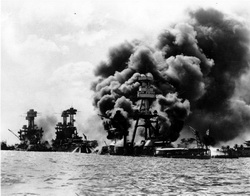
December 7, 1941. From left, the USS USS West Virginia, USS Tennessee, both damaged and USS Arizona, sunk. The weather played a key part in the attack on Pearl Harbor.
The weather that morning was beautiful over Pearl Harbor as one might expect in paradise. The USS Tennessee reported winds at 11 to 16 miles an hour and slight wind ripples on the water of the bay. The USS Oklahoma reported clear skies with “intermittent moving fleecy clouds.” Little did the men making those weather reports know that hell was about to rain down on them.
69 years ago today, the United States was forced into World War II with the brutal surprise attack on Pearl Harbor. Over 2,300 servicemen lost their lives on that fateful day, a “date which will live in infamy.” Relatively unknown in the stories of that fateful day is how the weather played a key and prominent role.
On December 4th, a Japanese intelligence officer at their embassy in Washington D.C. was listening to Radio Tokyo as he had been for the last two weeks. The weather report: “Higashi no kaze ame”, or “east wind, rain.” That seemingly innocent phrase was in actuality code to Japanese diplomats to destroy all of their cryptographic equipment, books and top secret documents as an attack was imminent. A weather report sounded the alarm that war was coming.
On Oahu, December and January are actually the cloudiest months and this was a concern for the Japanese in the planning of their attack. Timing was of the essence as winter in the Pacific can be brutal and if they were forced to wait till late December, success would be in doubt. The clouds would be good for hiding the planes on their approach to the islands but if they couldn’t see their targets, the attack could not be successful.
220 miles north of Oahu and heading east into a steady wind, the Japanese fleet launched its planes at 6:10am. The wind provided the extra lift for the bomb-laden planes and low clouds at 5,000 feet helped to provide cover for the fleet and its planes. The question remained however – would there be clouds over the target?
As the planes headed toward Pearl, U.S. code breakers intercepted a message from Tokyo to Japanese diplomats telling them to break off talks with the United States. At 7:33am, Army Chief of Staff, General George C. Marshall, believed this could be the harbinger of an attack and he sends a warning to Lt. Gen. Walter C. Short, commander of U.S. Army forces in Hawaii. Atmospheric static however prevents the message from being sent by radio and Marshall’s message is sent via commercial telegraph instead. Short’s headquarters receives the message at 11:45am and he did not see it until 3:00pm – more than eight hours after the attack had started.
Flying between 9,000 and 14,000 feet, the clouds provided the cover that the Japanese planes needed. Using a Honolulu radio station to guide them, the planes neared the north coast at 7:30am and heard the radio announcer report, “clouds, mostly over the mountains. Visibility good.” That is exactly what they wanted to hear. Their approach over the mountains of the island was concealed by the clouds and as they neared Pearl Harbor, those clear skies reported by the USS Oklahoma and Tennessee provided the bombers the visibility they needed to hit their targets. At 7:55am, metal rain began to fall on our soldiers, sailors and airmen.
Our nation was forever changed that day and as is often the case, the weather played a key role in this moment in history. After the attack, Japanese Admiral Isoroku Yamamoto said, “We have awakened a sleeping giant and have instilled in him a terrible resolve.” Indeed that was the case but the price was heavy as nearly 300,000 United States service members would lose their lives in the years to come.
Dallas City Hall, Veterans Day, November 11, 2004. Houston James, a survivor of the attack on Pearl Harbor, hugs Marine Staff Sergeant Mark Graunke Jr., a member of an explosive disposal team who lost his left hand, one leg and an eye in Iraq.
On personal note, I ask all of our readers to take the time today to acknowledge and remember not only those that paid the ultimate sacrifice on December 7, 1941 and in the following years, but also remember that more than 16 million men and women served in the armed forces during World War II. Of those, a mere 2.3 million are still with us today and 1,000 World War II veterans die each and every day. As we mourn their passing, we should also remember that which they stood for – honor, sacrifice, courage, God and country. There had never been – and there never will be – a generation like theirs. I thank them for their service and hope they may have the peace in heaven that they did not see while on earth. God bless you all.
For more information: Please help Thornton build a memorial to honor not only World War II veterans but all veterans from all branches of service and all wars. The owner and operator of ThorntonWeather.com is a significant contributor to the project and asks that our visitors consider donating to the project. Please visit the Thornton Veterans Memorial website for more information.
December 4 to December 11 - This week in Denver weather history
While Denver still waits for its first significant snowfall of the season, in years past it has been much easier to come by. Looking back we see one five day storm that dumped snow that was measured in feet and many other smaller ones that were significant in their own right.
1-5
In 1913…the 1st marked the start of the heaviest 5-day total snowfall in the city’s history. During this period snowfall totaled 45.7 inches. Starting on the 1st…snow fell intermittently for 3 days and accumulated a little over 8 inches. On the 4th and 5th…an additional 37.4 inches of snow fell. At Georgetown in the foothills west of Denver even more snow fell…86 inches over the 5 days with the most…63 inches…on the 4th. In Colorado…snowfall was heavy along the eastern slopes of the mountains from the Palmer Divide north. High winds during the storm caused heavy drifting…which blocked all transportation. Snow cover of an inch or more from the storm persisted for 60 consecutive days from the 1st through January 29…1914. Additional snowfall in December and January prolonged the number of days. This is the third longest period of snow cover on record in the city.
2-17
In 1939…more than 2 weeks of unseasonably warm weather made the month the 3rd warmest on record. Seven daily temperature records were set…including the all time record high temperature for the month of 79 degrees on the 5th. Daytime highs were balmy with 14 days in the 60’s and 70’s. Low temperatures dipped to freezing or below on only 5 days. The period was dry with only a trace of snow on the 12th.
3-15
In 1972…a protracted cold spell held an icy grip on metro Denver when maximum temperatures never reached above freezing for 10 consecutive days from the 3rd through the 12th and minimum temperatures dipped below zero on eleven consecutive days from the 5th through the 15th. Daily low temperature records were set with 15 degrees below zero on the 5th…17 degrees below zero on the 6th… And 18 degrees below zero on the 10th. Daily record low maximum readings were set with 3 degrees on the 6th and 6 degrees on the 9th. The very cold temperatures were caused by 3 to 5 inches of snow cover and a Canadian air mass.
November 2010 goes down in the books as drier and warmer than normal. (iStockphoto / johnnyscriv)
November 2010 was most notable not for what weather condition occurred but rather for what it lacked – snow. Historically November is Denver’s second snowiest month but 2010 saw us receive very little of the white stuff as we start out the season far behind where we average.
At the official Denver weather monitoring station at Denver International Airport a mere 1.5 inches of the white stuff was recorded. That is 9.2 inches below the historical November average of 10.7 inches. Despite that, the month fell short of the top 10 least snowiest Novembers as number 10 on that list is 1971 with 1.4 inches. Given that no snow was recorded in September or October, the 2010 snow season is off to a dismal start at more than 15 inches below normal.
In terms of precipitation, only 0.5 inch was collected in the rain bucket – barely more than half of the normal of 0.98 inch. While dry, it wasn’t enough to put the month into top 10 driest November status. Three years in Denver history have recorded only a trace of precipitation and the number 10 slot is held by 1989 when only 0.15 inch of precipitation was recorded. No precipitation or snowfall records were set or tied during the month.
Here in Thornton we fared drier than the official Denver tallies on all fronts. We recorded only 1.14 inches of snow and 0.33 inch of precipitation.
Temperature-wise Denver ended the month warmer than normal with an average temperature of 38.3 degrees. This was 0.8 degrees above the normal of 37.5 degrees. Temperatures ranged from a high of 77 degrees on the 6th down to a low of 4 degrees on the 25th. There were 24 days with low temperatures below the freezing mark which is normal. On only one day, the 29th, did we fail to hit a high temperature of at least freezing as the thermometer only climbed to 31 degrees that day. No temperature records were set or tied during the month.
Overall Thornton’s average temperature for the month was cooler than Denver’s. The average temperature was 36.8 degrees with the warmest day hitting 78.7 degrees and the lowest temperature being 9.0 degrees.
Wind is of course a fact of life on the plains and November 2010 did set a new peak wind gust for the month of 55 mph on the 16th. This easily broke the old record of 49 mph set in 1990.
CLIMATE REPORT
NATIONAL WEATHER SERVICE BOULDER, CO
745 AM MST FRI DEC 3 2010

...................................

...THE DENVER CO CLIMATE SUMMARY FOR THE MONTH OF NOVEMBER 2010...

CLIMATE NORMAL PERIOD 1971 TO 2000
CLIMATE RECORD PERIOD 1872 TO 2010

WEATHER         OBSERVED          NORMAL  DEPART  LAST YEAR`S
                 VALUE   DATE(S)  VALUE   FROM    VALUE  DATE(S)
                                          NORMAL
................................................................
TEMPERATURE (F)
RECORD
 HIGH              80   11/08/2006
 LOW              -18   11/29/1877
HIGHEST            77   11/06        79      -2       77  11/05
LOWEST              4   11/25       -18      22       16  11/16
AVG. MAXIMUM     52.6              51.5     1.1     56.4
AVG. MINIMUM     24.0              23.5     0.5     28.8
MEAN             38.3              37.5     0.8     42.6
DAYS MAX >= 90      0               0.0     0.0        0
DAYS MAX = .01         6               5.6     0.4        3
DAYS >= .10         2                MM      MM        3
DAYS >= .50         0                MM      MM        0
DAYS >= 1.00        0                MM      MM        0
GREATEST
 24 HR. TOTAL    0.15 11/16 TO 11/16         0.33 11/14 TO 11/15

SNOWFALL (INCHES)
RECORDS
 TOTAL           42.6  1946
TOTALS            1.5               10.7

DEGREE_DAYS
HEATING TOTAL     793               826     -33      664
 SINCE 7/1       1128              1408    -280     1479
COOLING TOTAL       0                 0       0        0
 SINCE 1/1        870               696     174      533

FREEZE DATES
RECORD
 EARLIEST     09/08/1962
 LATEST       06/08/2007
EARLIEST                        10/07
LATEST                          05/05
.................................................................

WIND (MPH)
AVERAGE WIND SPEED              9.7
RESULTANT WIND SPEED/DIRECTION   2/228
HIGHEST WIND SPEED/DIRECTION    45/310    DATE  11/16
HIGHEST GUST SPEED/DIRECTION    55/320    DATE  11/16

SKY COVER
POSSIBLE SUNSHINE (PERCENT)   MM

NUMBER OF DAYS FAIR            9
NUMBER OF DAYS PC             17
NUMBER OF DAYS CLOUDY          4

AVERAGE RH (PERCENT)     51

WEATHER CONDITIONS. NUMBER OF DAYS WITH
THUNDERSTORM              0     MIXED PRECIP               0
HEAVY RAIN                0     RAIN                       1
LIGHT RAIN                2     FREEZING RAIN              0
LT FREEZING RAIN          0     HAIL                       0
HEAVY SNOW                1     SNOW                       4
LIGHT SNOW                9     SLEET                      0
FOG                      13     FOG W/VIS
Weather, natural disasters & climate news and information.