As an early spring snowstorm hits northeastern Colorado with snow, bone chilling cold and wind, schools and businesses are closing for the day. Adams 12 Five Star Schools, Brighton 27J, Adams 50, Adams 14 and Mapleton School District are among those closed for the day.
April 7 to April 13: This Week in Denver Weather History
While the calendar may say spring, wintry weather can and often does appear and many times it has a big impact. We clearly see this in our look back at this week in weather history where wind and snow make many appearances.
From the National Weather Service:
4-7
In 1909…post-frontal rain changed to heavy snow on the afternoon of the 4th and continued through mid-morning of the 7th. Total snowfall was 18.7 inches…but most of the snow…14.0 inches…fell from 6:00 pm on the 4th to 6:00 pm on the 5th. North to northeast winds were sustained to 32 mph on the 4th and to 30 mph on the 7th. Total precipitation from the storm was 1.78 inches.
5-7
In 1916…rain changed to snow behind a cold front on the 5th and totaled 4.5 inches in the city. A thunderstorm produced snow on the 6th. North winds were sustained to 35 mph with gusts to 38 mph on the 7th.
6-7
In 1872…rain changed to snow overnight. Snow with high north winds continued all day on the 7th. Precipitation (rain and melted snow) totaled 0.50 inch. Due to problems on the lines…the morning weather report was not sent by telegraph until 3:10 pm and the midnight report was not sent at all.
In 1957…heavy snowfall totaled 6.6 inches at Stapleton Airport where north winds gusted to 46 mph. This was the second heavy snow event in less than 4 days.
In 1969…winds gusting as high as 50 to 60 mph caused only light damage along the eastern foothills. The strong winds contributed to the spread of a forest fire near Boulder. Sustained winds of 25 mph with gusts to 53 mph were recorded in Boulder. Southwest winds gusted to 38 mph on the 6th and 44 mph on the 7th at Stapleton International Airport.
In 1980…high winds howled along the foothills each day. A wind gust to 72 mph was recorded in Lakewood. The strong winds blew a camper top off a pickup truck in Denver. At Stapleton International Airport…west winds gusted to 41 mph on both days.
In 1998…a spring storm brought a mix of snow and thunder to metro Denver…the foothills…and Palmer Divide. Conifer and Elizabeth both measured 4 inches of new snow. On the 6th…only 0.1 inch of snow fell at the site of the former Stapleton International Airport where thunder was heard on both days. Precipitation totaled 0.60 inch at Denver International Airport where west winds gusted to 43 mph on the 6th.
6-8
In 1973…a major spring snow storm dumped 11.6 inches of snowfall over metro Denver. North wind gusts of 30 to 35 mph produced some blowing snow. Most of the heavy wet snow… 10.1 inches…fell on the 7th when temperatures remained in the 20’s. Snow accumulated on the ground to a maximum depth of 9 inches. Low temperature of 5 degrees on the 8th was a new record minimum for the date and the lowest for so late in the season.
7
In 1906…north winds were sustained to 48 mph in the city.
In 1958…strong south winds blew most of the day across metro Denver. A wind gust to 52 mph was recorded at Stapleton Airport.
In 1962…strong gusty winds associated with a cold front caused considerable damage to power lines…signs… Buildings…and trees across metro Denver. In Boulder…an outdoor movie screen…valued at 10 thousand dollars…was wrecked. In Denver…a youth was injured when a car was blown off a jack…pinning him underneath. Wind gusts to 61 mph were recorded at Stapleton Airport where visibility was reduced to 1/2 mile in blowing dust. Snowfall totaled 2.6 inches at Stapleton Airport.
In 1971…wind gusts to 69 mph were recorded at the National Bureau of Standards in Boulder. In downtown Boulder…winds peaked to 54 mph. West winds gusted to 31 mph at Stapleton International Airport.
In 1989…high winds occurred in the foothills west of Denver. At Nederland west of Boulder…high winds damaged roofs… Toppled trees…and caused power outages. Winds estimated as high as 90 mph in Georgetown overturned campers and even semi-trailers on I-70 and damaged road signs. Three trailer homes were blown off their foundations and a 50-foot tree toppled onto the roof of a home…causing considerable damage. Winds reached 94 mph at Rollinsville southwest of Boulder. Northwest winds gusted to 43 mph at Stapleton International Airport.
With snowpack lagging and spring set to arrive, hopes were high that March could bring some relief to Colorado’s parched landscape and Mother Nature did oblige. March 2013 brought above average snowfall and cooler than normal temperatures.
The month started out with near normal temperatures but the first in a series of disturbances throughout the month arrived on the 4th. A couple of inches was delivered to the area on the date which was followed by a few days of mild weather.
The warmth did not last as another storm system which began a repeating pattern across the month with mild temperatures followed by periods of cold and snow.
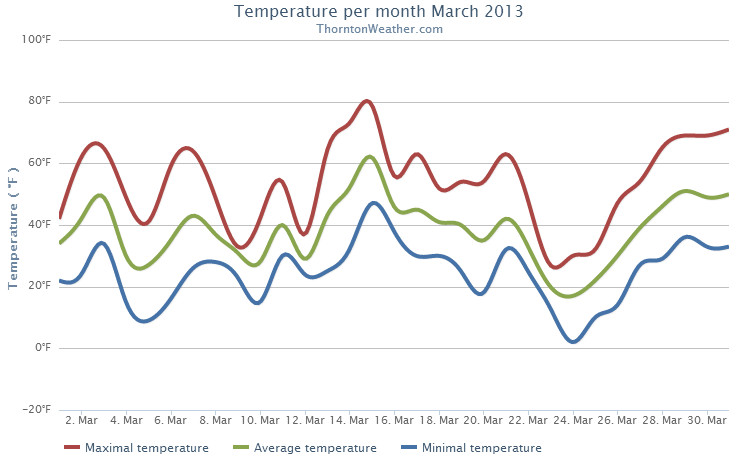
Thornton’s overall average temperature for the month came in at 38.3 degrees. At Denver’s official weather station at Denver International Airport the month averaged 37.7 degrees. Both locations’ average temperatures were below the March historical average (1981 to 2010) of 40.4 degrees.
We recorded 25 days with low temperatures dropping below the freezing mark. Three days saw high temperatures fail to climb above 32 degrees.
Our warmest temperature during March 2013 was a reading of 78.6 degrees on the 15th. The coldest reading was on the 24th when the mercury dropped to a bone-chilling 2 degrees. Out at DIA, the warmest reading was 76 degrees on the 15th and the coldest was 2 degrees on the 25th.
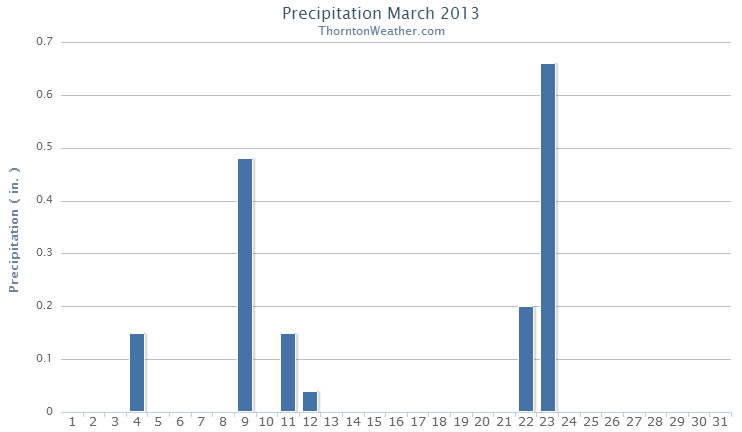
In terms of precipitation, Thornton saw 1.45 inches in the rain bucket, almost all from snow. Denver’s numbers were near identical at 1.47 inches. Both were well above the March average of 0.92 inch.
Snowfall was the big story for the month as Thornton recorded 20.2 inches of the white stuff. Out at DIA the Mile High City saw even more as it measured 23.5 inches. March historically averages 10.7 inches so we were well above normal while the month’s reputation as our snowiest month of the year held true.
The month did come very close to making the list of ‘top 10 snowiest Marches.’ The number 10 spot on that list came in 1981 when 24.0 inches was recorded.
Despite the cold and snow, only one weather record was set during the month. The 11.6 inches of snow recorded at DIA from the 22nd to the 23rd set a two-day snowfall total record for the date, besting the previous mark of 8.0 inches set in 2010.
Thornton, Colorado March 2013 TemperaturesThornton, Colorado March 2013 Precipitation
...THE DENVER CO CLIMATE SUMMARY FOR THE MONTH OF MARCH 2013...

CLIMATE NORMAL PERIOD 1981 TO 2010
CLIMATE RECORD PERIOD 1872 TO 2013

WEATHER         OBSERVED          NORMAL  DEPART  LAST YEAR`S
                 VALUE   DATE(S)  VALUE   FROM    VALUE  DATE(S)
                                          NORMAL
................................................................
TEMPERATURE (F)
RECORD
 HIGH              84   03/26/1971
 LOW              -11   03/28/1886
HIGHEST            76   03/15        84      -8       81  03/31
LOWEST              2   03/25       -11      13       16  03/02
AVG. MAXIMUM     50.7              54.4    -3.7     65.5
AVG. MINIMUM     24.6              26.4    -1.8     32.9
MEAN             37.7              40.4    -2.7     49.2
DAYS MAX >= 90      0               0.0     0.0        0
DAYS MAX = .01         6               5.9     0.1        2
DAYS >= .10         4               2.4     1.6        0
DAYS >= .50         0               0.3    -0.3        0
DAYS >= 1.00        0               0.1    -0.1        0
GREATEST
 24 HR. TOTAL    0.47   03/22 TO 03/22           03/01 TO 03/02
                                                          03/01 TO 03/01
                                                          03/01 TO 03/01
 STORM TOTAL       MM                                 MM
 (MM/DD(HH))            MM                    03/02(00) TO 03/02(00)
                                                 03/01(00) TO 03/01(00)1
                                                 03/01(00) TO 03/01(00)1

SNOWFALL (INCHES)
RECORDS
 TOTAL             MM   5
TOTALS           23.5              10.7

DEGREE_DAYS
HEATING TOTAL     840               763      77      483
 SINCE 7/1       5112              5202     -90     4863
COOLING TOTAL       0                 0       0        0
 SINCE 1/1          0                 0       0        0

FREEZE DATES
RECORD
 EARLIEST     09/08/1962
 LATEST       06/08/2007
EARLIEST      03/01             10/07
LATEST                          05/05
..................................................

WIND (MPH)
AVERAGE WIND SPEED              10.1
RESULTANT WIND SPEED/DIRECTION   1/223
HIGHEST WIND SPEED/DIRECTION    38/010    DATE  03/09
HIGHEST GUST SPEED/DIRECTION    47/280    DATE  03/17

SKY COVER
POSSIBLE SUNSHINE (PERCENT)   MM
AVERAGE SKY COVER           0.60
NUMBER OF DAYS FAIR            2
NUMBER OF DAYS PC             20
NUMBER OF DAYS CLOUDY          9

AVERAGE RH (PERCENT)     53

WEATHER CONDITIONS. NUMBER OF DAYS WITH
THUNDERSTORM              0     MIXED PRECIP               0
HEAVY RAIN                0     RAIN                       0
LIGHT RAIN                1     FREEZING RAIN              0
LT FREEZING RAIN          0     HAIL                       0
HEAVY SNOW                3     SNOW                       5
LIGHT SNOW                8     SLEET                      0
FOG                       9     FOG W/VIS
March 31 to April 6: This Week in Denver Weather History
Early spring can bring a wide variety of conditions from wintry storms to severe weather. Our look back at this week in Denver weather history shows that just about any type of weather condition can occur this time of year.
From the National Weather Service:
29-31
In 1970…snowfall totaled 6.0 inches at Stapleton International Airport. Heavy snow accumulation in Boulder on the 29th caused the collapse of a carport at an apartment building…damaging 11 automobiles. Northeast winds gusted to 24 mph at Stapleton International Airport.
30-31
In 1896…heavy snowfall totaled 7.5 inches in downtown Denver. Northwest winds gusted to 26 mph.
In 1897…rain changed to snow during the early morning of the 30th and totaled 6.2 inches before ending during the late morning of the 31st. Northwest winds were sustained to 35 mph with gusts to 46 mph.
In 1929…heavy snowfall of 7.0 inches was recorded over downtown Denver. Northwest winds were sustained to 23 mph on the 30th.
In 1953…heavy snowfall totaled 8.6 inches at Stapleton Airport where northeast winds gusted to 23 mph.
In 1955…a vigorous cold front produced north winds at 40 mph with gusts as high as 54 mph at Stapleton Airport. Rain and snow showers and blowing dust accompanied the front. Snowfall totaled only 0.1 inch at Stapleton Airport on the 31st.
In 1988…snow began falling on the afternoon of the 30th and continued through the 31st…burying metro Denver. Twelve to 18 inches of snow fell in the foothills to the west of Denver and Boulder with 6 to 12 inches across the rest of metro Denver. The storm disrupted aircraft operations at Stapleton International Airport where snowfall totaled 7.1 inches and north winds gusting to 32 mph reduced the visibility to less than 1/4 mile at times…causing air traffic delays of 2 to 3 hours.
In 2000…heavy snow once again developed over the foothills and the higher terrain to the south of metro Denver. Snowfall totals from the storm included: 16 inches atop Squaw Mountain…15 inches near Rollinsville…13 inches near Evergreen…12 inches near Morrison…11 inches in Coal Creek Canyon…10 inches near Blackhawk and in Eldorado Springs…9 inches at Ken Caryl Ranch and Larkspur… And 8 inches near Elizabeth. Snowfall totaled only 4.1 inches at the site of the former Stapleton International Airport. North winds gusted to 32 mph at Denver International Airport on the 30th.
In 2005…a strong spring storm intensified over the eastern plains of Colorado and produced near-blizzard conditions to the east and southeast of Denver overnight. North to northwest winds from 20 to 35 mph with gusts to 50 mph produced extensive blowing snow and caused near zero visibilities at times and snow drifts from 2 to 4 feet in depth. Snowfall amounts included: 12 inches near Bennett…8 inches around Castle Rock… 7 inches near Sedalia…and 6 inches near Parker. Only 0.3 inch of snow was reported at Denver Stapleton. At Denver International Airport…north winds gusted to 37 mph on the 30th and 36 mph on the 31st.
31
In 1873…high winds damaged buildings in the city. Northwest winds with sustained velocities to near 40 mph blew from 9:00 am until sunset.
In 1937…north to northeast winds sustained to 25 mph with gusts to 32 mph produced a light dust storm in the city during the afternoon.
In 1971…wind gusts to 92 mph were recorded in the south hills area of Boulder. At the National Bureau of Standards in Boulder sustained winds of 46 mph with gusts to 83 mph were measured. Damage was minor. Northwest winds gusted to 41 mph at Stapleton International Airport.
In 1983…high winds with gusts to 70 mph in Boulder caused minor damage.
31-1
In 1876…heavy snow began during the night and lasted all day on the 31st and through the morning of the 1st. The average depth of snow fall was 10 to 12 inches…but strong winds whipped the snow into drifts of 8 to 10 feet deep on the streets of the city. Precipitation from the storm was 1.03 inches on the 31st and 0.37 inch on the 1st.
In 1891…heavy moist snowfall totaled 18.0 inches in the city. Northeast winds were sustained to 20 mph with gusts to 24 mph on the 31st.
In 1936…northeast winds sustained to 21 mph produced a light dust storm in the city.
In 1975…a major storm dumped 9.3 inches of snowfall at Stapleton International Airport where northwest winds gusted to 41 mph. Rain changed to snow on the afternoon of the 31st…reducing the visibility to as low as 1/8 mile. Snow continued all day on the 1st and accumulated to a depth of 8 inches on the ground. The minimum temperature of 10 degrees on the 1st set a new record low for the date.
One of the most common requests we receive is for a ThorntonWeather.com app for mobile devices. Unfortunately, short of a lot of donations to fund it, development of one is prohibitively expensive. However, there are third party programs that will allow you to get Thornton’s weather with data from our station.
The choices range from the basic to major name apps that display ThorntonWeather.com data. This article will detail the simpler ones that do little more than display weather conditions from our site as an app and as a widget. While basic, they all do a good job and keep it simple.
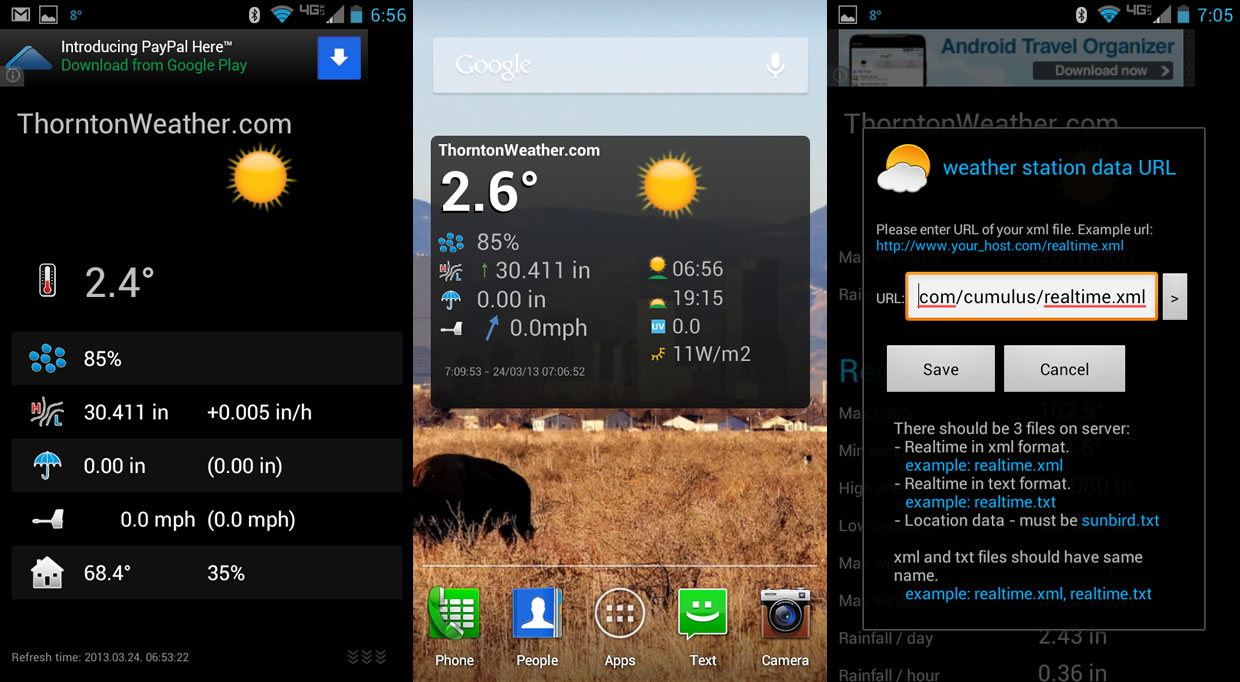
Weather Station for Cumulus is basic but has a very nice display in the app and widget. You will need to configure the 'weather station data URL' to point to ThorntonWeather.com's file. Click the image for a larger view.
This app and widget are very nice and probably our favorite due to the simplicity of the display.
Once downloaded, start up the app and choose “Set Location URL.” On the next screen you will enter the location of a file on our server that is constantly updated with current conditions. In the URL box enter:
Note that the entry is case-sensitive so be sure to enter it in all lowercase.
Once done, click Save. You then will shown the current conditions from our station. Scrolling down displays more information such as today’s and yesterday’s highs and lows and more.
Using the setting menu, you will want to update the ‘Widget refresh time interval’. This determines how often the widget polls our site for the latest conditions. We ask that you please select 30 minutes or longer so as to not cause an undue burden to our site server.
Adding the widget to one of your devices screens is done in the Apps menu. Select Widgets, then scroll to the right to find “Weather Station.” Two sizes are available.
Note that the weather icon displayed is the forecast as generated by our Davis Instruments weather station. Unfortunately this is not a particularly accurate forecast so it should largely be disregarded.
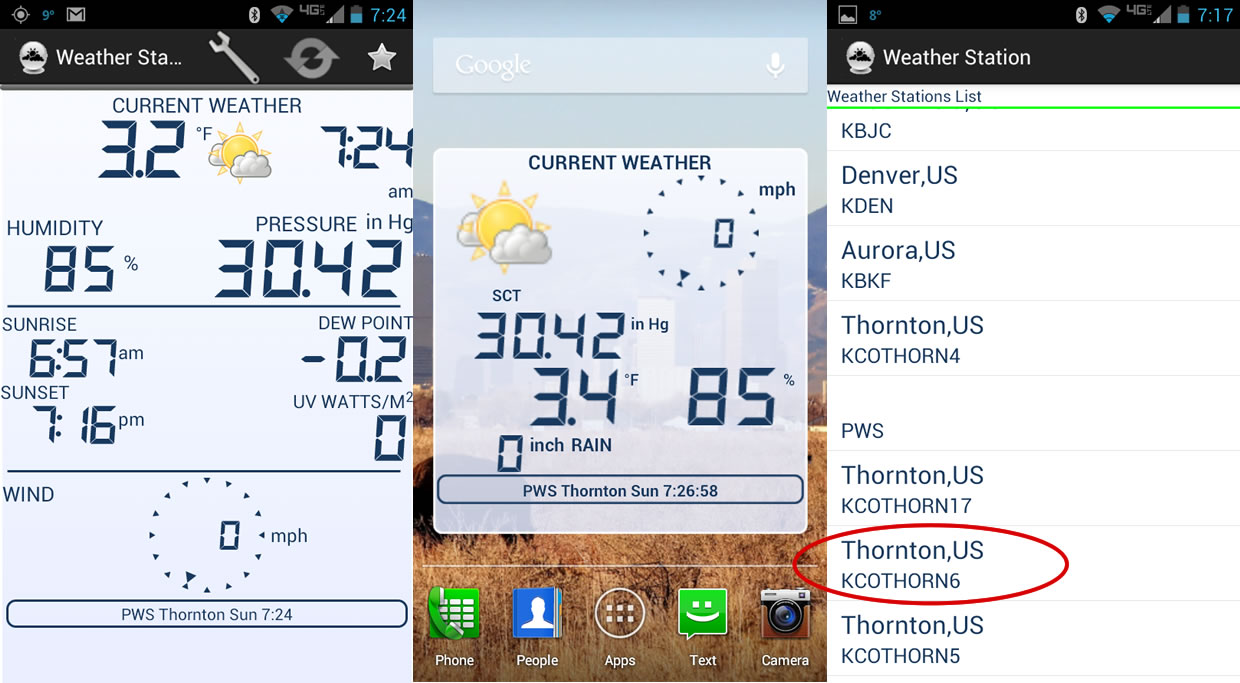
Weather Station is a nice app and widget but the varying font sizes and data layouts can be a bit odd. You will need to configure the app to use pull data from ThorntonWeather.com's Weather Underground feed. Click the image for a larger view.
We have a lot of hope for Weather Station and think that someday it will improve and be one of the better ones. The developer is active and issues regular updates however the displays are a bit ‘off’ with some versions of the program due to odd font sizes and layouts (particularly with the widgets).
For tablet devices, this does have one of the nicest and full featured displays of any and is probably the best choice for those.
Once downloaded, the program tries to pick the closest station using stations that upload to Weather Underground. However it likely will not choose ThorntonWeather.com’s station as there are many others in the area (most far less accurate).
Click the wrench at the top to open the settings menu. Start by choosing Select Display Units. You will want to change them all to their English / Imperial settings. For temperature choose F, Pressure inHG, rain inch, and wind mph.
Then select Weather Station List. Scroll down under the PWS heading, select KCOTHORN6. That is our station’s identifier on Weather Underground. When you touch it, you will receive confirmation it is activated.
Use the back button to return to the main screen and the conditions should update with data from ThorntonWeather.com. As for widgets, the program has four of them available to choose from.
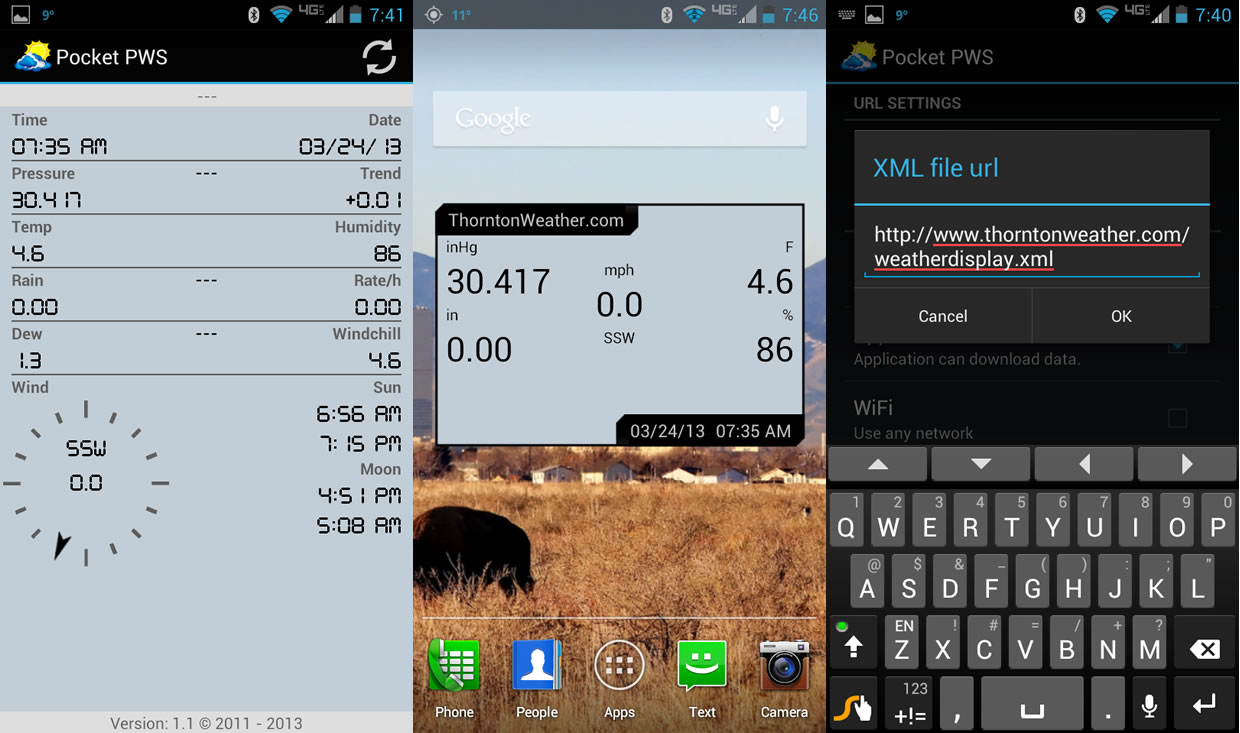
Pocket PWS is the newest app / widget and a bit basic but that makes it easy to view. You will need to configure the 'XML file url' to point to ThorntonWeather.com's data file. Click the image for a larger view.
This is the newest app that we have found and while it is a bit Spartan, it is functional and free.
Once downloaded you will be prompted to set the URL for the file with the current conditions. Go into the settings and select XML file url. In the entry box, enter:
http://www.thorntonweather.com/weatherdisplay.xml
Note that the entry is case-sensitive so be sure to enter it in all lowercase.
Click OK and the app will start displaying current conditions from our station. There is also a Pocket PWS widget you can add to one of your Android device’s home screens.
Conclusion
In a future story we will detail the more extensive Android weather apps that can be used to display ThorntonWeather.com data. Should you have any problems getting any of the above listed apps configured, do let us know and we will try to help you.
If you have an Apple device, well, we can’t help you much as we only own Android devices. However if you find an app in the Apple app store that can read data from a Personal Weather Station (PWS), let us know and we will take a look and see if we can help you configure it.
Remember that we do have a mobile web site optimized for all smartphones that has live conditions, forecasts and more. Check it out and bookmark it here: http://m.thorntonweather.com
March 24 to March 30: This Week in Denver Weather History
As we have witnessed in recent days, significant snow events can make an appearance in Denver during the month of March and there have been a number of them in our past. Also not unusual and appearing are powerful, damaging winds. These types of events as well as thunderstorms, hail and even a tornado have occurred during this week in Denver weather history.
From the National Weather Service:
22-24
In 1965…a vigorous cold front swept across metro Denver late on the afternoon of the 22nd with east-northeast winds gusting to 38 mph causing some blowing dust. Snowfall from the storm totaled 4.4 inches at Stapleton International Airport. Temperatures on the 22nd dropped from a maximum of 63 degrees to 18 degrees in just 10 hours and dipped to 3 degrees below zero on the morning of the 24th. Maximum temperatures warmed to only 19 degrees on the 23rd and 18 degrees on the 24th.
23-24
In 1909…post-frontal rain on the 23rd changed to heavy snow during the evening and continued through the morning of the 24th. Snowfall totaled 13.8 inches. Rain and melted snow… Totaled 2.43 inches…which was the record greatest 24 hour precipitation ever recorded in March at that time. A thunderstorm of moderate intensity occurred on the 23rd in advance of the cold front. North winds were sustained to 27 mph overnight.
In 1990…several hours of freezing drizzle covered roadways with a thin layer of “black ice” which caused nearly 100 traffic accidents across metro Denver. In Boulder…snow and freezing rain caused numerous accidents and brief power outages. Snow in Boulder ranged from an inch east of town to 4 to 5 inches near Table Mesa. At times thunder was heard during the snow. Snowfall totaled only 0.6 inch at Stapleton International Airport where northwest winds gusted to 30 mph on the 23rd.
In 1995…high winds developed late on the 23rd and continued through the 24th. A few windows were blown out of a Denver high rise building…spraying glass on the sidewalks and streets below. Southeast winds gusted to 48 mph at Denver International Airport on the 23rd.
In 1996…the third storm in 10 days brought heavy snow to the mountains…foothills…and metro Denver. Snowfall totaled 18 inches at Golden Gate Canyon and 10 inches at Nederland in the foothills. Across metro Denver… Snowfall ranged from 4 to 8 inches. At the site of the former Stapleton International Airport…snowfall totaled 6.5 inches with most of the snow occurring on the 24th. North winds gusted to 34 mph at Denver International Airport. As the storm moved east on the 24th and 25th… Blizzard conditions developed over northeastern Colorado closing both I-70 and I-76 east of Denver.
In 2010…a powerful spring snowstorm swept across northern Colorado. The heaviest snowfall occurred in and near the Front Range foothills and deep upslope developed. The heavy…wet snow clung to tree limbs and power lines…which caused 36500 electrical outages throughout Denver and the surrounding metro area. Power outages also occurred in Douglas and Elbert counties. In addition…approximately 5 thousand travelers were stranded at Denver International Airport due to flight cancellations and delays. Initially… The snow fell at a rate of 2 to 4 inches per hour…between Boulder and Denver…bringing the evening rush hour to a complete halt. Countless motorists were stuck on U.S. Highway 36 for several hours. Other road closures included I-70…from Idaho Springs to Genesee and I-25 in both directions…from Lincoln Avenue south to Greenland… Or about 15 miles south of Castle Rock. In and near the Front Range foothills and Palmer Ridge…storm totals included: 26 inches at Coal Creek Canyon…23.5 inches…3 miles south of Evergreen; 22 inches at Aspen Springs…13 miles northwest of Golden and 3 miles west of Jamestown; 21.5 inches…3 miles north of Blackhawk…20 inches at Genesee; 16 inches near Nederland; 14 inches near Elizabeth and Strontia Springs dam; 13 inches at Bergen Park and 3 miles southeast of Indian Hills; 12.5 inches… 3 miles southwest of Conifer; 11.5 inches at St. Mary’s Glacier. In Denver and the surrounding suburbs…storm totals included: 15 inches at lone tree; 14 inches near Highlands Ranch; 13 inches near Louisville…12.5 inches at Aurora…Commerce City…Englewood and 5 miles west of Littleton; 12 inches at Erie and Greenwood Village; 11 inches at Ralston Reservoir and Westminster; 10.5 inches at the national weather service in Boulder…10 inches… 4 miles northeast of Castle Rock…Fredrick…Lakewood…3 miles southeast of Morrison and 4 miles southeast of Watkins; 9.5 inches…3 miles southeast of Denver; 9 inches in Broomfield…Lafayette…Northglenn and Thornton; 8.5 inches near Federal Heights; 8 inches in Arvada… Brighton and Wheat Ridge; 6 inches…5 miles southwest of Hudson. Officially…10.8 inches of snow was measured at Denver International Airport.
23-25
In 1891…rain changed to snow and totaled 8.8 inches in downtown Denver. Most of the snow fell on the 24th. Winds were light.
In 1964…heavy snowfall of 5.8 inches was measured at Stapleton International Airport. North-northeast winds gusted to 21 mph behind a cold front.
After years of saying ‘weather isn’t climate,’ climate change alarmists now routinely seize on mundane weather events to promote their cause. Latest is website Quartz.com which fretted about how recent snows in Colorado and Ireland portend climate change’s impact on sports and the globe and then follows it up with a ridiculous claim of temperatures 40 degrees above normal in Brazil. Read the rest of this story on Examiner.com
On June 3, 1981 a tornado struck Thornton in what is the worst twister to have struck the Denver metro area. Are you ready should disaster strike again? Image courtesy the City of Thornton archives.
Severe weather is a fact of life in Colorado – from blizzards to tornadoes we can and do see it all. Each year the weather is responsible for claiming lives in our state and across the nation and the threat is very real. Storm spotter training allows you to learn how to protect yourself and your family while providing a public service.
Education is key to knowing how to protect you and your family. Whether you want to be an official storm spotter or maybe just want to learn more about severe weather, storm spotter training can provide you an incredible opportunity to learn.
The storm spotter program is a nationwide program with more than 280,000 trained spotters. These volunteers report weather hazards to their local National Weather Service office providing vital information when severe strikes. Data from spotters include severe wind, rain, snow measurements, thunderstorms and hail and of course tornadoes.
Storm spotters are part of the ranks of citizens who form the Nation’s first line of defense against severe weather. There can be no finer reward than to know that their efforts have given communities the precious gift of time–seconds and minutes that can help save lives.
By completing one of these training classes you can become an official storm spotter. When severe weather strikes, you can report it by calling a special toll free number or submit your report via the National Weather Service’s website.
These are great sessions for anyone wanting to learn more about the severe weather we experience in Colorado, whether you want to be an official spotter or not. All training is free. Topics include:
Below are the dates, times and locations announced thus far with the first occurring on Sunday, February 17 and two scheduled in May in the north Denver metro area. We will try to keep this updated but you can click here for any new dates on the National Weather Service website.
Schedule updated 3/28/13:
April, 2013 – Upcoming
Day
City, State
Time
Location
04
Kiowa, CO
(Elbert County)
6:00pm MDT
Elbert County Fairgrounds 75 Ute Ave – Kiowa, Co 80117
After years of saying ‘weather isn’t climate,’ climate change alarmists now routinely seize on mundane weather events to promote their cause. Latest is website Quartz.com which fretted about how recent snows in Colorado and…
The first weekend of spring contained conditions in the Denver area not normally associated with that season as a powerful wintry storm pummeled northeastern Colorado. Snowfall totals were impressive as the Mile High City’s seasonal total…